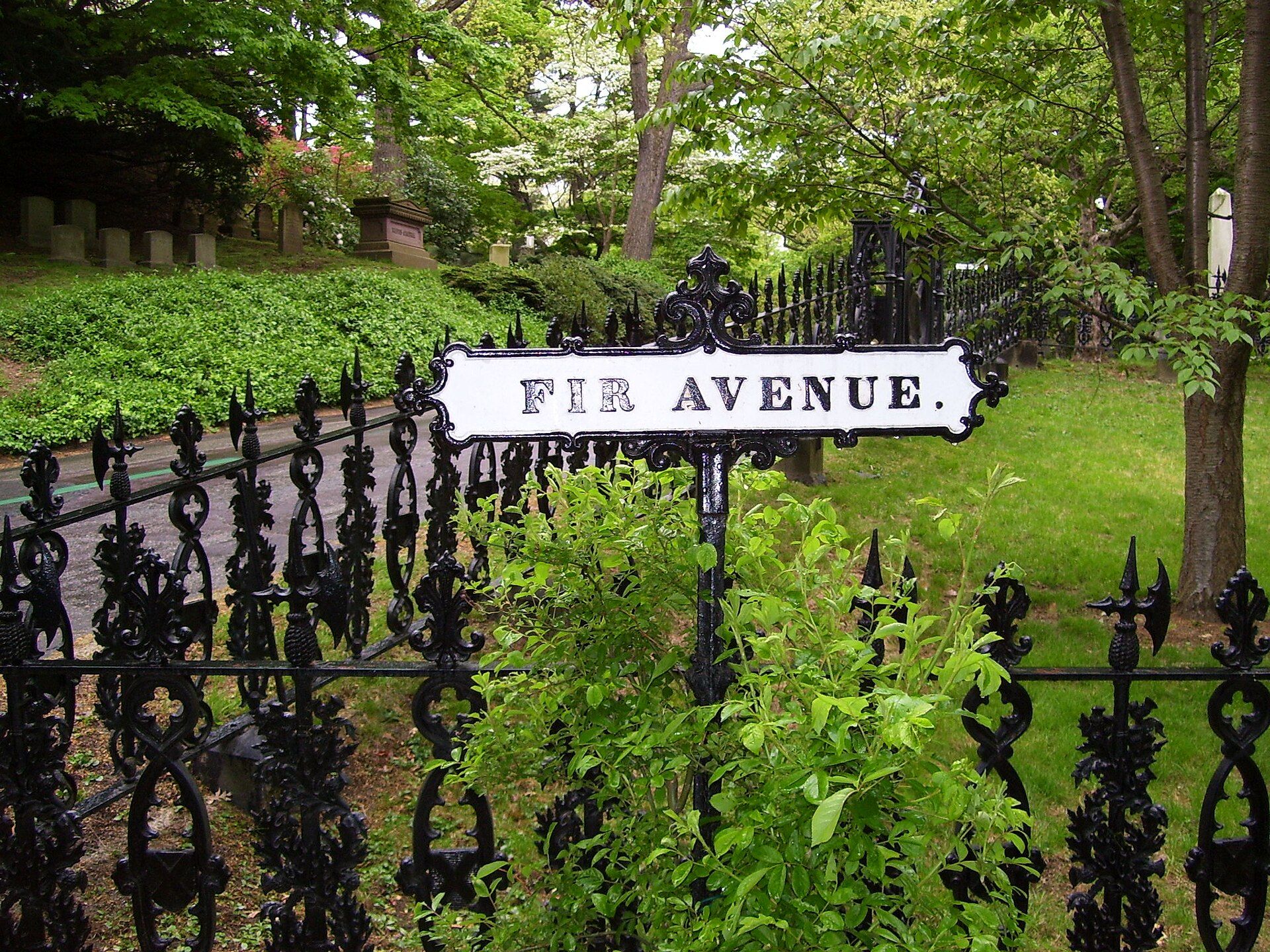
Its neighborhoods include Bemis, Coolidge Square, East Watertown, Watertown Square, and the West End. Landmarks include Armenian Museum of America, Elmwood and Watertown Arsenal. Watertown is the birthplace of Eliza Dushku, actress.
Every piece is drawn from Watertown's own map data and historic archives, then printed and shipped from the USA when you order. No two towns look alike.
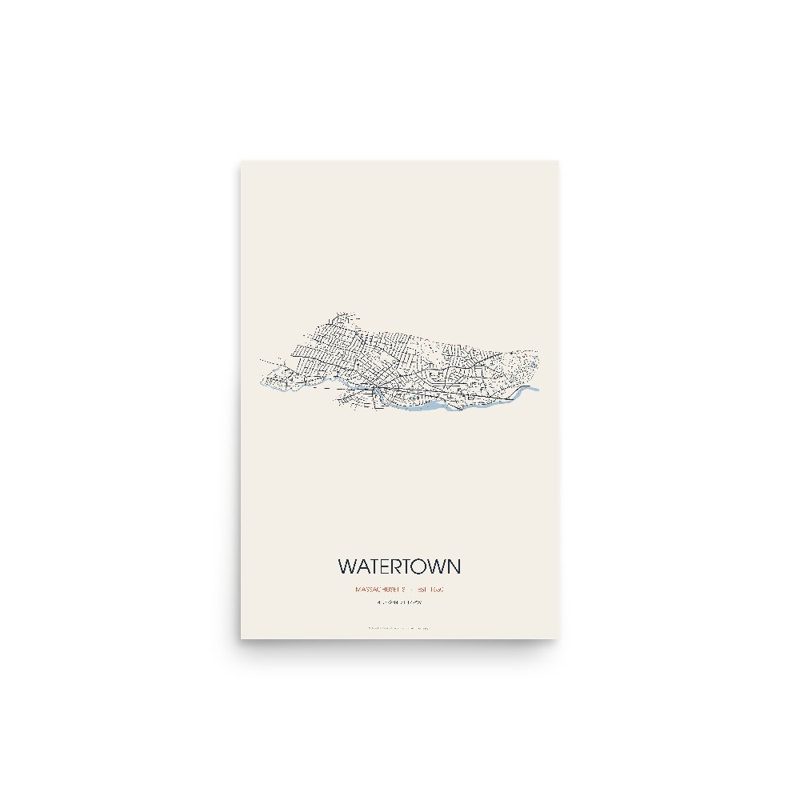
Every road in town, on archival matte paper
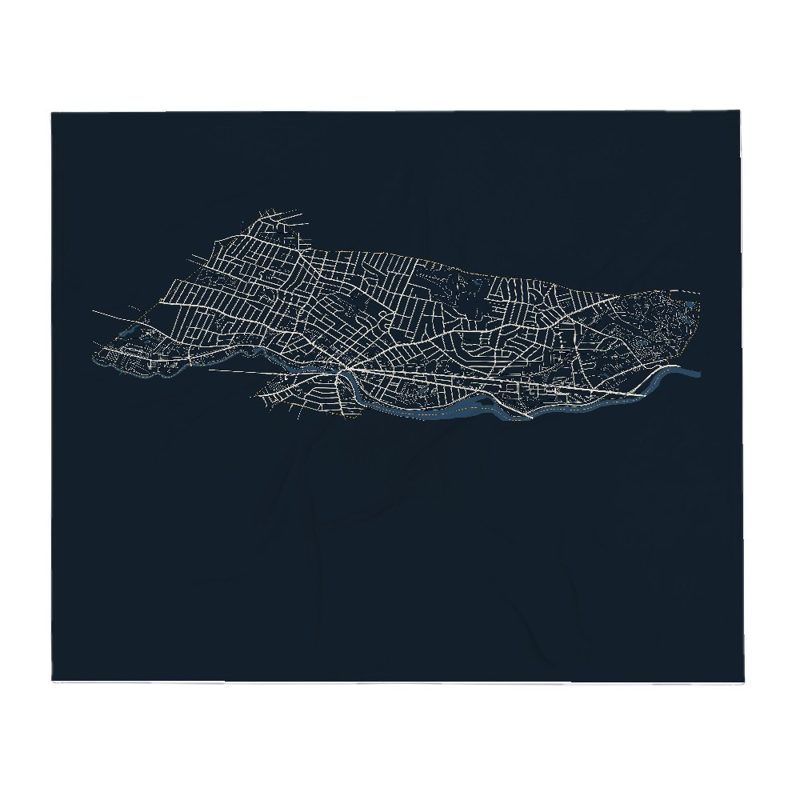
The same map, in navy and silver
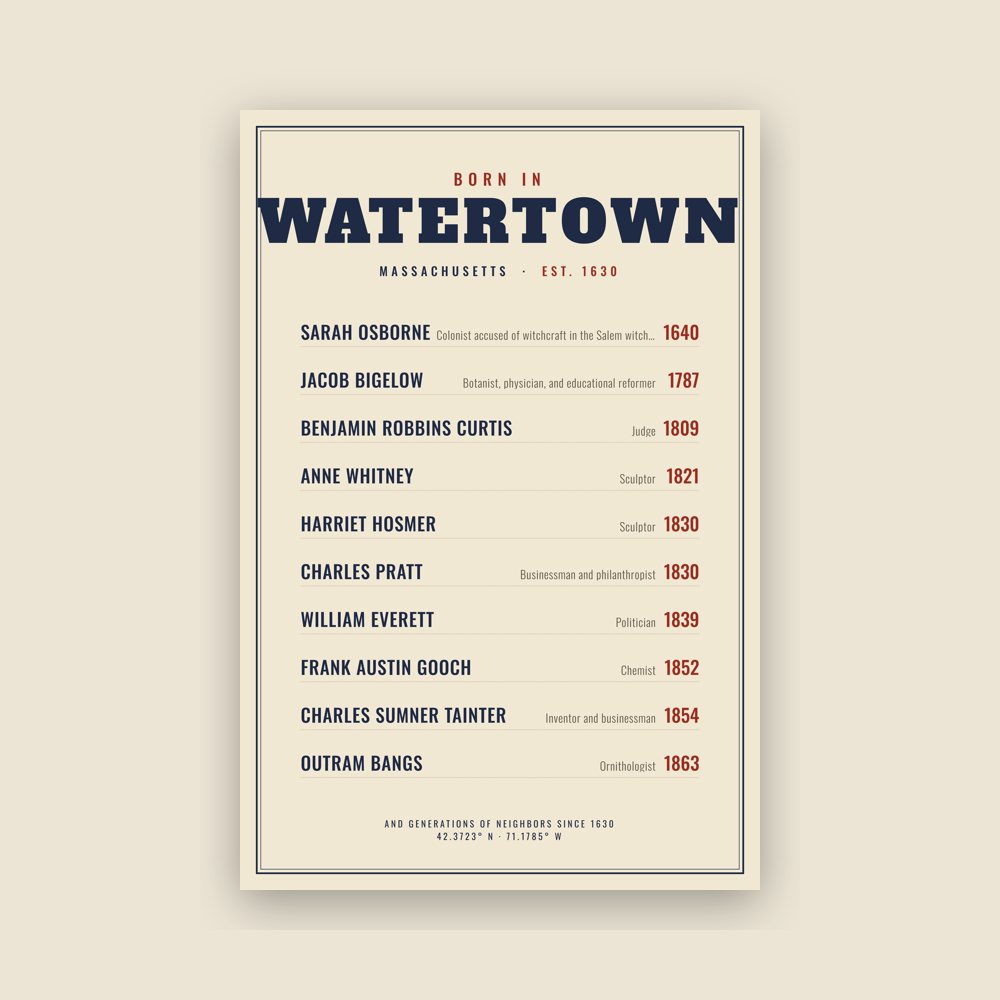
Famous natives, by birth year
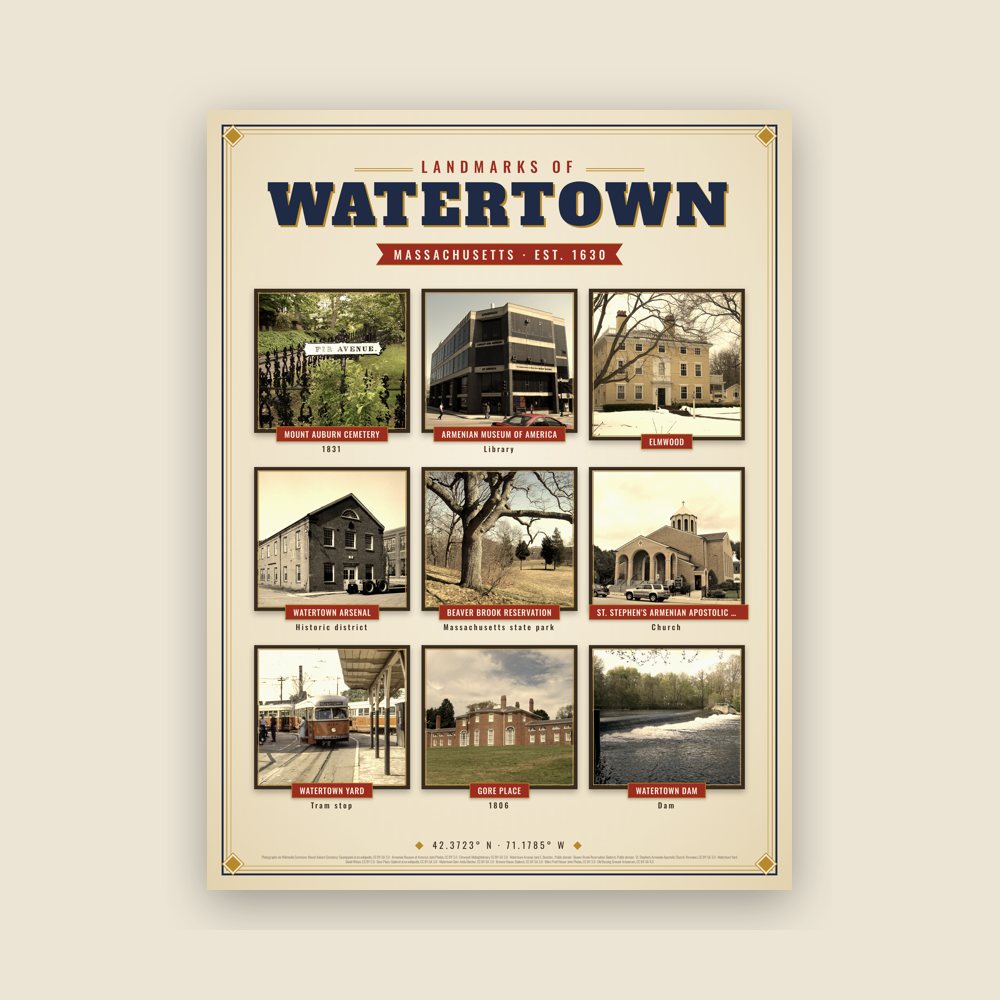
Nine local landmarks, archival matte
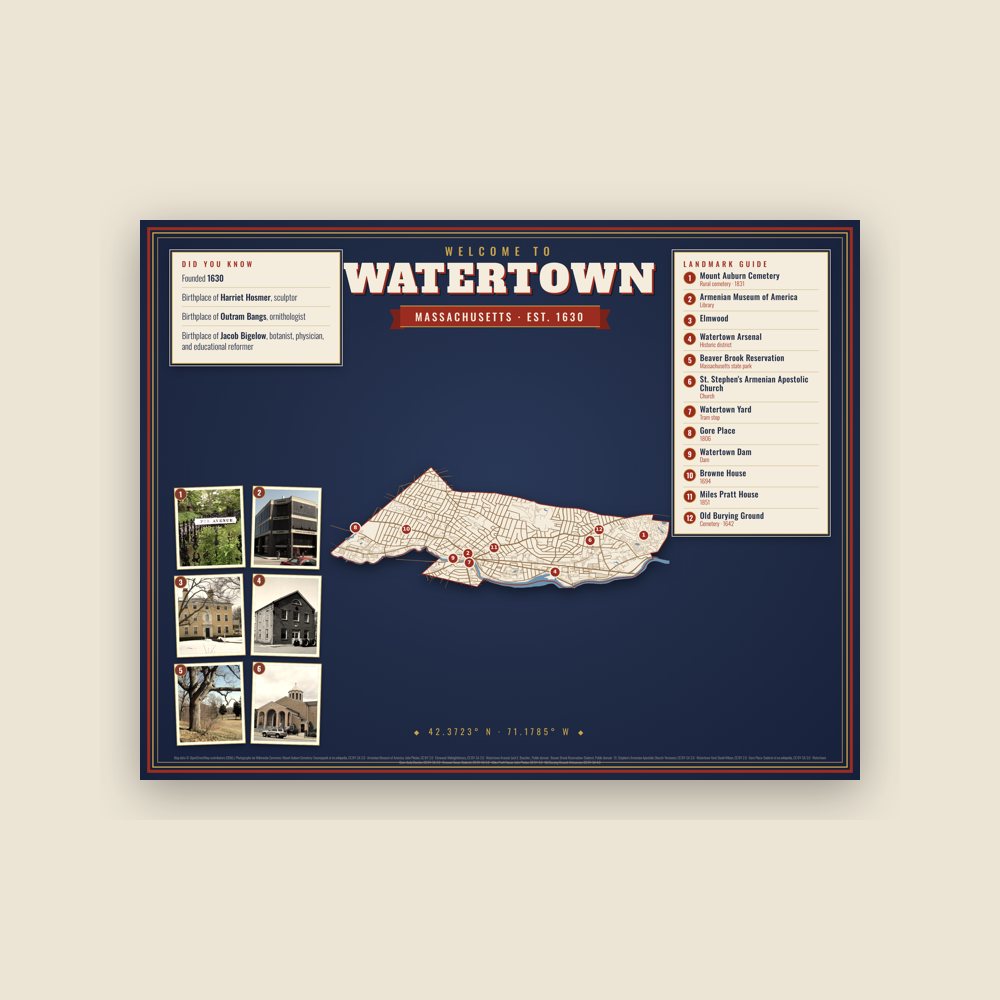
Map of local landmarks, washable fabric
Heavy-blend fleece, street map printed on the back
Soft Bella+Canvas jersey
Glossy ceramic, dishwasher safe
Ceramic keepsake, gold ribbon
Weatherproof, for the front walk
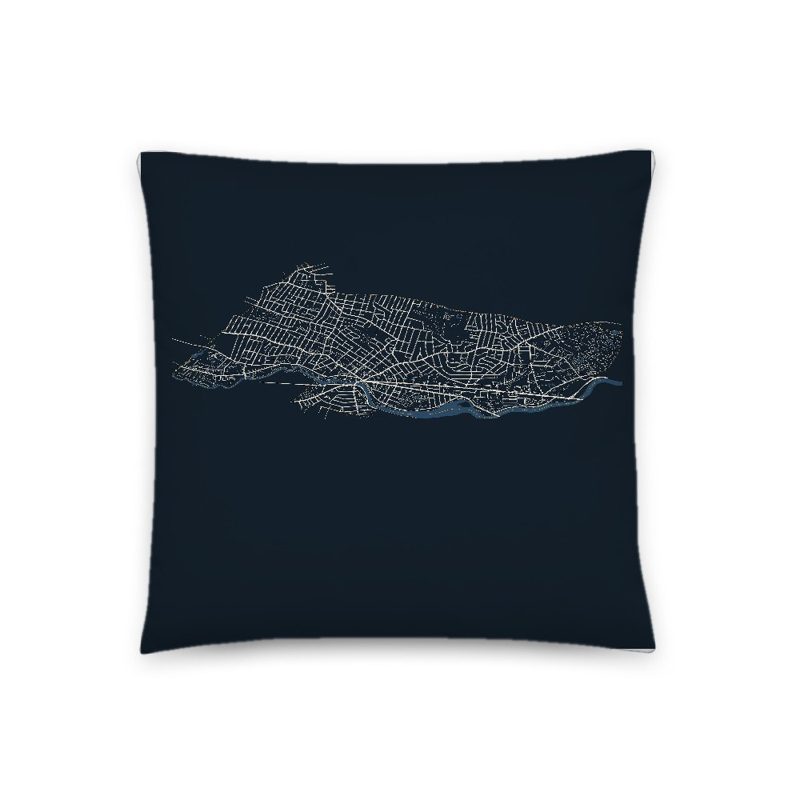
Soft-touch, zip cover
Sturdy all-over-print tote
Glossy top, cork back
Soft fleece, 50″×60″
20 oz, double-wall stainless
Population 2010: 31,915 → 2020: 35,329
From Wikidata (CC0).
Archeological evidence suggests that Watertown was inhabited for thousands of years before colonization. At the time of the earliest European reports in the 1600s, there were at least two important settlements of Massachusett people along the river later known as the Charles: Nonantum in present-day Newton, and Pequossette or Peguusset, "where the narrows open out" near modern-day Watertown Square. A contemporary English source lists "Pigsgusset" as the native name of "Water towne." Massachusett people built a fishing weir at Pequossette to trap herring at the site of the current Watertown Dam. The annual fish migration, as both alewife and blueback herring swim upstream from their adult home in the sea to spawn in the fresh water where they were hatched, still occurs every spring.
Watertown, first known to settlers as Saltonstall Plantation, was one of the earliest of the Massachusetts Bay Colony settlements. Founded in early 1630 by a group of settlers led by Richard Saltonstall and George Phillips, it was officially incorporated that same year. The alternate spelling "Waterton" is seen in some early documents.
The first buildings were upon land now included within the limits of Cambridge known as Gerry's Landing. For its first quarter century Watertown ranked next to Boston in population and area. Since then its limits have been greatly reduced. Thrice portions have been added to Cambridge, and it has contributed territory to form the new towns of Weston (1712), Waltham (1738), Lincoln (1754) and Belmont (1859). In 1632 the residents of Watertown protested against being compelled to pay a tax for the erection of a stockade fort at Cambridge; this was the first protest in America against taxation without representation and led to the establishment of representative democracy in the colony. As early as the close of the 17th century, Watertown was the chief horse and cattle market in New England and was known for its fertile gardens and fine estates. Here about 1632 was erected the first gristmill in the colony, and in 1662 one of the first woolen mills in America was built here. The first burying ground, on Arlington Street, was established in the 1660s. It contains a monument to Joseph Coolidge, the only Watertown resident killed during the British retreat from Concord in April 1775.
Much excitement was generated in Watertown towards the start of the American Revolutionary War period. In 1773, many of its citizens were engaged with the Sons of Liberty in another tax protest, this time against the British Tea Tax which resulted in the famous Boston Tea Party protest.
Then later (April 1775), some 134 Watertown minutemen responded to the alarm from Lexington to rout the British soldiers from their march to Concord. Thereafter many of these citizen soldiers were part of the first battle line formed at the Siege of Boston. Another Watertown citizen, Israel Bissell, was the first rider to take the news of the British attack and rode all the way to Connecticut, New York and Philadelphia.
The Massachusetts Provincial Congress, after adjournment from Concord, met from April to July 1775 in the First Parish Church, the site of which is marked by a monument. On July 3, George Washington was greeted in Watertown; the following day he took command of the Army in Cambridge. The Massachusetts General Court held its sessions here from 1775 to 1778. Committees met in the nearby Edmund Fowle House. Boston town meetings were held here during the siege of Boston, when many Boston families made their homes in the neighborhood. For several months early in the American Revolution the committees of safety and committee of correspondence made Watertown their headquarters and it was from here that General Joseph Warren set out for Bunker Hill.
The Treaty of Watertown, the first treaty signed between the newly formed United States of America and a foreign power, the St. John's and Mi'kmaq First Nations of Nova Scotia, was signed in this house.
The Coolidge Tavern, built in 1742, was frequented by minutemen during the war. Here, Washington was entertained on his New England tour in 1789. The tavern was demolished in 1918 to make way for a trolley terminal.
From 1832 to 1834, Theodore Parker conducted a private school and his name is still preserved in the Parker School, though the building no longer operates as a public school.
Mount Auburn Cemetery was founded in 1831, creating the first garden cemetery in the United States. The landscape of Mount Auburn provided inspiration for the nation's first public parks and picturesque suburbs designed by the early generations of American landscape architects. Mount Auburn has been recognized as one of the most significant designed landscapes in the country. Although perceived as a Cambridge institution, almost all of the cemetery is actually in Watertown.
The Watertown Arsenal operated continuously as a military munitions and research facility from 1816 until 1995, when the Army sold the property, by then known as the Army Materials Technology Laboratory, to the town of Watertown. The Arsenal is notable for being the site of a 1911 strike prompted by the management methods of operations research pioneer Frederick Winslow Taylor (Taylor and 1911 Watertown Arsenal Strike). Taylor's method, which he dubbed "Scientific Management," broke tasks down into smaller components. Workers no longer completed whole items; instead, they were timed using stopwatches as they did small tasks repetitively, as Taylor attempted to find the balance of tasks that resulted in the maximum output from workers. The strike and its causes were controversial enough that they resulted in Congressional hearings in 1911; Congress passed a law in 1915 banning the method in government-owned arsenals. Taylor's methods spread widely, influencing such industrialists as Henry Ford, and the idea is one of the underlying inspirations of the factory (assembly) line industrial method. The Watertown Arsenal was the site of a major superfund cleanup in the 1990s, and has now become a center for shopping, dining and the arts, with the opening of several restaurants and a new theatre. The site includes the Arsenal Center for the Arts, a regional arts center that opened in 2005. The Arsenal was owned by the electronic health record system maker athenahealth, until it was sold to Alexandria Real Estate Equities in 2019, adding to the life science focused development along Arsenal Street. Arsenal Street features two shopping malls across the street from one another, with the Watertown Mall on one side and Arsenal Yards on the other.
The Stanley Brothers built the first of their steam-powered cars, which came to be known as Stanley Steamers, in Watertown in 1897.
The Locomobile Company of America, founded in 1899, also produced steam-powered cars in Watertown until the company moved to Bridgeport, Connecticut.
Shortly after midnight of April 18–19, 2013, the two suspects in the Boston Marathon bombing engaged in a protracted battle with police, in Watertown involving the use of firearms and explosives. Tamerlan Tsarnaev was critically wounded and later pronounced dead and the town was completely locked down for hours as police, FBI, and Army National Guard personnel patrolled it, looking for the remaining suspect, Dzhokhar Tsarnaev, who was captured wounded but alive in a boat shortly after the lockdown ended on the following evening.
In the November 2021 election, the citizens voted to amend the official name of the city to "The City of Watertown" (from "The City Known as the Town of Watertown").
Adapted (trimmed) from the Wikipedia article Watertown, Massachusetts, revision 1380553001 by its contributors, licensed CC BY-SA 4.0.
We share a part of every Watertown sale with local partners, and we'd love to print from your collection. Old photographs, maps and postcards make the best keepsakes.
Partner with us