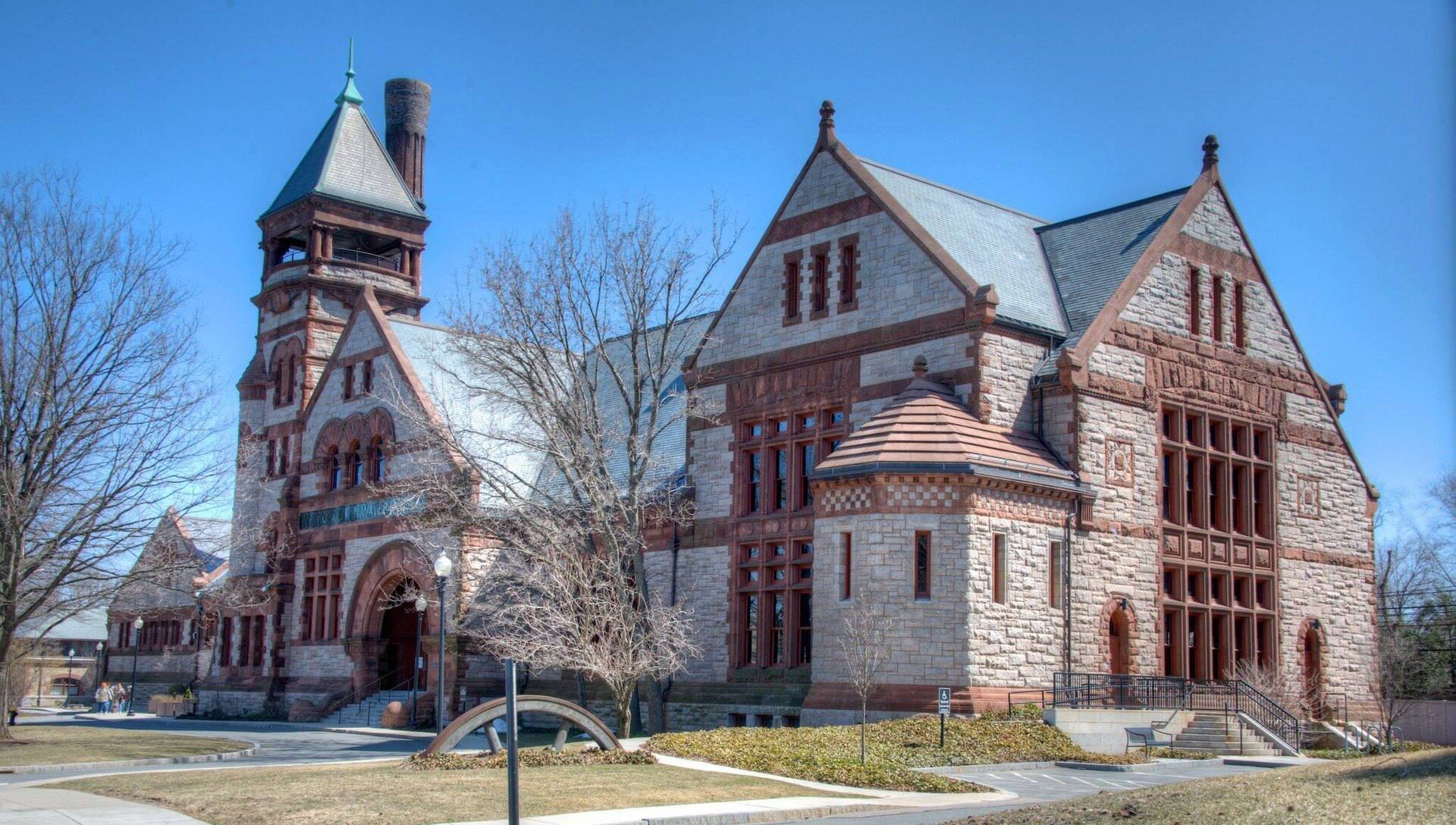
Newton was originally part of "the newe towne", which was settled in 1630 and renamed Cambridge in 1638. Landmarks include Metropolitan Waterworks Museum, Boston College station and Alumni Stadium. Newton is the birthplace of Jack Lemmon, actor.
Every piece is drawn from Newton's own map data and historic archives, then printed and shipped from the USA when you order. No two towns look alike.
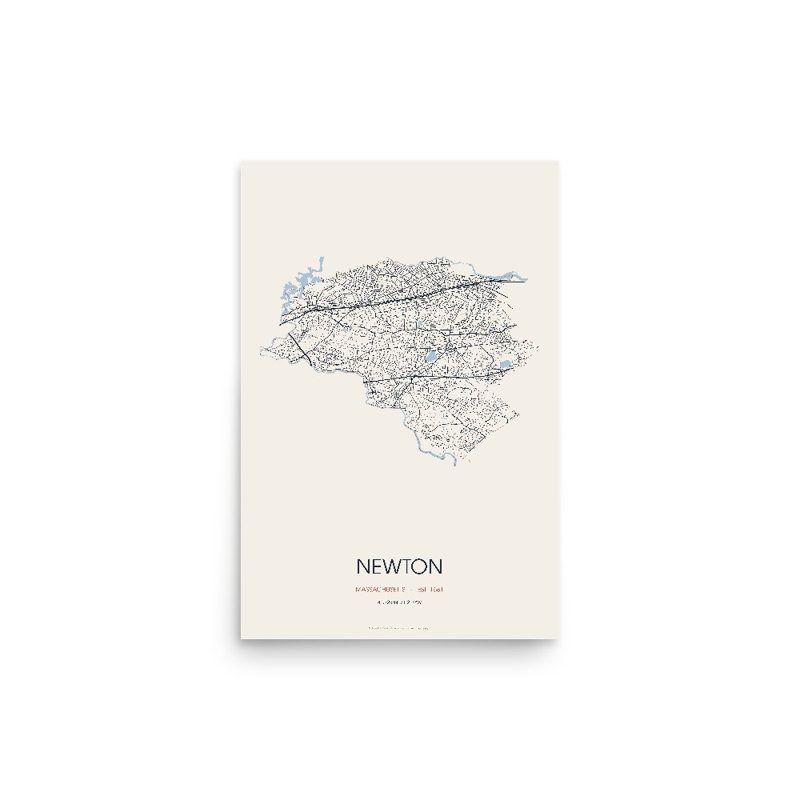
Every road in town, on archival matte paper
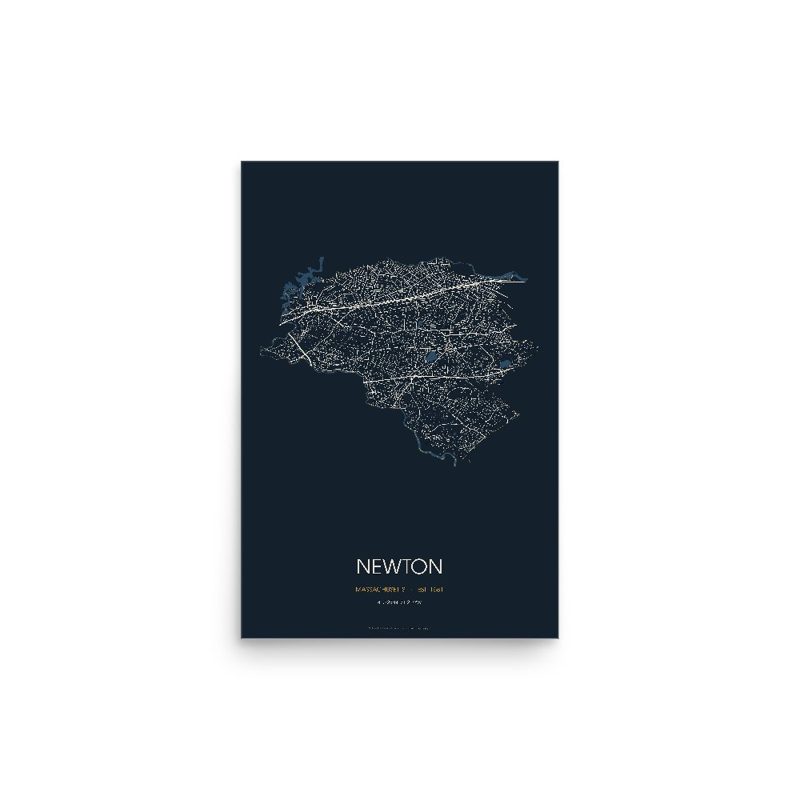
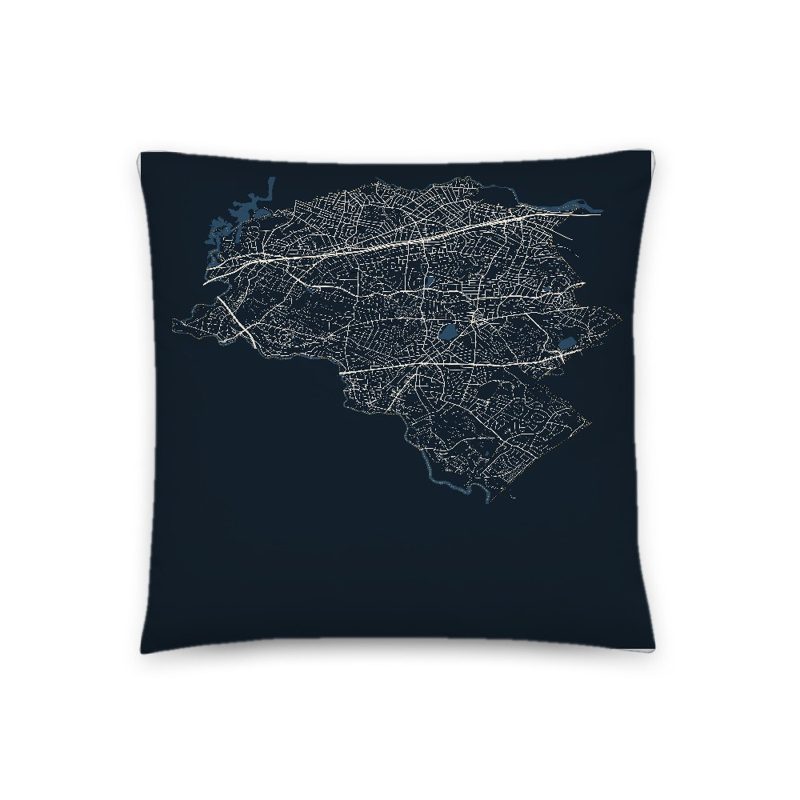
The same map, in navy and silver
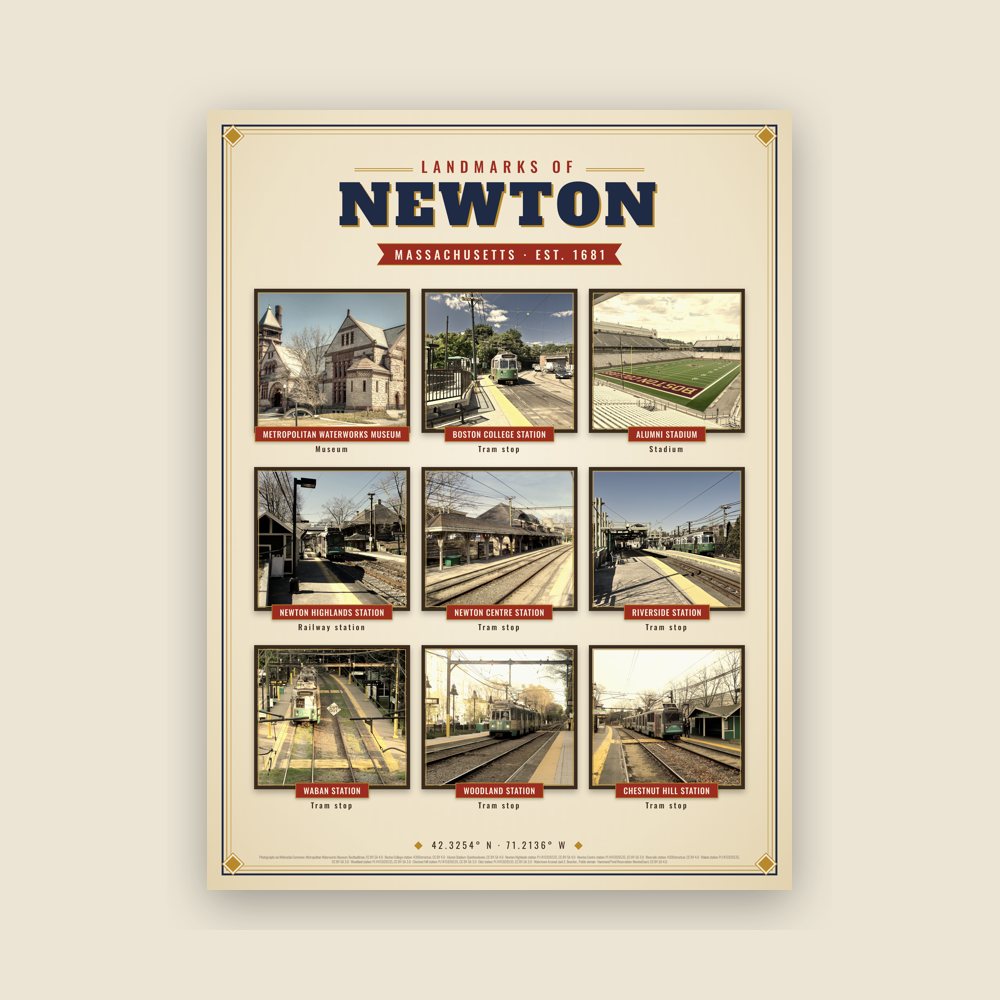
Nine local landmarks, archival matte
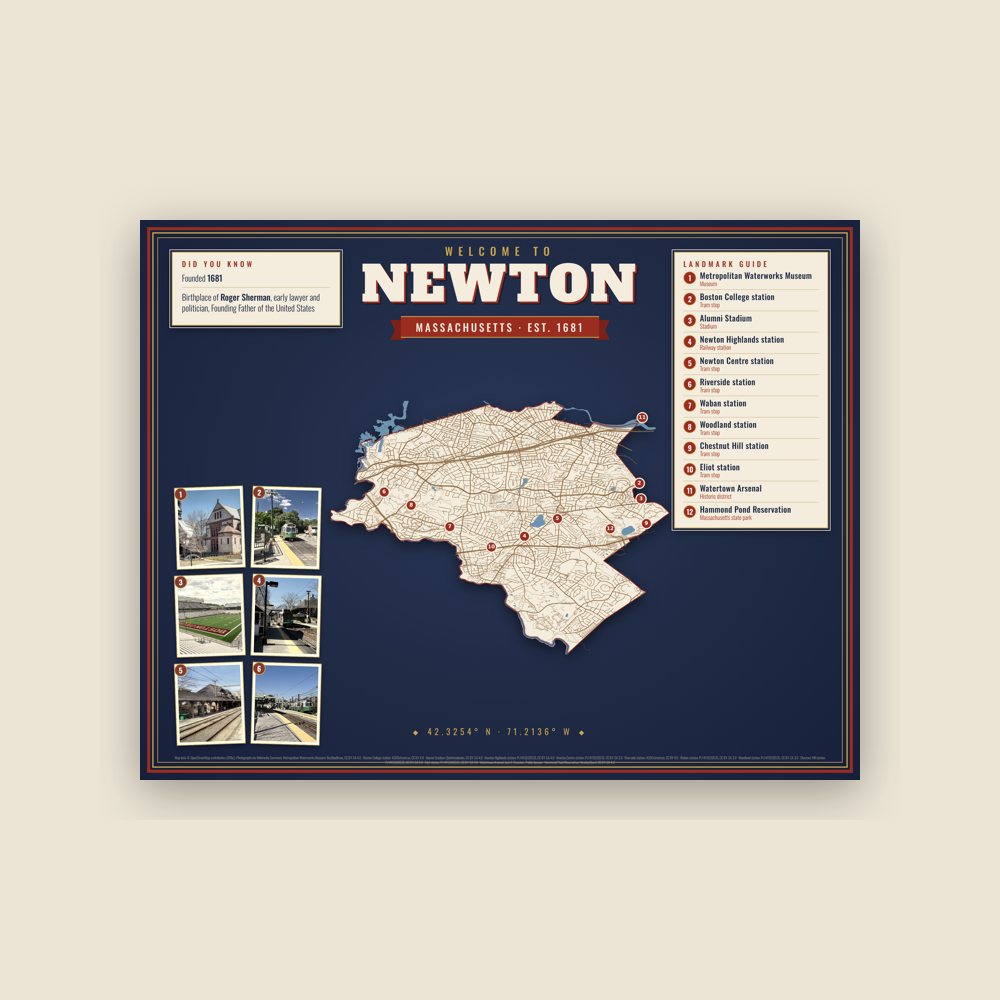
Map of local landmarks, washable fabric
Heavy-blend fleece, street map printed on the back
Soft Bella+Canvas jersey
Glossy ceramic, dishwasher safe
Ceramic keepsake, gold ribbon
Weatherproof, for the front walk
Soft-touch, zip cover
Sturdy all-over-print tote
Glossy top, cork back
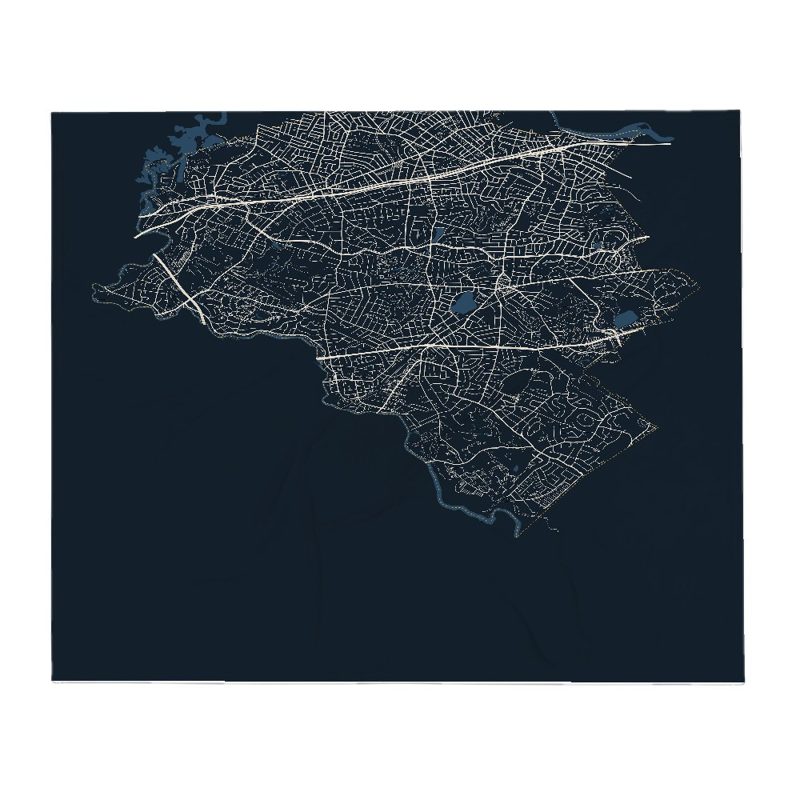
Soft fleece, 50″×60″
20 oz, double-wall stainless
Population 2010: 85,146 → 2020: 88,923
From Wikidata (CC0).
Newton was originally part of "the newe towne", which was settled in 1630 and renamed Cambridge in 1638. The first English settlement of what is now Newton began in 1639. Roxbury minister John Eliot persuaded the Native American people of Nonantum, a sub-tribe of the Massachusett led by a sachem named Waban, to relocate to Natick in 1651, fearing that they would be exploited by colonists. Newton was incorporated as a separate town, known as Cambridge Village, on December 15, 1681, then renamed Newtown in 1691, and finally Newton in 1766. It became a city on January 5, 1874. Newton is known as The Garden City.
In the early 1600s, Watertown had claimed a large area of land on the south side of the Charles River (modern-day Newton). They gave it up to Newtown, except for a strip "two hundred rods long and sixty rods wide" to "protect their fishing privileges".
In Reflections in Bullough's Pond, Newton historian Diana Muir describes the early industries that developed in the late 18th and early 19th centuries in a series of mills built to take advantage of the water power available at Newton Upper Falls and Newton Lower Falls. Snuff, chocolate, glue, paper and other products were produced in these small mills but, according to Muir, the water power available in Newton was not sufficient to turn Newton into a manufacturing city, although it was, beginning in 1902, the home of the Stanley Motor Carriage Company, the maker of the Stanley Steamer.
Nineteenth-century Newton, following the American Civil War, was a patchwork of villages. The northern villages of Auburndale, Newton Corner, Newtonville, and West Newton were the most affluent. In contrast, both Waban and Chestnut Hill were sparsely populated.
Several village-based "improvement societies" were founded by residents between 1878 and 1904. No citywide improvement society was ever founded.
In 1889, Moses King published King's Handbook of Newton, a descriptive guide to all of Newton's significant locations and historic structures along with anecdotes and stories from the locals at the time. The information was collected by its author and close associate of King, Moses Forster Sweetser.
Newton, according to Muir, became one of North America's earliest commuter suburbs. The Boston and Worcester, one of North America's earliest railroads, reached West Newton in 1834. Wealthy Bostonian businessmen took advantage of the new commuting opportunity offered by the railroad, building gracious homes on erstwhile farmland of West Newton hill and on Commonwealth Avenue. Muir points out that these early commuters needed sufficient wealth to employ a groom and keep horses, to drive them from their hilltop homes to the station.
Further suburbanization came in waves. One wave began with the streetcar lines that made many parts of Newton accessible for commuters in the late nineteenth century. The next wave came in the 1920s when automobiles became affordable to a growing upper middle class. Even then, however, Oak Hill continued to be farmed, mostly market gardening, until the prosperity of the 1950s made all of Newton more densely settled.
Two of the hijackers of the September 11 attacks stayed in Newton the night before the attacks. The hijackers of American Airlines Flight 11 spent their last night in Newton's Park Inn, an economy motel across the street from the Chestnut Hill Mall and within walking distance of The Atrium.
Each April on Patriots' Day, the Boston Marathon is run through the city, entering from Wellesley on Route 16 (Washington Street) where runners encounter the first of the four infamous Newton Hills. It then turns right onto Route 30 (Commonwealth Avenue) for the long haul into Boston. There are two more hills before reaching Centre Street, and then the fourth and most noted, Heartbreak Hill, rises shortly after Centre Street. Residents and visitors line the race route along Washington Street and Commonwealth Avenue to cheer on the runners.
Adapted (trimmed) from the Wikipedia article Newton, Massachusetts, revision 1380488952 by its contributors, licensed CC BY-SA 4.0.
We share a part of every Newton sale with local partners, and we'd love to print from your collection. Old photographs, maps and postcards make the best keepsakes.
Partner with us