
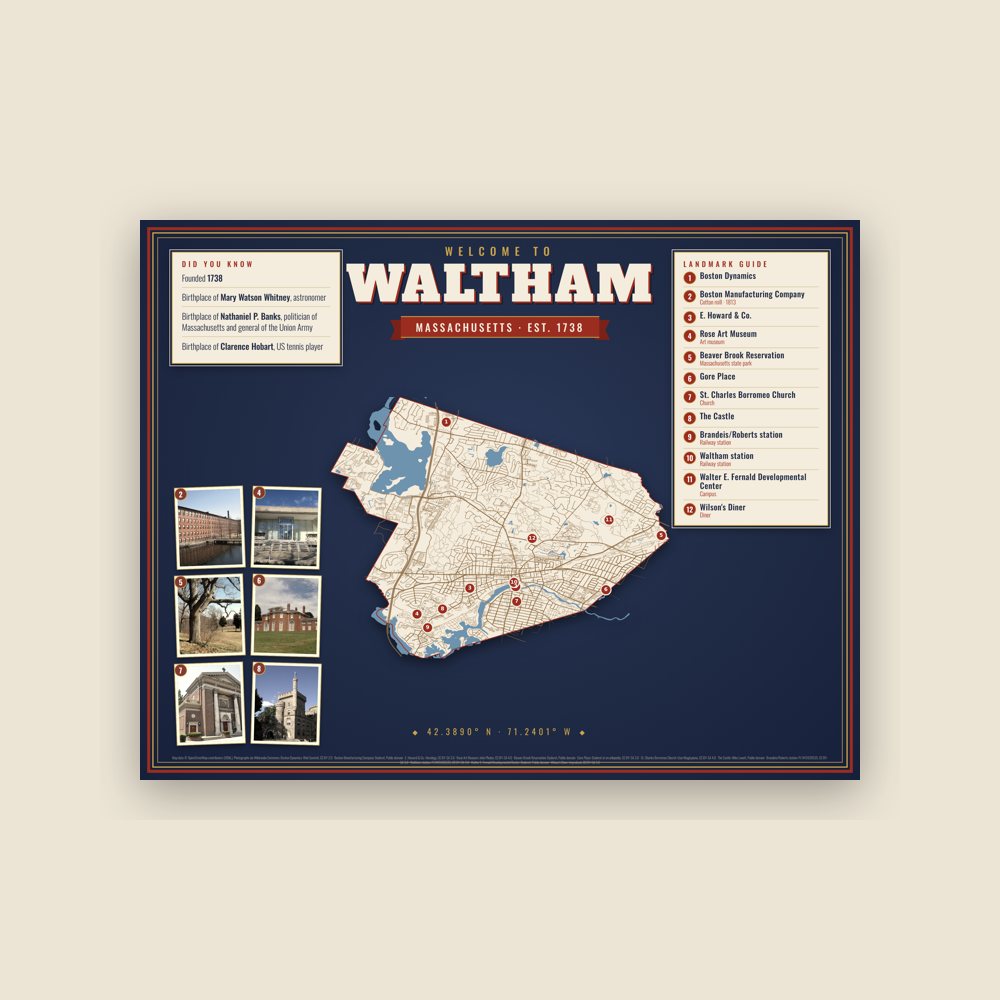
The original home of the Boston Manufacturing Company, the city was a prototype for 19th century industrial city planning, spawning what became known as the Waltham-Lowell system of labor and production. Landmarks include Boston Dynamics, Boston Manufacturing Company and E. Howard & Co.. Waltham is the birthplace of Kenneth G. Wilson, nobel prize winning US physicist.
Every piece is drawn from Waltham's own map data and historic archives, then printed and shipped from the USA when you order. No two towns look alike.
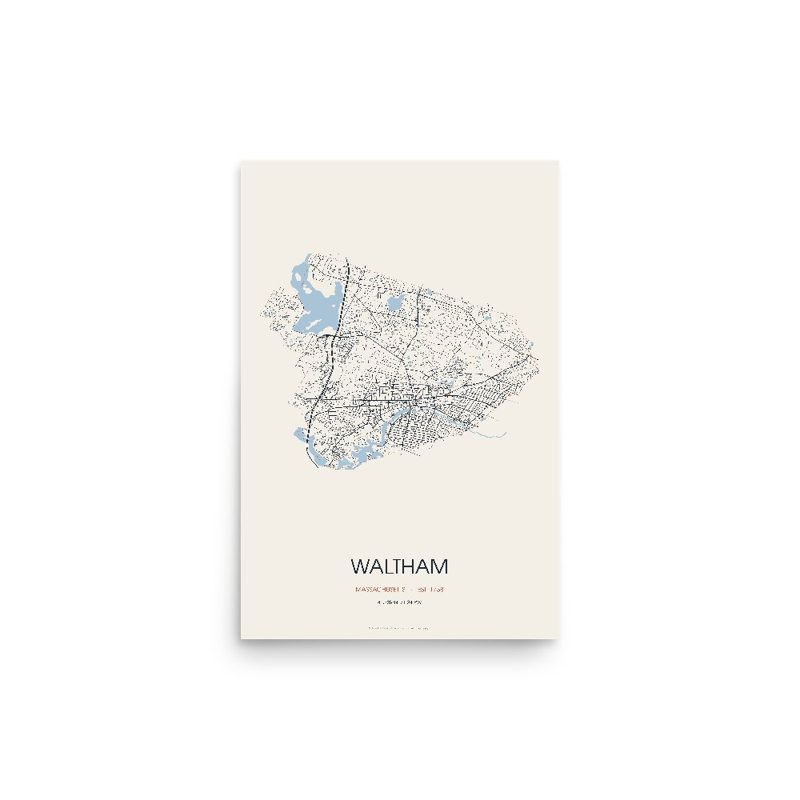
Every road in town, on archival matte paper
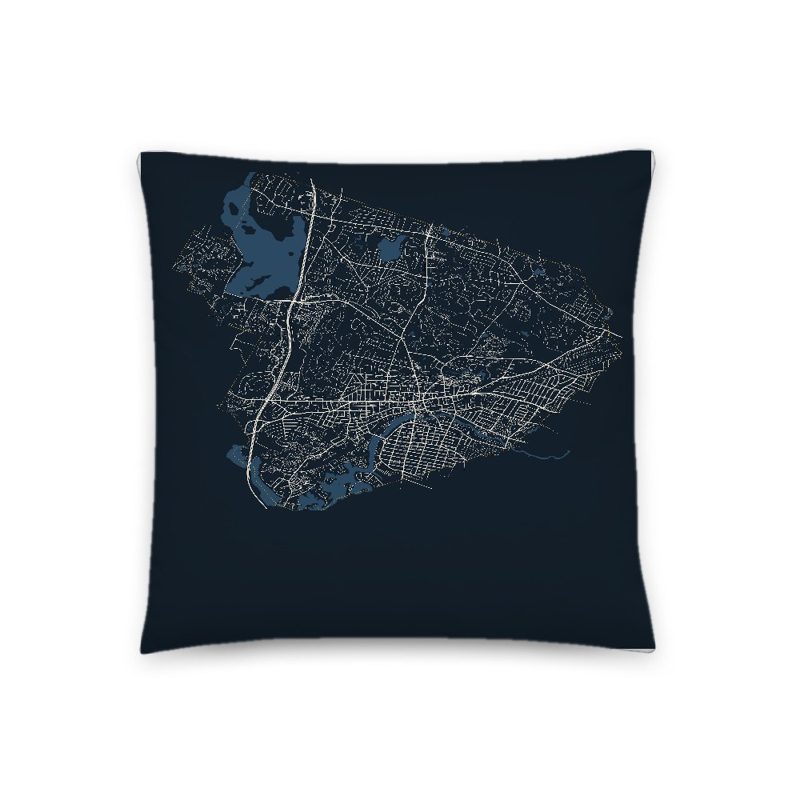
The same map, in navy and silver
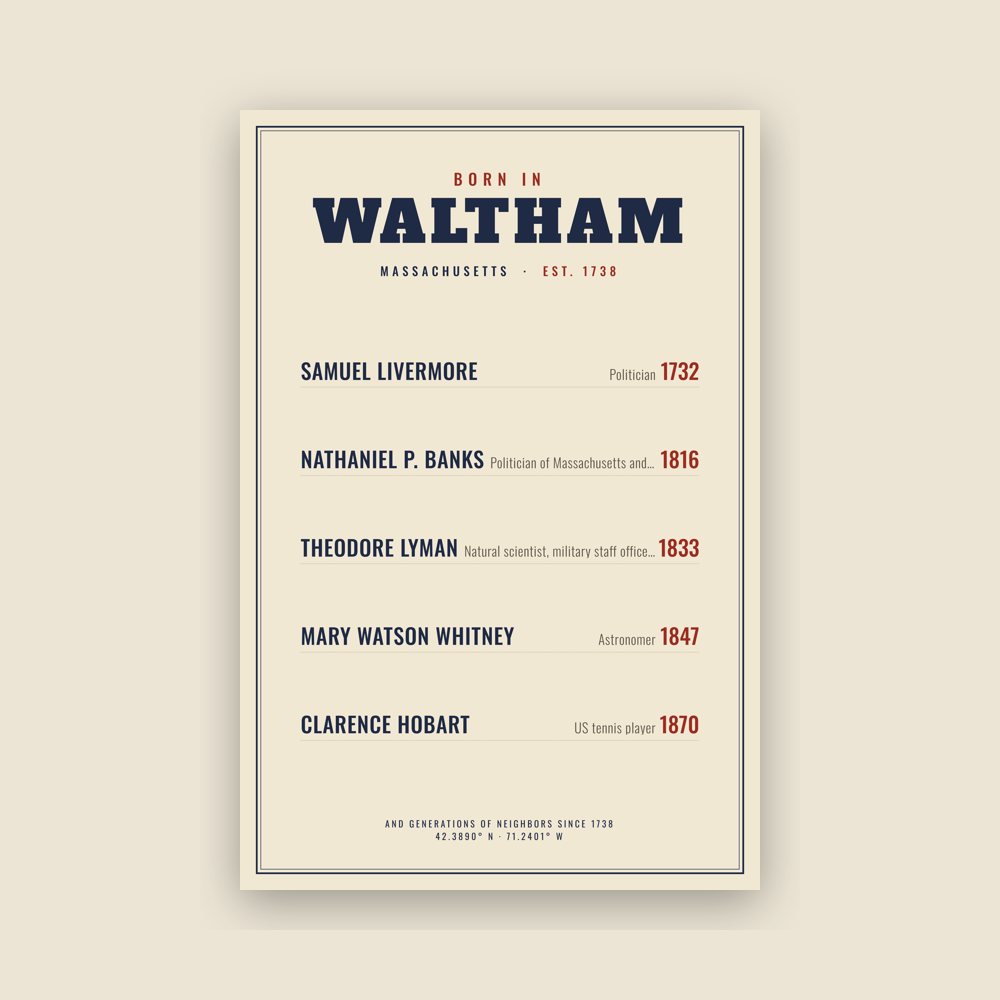
Famous natives, by birth year
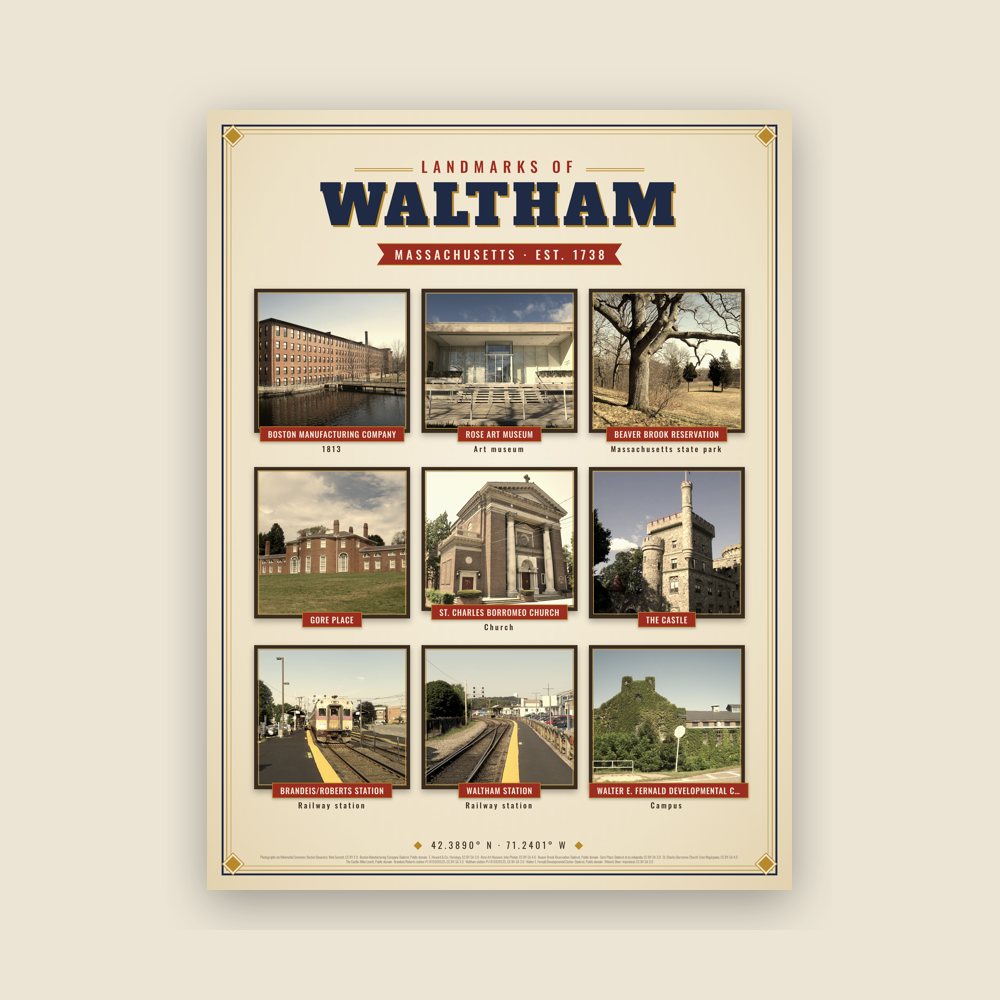
Nine local landmarks, archival matte
Map of local landmarks, washable fabric
Heavy-blend fleece, street map printed on the back
Soft Bella+Canvas jersey
Glossy ceramic, dishwasher safe
Ceramic keepsake, gold ribbon
Weatherproof, for the front walk
Soft-touch, zip cover
Sturdy all-over-print tote
Glossy top, cork back
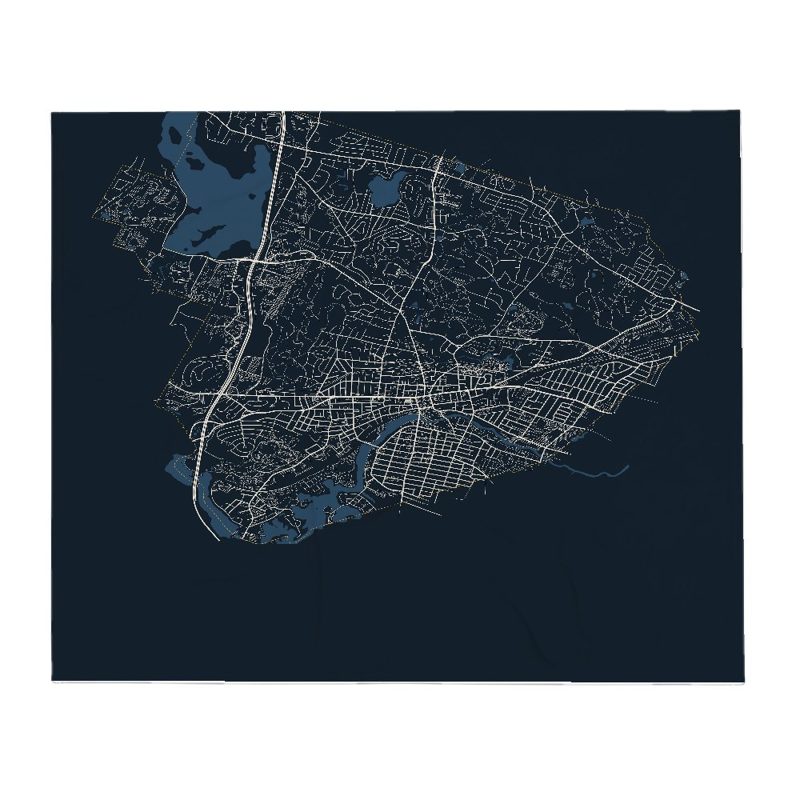
Soft fleece, 50″×60″
20 oz, double-wall stainless
Population 2010: 60,632 → 2020: 65,218
From Wikidata (CC0).
Waltham was first settled by the English in 1634 as part of Watertown, and was officially incorporated as a separate town in 1738, but the area was inhabited for thousands of years prior to English colonization. At the time of European arrival, Waltham was in a border zone between the territories of the Pawtucket confederation and the Massachusett, with nearby native settlements at Nonantum and Pequosset (Watertown). Early settlers recorded the presence of an "Indian Stockade" near today's Cambridge Reservoir, and an "Indian Hollow" in today's Calvary Cemetery. A native trail through Waltham, the "Old Connecticut Path" saw continued use after colonization and became the basis for present day Route 20.
Waltham is most likely named for Waltham Abbey in the County of Essex, England. The first record of the name is from the articles of incorporation, dated January 15, 1738. The name derives from the Anglo-Saxon words, weald or wald "forest" and ham "homestead" or "enclosure." Waltham had no recognizable town center until the 1830s, when the nearby Boston Manufacturing Company gave the town the land that now serves as its central square.
In the early 19th century, Francis Cabot Lowell and his friends and colleagues established in Waltham the Boston Manufacturing Company—the first integrated textile mill in the United States—with the goal of eliminating the problems of co-ordination, quality control, and shipping inherent in the subcontracting based textile industry. The Waltham–Lowell system of production derives its name from the city and the founder of the mill.
The city is home to a number of large estates, including Gore Place, a mansion built in 1806 for former Massachusetts governor Christopher Gore, the Robert Treat Paine Estate, a residence designed by architect Henry Hobson Richardson and landscape architect Frederick Law Olmsted for philanthropist Robert Treat Paine, Jr. (1810–1905), and the Lyman Estate, a 400-acre (1.6 km2) estate built in 1793 by Boston merchant Theodore Lyman I.
In the late 19th and early 20th century, Waltham was home to the brass era automobile manufacturer Metz, where the first production motorcycle in the U.S. was built.
Another first in Waltham industrial history involves the method to mass-produce the magnetron tube, invented by Percy Spencer at Raytheon. During World War II, the magnetron tube technology was applied to radar. Later, magnetron tubes were used as components in microwave ovens.
Waltham was also the home of the Walter E. Fernald State School, the western hemisphere's oldest publicly funded institution serving people with developmental disabilities. The storied and controversial history of the institution has long been covered by local and, at times, national media.
The name of the city is pronounced with the primary stress on the first syllable and a full vowel in the second syllable, WAWL-tham, though the name of the Waltham watch was pronounced with a reduced schwa in the second syllable: . At one time, most people would have pronounced it in the British way, "Walthum", but when people came to work in the mills from Nova Scotia, the pronunciation evolved. The local version became a phonetic sounding to accommodate French speakers who could not pronounce it in the British way. In some areas, the city is referred to as "The Waltham".
Adapted (trimmed) from the Wikipedia article Waltham, Massachusetts, revision 1379598158 by its contributors, licensed CC BY-SA 4.0.
We share a part of every Waltham sale with local partners, and we'd love to print from your collection. Old photographs, maps and postcards make the best keepsakes.
Partner with us