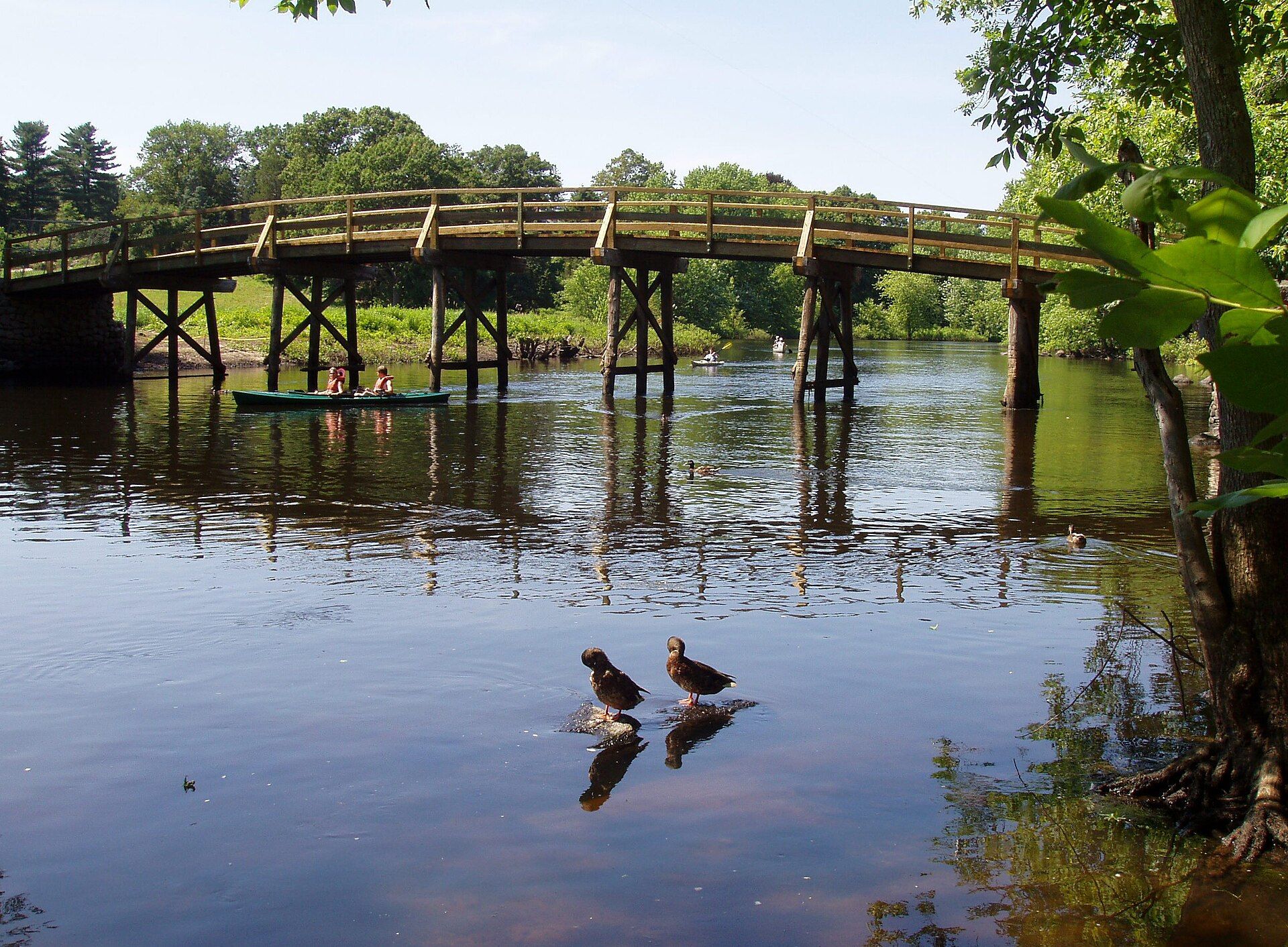
The town center is near where the Sudbury and Assabet rivers join to form the Concord River. Landmarks include Minute man, Old North Bridge and Sleepy Hollow Cemetery. Concord is the birthplace of Henry David Thoreau, essayist, poet, and philosopher.
Every piece is drawn from Concord's own map data and historic archives, then printed and shipped from the USA when you order. No two towns look alike.
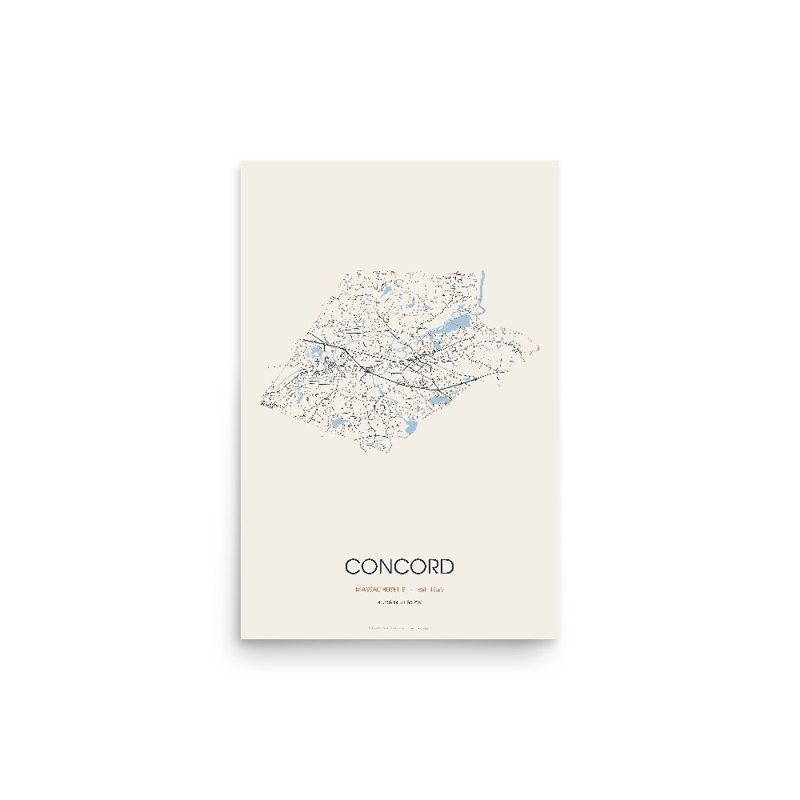
Every road in town, on archival matte paper
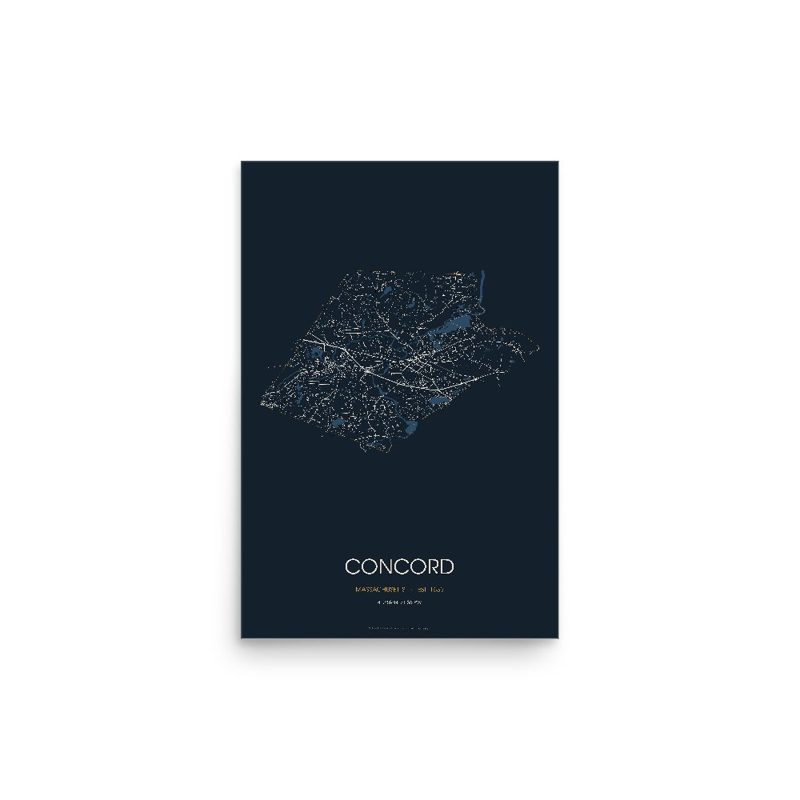
The same map, in navy and silver
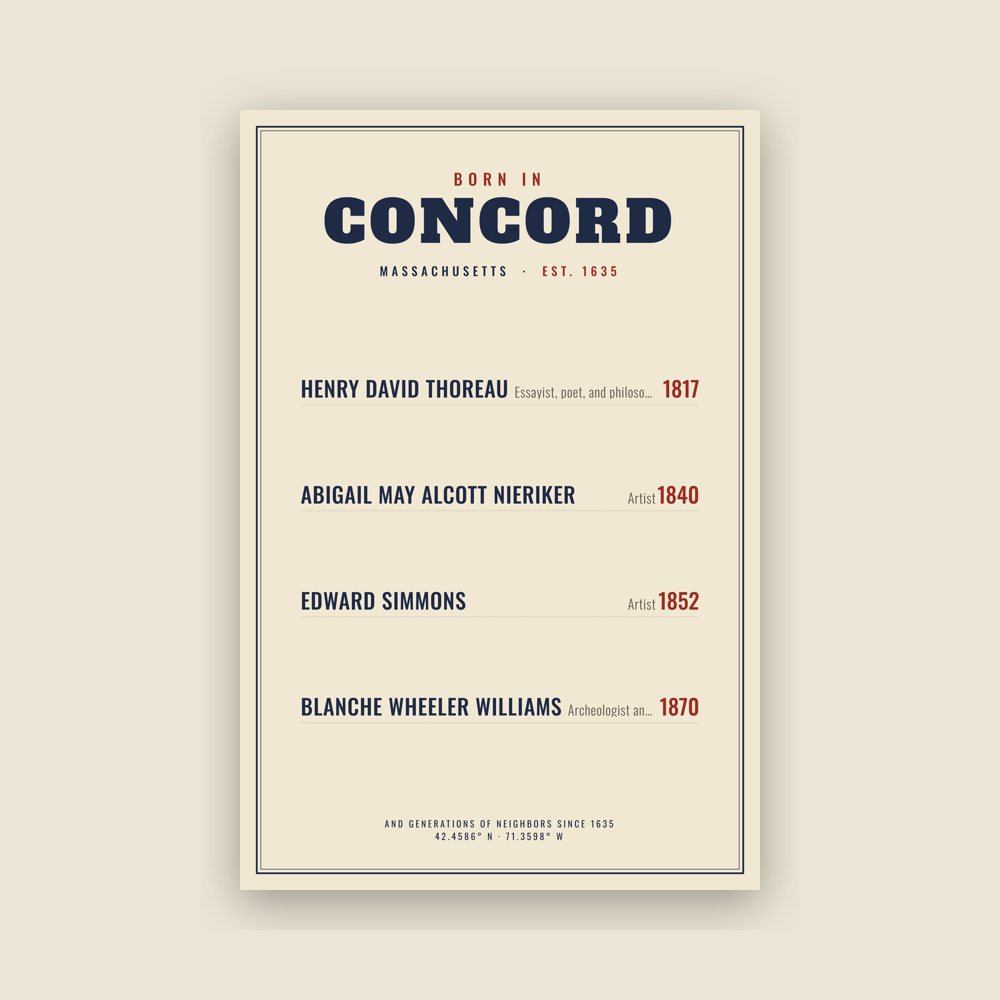
Famous natives, by birth year
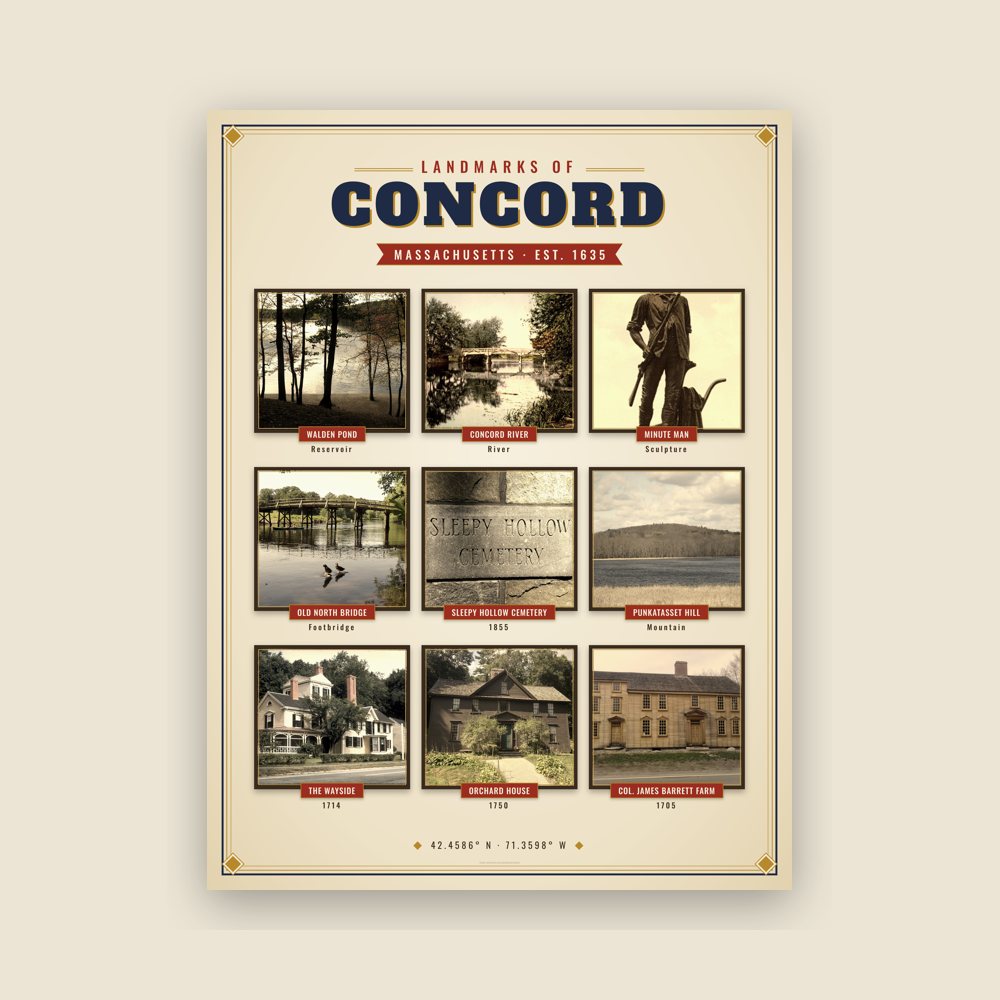
Nine local landmarks, archival matte
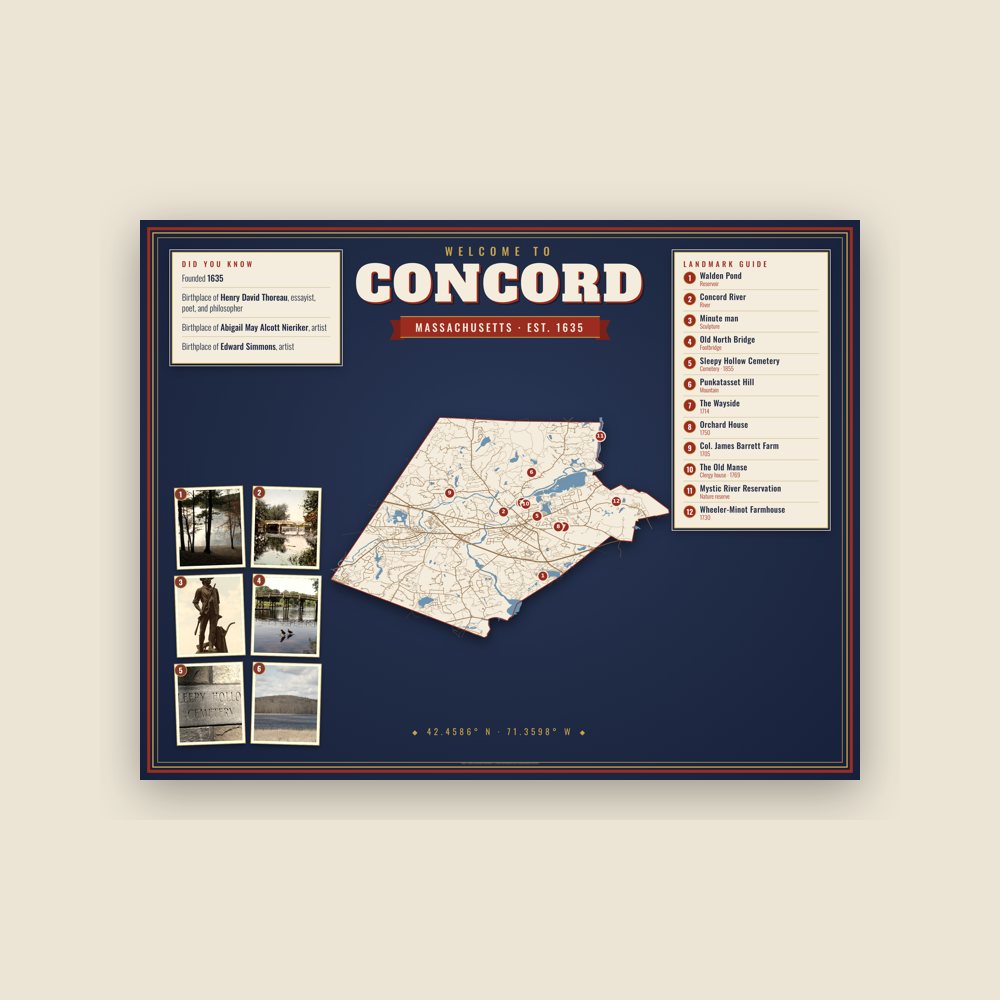
Map of local landmarks, washable fabric
Heavy-blend fleece, street map printed on the back
Soft Bella+Canvas jersey
Glossy ceramic, dishwasher safe
Ceramic keepsake, gold ribbon
Weatherproof, for the front walk
24″×16″, printed coir-look fibers, rubber back
12″×12″ printed wood, ready to hang
Soft-touch, zip cover
Sturdy all-over-print tote
Glossy top, cork back
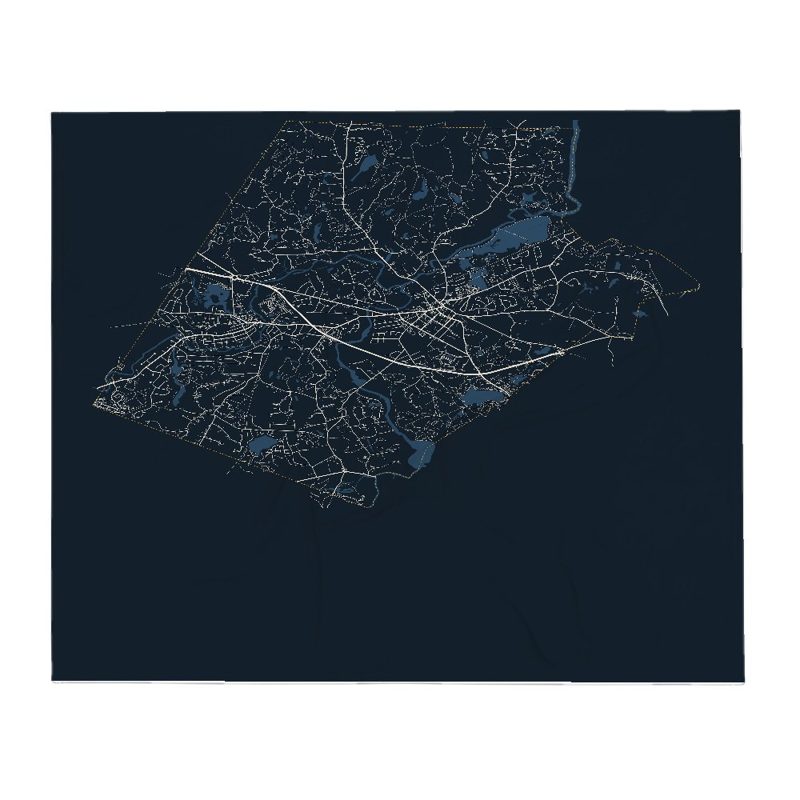
Soft fleece, 50″×60″
20 oz, double-wall stainless
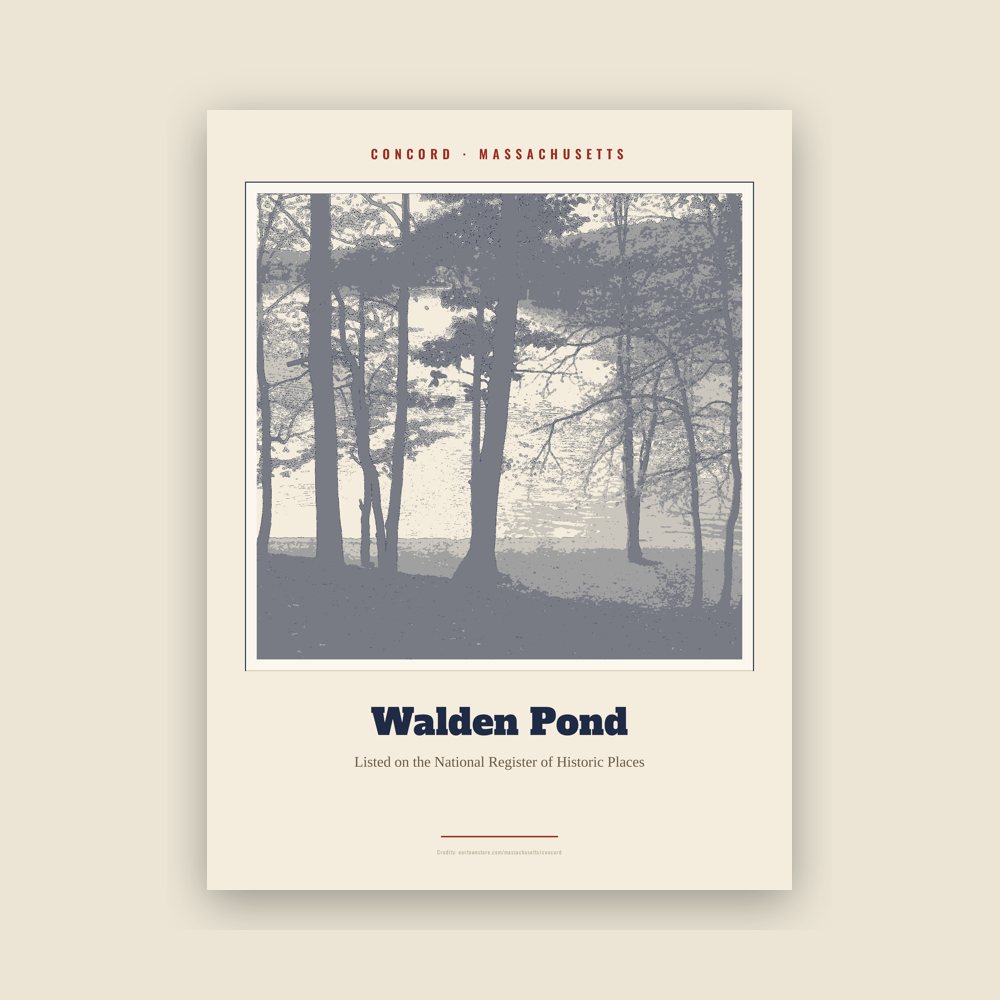
Archival matte print of a local landmark, credited to its photographer
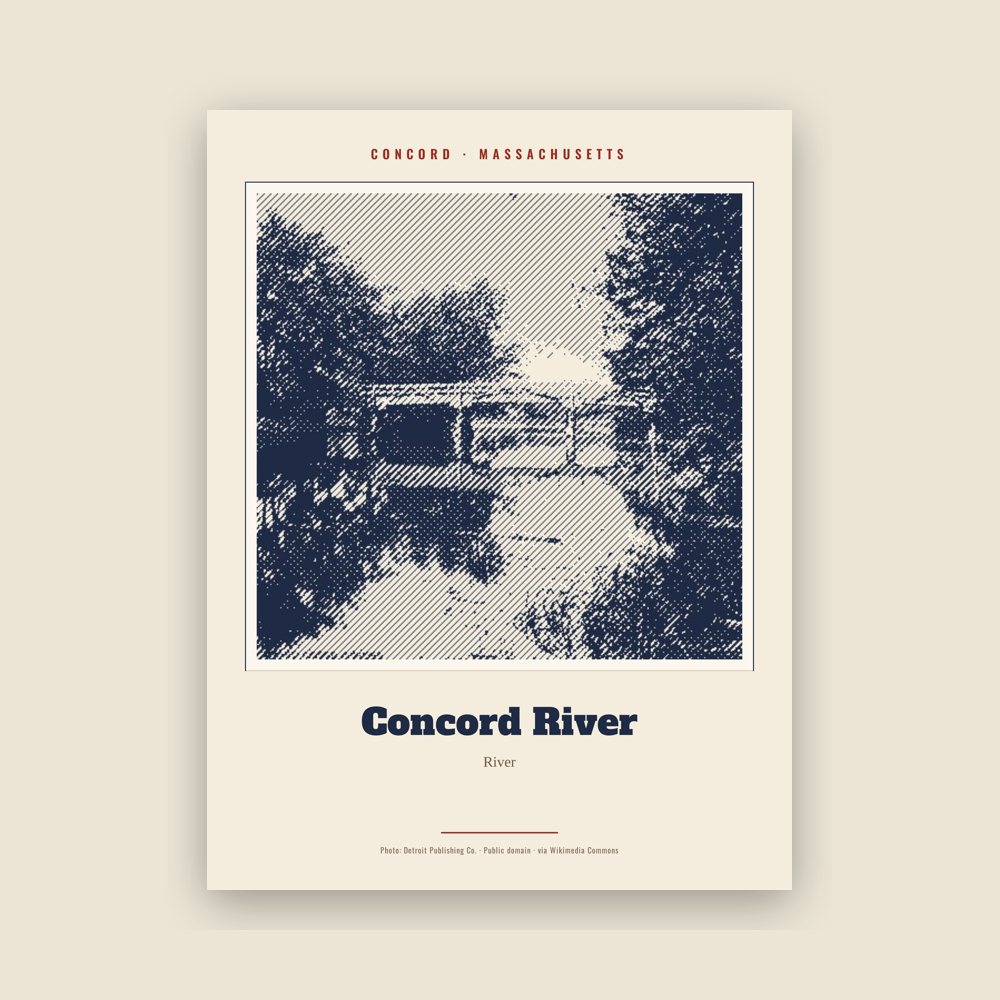
Archival matte print of a local landmark, credited to its photographer
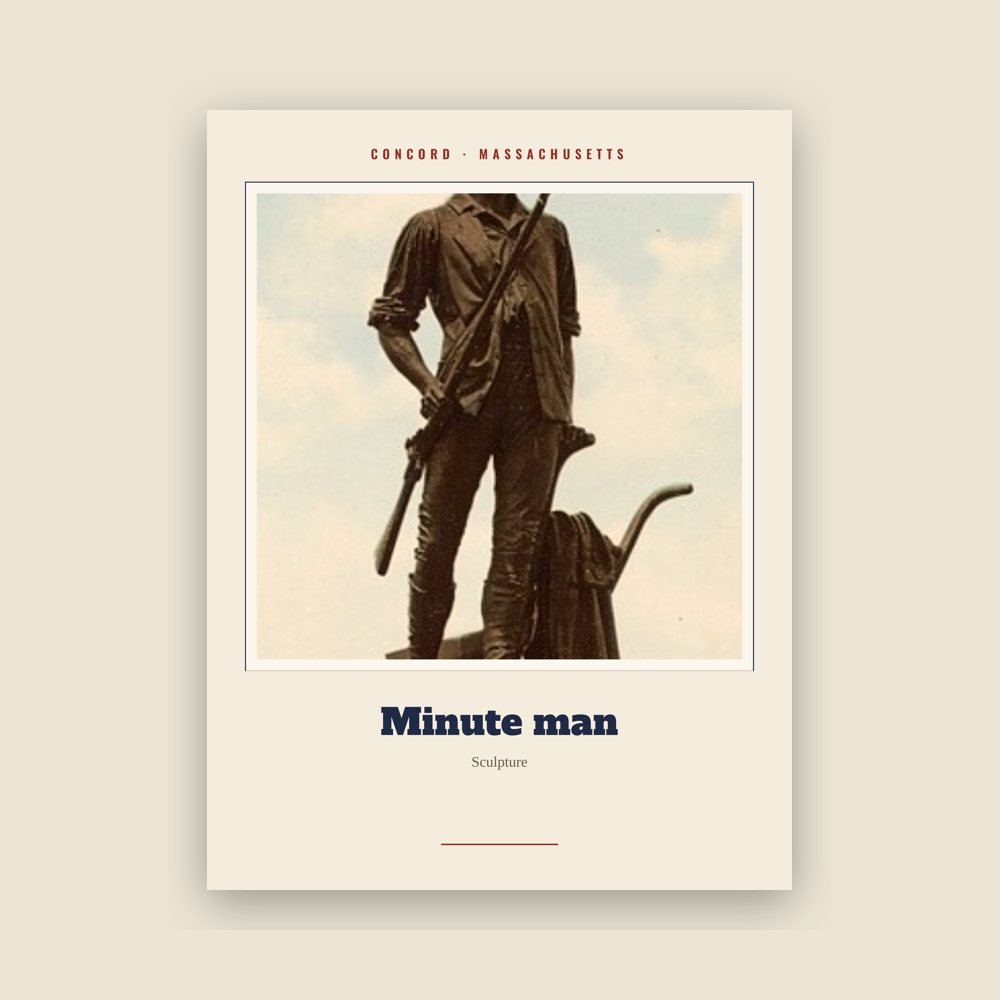
Archival matte print of a local landmark, credited to its photographer
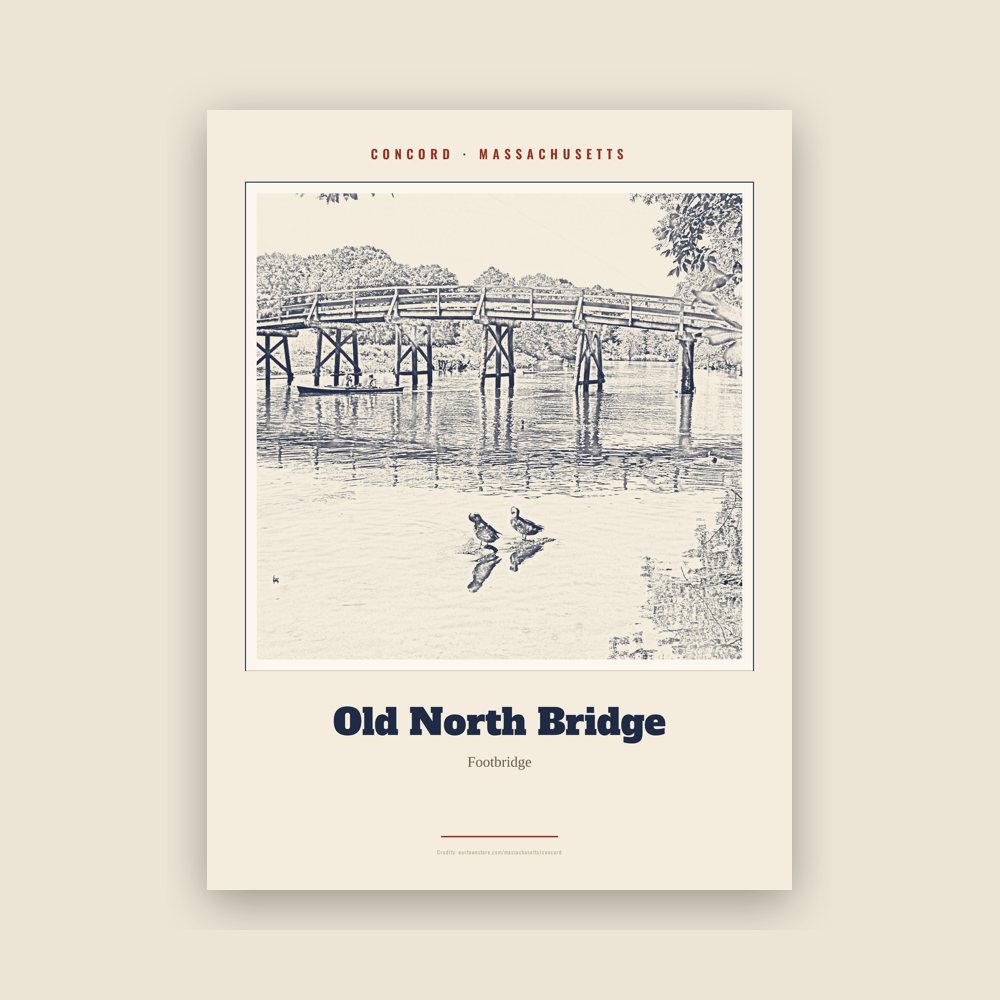
Archival matte print of a local landmark, credited to its photographer
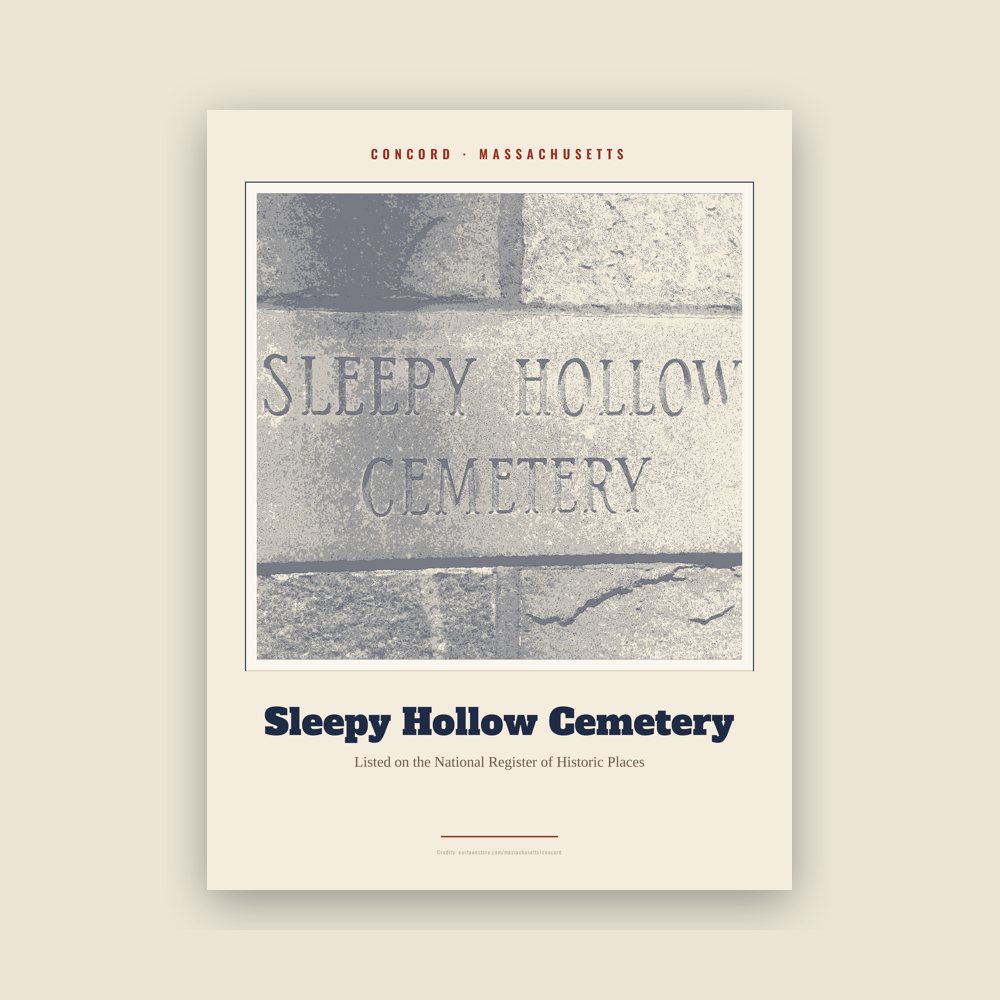
Archival matte print of a local landmark, credited to its photographer
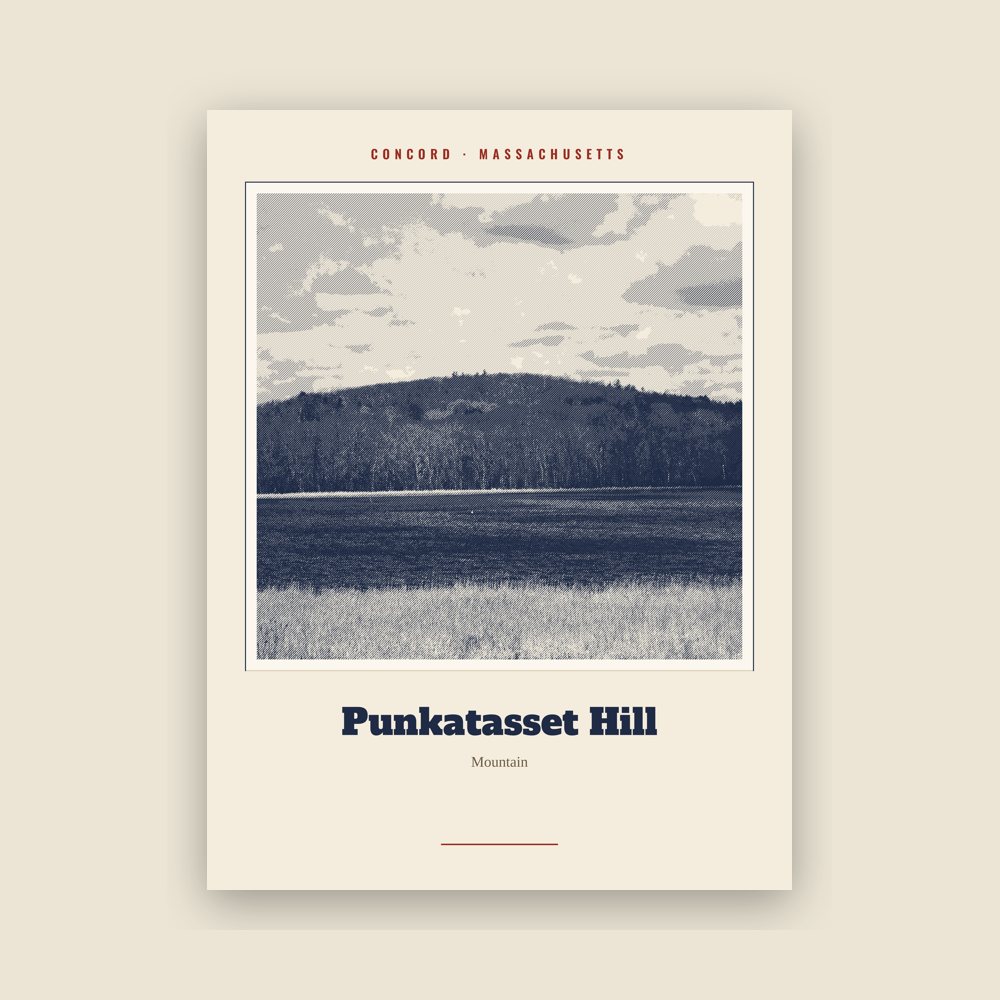
Archival matte print of a local landmark, credited to its photographer
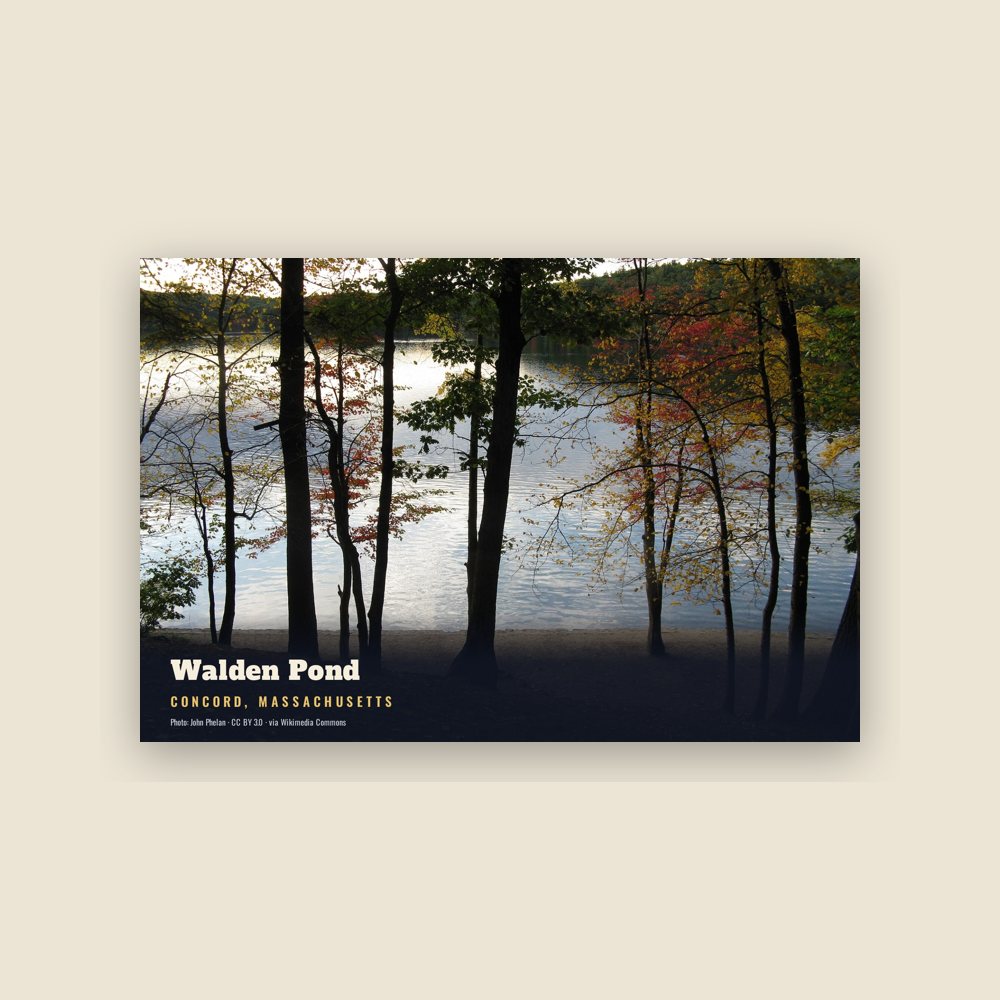
6″×4″ postcard, glossy front
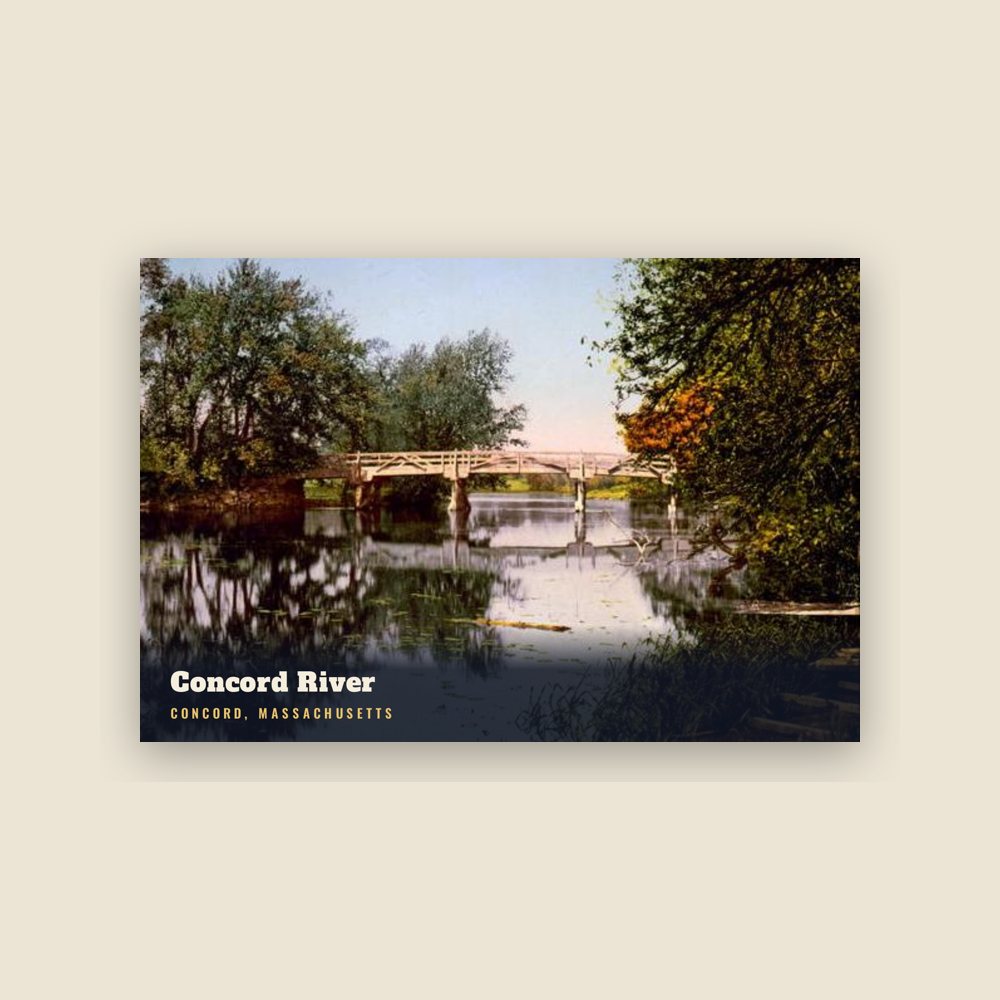
6″×4″ postcard, glossy front
6″×4″ postcard, glossy front
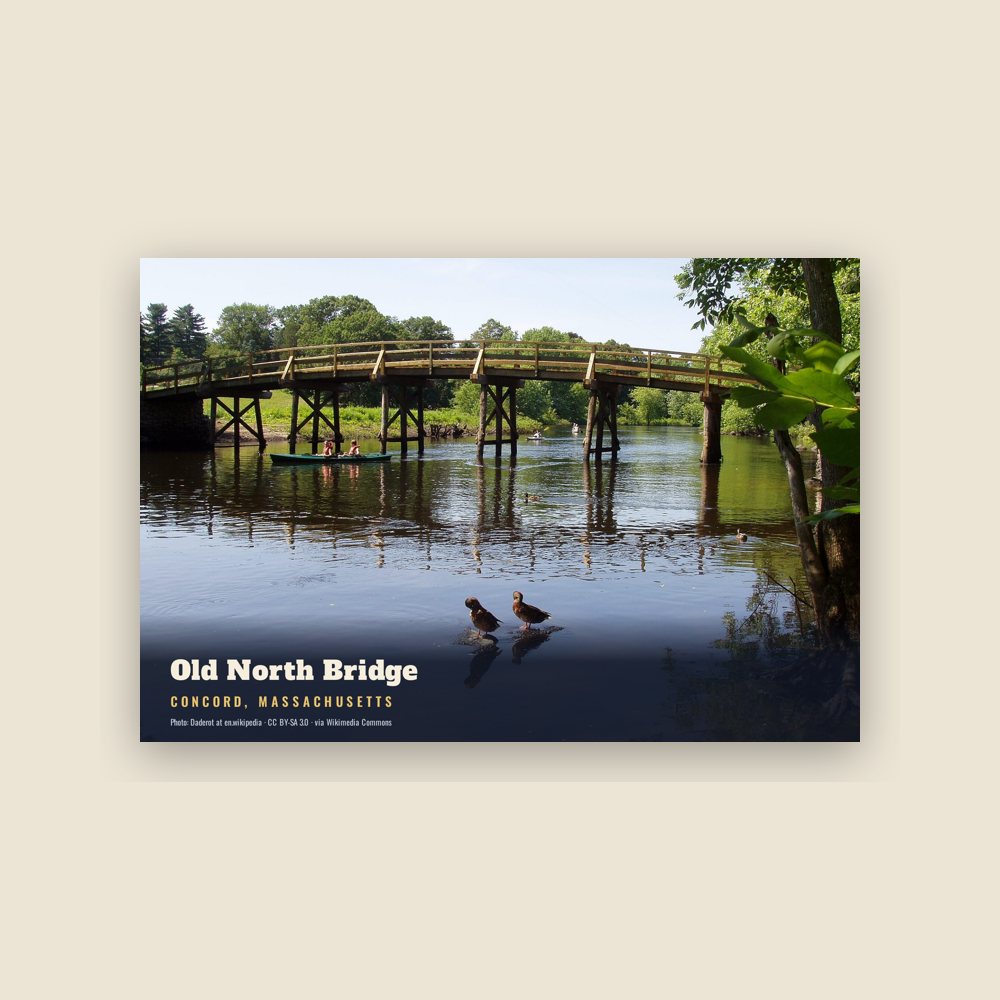
6″×4″ postcard, glossy front
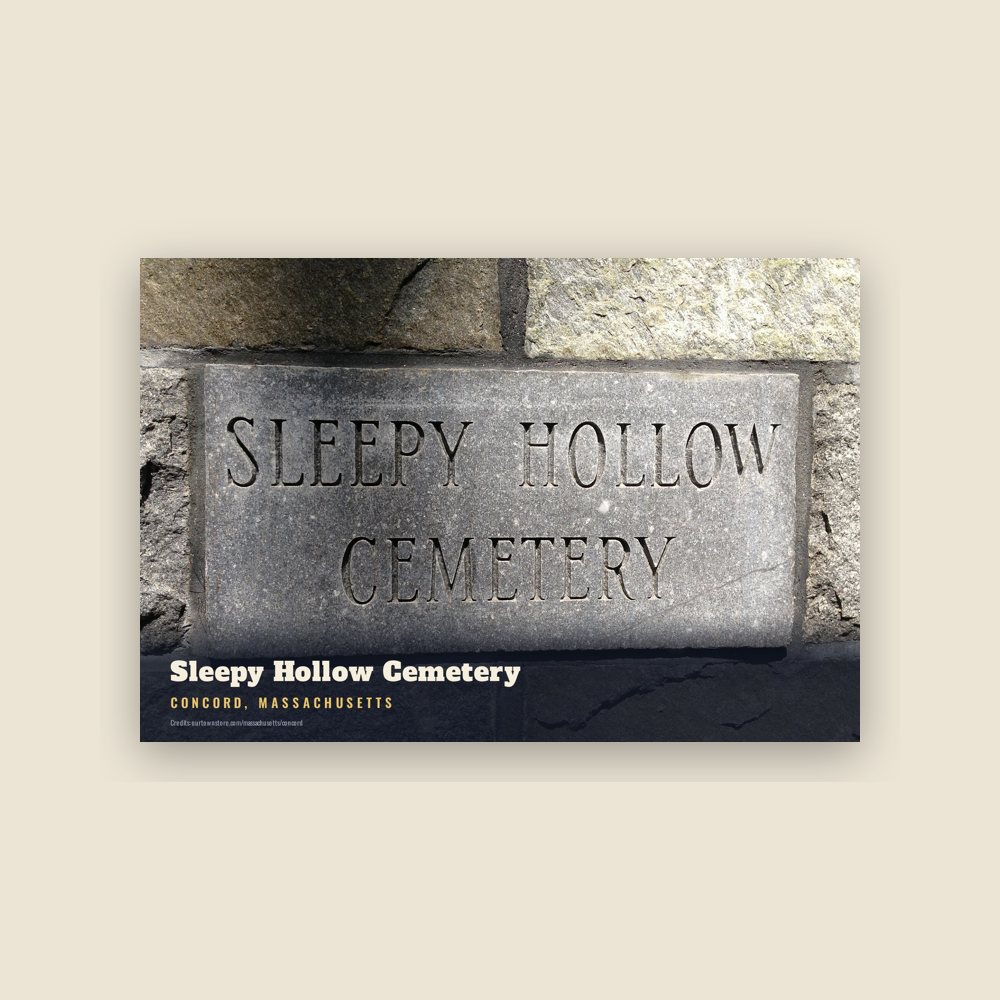
6″×4″ postcard, glossy front
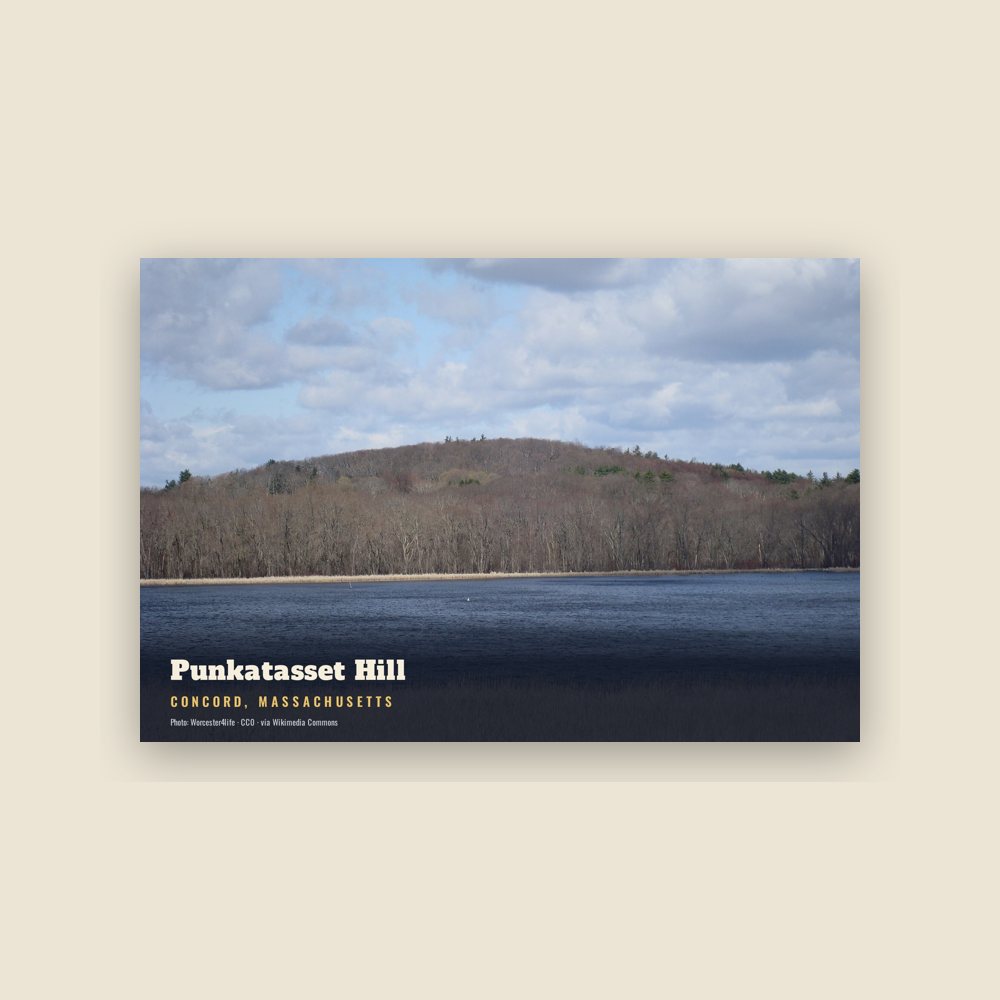
6″×4″ postcard, glossy front
Population 2010: 17,668 → 2020: 18,491
From Wikidata (CC0).
The area which became the town of Concord was originally known as "Musketaquid", situated at the confluence of the Sudbury and Assabet rivers. The name was an Algonquian word for "grassy plain", fitting the area's low-lying marshes and kettle holes. Native Americans had cultivated corn crops there; the rivers were rich with fish and the land was lush and arable. The area was largely depopulated in 1633 by an epidemic of smallpox, a disease likely to have been introduced to the New World by European explorers and settlers.
In 1635, a group of English settlers led by Rev. Peter Bulkley and Major Simon Willard received a land grant from the General Court and negotiated a land purchase with the local indigenous tribes. Bulkeley was an influential religious leader who "carried a good number of planters with him into the woods"; Willard was a canny trader who spoke the Algonquian language and had gained the trust of Native Americans. They exchanged wampum, hatchets, knives, cloth and other useful items for the six-square-mile (16 km2) purchase from Squaw Sachem of Mistick, which formed the basis of the new town, called "Concord" in appreciation of the peaceful acquisition.
The battles of Lexington and Concord were the first military engagements of the American Revolutionary War. On April 19, 1775, 700 British Army troops led by Lieutenant-Colonel Francis Smith marched from Boston to Concord to confiscate a cache of arms stored in the town. Unbeknownst to them, Patriot leaders had moved most of the cache elsewhere. Around 150 Patriot minutemen from local towns, who had been forewarned of the Army's march by Samuel Prescott on April 18, quickly mustered and confronted the British in Lexington. Though who fired the first shot is unknown, a firefight broke out and the British fired a volley at the Americans before dispersing them with a bayonet charge, killing eight. The British proceeded into Concord and dispersed into company-sized formations to search for the cache. At 11:00am, 400 minutemen engaged 100 British troops at the Old North Bridge, leading to a number of casualties on both sides and forcing them to fall back and rejoin the Army's main force.
After the British completed their search for the cache in Concord, they marched back to Boston, but were constantly attacked by minutemen in hit-and-run attacks, suffering more casualties before reaching Charlestown. The minutemen then blockaded the narrow land accesses to Charlestown, initiating the siege of Boston. Poet Ralph Waldo Emerson subsequently described the shot fired by the minutemen at the Old North Bridge in his 1837 poem "Concord Hymn" as the "shot heard round the world". In 1894, the Lexington Historical Society petitioned the Massachusetts State Legislature to proclaim April 19 "Lexington Day"; Concord countered with "Concord Day". Governor Frederic T. Greenhalge opted for a compromise, proclaiming the day as Patriots' Day. In April 1975, Concord hosted a bicentennial celebration of the battle, featuring an address at the Old North Bridge by President Gerald Ford.
Concord has a remarkably rich literary history centered in the 19th century around Ralph Waldo Emerson (1803–1882), who moved there in 1835 and quickly became its most prominent citizen. A successful lecturer and philosopher, Emerson had deep roots in the town: his father, Rev. William Emerson (1769–1811), grew up in Concord before becoming an eminent Boston minister, and his grandfather, William Emerson Sr., witnessed the battle at the North Bridge from his house, and later became a chaplain in the Continental Army. Emerson was at the center of a group of like-minded Transcendentalists living in Concord. Among them were the author Nathaniel Hawthorne (1804–1864) and the philosopher Amos Bronson Alcott (1799–1888), the father of Louisa May Alcott (1832–1888). A native Concordian, Henry David Thoreau (1817–1862) was another notable member of Emerson's circle. This substantial collection of literary talent in one small town led Henry James to dub Concord "the biggest little place in America."
Among the products of this intellectually stimulating environment were Emerson's many essays, including Self-Reliance (1841), Louisa May Alcott's novel Little Women (1868), and Hawthorne's story collection Mosses from an Old Manse (1846). Thoreau famously lived in a small cabin near Walden Pond, where he wrote Walden (1854). After being imprisoned in the Concord jail for refusing to pay taxes in political protest against slavery and the Mexican–American War, Thoreau penned the influential essay "Resistance to Civil Government", popularly known as Civil Disobedience (1849). Evidencing their strong political beliefs through actions, Thoreau and many of his neighbors served as station masters and agents on the Underground Railroad.
The Wayside, a house on Lexington Road, has been home to several authors. It was occupied by scientist John Winthrop (1714–1779) when Harvard College was temporarily moved to Concord during the Revolutionary War. The Wayside was later the home of the Alcott family (who referred to it as "Hillside"); the Alcotts sold it to Hawthorne in 1852, and the family moved into the adjacent Orchard House in 1858. Hawthorne dubbed the house "The Wayside" and lived there until his death. The house was purchased in 1883 by Boston publisher Daniel Lothrop and his wife, Harriett, who wrote the Five Little Peppers series and other children's books under the pen name Margaret Sidney. Today, The Wayside and the Orchard House are both museums. Emerson, Thoreau, Hawthorne and the Alcotts are buried on Authors' Ridge in Concord's Sleepy Hollow Cemetery.
The 20th-century composer Charles Ives wrote his Concord Sonata (c. 1904–1915) as a series of impressionistic portraits of literary figures associated with the town. Concord maintains a lively literary culture to this day; notable authors who have called the town home in recent years include Doris Kearns Goodwin, Alan Lightman, Robert B. Parker and Gregory Maguire.
In 1849, Ephraim Wales Bull developed the now-ubiquitous Concord grape at his home on Lexington Road, where the original vine still grows. Welch's, the first company to sell grape juice, maintains a headquarters in Concord. The Boston-born Bull developed the Concord grape by experimenting with seeds from some of the native species. On his farm outside Concord, down the road from the Emerson, Thoreau, Hawthorne and Alcott homesteads, he planted some 22,000 seedlings before producing the ideal grape. Early ripening, to escape the killing northern frosts, but with a rich, full-bodied flavor, the hardy Concord grape thrives where European cuttings had failed to survive. In 1853, Bull felt ready to put the first bunches of Concord grapes before the public and won a prize at the Boston Horticultural Society Exhibition. From these early arbors, the fame of Bull's Concord grape spread worldwide, bringing him up to $1,000 a cutting, but he died a relatively poor man. The inscription on his tombstone reads, "He sowed—others reaped."
On September 5, 2012, Concord became the first community in the United States to approve a ban on the sale of water in single-serving plastic bottles. The law banned the sale of PET bottles of one liter (34 U.S. fl oz) or less starting January 1, 2013. The ban provoked national controversy. An editorial in the Los Angeles Times characterized the ban as "born of convoluted reasoning" and "wrongheaded." Some residents believed the ban would do little to affect the sales of bottled water, which was still highly accessible in the surrounding areas, and that it restricted consumers' freedom of choice. Opponents also considered the ban to unfairly target one product in particular, when other, less healthy alternatives such as soda and fruit juice were still readily available in bottled form.
Nonetheless, subsequent efforts to repeal the ban failed in open town meetings. An effort to repeal Concord's ban on the sale of plastic water bottles was resoundingly defeated at a Town Meeting. Resident Jean Hill, who led the initial fight for the ban, said, "I really feel at the age of 86 that I've really accomplished something." Town Moderator Eric Van Loon did not even bother taking an official tally because opposition to repeal was so overwhelming. It appeared that upwards of 80 to 90 percent of the 1,127 voters in attendance raised their ballots against the repeal measure.
The issue had been bubbling in Concord for several years prior to the ban. In 2010, a ban approved in a town meeting, which wasn't written as a bylaw, was rejected by the state attorney general's office. In 2011, a new version of the ban narrowly failed at a town meeting by a vote of 265 to 272. The ban on selling water in polyethylene terephthalate (PET) bottles of one liter or less passed in 2012 by a vote of 403 to 364, and a repeal effort in April failed by a vote of 621 to 687.
Adapted (trimmed) from the Wikipedia article Concord, Massachusetts, revision 1374273200 by its contributors, licensed CC BY-SA 4.0.
We share a part of every Concord sale with local partners, and we'd love to print from your collection. Old photographs, maps and postcards make the best keepsakes.
Partner with us