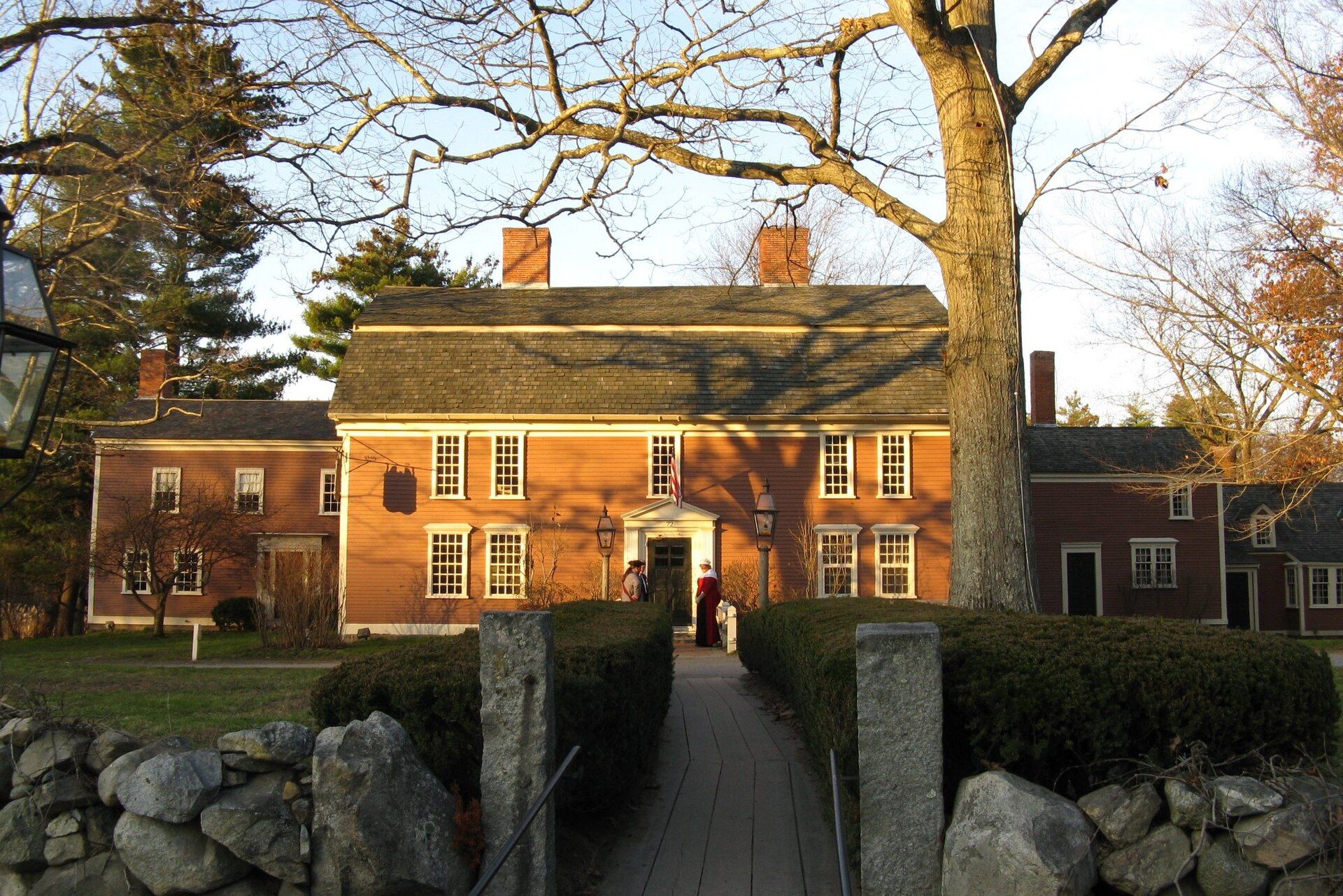
Incorporated in 1639, the boundaries of Sudbury included (by 1653) what is now Wayland (which split off in 1780, initially as East Sudbury), and parts of present day Framingham, Marlborough, Stow and Maynard (the latter town splitting off in 1871). Landmarks include Wayside Inn, Great Meadows National Wildlife Refuge and Bogle-Walker House. Sudbury is the birthplace of Scott Evans, actor.
Every piece is drawn from Sudbury's own map data and historic archives, then printed and shipped from the USA when you order. No two towns look alike.
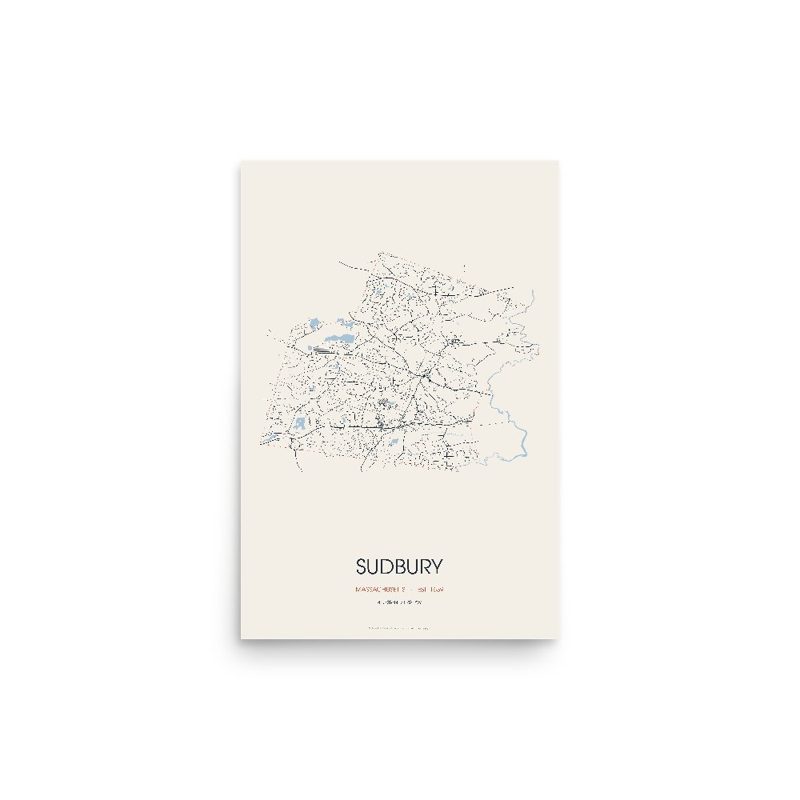
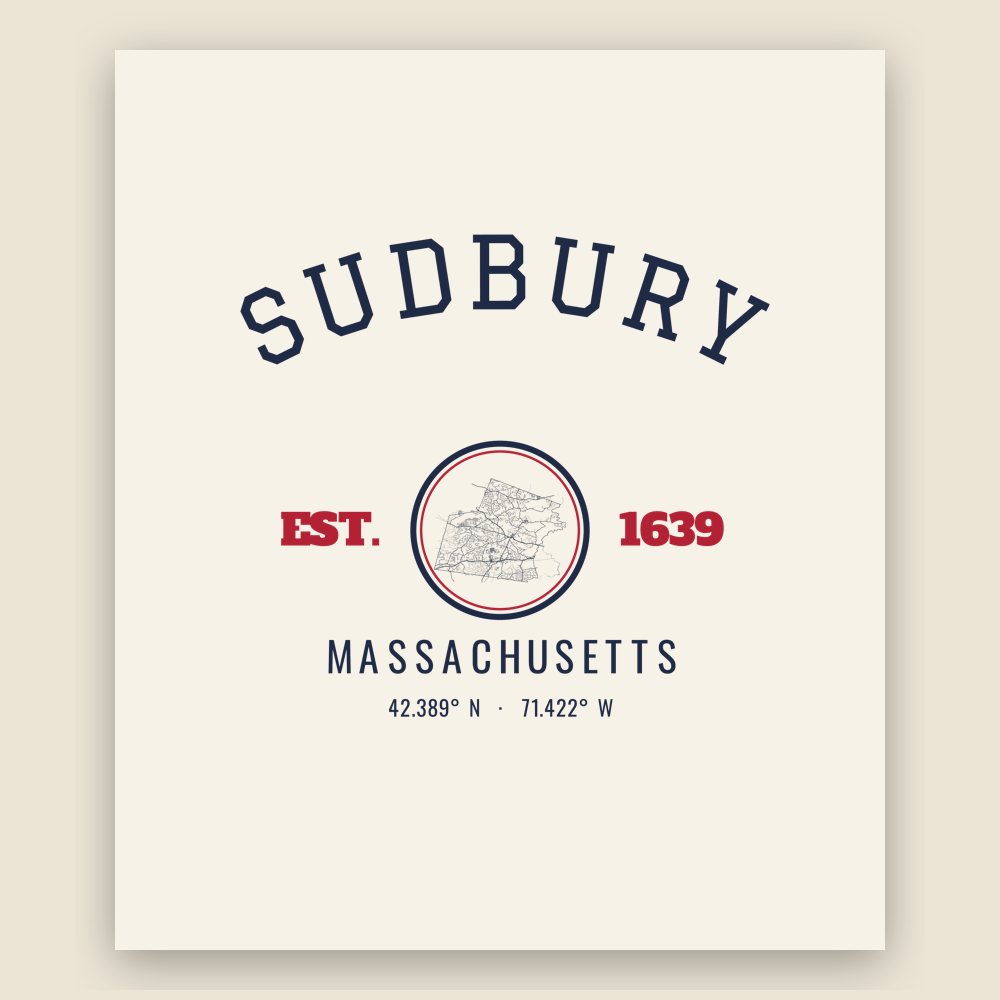
Every road in town, on archival matte paper
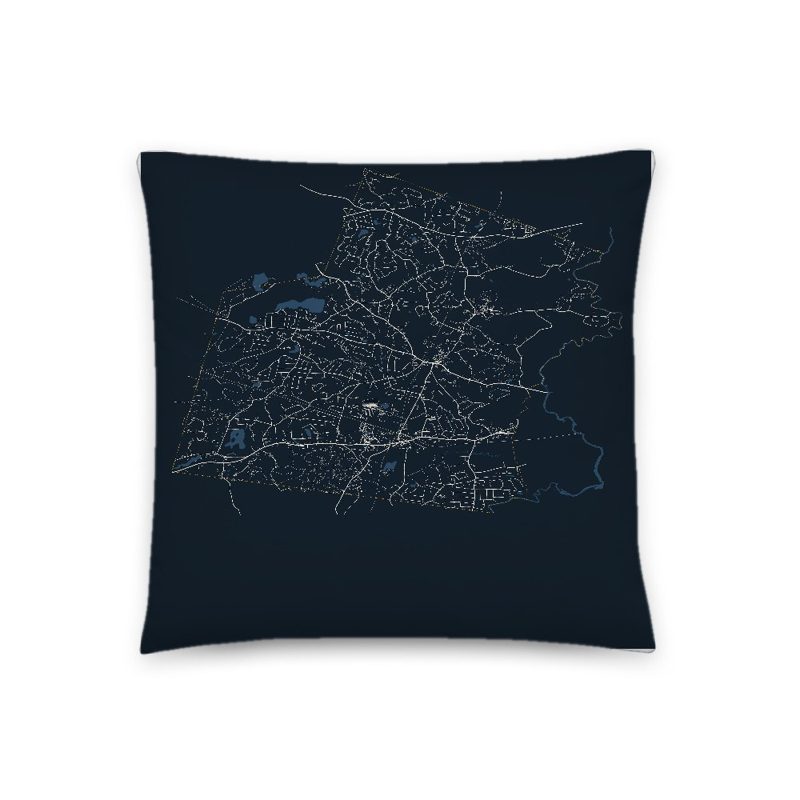
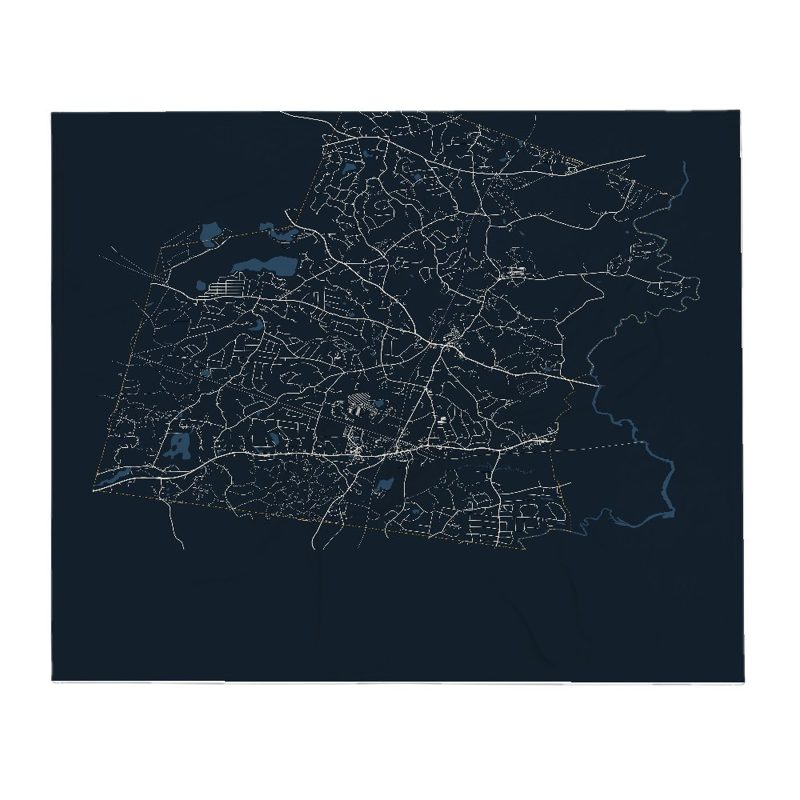
The same map, in navy and silver
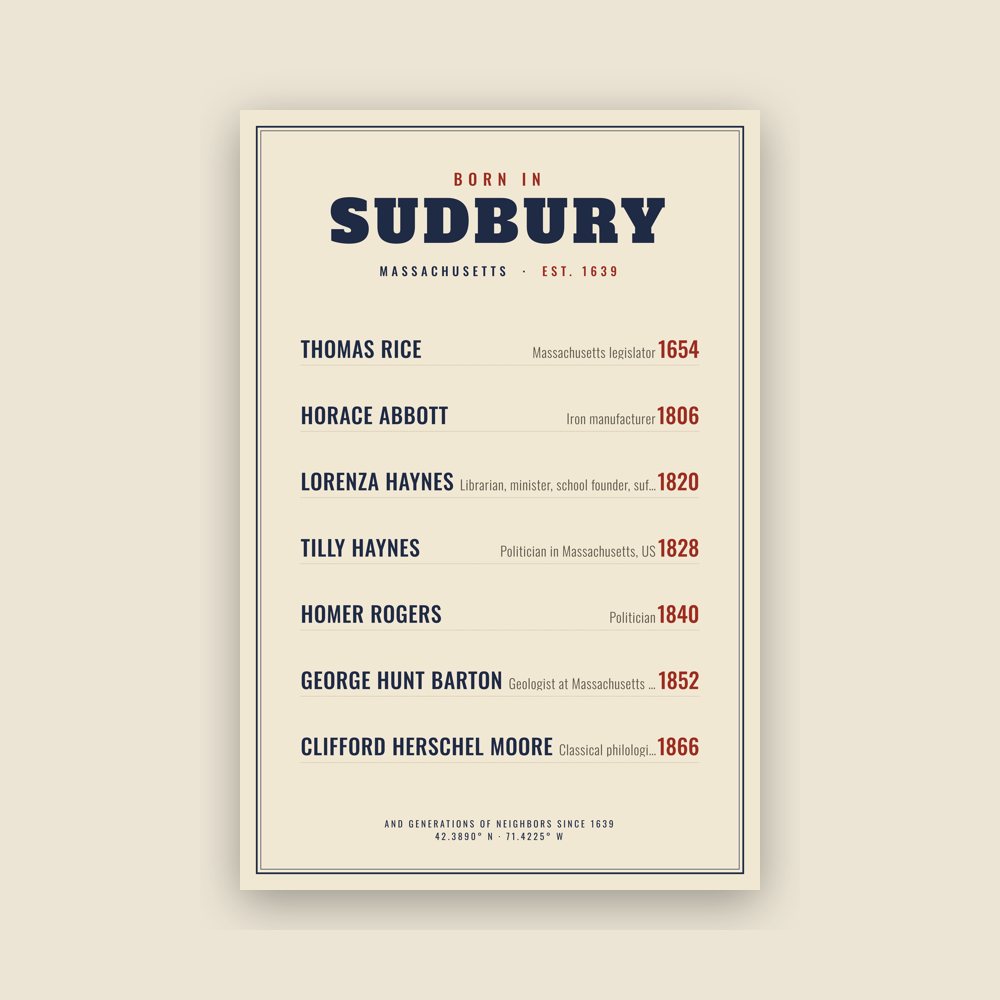
Famous natives, by birth year
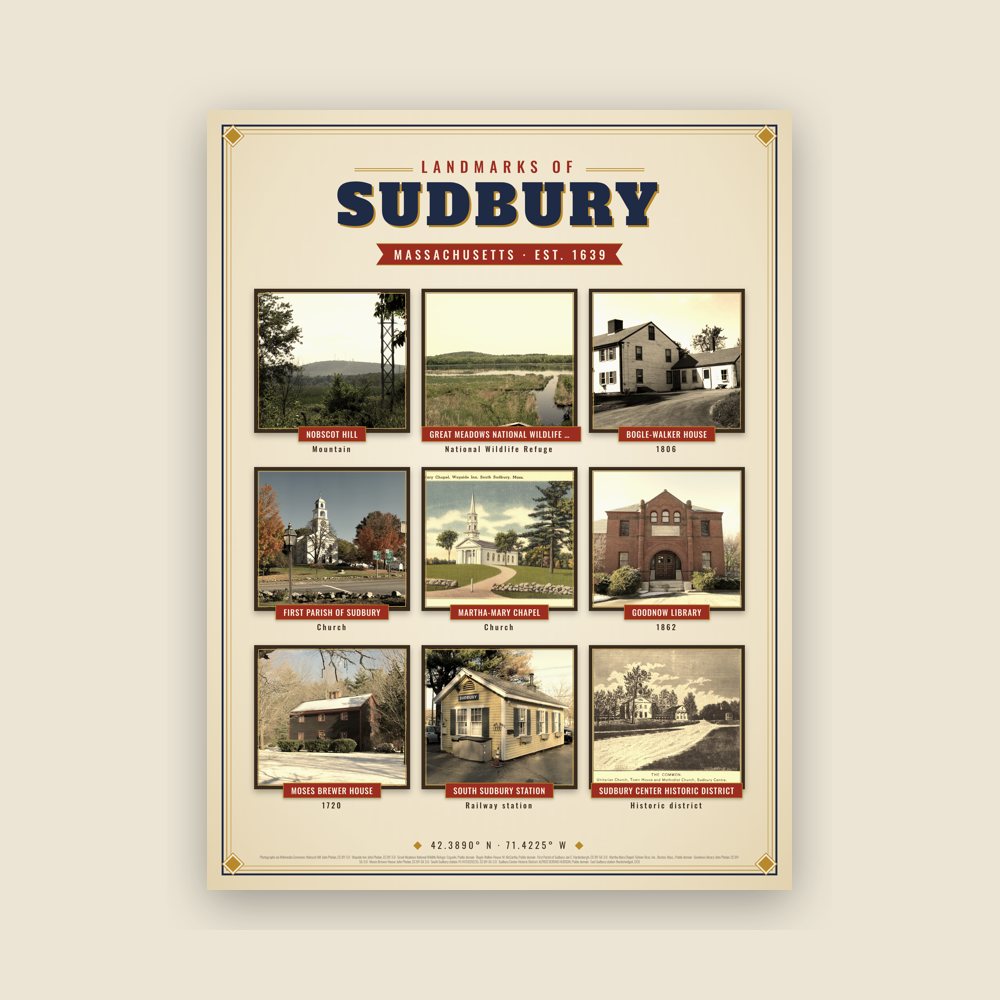
Nine local landmarks, archival matte
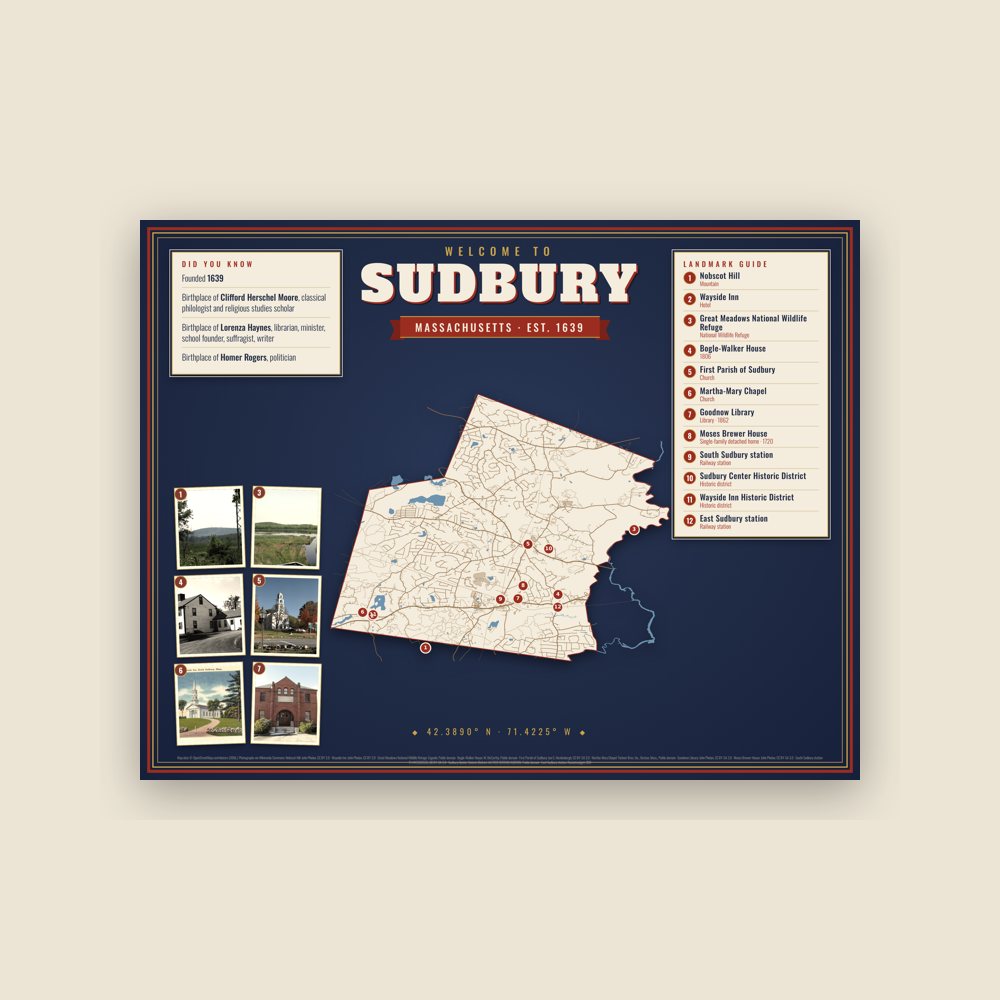
Map of local landmarks, washable fabric
Heavy-blend fleece, street map printed on the back
Soft Bella+Canvas jersey
Glossy ceramic, dishwasher safe
Ceramic keepsake, gold ribbon
Weatherproof, for the front walk
Soft-touch, zip cover
Sturdy all-over-print tote
Glossy top, cork back
Soft fleece, 50″×60″
20 oz, double-wall stainless
Population 2010: 17,653 → 2010: 17,659 → 2020: 18,934
From Wikidata (CC0).
Incorporated in 1639, the boundaries of Sudbury included (by 1653) what is now Wayland (which split off in 1780, initially as East Sudbury), and parts of present day Framingham, Marlborough, Stow and Maynard (the latter town splitting off in 1871). Nipmuc Indians lived in what is now Sudbury, including Tantamous, a medicine man, and his son Peter Jethro, who deeded a large parcel of land to Sudbury for settlement in 1684.
The original town center and meetinghouse were located near the Sudbury River at what is now known as Wayland's North Cemetery. For the residents on the west side of the river, it was a treacherous passage in the winter and attendance at both worship services and Town Meetings was compulsory. In 1723 the West Parish meetinghouse was built west of the river at an area known as Rocky Plains (presently the Town Center). It served as a place for both worship and Town Meetings. The church and town separated in 1836 and a new Town House was built in 1846. Since then, the Sudbury Center Historic District has changed little, with the exception of the Town Hall, built in 1932 to replace the Town House, which burnt down in 1930.
Sudbury also contributed the most militia during King Philip's War and was the site of the well-known attack on Sudbury. Ephraim Curtis was a successful leader of the militia of West Sudbury and would lend his name to the town's junior high school. Sudbury militiamen participated in the battles of Lexington and Concord in 1775, where they sniped at British Army troops returning to Boston.
One of Sudbury's historic landmarks, the Wayside Inn, claims to be the country's oldest operating inn, built and run by the Howe family for many generations. Henry Wadsworth Longfellow wrote Tales of a Wayside Inn, a book of poems published in 1863. In the book, the poem The Landlord's Tale was the source of the immortal phrase "listen my children and you shall hear, of the midnight ride of Paul Revere." Henry Ford bought the inn in 1923, restored it and donated it to a charitable foundation which continues to run it as an operating inn to this day. Ford also built a boys' school on the property, as well as a grist mill, and the Martha-Mary Chapel. He brought in the Redstone Schoolhouse from Sterling, which was reputed to be the school in Sarah Josepha Hale's nursery rhyme Mary Had a Little Lamb. However, Giuseppi Cavicchio's refusal to sell his water rights scuttled Henry Ford's plans to build an auto parts factory at the site of Charles O. Parmenter's mill in South Sudbury.
In August 1925, a Sudbury farm was the scene of a riot between local members of the Ku Klux Klan and Irish-American youths from the area. Five people were wounded by gunshots, and the State Police arrested over 100 Klansmen. Massachusetts officials cracked down on the group's meetings thereafter, and the Klan died out in the area.
In the period after World War II, Sudbury experienced rapid growth in population and industry. Defense contractor Raytheon was a significant employer, operating a large research facility in Sudbury from 1958 until 2016. Another major employer in that period was Sperry Rand. In the 1970s, the town was home to many of the engineers working in the minicomputer revolution at Digital Equipment Corporation in nearby Maynard. Sudbury was also one of the largest carnation-growing towns, with many greenhouse operations.
From 1960–1969, Sudbury challenged and prevailed against a proposal by Boston Edison Company that would have installed overhead transmission lines through what is now Great Meadows National Wildlife Refuge. Ultimately, the line was instead buried under streets to Maynard. From 2017–2023, Sudbury challenged a proposal by Eversource to install buried transmission lines under the former Massachusetts Central Railroad right of way from Sudbury to Hudson now owned by the Massachusetts Bay Transportation Authority. None of these lawsuits were found to have merit, and the buried transmission lines were installed by 2024, which also subsidized the majority of the cost and construction of a 7.6-mile (12.2 km) section of the Mass Central Rail Trail—Wayside, which was paved in 2025.
Residentially, Sudbury's 1-acre (4,000 m2) zoning bylaws helped the town maintain a more rural character through the 1970s and 1980s when developments of single-family Colonials and large Capes established it as an affluent location. Economic growth was restricted to the town's main thoroughfare, US Route 20. Significant tracts of open space—including much wetland—were preserved in the northern half of town and along the Hop Brook corridor flowing from the Wayside Inn Historic District in the southwest part of town through the King Philip Historic District (the site of a conflict in King Philip's War) and into the Sudbury River at the southeast border with Wayland. A significant portion of the Assabet River National Wildlife Refuge (opened in 2005) is located in Sudbury.
Adapted (trimmed) from the Wikipedia article Sudbury, Massachusetts, revision 1374938809 by its contributors, licensed CC BY-SA 4.0.
We share a part of every Sudbury sale with local partners, and we'd love to print from your collection. Old photographs, maps and postcards make the best keepsakes.
Partner with us