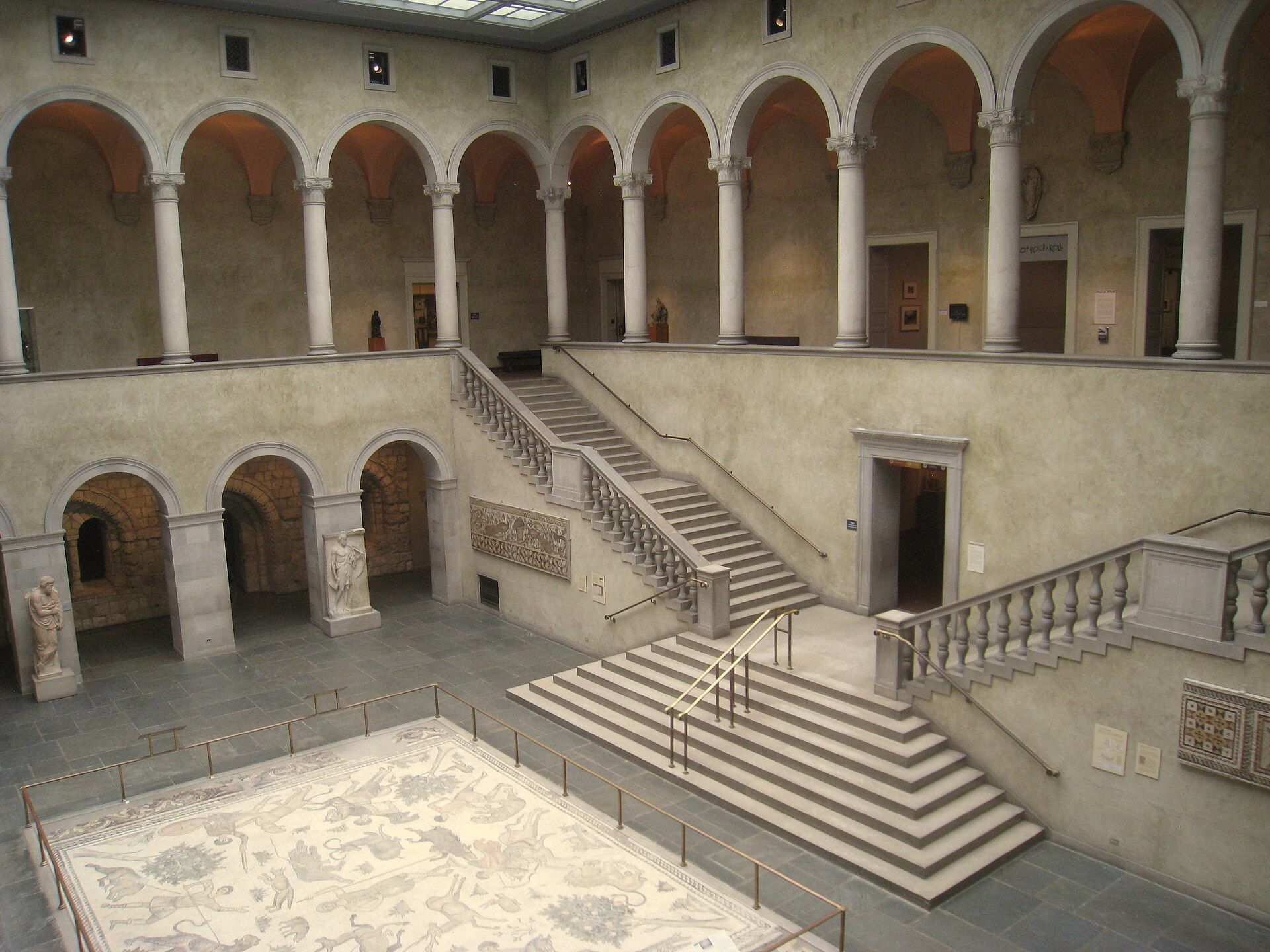
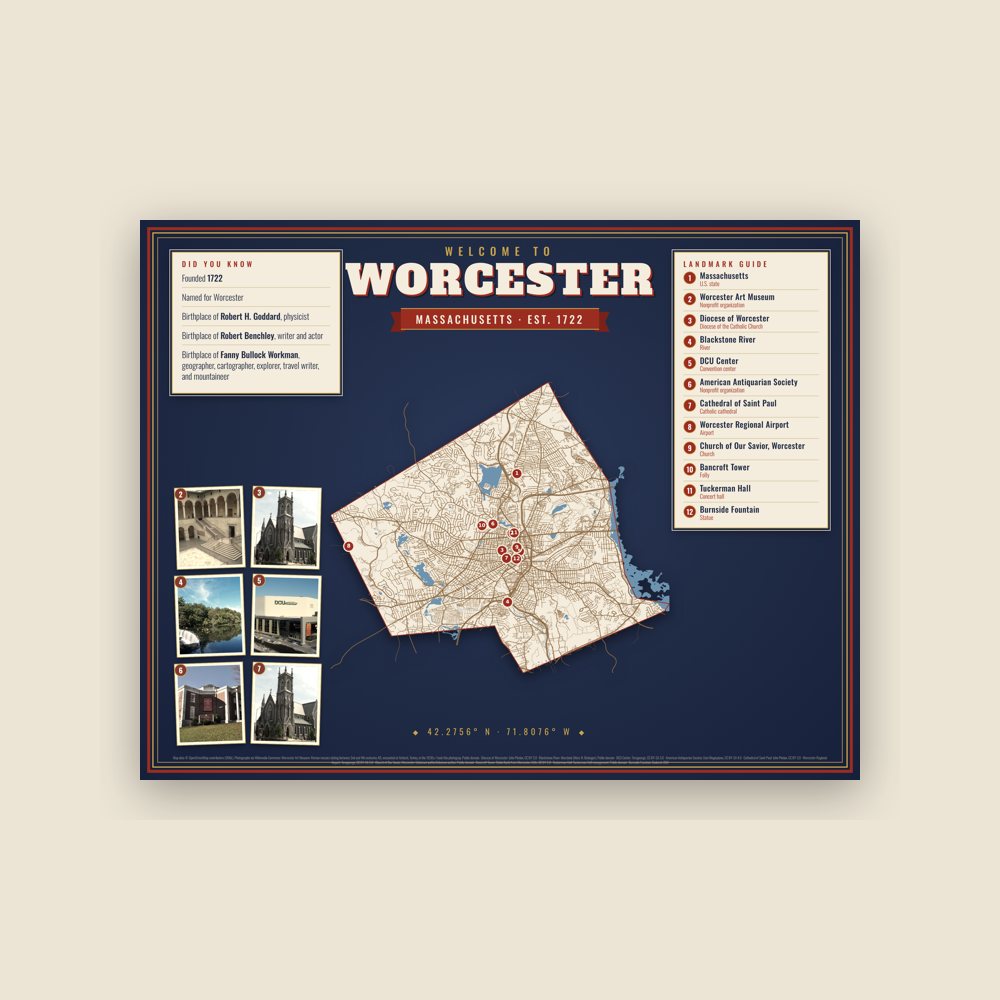
The principal city of Central Massachusetts, Worcester is both the second-most populous city in the state, and the 113th most populous city in the United States. Landmarks include Massachusetts, Worcester Art Museum and Diocese of Worcester. Worcester is the birthplace of Robert H. Goddard, physicist.
Every piece is drawn from Worcester's own map data and historic archives, then printed and shipped from the USA when you order. No two towns look alike.
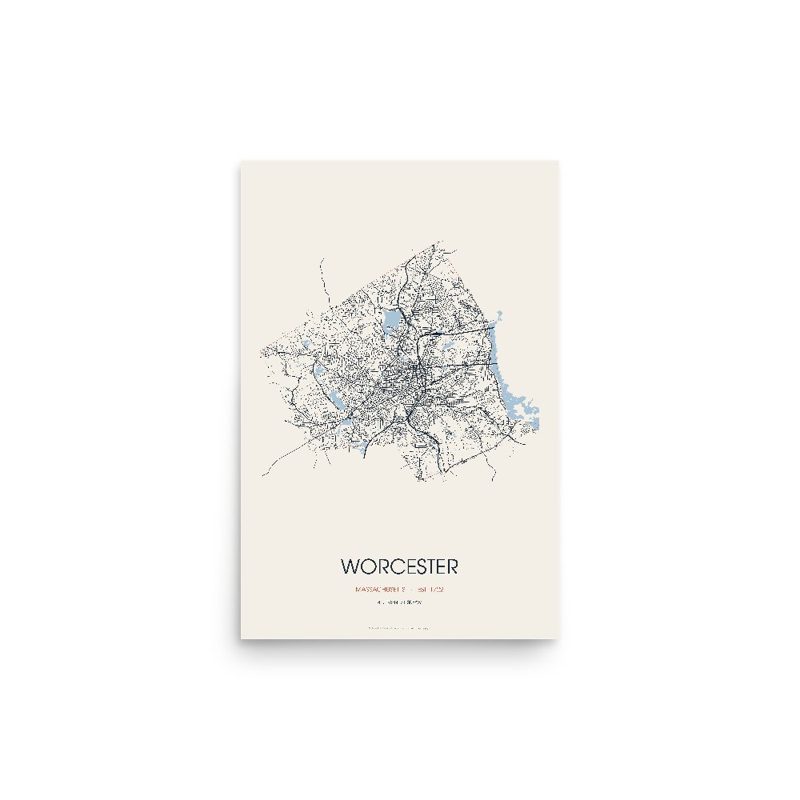
Every road in town, on archival matte paper
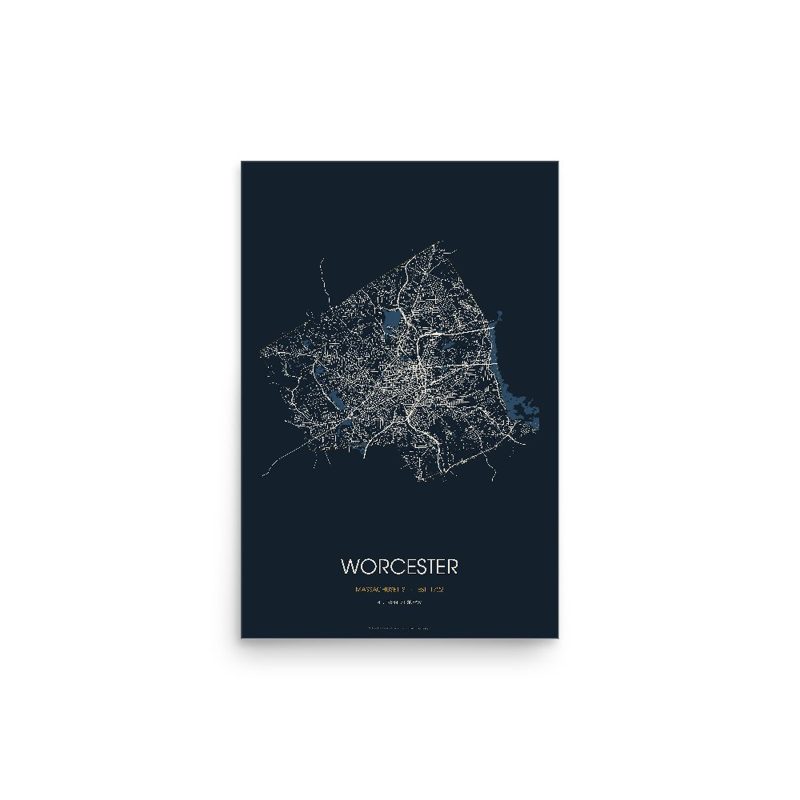
The same map, in navy and silver
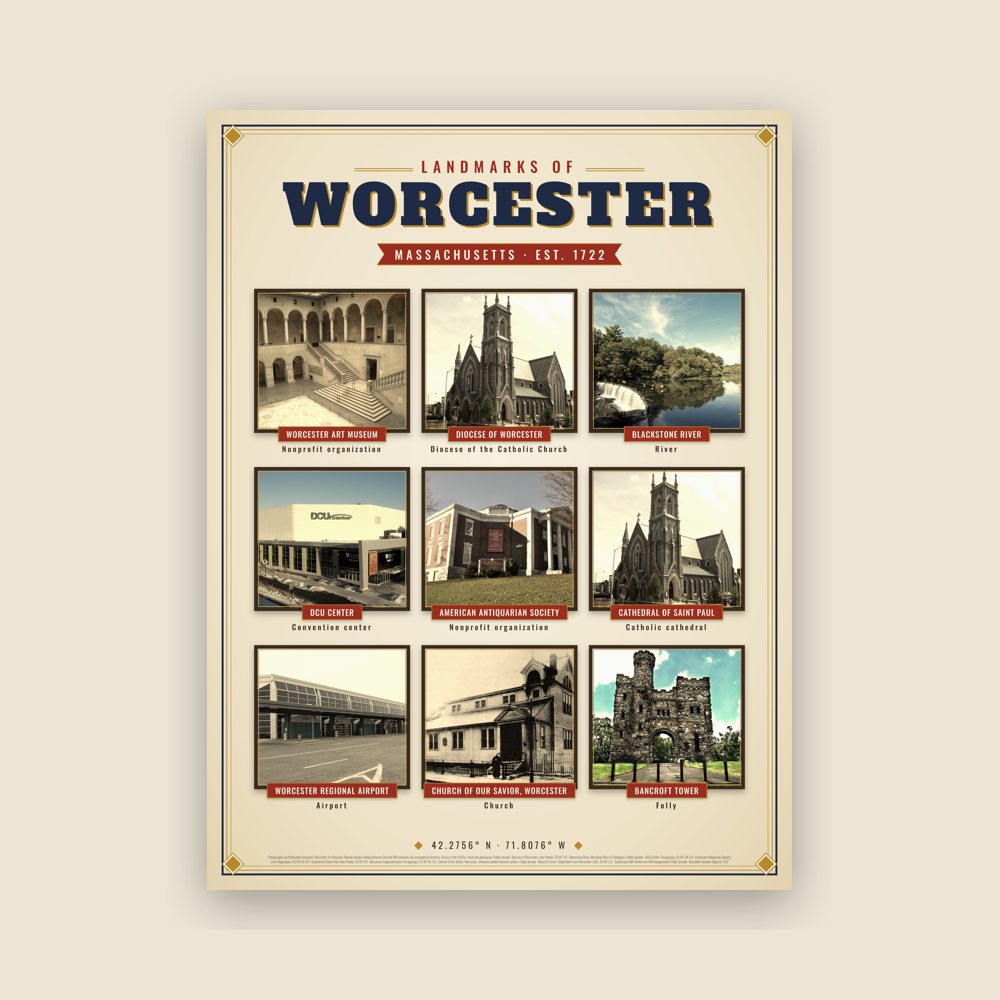
Nine local landmarks, archival matte
Map of local landmarks, washable fabric
Heavy-blend fleece, street map printed on the back
Soft Bella+Canvas jersey
Glossy ceramic, dishwasher safe
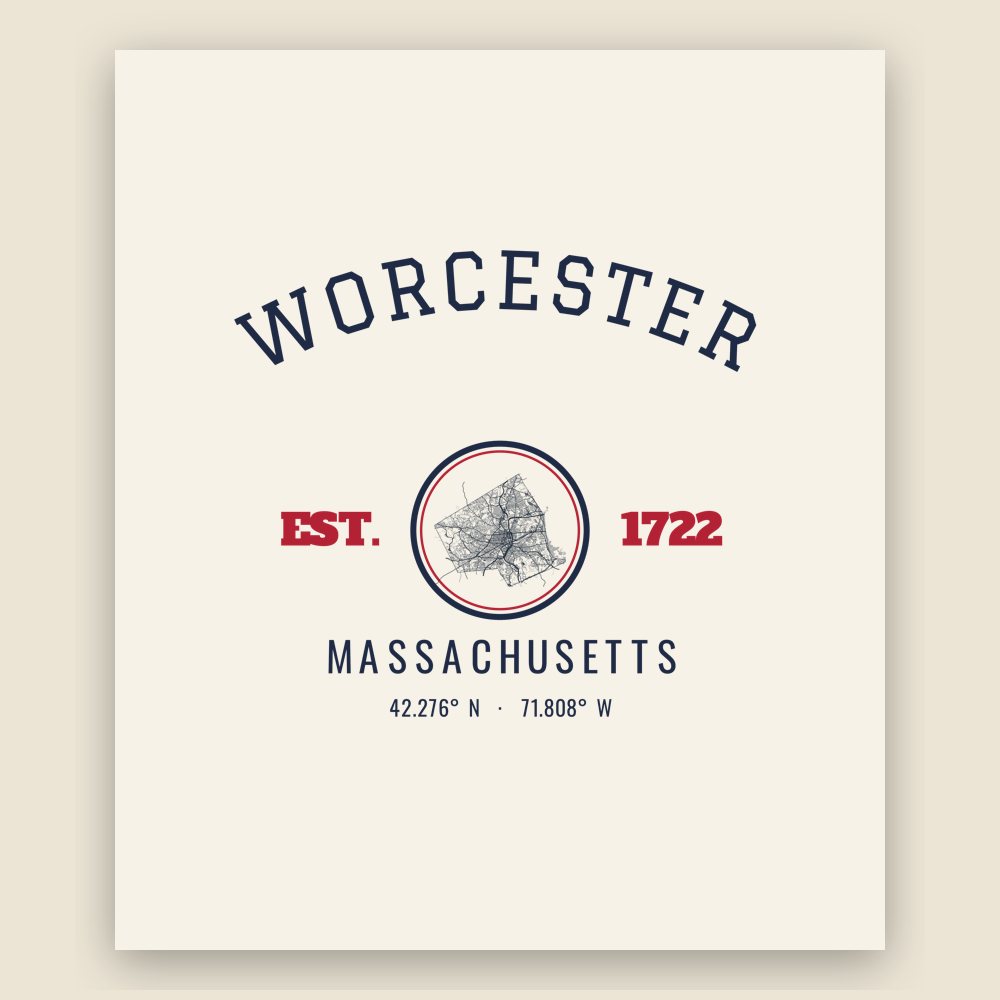
Ceramic keepsake, gold ribbon
Weatherproof, for the front walk
24″×16″, printed coir-look fibers, rubber back
12″×12″ printed wood, ready to hang
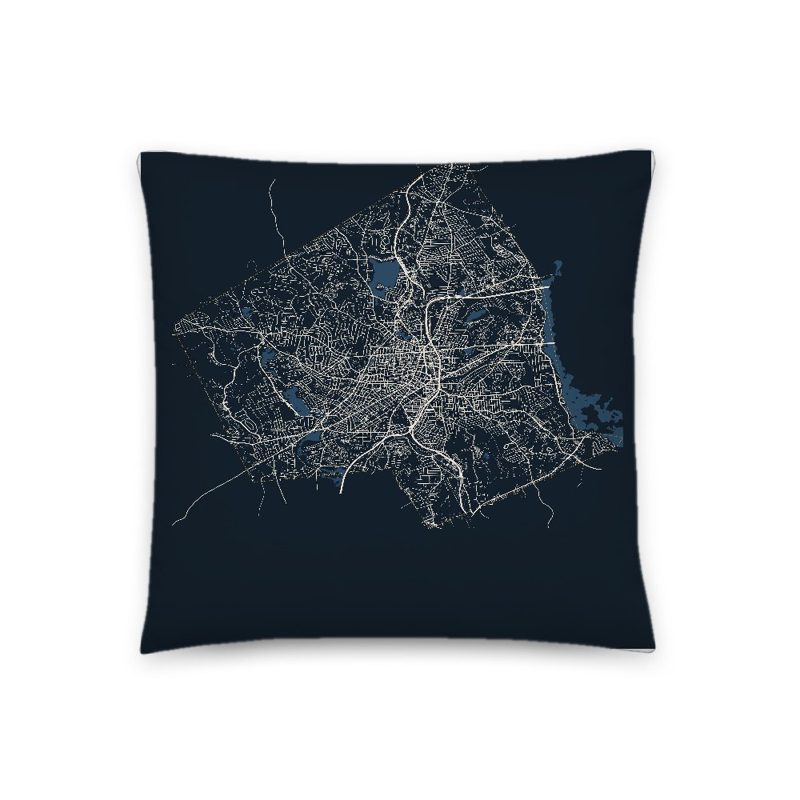
Soft-touch, zip cover
Sturdy all-over-print tote
Glossy top, cork back
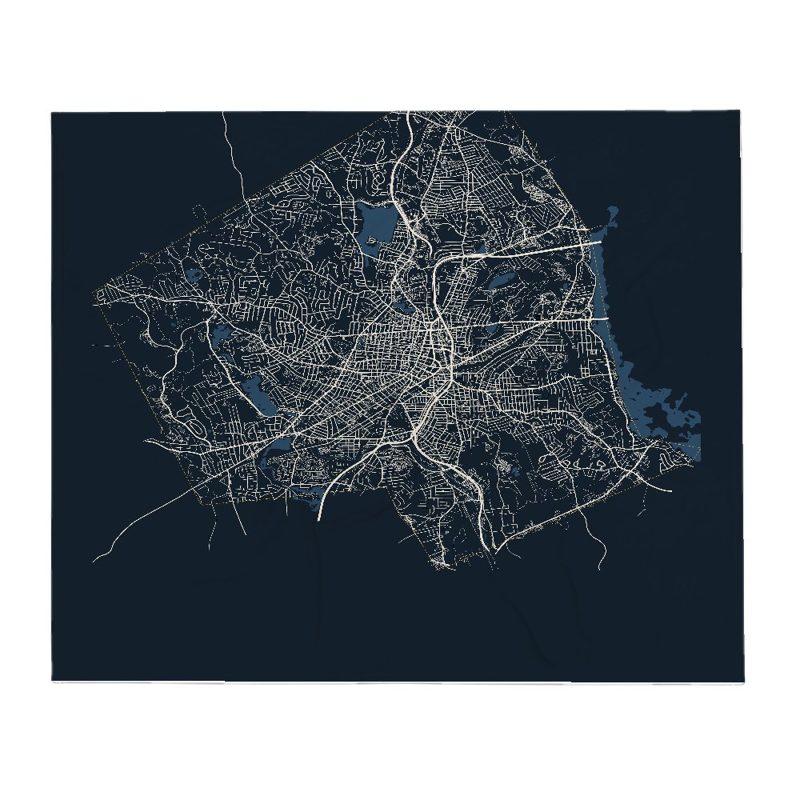
Soft fleece, 50″×60″
20 oz, double-wall stainless
Named for Worcester (city and the county town of Worcestershire, England).
Population 2010: 181,045 → 2014: 183,016 → 2020: 206,518
From Wikidata (CC0).
The area was inhabited by members of the Nipmuc tribe at the time of European contact. The native people called the region Quinsigamond and built a settlement on Pakachoag Hill in Auburn.
In 1673, English settlers John Eliot and Daniel Gookin led an expedition to Quinsigamond to establish a new Christian Indian praying town and identify a new location for an English settlement. On July 13, 1674, Gookin obtained a deed to eight square miles (21 km2) of land in Quinsigamond from the Nipmuc people and English traders and settlers began to inhabit the region.
In 1675, King Philip's War broke out throughout New England with the Nipmuc Indians coming to the aid of Indian leader King Philip. The English settlers completely abandoned the Quinsigamond area and the empty buildings were burned by the Indian forces. The town was again abandoned during Queen Anne's War in 1702.
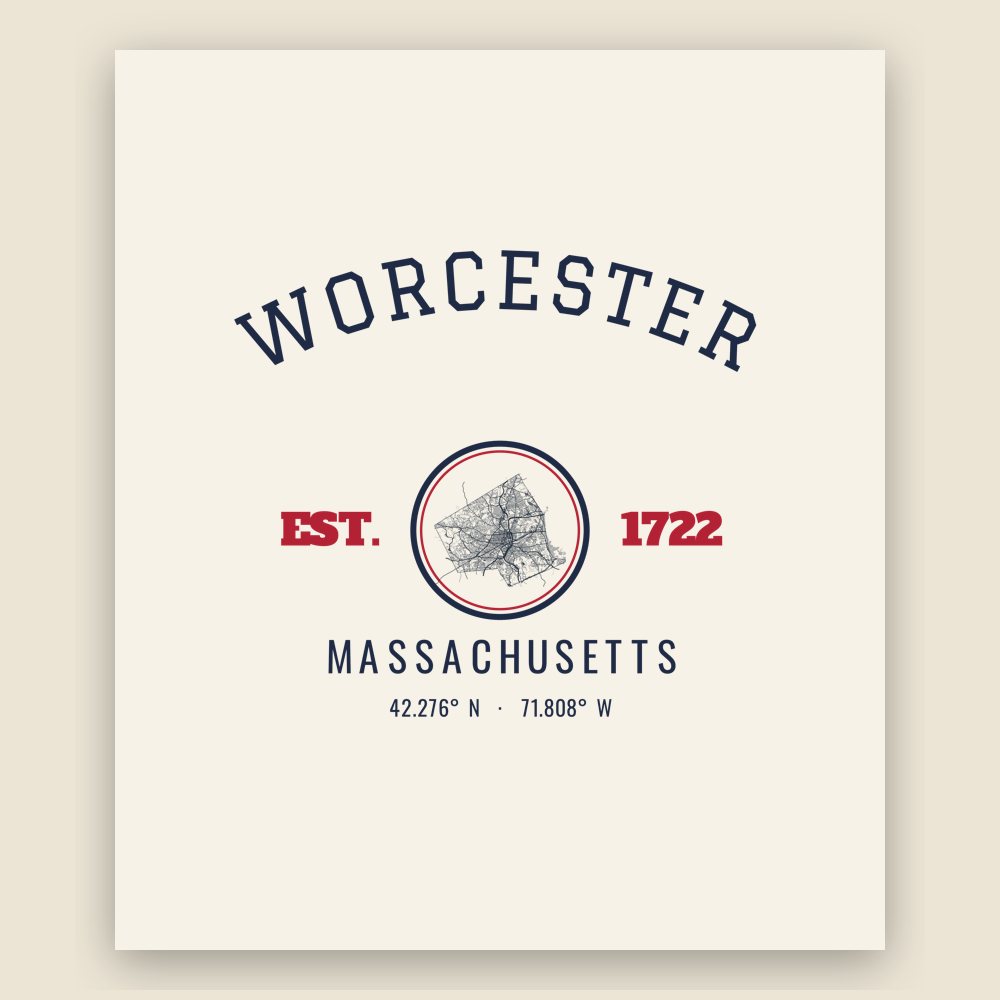
In 1713, Worcester was permanently resettled for a third and final time by Jonas Rice. Named after the city of Worcester, England, the town was incorporated on June 14, 1722.
On April 2, 1731, Worcester was chosen as the county seat of the newly founded Worcester County government. Between 1755 and 1758, future U.S. president John Adams worked as a schoolteacher and studied law in Worcester.
Worcester also had a role in the start of the American Revolution. On September 6, 1774, 4,622 militiamen from 37 towns in Worcester County assembled and marched on Main Street, Worcester; they sought to shut down the Crown's court before it could sit for a new session. The event was dubbed the Worcester Revolution, or the Worcester Revolt. Having seized the courthouse, the militiamen waited for the 25 appointees from the Crown to arrive, where they were denied entry and later forced to disavow their appointments by King George III. Bloodshed and violence was avoided, with no shots fired. British authority had been demonstrably overthrown in the American colonies for the first time.
In the 1770s, Worcester became a center of American revolutionary activity. The Worcester Revolt on September 6, 1774, was an early successful attempt to throw off British rule. British General Thomas Gage was given information of patriot ammunition stockpiled in Worcester in 1775. That same year, Massachusetts Spy publisher Isaiah Thomas moved his radical newspaper out of British occupied Boston to Worcester. Thomas would continuously publish his paper throughout the American Revolutionary War. On July 14, 1776, Thomas performed the first public reading in Massachusetts of the Declaration of Independence from the porch of the Old South Church, where the 19th-century Worcester City Hall stands today. He would later go on to form the American Antiquarian Society in Worcester in 1812. During the years leading up to and through the American Revolution, Worcester was an important inland center of Patriot activity and organization. In 1755–1758, future U.S. president John Adams worked as a schoolteacher in Worcester while studying law, an experience that helped shape his later views on education and self-government.
By the early 1770s, Worcester's location on the main route between Boston and western Massachusetts made it a hub for revolutionary communication and militia mobilization. In September 1774, local Patriots forced royal officials to resign and closed the county courts, effectively ending British authority in Worcester County months before the battles of Lexington and Concord.
According to local tradition, John Hancock briefly took refuge in Worcester in 1774–1775 as tensions escalated in Boston. In the winter of 1775–1776, General Henry Knox's famous "noble train of artillery" passed through Worcester while transporting captured cannon from Fort Ticonderoga to Boston, stopping for supplies and repairs on its way to aid the siege of the city.
Worcester continued to commemorate its Revolutionary heritage in the decades that followed. When the Marquis de Lafayette made his triumphal tour of the United States in 1824, he was greeted with great ceremony in Worcester by local citizens and surviving veterans of the Revolution.
Throughout the conflict, Worcester's residents contributed soldiers, supplies, and civic leadership to the Patriot cause, leaving a lasting legacy reflected in the city's Revolutionary monuments and archives.
During the turn of the 19th century, Worcester's economy moved into manufacturing. Factories producing textiles, shoes and clothing opened along the nearby Blackstone River.
The manufacturing industry in Worcester began to thrive with the opening of the Blackstone Canal in 1828 and the opening of the Worcester and Boston Railroad in 1835. The city transformed into a transportation hub and the manufacturing industry flourished.
Worcester was officially chartered as a city on February 29, 1848. The city's industries soon attracted immigrants of primarily Irish, Scottish, French, German, and Swedish descent in the mid-19th century and later many immigrants of Lithuanian, Polish, Italian, Greek, Turkish, Armenian, Syrian, and Lebanese descent. Immigrants moved into new three-decker houses (which originated in Worcester) lining hundreds of Worcester's expanding streets and neighborhoods.
In 1831, Ichabod Washburn opened the Washburn & Moen Company. The company would become the largest wire manufacturing in the country and Washburn became one of the leading industrial and philanthropic figures in the city.
Worcester became a center of machinery, wire products and power looms with large manufacturers, including Washburn & Moen, Wyman-Gordon Company, American Steel & Wire, Morgan Construction and the Norton Company. In 1908, the Royal Worcester Corset Company was the largest employer of women in the United States.
New England Candlepin bowling was invented in Worcester by Justin White in 1879. Esther Howland began the first line of Valentine's Day cards from her Worcester home in 1847. Loring Coes invented the first monkey wrench and Russell Hawes created the first envelope folding machine. On June 12, 1880, Lee Richmond pitched the first perfect game in Major league baseball history for the Worcester Ruby Legs at the Worcester Agricultural Fairgrounds. The first three-decker homes were built by Francis Gallagher (1830–1911) in Worcester.
After World War II, Worcester began to fall into decline as the city lost its manufacturing base. Worcester felt the national trends of movement away from historic urban centers. The city's population dropped over 20% from 1950 to 1980. In the mid-20th century, large urban renewal projects were undertaken to try to reverse the city's decline. A huge area of downtown Worcester was demolished for new office towers and the 1,000,000 sq ft (93,000 m2) Worcester Center Galleria shopping mall. After 30 years, the Galleria would lose most of its major tenants and its appeal to more suburban shopping malls around Worcester County.
On June 9, 1953, an F4 tornado touched down in Petersham, northwest of Worcester. The tornado tore through 48 miles (77 km) of Worcester County including a large area of the city of Worcester. The tornado left massive destruction and killed 94 people. The Worcester tornado would be the deadliest tornado ever to hit Massachusetts, and New England in general. Debris from the tornado landed as far away as Dedham.
In the 1960s, Interstate 290 was built right through the center of Worcester, permanently dividing the city. In 1963, Worcester native Harvey Ball introduced the yellow smiley face to American culture.
In the late 20th century, Worcester's economy began to recover as the city expanded into biotechnology and healthcare fields. The UMass Chan Medical School became a leader in biomedical research and the Massachusetts Biotechnology Research Park became a center of medical research and development. Worcester hospitals Saint Vincent Hospital and UMass Memorial Health Care are two of the largest employers in the city. Worcester's many colleges, including the Quinsigamond Community College, College of the Holy Cross, Worcester Polytechnic Institute, Clark University, UMass Medical School, Assumption University, Massachusetts College of Pharmacy and Health Sciences, and Worcester State University, attract many students to the area and help drive the new economy.
In recent decades, a renewed interest in the city's downtown has brought new investment and construction to Worcester. A Convention Center was built along the DCU Center arena in downtown Worcester in 1997. On December 3, 1999, a homeless couple accidentally started a five-alarm fire at the Worcester Cold Storage & Warehouse Company. The fire took the lives of six firemen and drew national attention as one of the worst firefighting tragedies of the late 20th century. President Bill Clinton, Vice President Al Gore and other local and national dignitaries attended the funeral service and memorial program in Worcester.
In 2000, Worcester's Union Station reopened after 25 years and a $32 million renovation. Hanover Insurance helped fund a multimillion-dollar renovation to the old Franklin Square Theater into the Hanover Theatre for the Performing Arts. In 2000, the Massachusetts College of Pharmacy and Health Sciences built a new campus in downtown Worcester. In 2007, Worcester Polytechnic Institute opened the first facility in their Gateway Park center in Lincoln Square. In 2004, Berkeley Investments proposed demolishing the old Worcester Center Galleria for a new mixed-used development called City Square. The ambitious project looked to reconnect old street patterns while creating a new retail, commercial and living destination in the city. After struggling to secure finances for a number of years, Hanover Insurance took over the project and demolition began on September 13, 2010. Unum Insurance and the Saint Vincent Hospital leased into the project and both facilities opened in 2013. The new Front Street opened on December 31, 2012.
The city has successfully resettled over 2,000 refugees coming from over 24 countries. Most of these refugees come from the Democratic Republic of the Congo, Iraq, Somalia, Bhutan, Syria, Ukraine and Afghanistan.
Adapted (trimmed) from the Wikipedia article Worcester, Massachusetts, revision 1379632350 by its contributors, licensed CC BY-SA 4.0.
We share a part of every Worcester sale with local partners, and we'd love to print from your collection. Old photographs, maps and postcards make the best keepsakes.
Partner with us