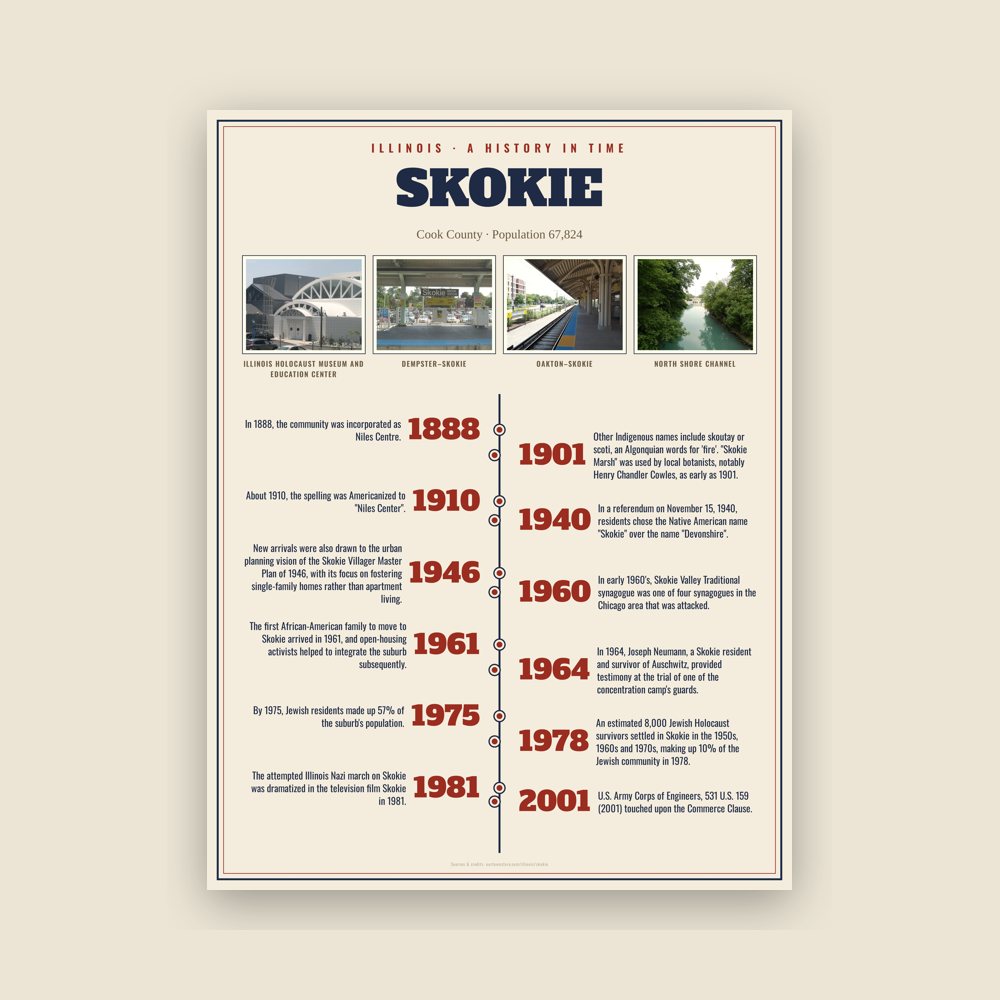
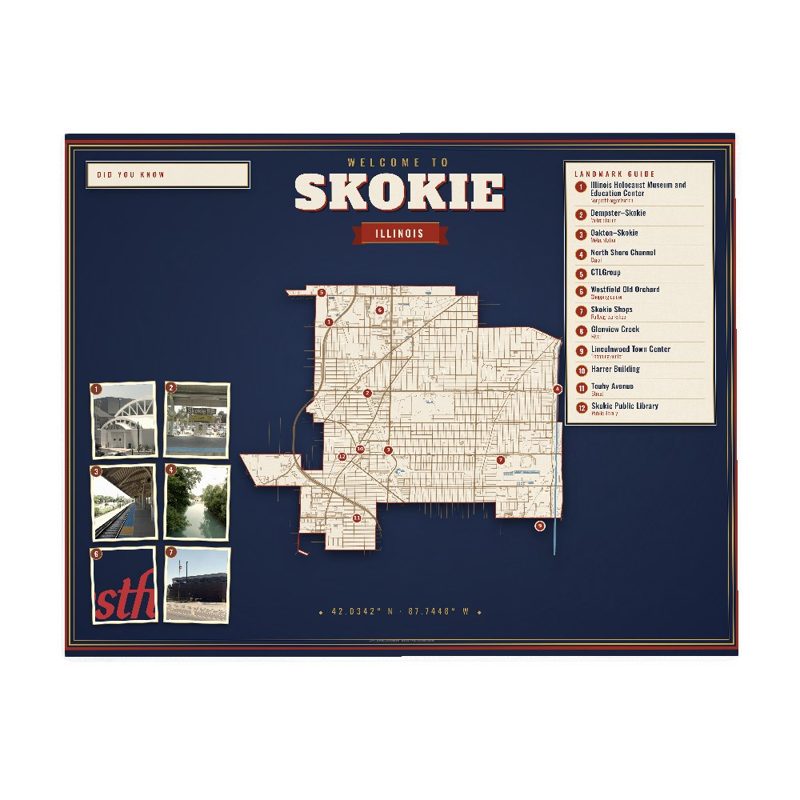
In 1888, the community was incorporated as Niles Centre. About 1910, the spelling was Americanized to "Niles Center". However, the name caused postal confusion with the neighboring village of Niles. A village-renaming campaign began in the 1930s. In a referendum on November 15, 1940, residents chose the Native American name "Skokie" over the name "Devonshire".
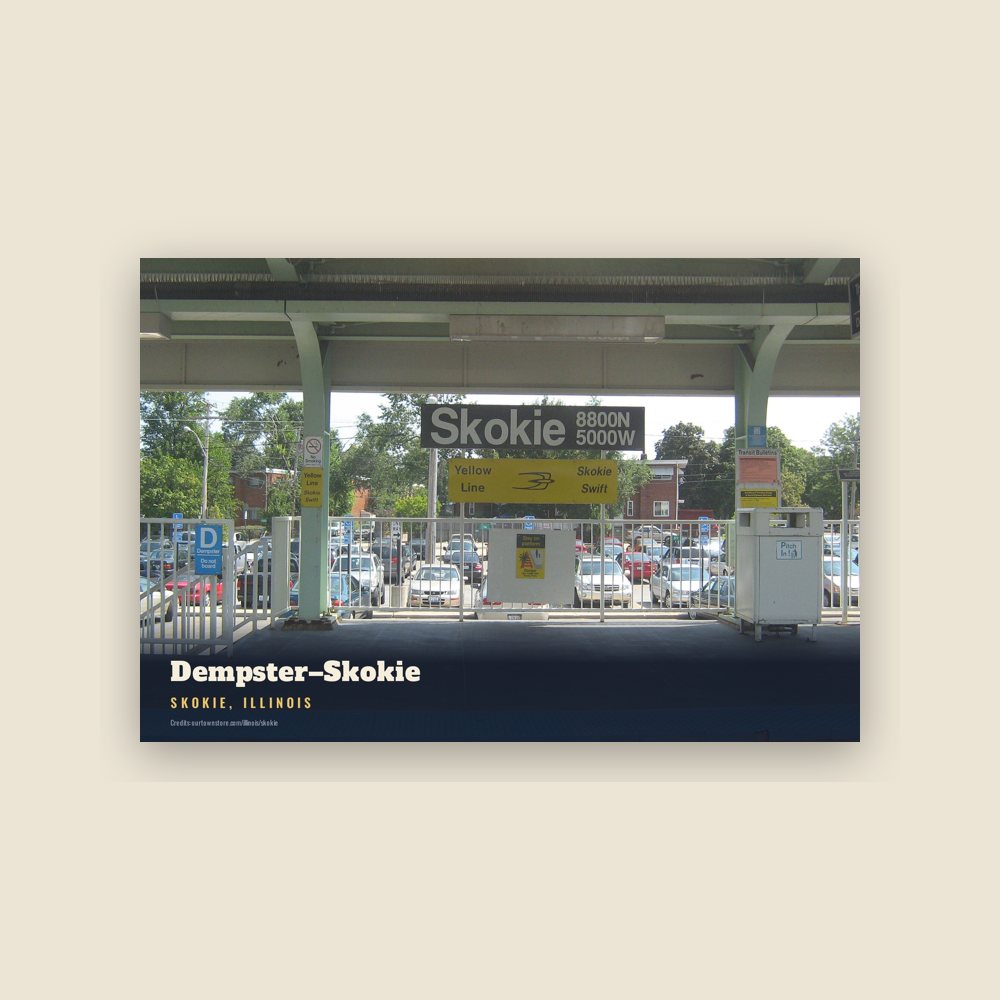
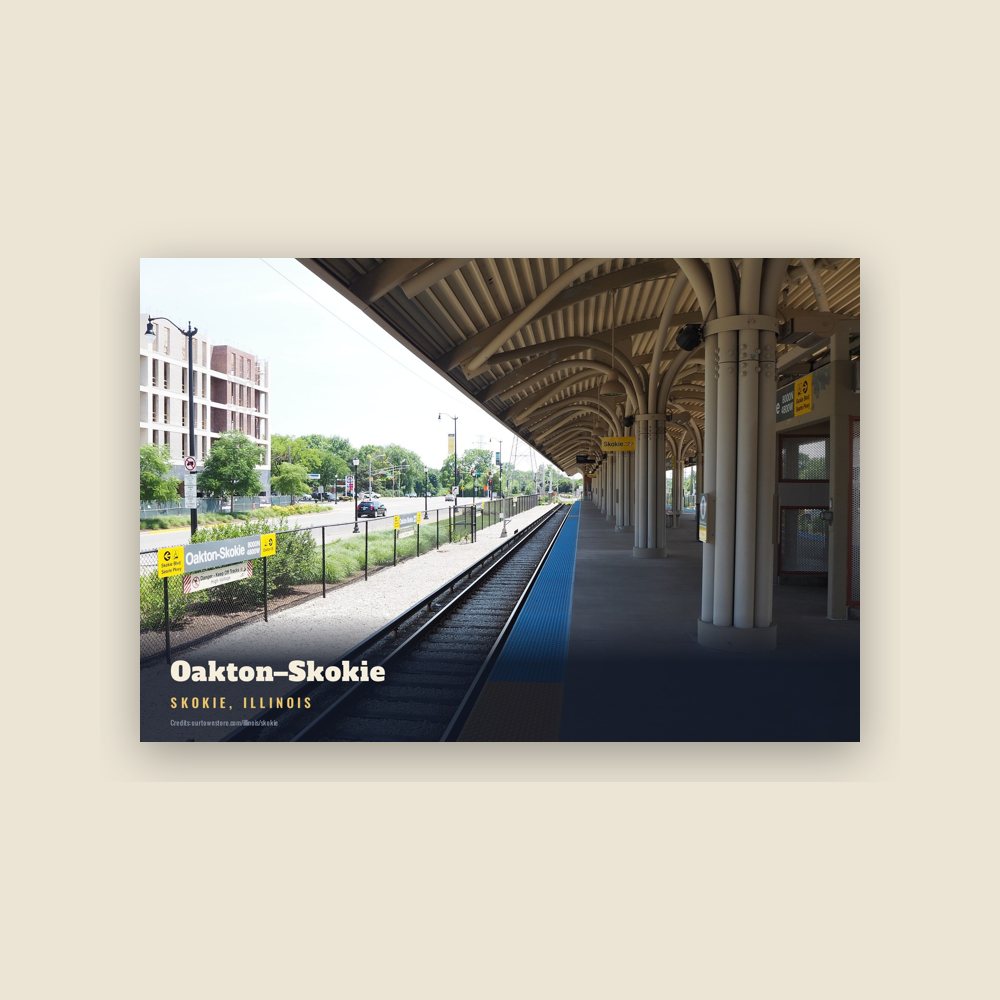
During the real estate boom of the 1920s, large parcels were subdivided; many two- and three-flat apartment buildings were built, with the "Chicago"-style bungalow a dominant architectural specimen. This coincided with train line service reaching the town beginning on March 28, 1925. Large-scale development ended as a result of the Great Crash of 1929 and consequent Great Depression. It was not until the 1940s and the 1950s, when parents of the baby boom generation moved their families out of Chicago, that Skokie's housing development began again. Consequently, the village developed commercially, an example being the Old Orchard Shopping Center, currently named Westfield Old Orchard.
During the night of November 27–28, 1934, after a gunfight in nearby Barrington that left two FBI agents dead, two accomplices of notorious 25-year-old bank-robber Baby Face Nelson (Lester Gillis) dumped his bullet-riddled body in a ditch along Niles Center Road adjoining the St. Peter Catholic Cemetery, a block north of Oakton Street in the town.
The first African-American family to move to Skokie arrived in 1961, and open-housing activists helped to integrate the suburb subsequently.
Read the full history
Name
Historic maps named the Skokie marsh as Chewab Skokie, a probable derivation from Kitchi-wap choku, a Potawatomi term meaning 'great marsh'. Other Indigenous names include skoutay or scoti, an Algonquian words for 'fire'. "Skokie Marsh" was used by local botanists, notably Henry Chandler Cowles, as early as 1901. The village name was changed from "Niles Center" to "Skokie" by referendum in 1940. The name change may also have been influenced by James Foster Porter, a Chicago resident, who had explored the "Skoki Valley" in Banff National Park in Canada in 1911 and admired the name; Porter supported the name "Skokie" in the referendum.
Jewish community
Skokie attracted Jewish residents as newcomers did not face the same level of hostility as they did in some other Chicago suburbs, where it wasn't supported to sell property to Jewish institutions. In the post-World War II real-estate developers and builders that were often Jewish themselves, advertised Skokie in the older, urban Jewish neighborhoods in the South, West and North Sides of Chicago. New arrivals were also drawn to the urban planning vision of the Skokie Villager Master Plan of 1946, with its focus on fostering single-family homes rather than apartment living. By 1975, Jewish residents made up 57% of the suburb's population.
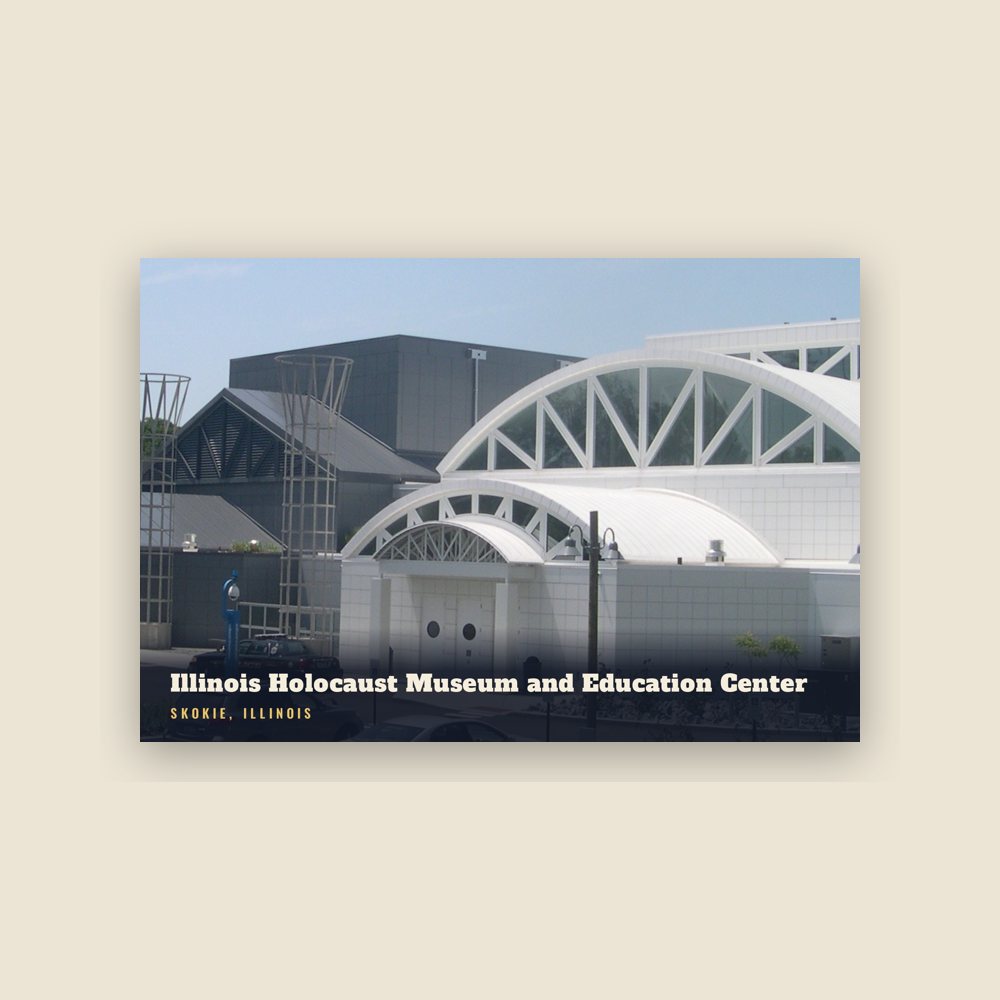
An estimated 8,000 Jewish Holocaust survivors settled in Skokie in the 1950s, 1960s and 1970s, making up 10% of the Jewish community in 1978. Yiddish was widely spoken and the area developed a Jewish character with synagogues, Hebrew Schools, Jewish delis, kosher butchers, Israeli bakeries and Judaica stores. Survivors mostly socialized among each other.
In 1964, Joseph Neumann, a Skokie resident and survivor of Auschwitz, provided testimony at the trial of one of the concentration camp's guards.
In early 1960's, Skokie Valley Traditional synagogue was one of four synagogues in the Chicago area that was attacked. The synagogue, now known as Skokie Valley Agudath Jacob Synagogue, has become the largest Orthodox Jewish congregation in Chicago.
Supreme Court rulings
Twice in its history, Skokie has been the focal point of cases before the United States Supreme Court. National Socialist Party of America v. Village of Skokie, 432 U.S. 43 (1977), involved a First Amendment issue. Solid Waste Agency of Northern Cook County (SWANCC) v. U.S. Army Corps of Engineers, 531 U.S. 159 (2001) touched upon the Commerce Clause.
National Socialist Party of America v. Village of Skokie
In 1977 and 1978, Illinois neo-Nazis of the National Socialist Party of America (NSPA) attempted to hold a march in Skokie, far from their headquarters on Chicago's south side. Originally, the neo-Nazis had planned a political rally in Marquette Park in Chicago. The park is located in what was then a predominantly all-white neighborhood, similar to the situation in 1966, when a crowd of 4,000 Marquette Park residents gathered to watch Martin Luther King Jr. lead a march, some waving Confederate flags or throwing bottles, bricks and rocks at the protesters; King was knocked to his knees when struck by a rock. However, the Chicago authorities thwarted the NSPA's plans.
Seeking another free-speech political venue, the NSPA group chose to march on Skokie. Given the many Holocaust survivors living in Skokie, the village's government thought the Nazi march would be disruptive, and refused the NSPA permission to hold the event. The NSPA appealed that decision, and the American Civil Liberties Union interceded on their behalf, in National Socialist Party of America v. Village of Skokie. An Illinois appeals court raised the injunction issued by a Cook County Circuit Court judge, ruling that the presence of the swastika, the Nazi emblem, would constitute deliberate provocation of the people of Skokie. However, the Court also ruled that Skokie's attorneys had failed to prove that either the Nazi uniform or their printed materials, which it was alleged that the Nazis intended to distribute, would incite violence.
Moreover, because Chicago subsequently lifted its Marquette Park political demonstration ban, the NSPA ultimately held its rally in Chicago. The attempted Illinois Nazi march on Skokie was dramatized in the television film Skokie in 1981. It was satirized in the film The Blues Brothers in 1980.
Migratory bird rule
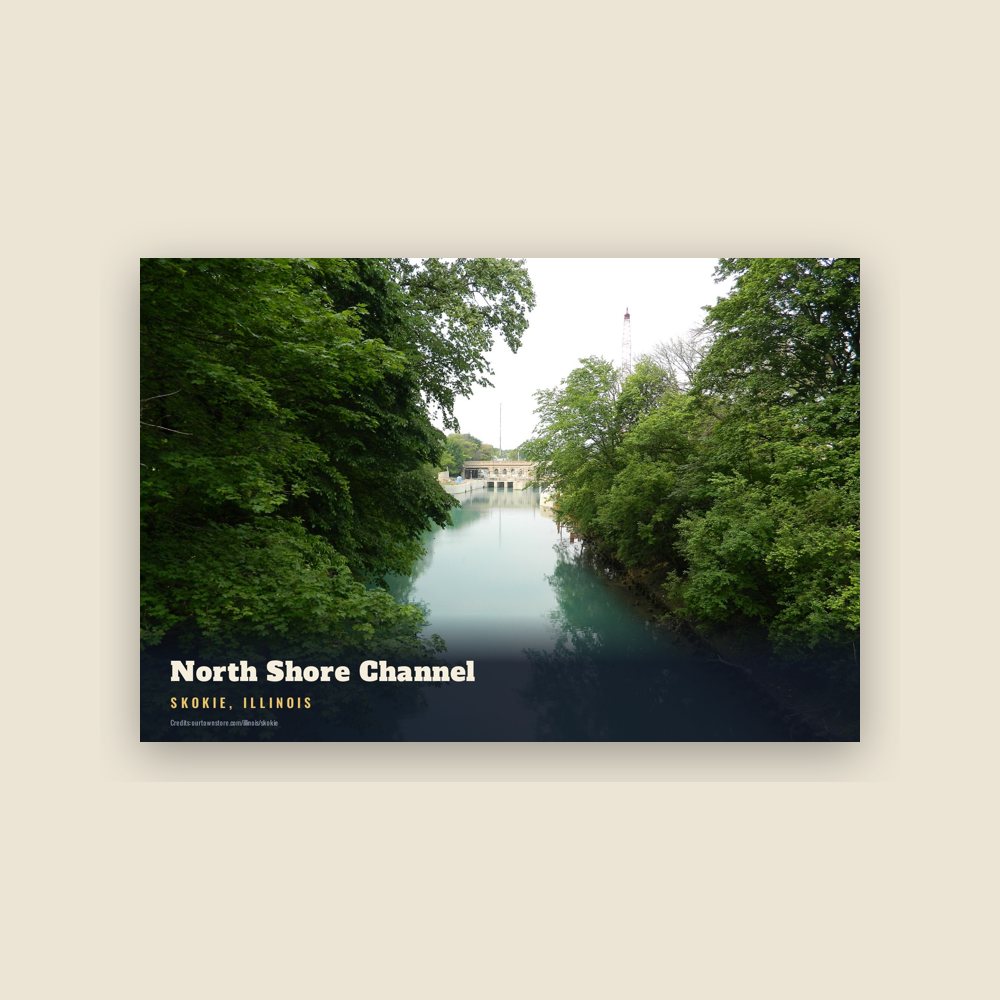
In 2001, the decision by Skokie and 22 other communities belonging to the Solid Waste Agency of Northern Cook County to use an isolated wetland as a solid waste disposal site resulted in a lawsuit. Ultimately, the case went all the way to the United States Supreme Court, and resulted in an overturn of the federal migratory bird rule.