A short history of White Plains
Early history
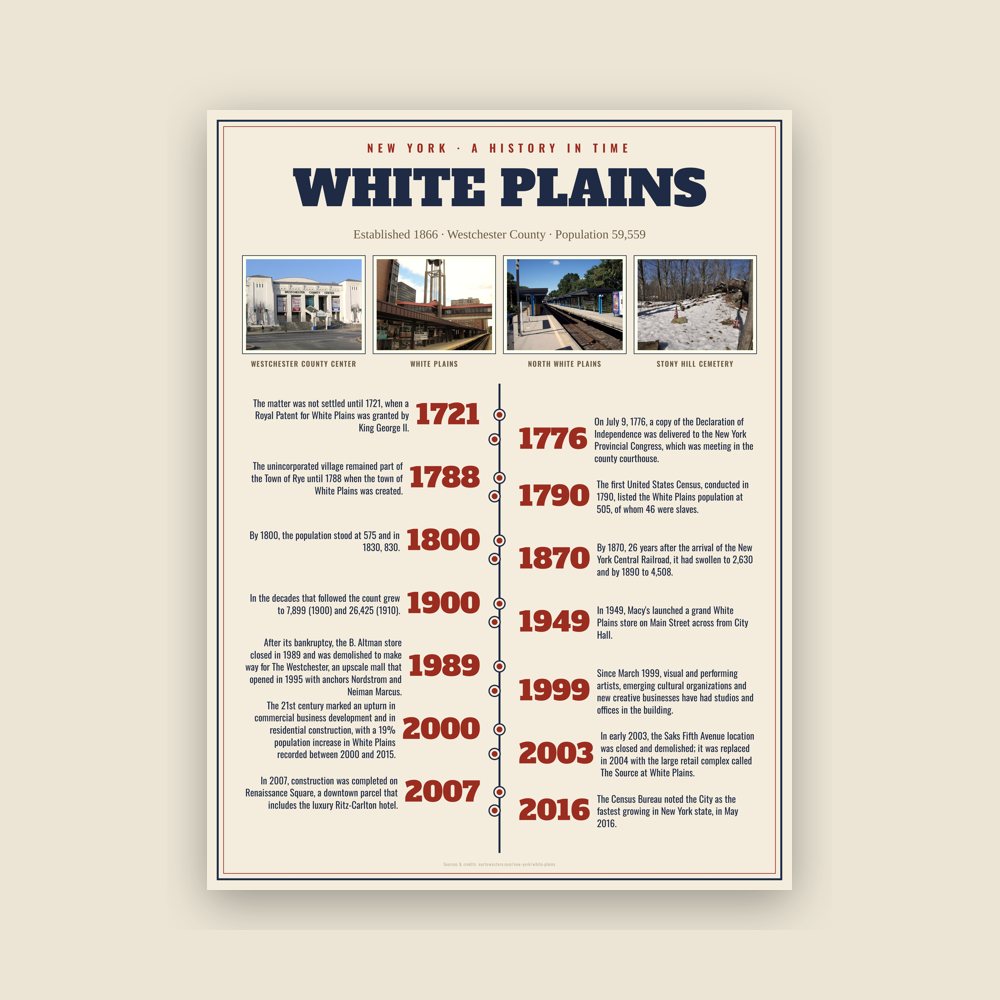
At the time of the Dutch settlement of Manhattan in the early 17th century, the region had been used as farmland by the Weckquaeskeck tribe, a Wappinger people, and was called "Quarropas". To early traders it was known as "the White Plains", either from the white balsam (Gnaphalium polycephalum) which was said to have covered it, or from the heavy mist that local tradition suggests hovered over the swamplands near the Bronx River. The first non-native settlement came in November 1683, when a party of Connecticut Puritans moved westward from an earlier settlement in Rye and bought about 4,400 acres (18 km2), presumably from the Weckquaeskeck. However, John Richbell of Mamaroneck claimed to have earlier title to much of the territory through his purchase of a far larger plot extending 20 miles (32 km) inland, perhaps from a different tribe. The matter was not settled until 1721, when a Royal Patent for White Plains was granted by King George II.
In 1758, White Plains became the seat of Westchester County when the colonial government for the county left West Chester, which was located in what is now the northern part of the borough of the Bronx, in New York City. The unincorporated village remained part of the Town of Rye until 1788 when the town of White Plains was created.
On July 9, 1776, a copy of the Declaration of Independence was delivered to the New York Provincial Congress, which was meeting in the county courthouse. The delegates quickly adopted a resolution approving the Declaration, thus declaring both the colony's independence and the formation of the State of New York. The Declaration itself was first publicly read from the steps of the courthouse on July 11.
During September and October 1776, troops led by George Washington took up positions in the hills of the village, hotly pursued by the British under General Sir William Howe, who attacked on October 28. The Battle of White Plains took place primarily on Chatterton Hill, (later known as "Battle Hill," and located just west of what was then a swamp but is now the downtown area) and the Bronx River. Howe's force of 4,000–6,000 British and Hessian soldiers required three attacks before the Continentals, numbering about 1,600 under the command of Generals Alexander McDougall and Israel Putnam, retreated, joining Washington's main force, which did not take part in the battle. Howe's forces had suffered 250 casualties, a severe loss, and he made no attempt to pursue the Continentals, whose casualties were about 125 dead and wounded. Three days after the battle, Washington withdrew north of the village, which was then occupied by Howe's forces. But after several inconclusive skirmishes over the next week, Howe withdrew on November 5, leaving White Plains to the Continentals. Ironically, one of Washington's subordinates, Major John Austin, who was probably drunk after having celebrated the enemy's withdrawal, reentered the village with his detachment and proceeded to burn it down. Although he was court-martialed and convicted for this action, he escaped punishment.
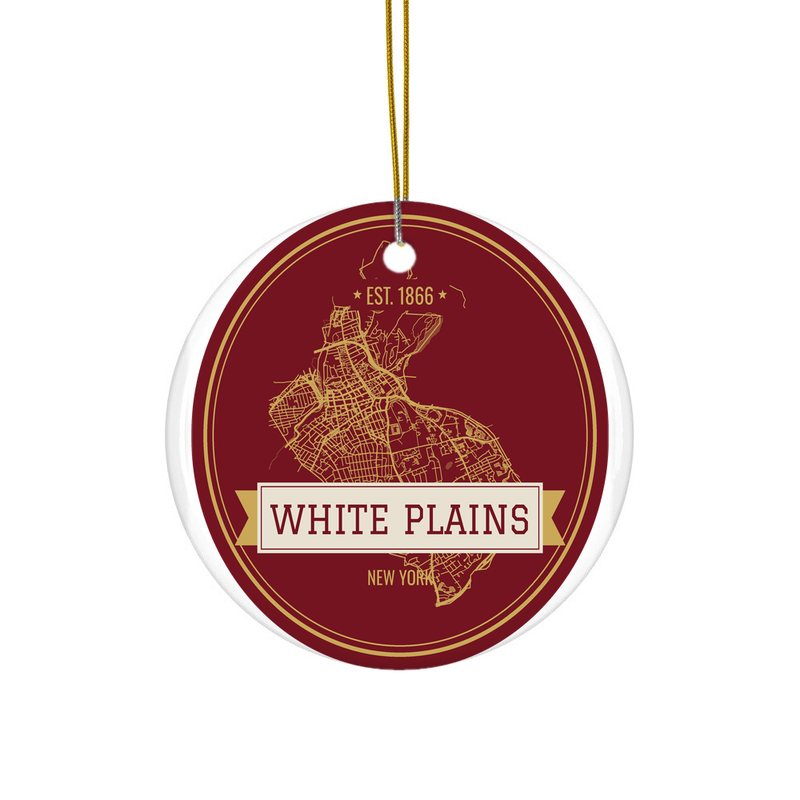
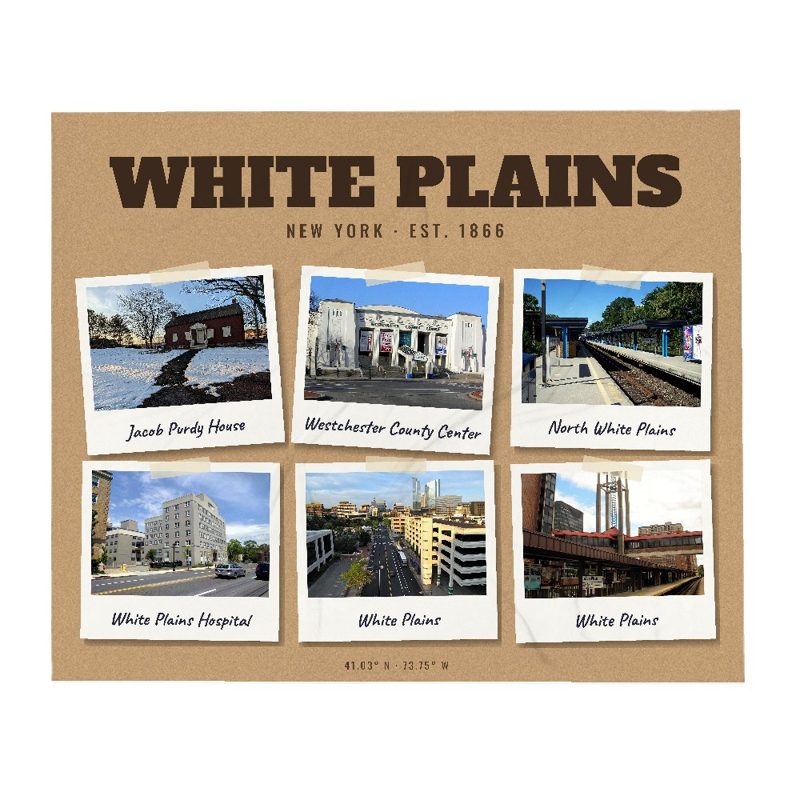
The first United States Census, conducted in 1790, listed the White Plains population at 505, of whom 46 were slaves. New York City's population at that time was about 33,000. By 1800, the population stood at 575 and in 1830, 830. By 1870, 26 years after the arrival of the New York Central Railroad, it had swollen to 2,630 and by 1890 to 4,508. In the decades that followed the count grew to 7,899 (1900) and 26,425 (1910). White Plains was incorporated as a village in 1866 and as a city in 1916.
Read the full history
Modern history
After World War II, White Plains' downtown area developed into a shopping district featuring branches of many famous New York-based department and specialty stores. Some of these retail locations were the first large-scale suburban stores built in the United States. In 1949, Macy's launched a grand White Plains store on Main Street across from City Hall. Other prestigious stores followed, such as B. Altman and Company, Rogers Peet, Saks Fifth Avenue, Lord & Taylor, Alexander's, Wallachs, and a short-lived branch of Bergdorf Goodman, which was converted to sister chain Neiman Marcus in 1981. Construction of nearby parkways and expressways in the 1940s through the 1970s brought shoppers from elsewhere.
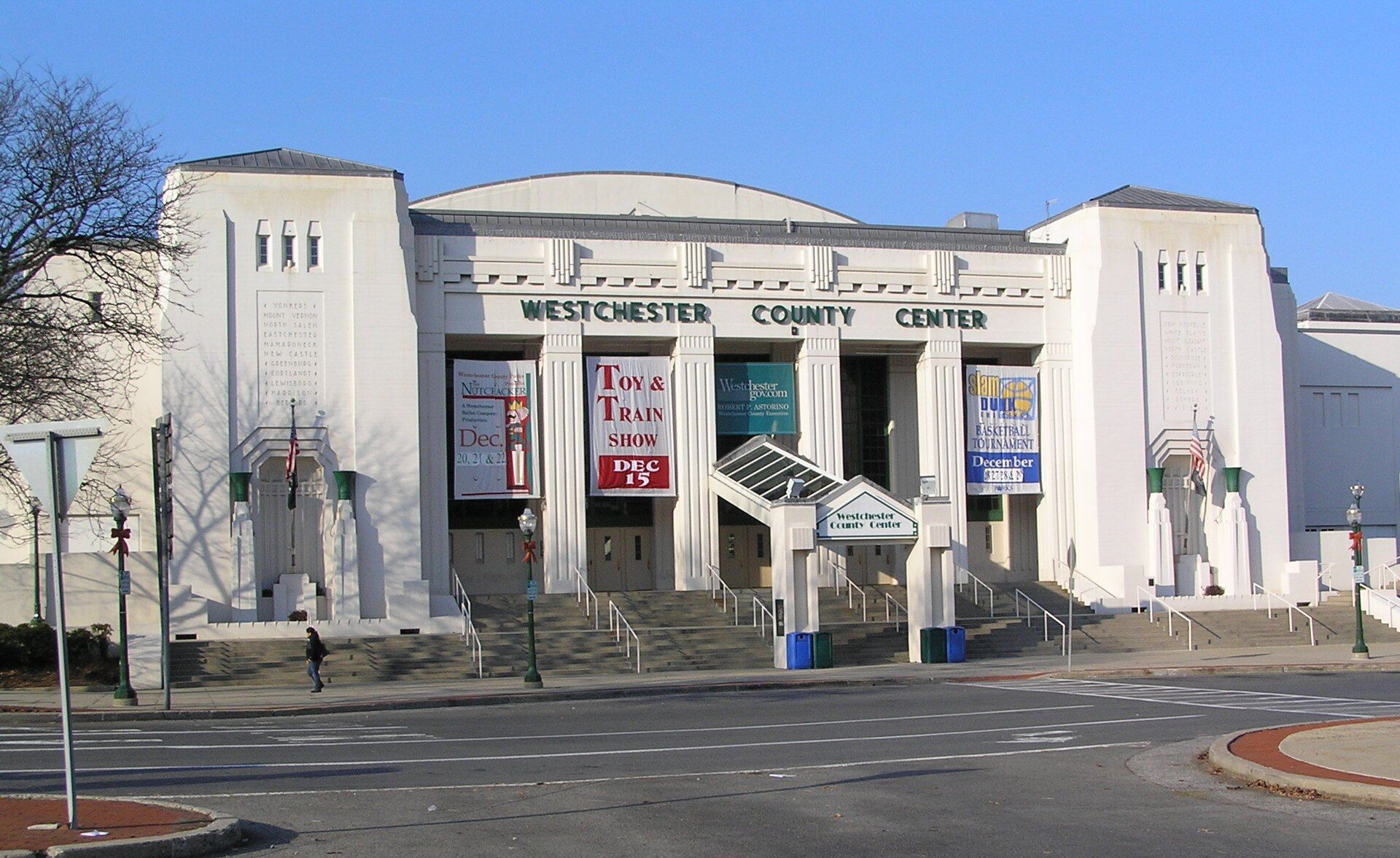
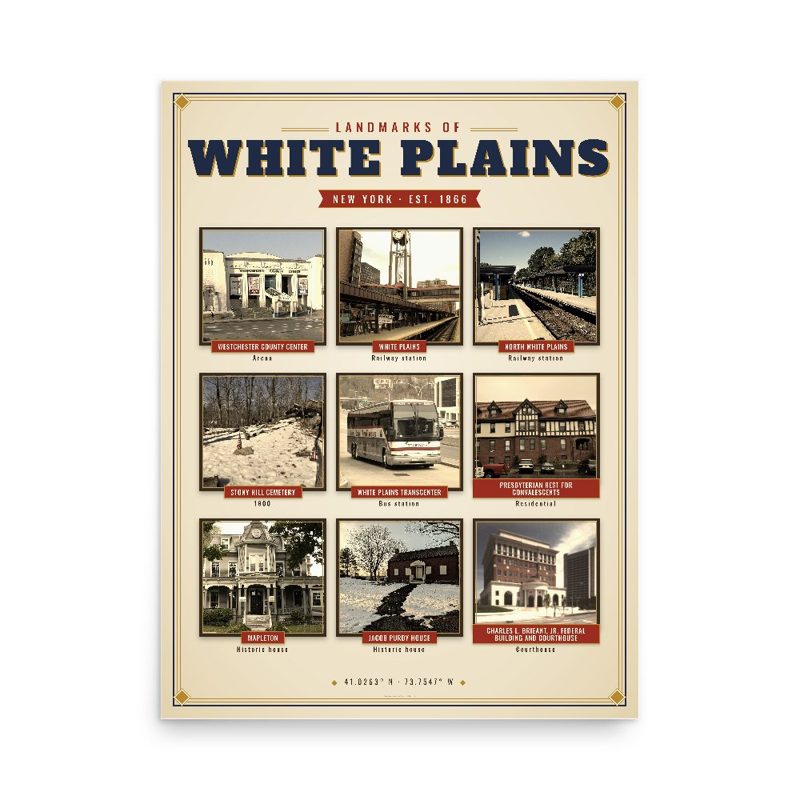
During the late 1960s, the city of White Plains developed an extensive urban renewal plan for residential, commercial and mixed-use redevelopment that called for the demolition of its entire central business district from the Bronx River Parkway east to Mamaroneck Avenue. By 1978, the urban renewal program centered around the construction of the Westchester County Courthouse (1974), the Westchester One office building (1975), the Galleria at White Plains mall (1978), and a number of other office towers, retail centers and smaller commercial buildings. At the time of its construction, the Westchester One building was the largest office building between New York City and Albany, and east to Hartford.
Beginning in the 1950s, many major corporations based in New York City moved operations to White Plains and other suburban locations. These included General Foods, PepsiCo, Hitachi USA, IBM, Nestlé, Snapple, and Heineken USA. In the 1980s, at least 50 Fortune 500 corporations had their headquarters in Westchester County and nearby Fairfield County, Connecticut, but with the corporate mergers and downsizing of the 1990s, many of these companies reduced their operations in White Plains or left the area completely.
White Plains is home to the Arts Exchange Building, which serves as the headquarters of the Westchester Arts Council. Since March 1999, visual and performing artists, emerging cultural organizations and new creative businesses have had studios and offices in the building. It is listed on the National Register of Historic Places.
The construction of the Galleria at White Plains mall in the 1970s ushered in a new era of downtown retail and office development, but by the early 1990s, economic development had stagnated, hampered by a deep recession and the overbuilding of the commercial real estate markets. For a time, White Plains had one of the highest office vacancy rates in the northeastern United States. Consolidation within the retail industry led to the closing of many of downtown's department and specialty stores. After its bankruptcy, the B. Altman store closed in 1989 and was demolished to make way for The Westchester, an upscale mall that opened in 1995 with anchors Nordstrom and Neiman Marcus. A freestanding branch of Macy's, one of downtown's original retail anchor stores, was moved two blocks away to The Galleria mall by its parent company, Federated Department Stores, replacing sister retailer Abraham & Straus when these two store divisions were merged in 1995.
A new courthouse for the Southern District of New York was opened in 1998 and several large-scale office properties in and near downtown, including the former General Foods headquarters building, were retrofitted and leased to accommodate smaller businesses. The Macy's store on Main Street remained vacant for several years until it was also later demolished to make way for the massive City Center at White Plains complex. This large mixed-use development features two 35-story apartment and condominium towers, 600,000-square-foot (60,000 m2) of retail, restaurant and entertainment space and new parking facilities.
The 21st century marked an upturn in commercial business development and in residential construction, with a 19% population increase in White Plains recorded between 2000 and 2015. The Census Bureau noted the City as the fastest growing in New York state, in May 2016.
The city is 31 minutes by express train from Midtown Manhattan, and this has attracted new residents who commute to New York City for work. In early 2003, the Saks Fifth Avenue location was closed and demolished; it was replaced in 2004 with the large retail complex called The Source at White Plains. In 2007, construction was completed on Renaissance Square, a downtown parcel that includes the luxury Ritz-Carlton hotel.
Adapted (trimmed) from the Wikipedia article White Plains, New York, revision 1385666435 by its contributors, licensed CC BY-SA 4.0.