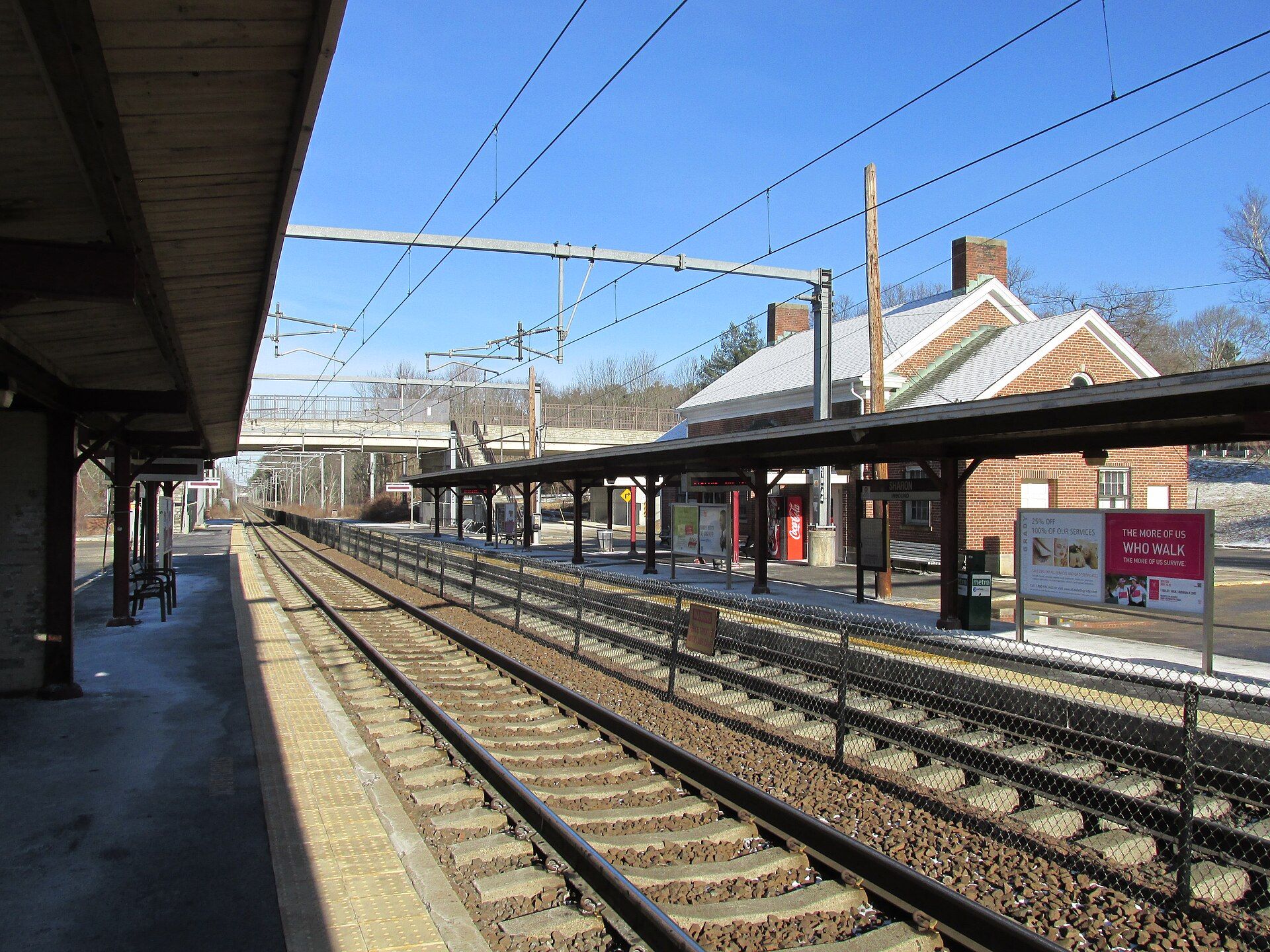
Sharon is part of Greater Boston, about 17 miles southwest of downtown Boston, and is connected to both Boston and Providence by the Providence/Stoughton Line. Landmarks include Sharon station, Cobb's Tavern and Borderland State Park. Sharon is the birthplace of Sarah Palfrey Cooke, tennis player.
Every piece is drawn from Sharon's own map data and historic archives, then printed and shipped from the USA when you order. No two towns look alike.
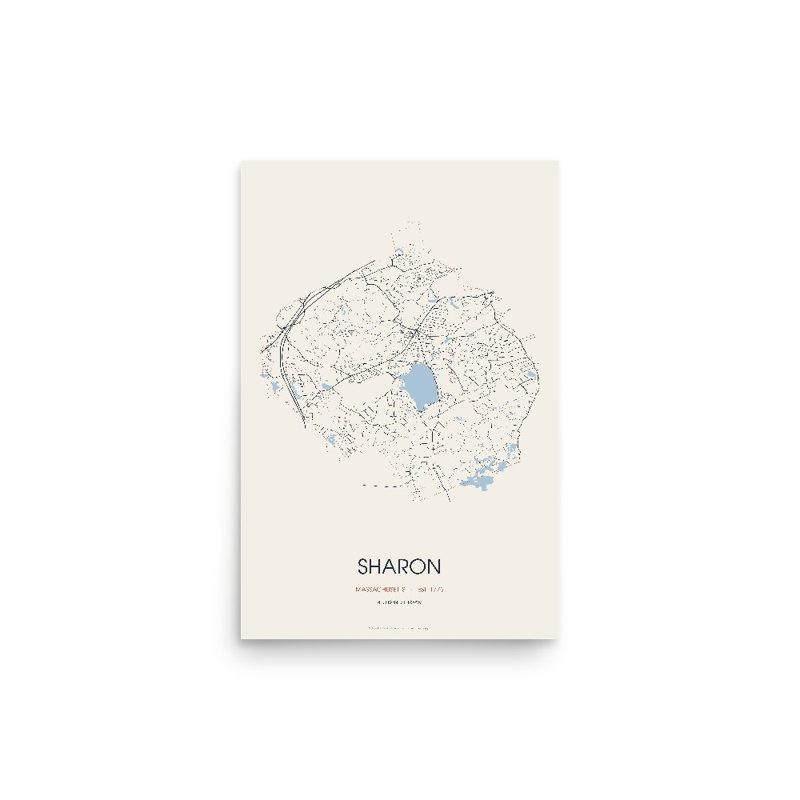
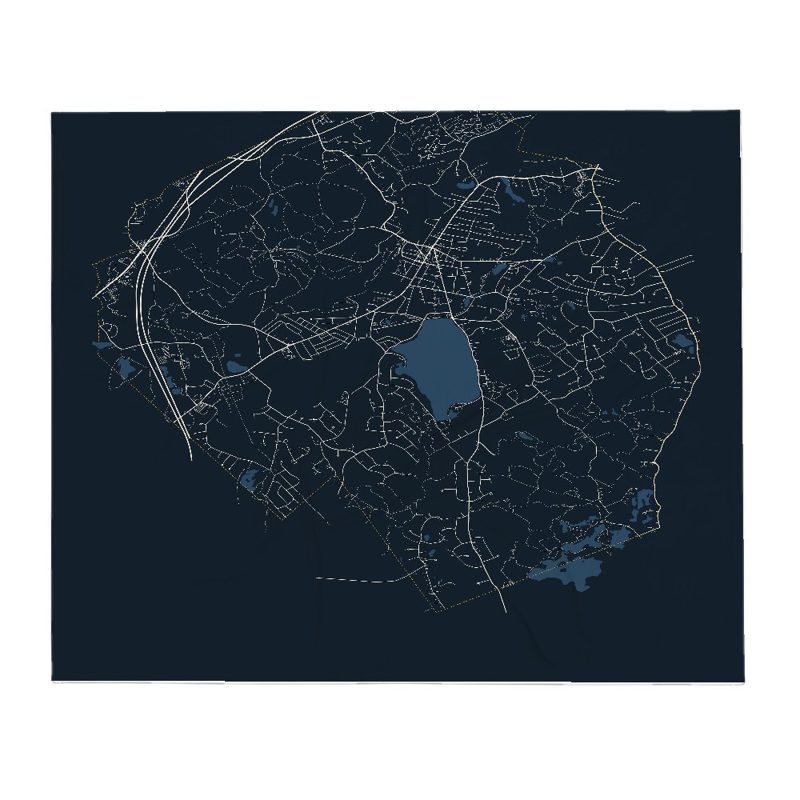
Every road in town, on archival matte paper
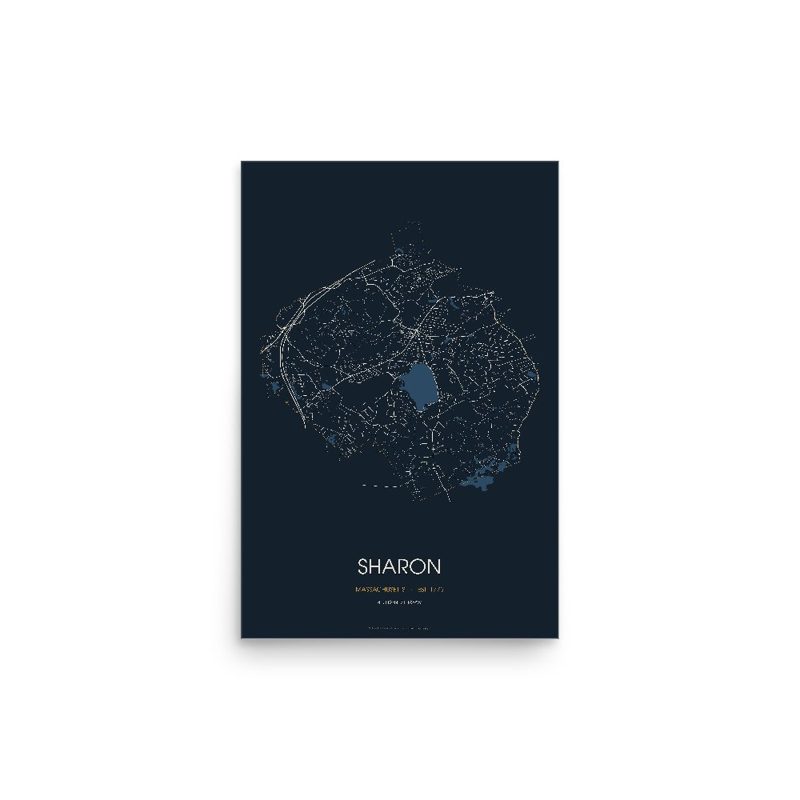
The same map, in navy and silver
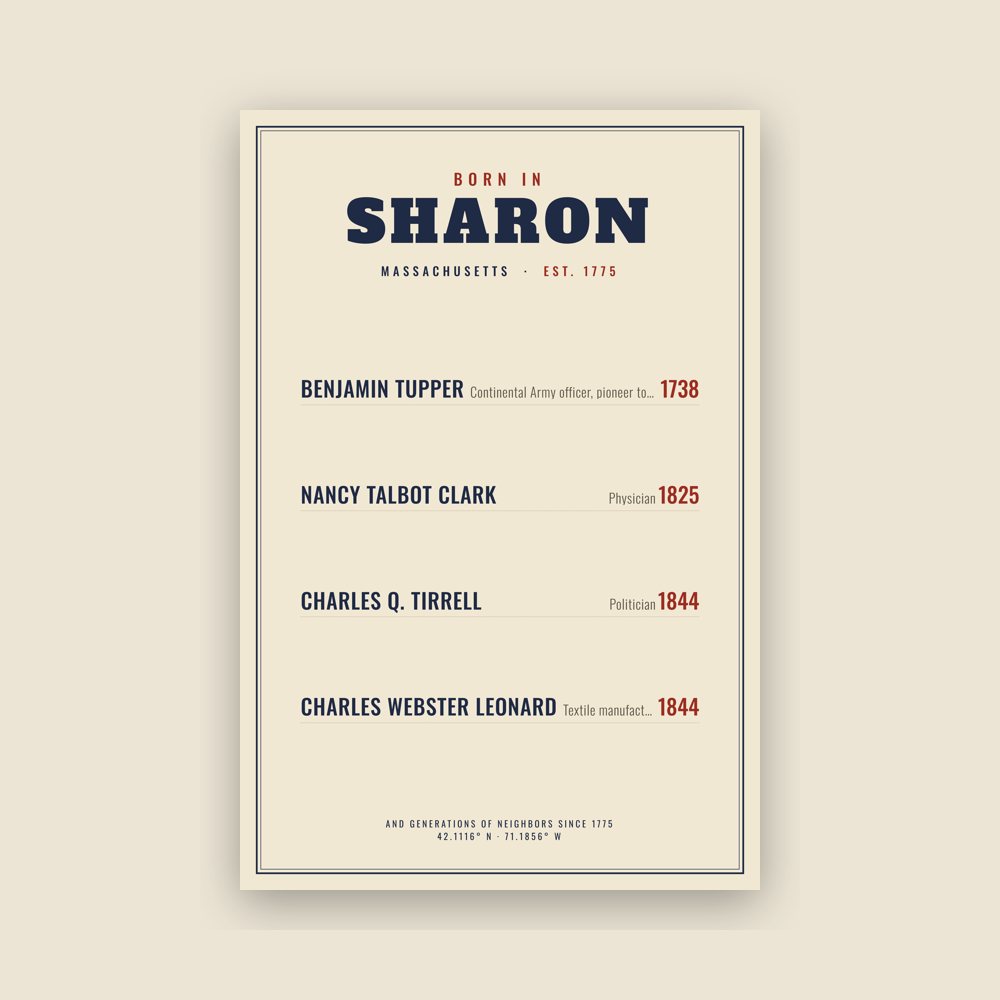
Famous natives, by birth year
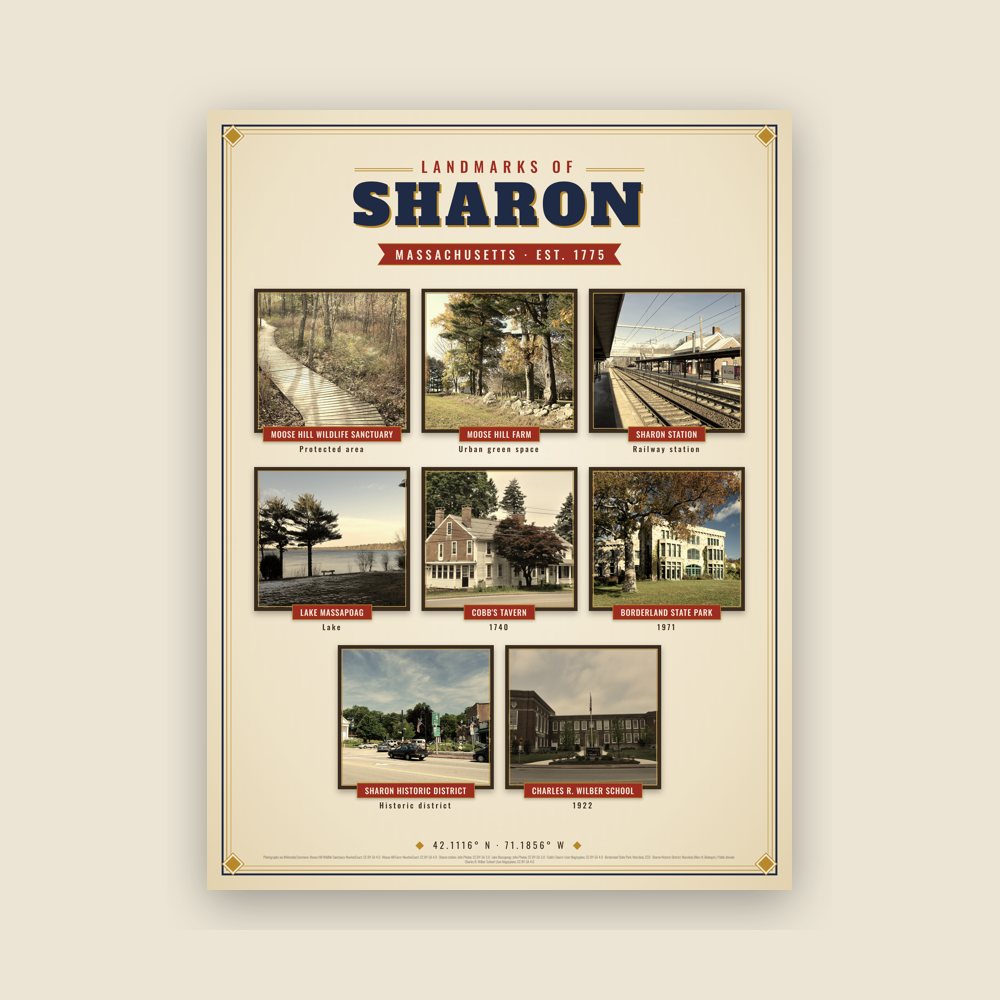
Nine local landmarks, archival matte
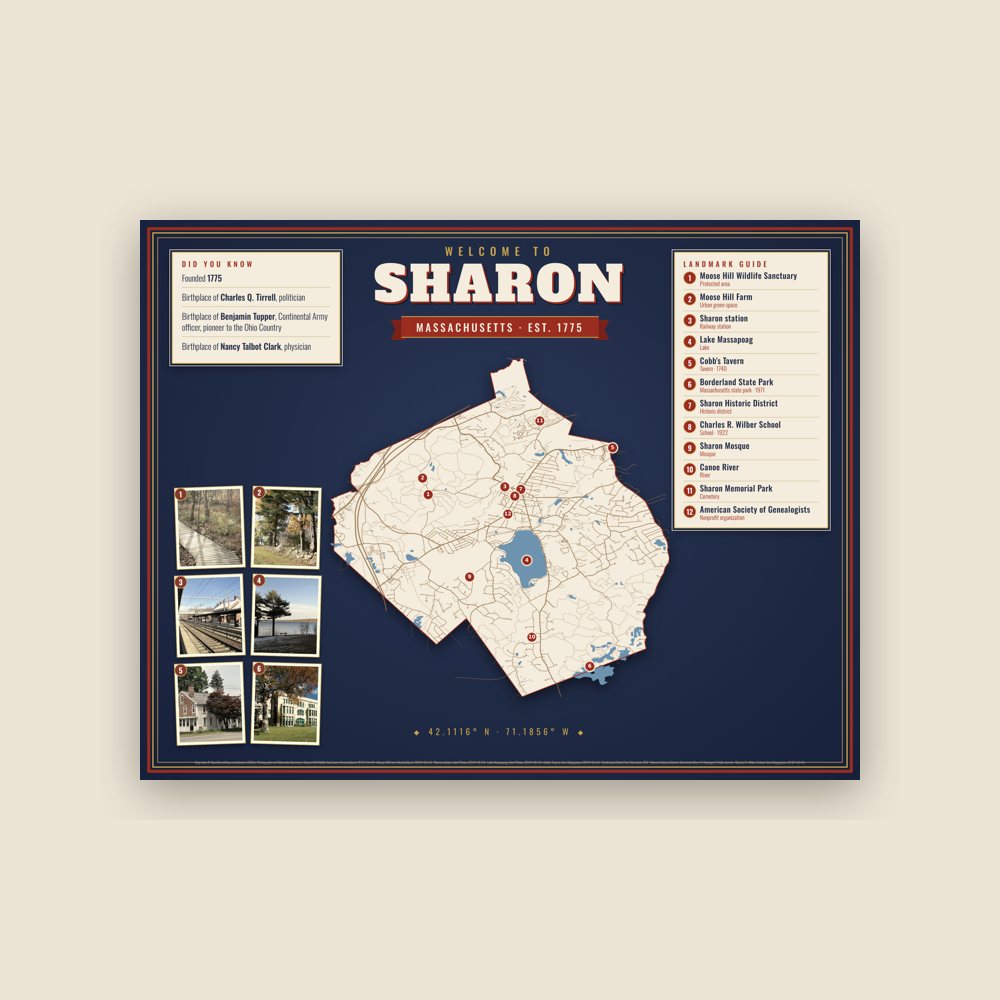
Map of local landmarks, washable fabric
Heavy-blend fleece, street map printed on the back
Soft Bella+Canvas jersey
Glossy ceramic, dishwasher safe
Ceramic keepsake, gold ribbon
Weatherproof, for the front walk
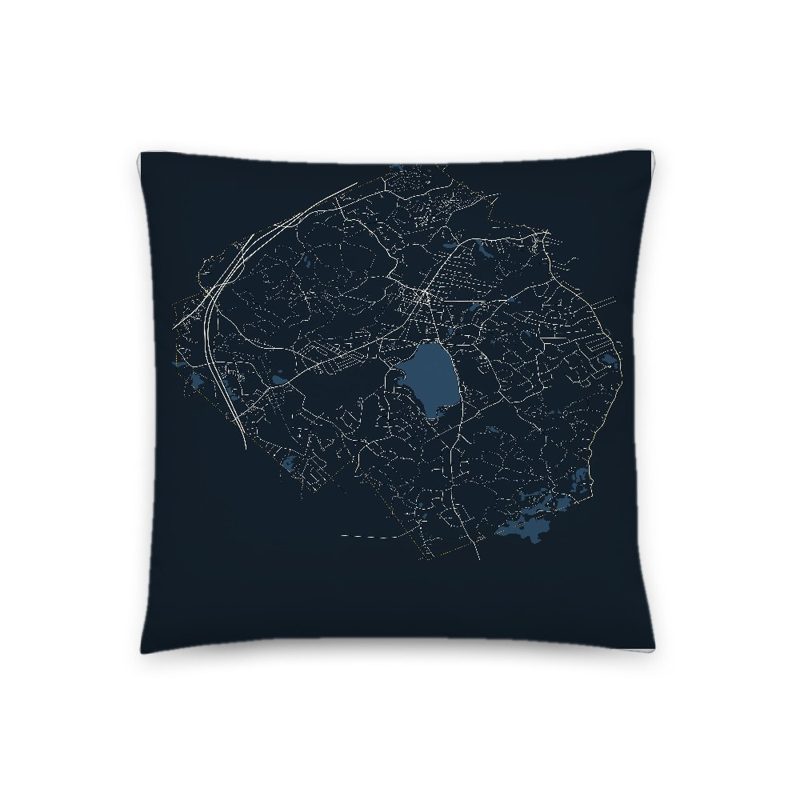
Soft-touch, zip cover
Sturdy all-over-print tote
Glossy top, cork back
Soft fleece, 50″×60″
20 oz, double-wall stainless
Population 2010: 17,612 → 2020: 18,575
From Wikidata (CC0).
The Town of Sharon was first settled as part of the Massachusetts Bay Colony in 1637 and was deemed the 2nd precinct of Stoughton in 1740. It was established as the district of Stoughtonham on June 21, 1765, incorporated as the Town of Stoughtonham on August 23, 1775, and was named Sharon on February 25, 1783, after Israel's Sharon plain, due to its high level of forestation. Several towns in New England were given this name. Part of Stoughtonham went to the new town of Foxborough on June 10, 1776. During the American Revolution, the townspeople of Sharon made cannonballs and cannons for the Continental Army at a local foundry.
In front of the Sharon Public Library stands a statue of Deborah Sampson, Sharon's town heroine. Sampson disguised herself as a man to fight in the Revolutionary War. After the war, she married Benjamin Gannett, a farmer, and lived in Sharon until the end of her life. Sampson began a campaign in 1790 to secure a pension from her time in the Revolutionary War, which earned the support of well known public figures, including Paul Revere. In 1804, Revere visited Sampson (then Sampson Gannett) at her farm in Sharon and wrote to the congressman of her district, William Eustis, that he found her "much more deserving than hundreds to whom Congress have been generous." Sampson was placed on the United States pension list a year later, and awarded an annual payment. She is buried in the local Rock Ridge Cemetery. A street in Sharon is named Deborah Sampson Street in her honor. In 1983, the Massachusetts General Court designated Sampson as the official State Heroine of the Commonwealth of Massachusetts.
Sharon is the former home of the Kendall Whaling Museum, founded by Henry P. Kendall in 1955. In 2001, the museum was merged with the New Bedford Whaling Museum, and its collection is now part of that museum, though the archives of the museum are still held in Sharon.
Sharon's Second Historic District in 1991. In 1980, Stoneholm, located at 188 Ames Street, becomes a National Historic Landmark. In 1984, the Stoughtonham Furnace Site (partially in Foxborough) becomes a National Historic Landmark. In 1997, Borderland State Park (partially in Easton) becomes a National Register District. In 2004, Sharon's Third Historic District was approved by Town Meeting and accepted by the Commonwealth.
Adapted (trimmed) from the Wikipedia article Sharon, Massachusetts, revision 1374475296 by its contributors, licensed CC BY-SA 4.0.
We share a part of every Sharon sale with local partners, and we'd love to print from your collection. Old photographs, maps and postcards make the best keepsakes.
Partner with us