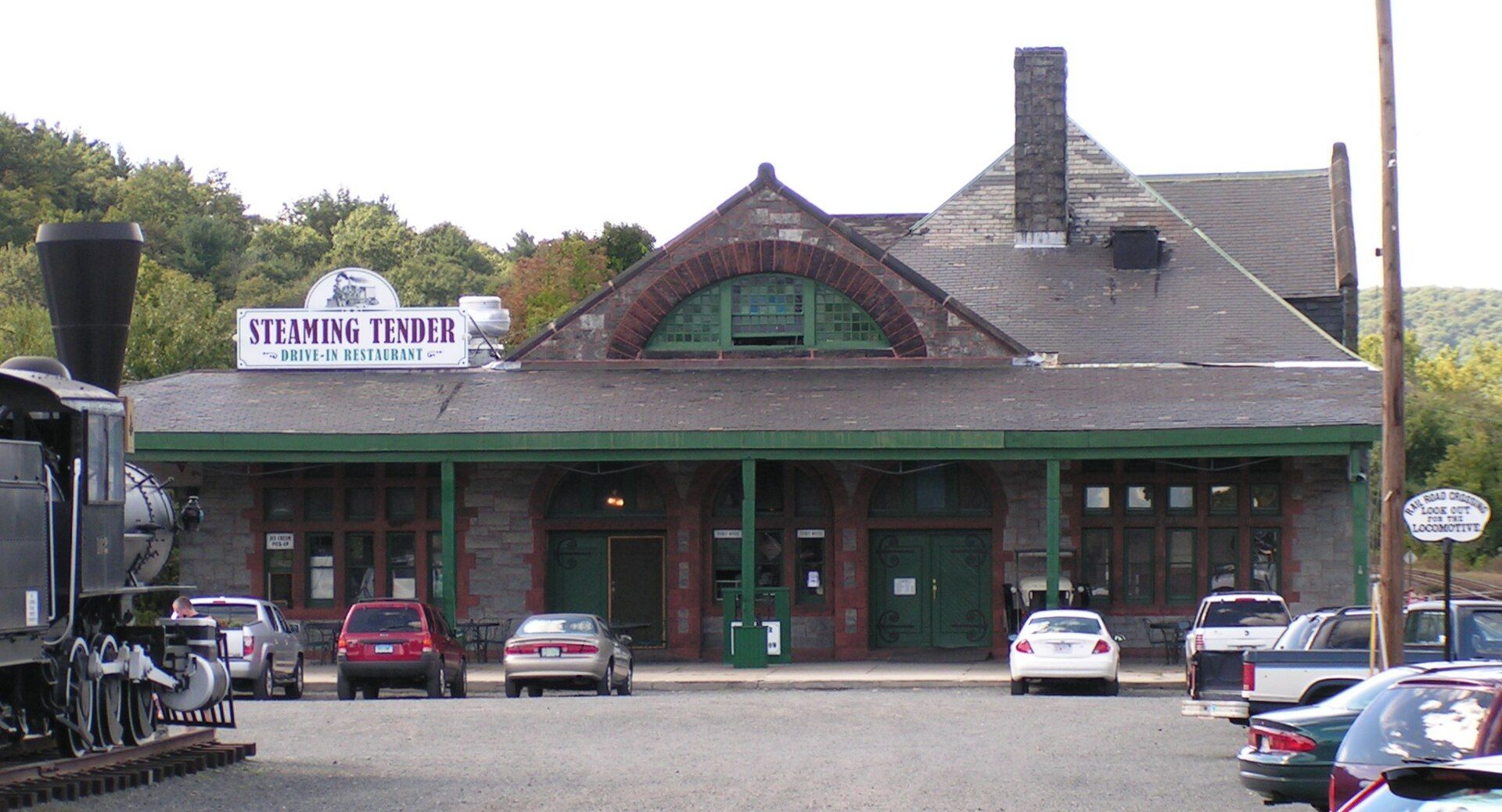
Palmer adopted a home rule charter in 2004 with a council-manager form of government. Landmarks include Union Station, Palmer Memorial Hall and United States Post Office–Palmer Main. Palmer is the birthplace of Chad Stahelski, stuntman and film director.
Every piece is drawn from Palmer's own map data and historic archives, then printed and shipped from the USA when you order. No two towns look alike.
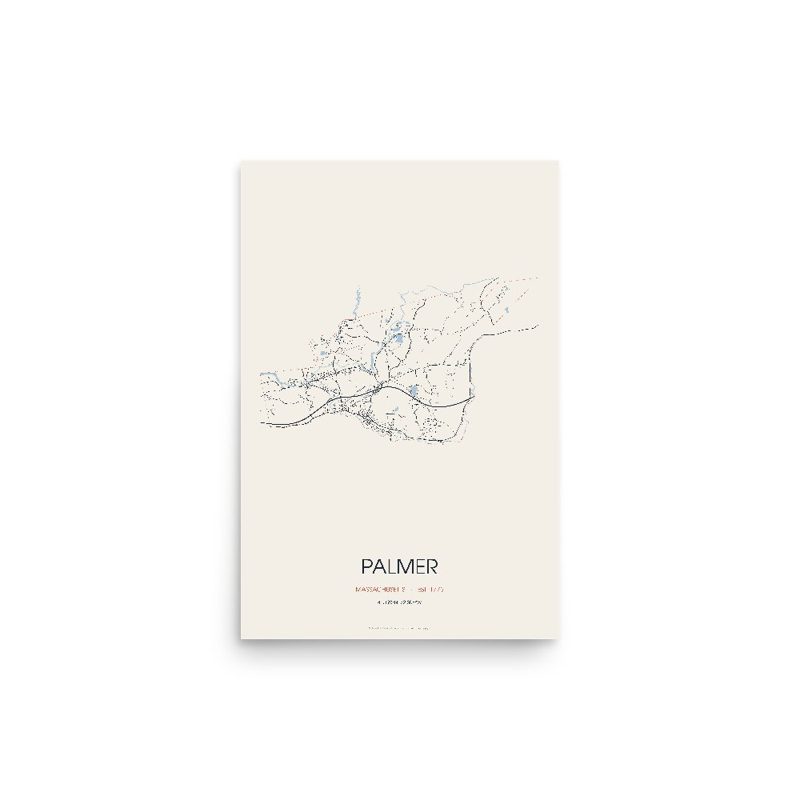
Every road in town, on archival matte paper
The same map, in navy and silver
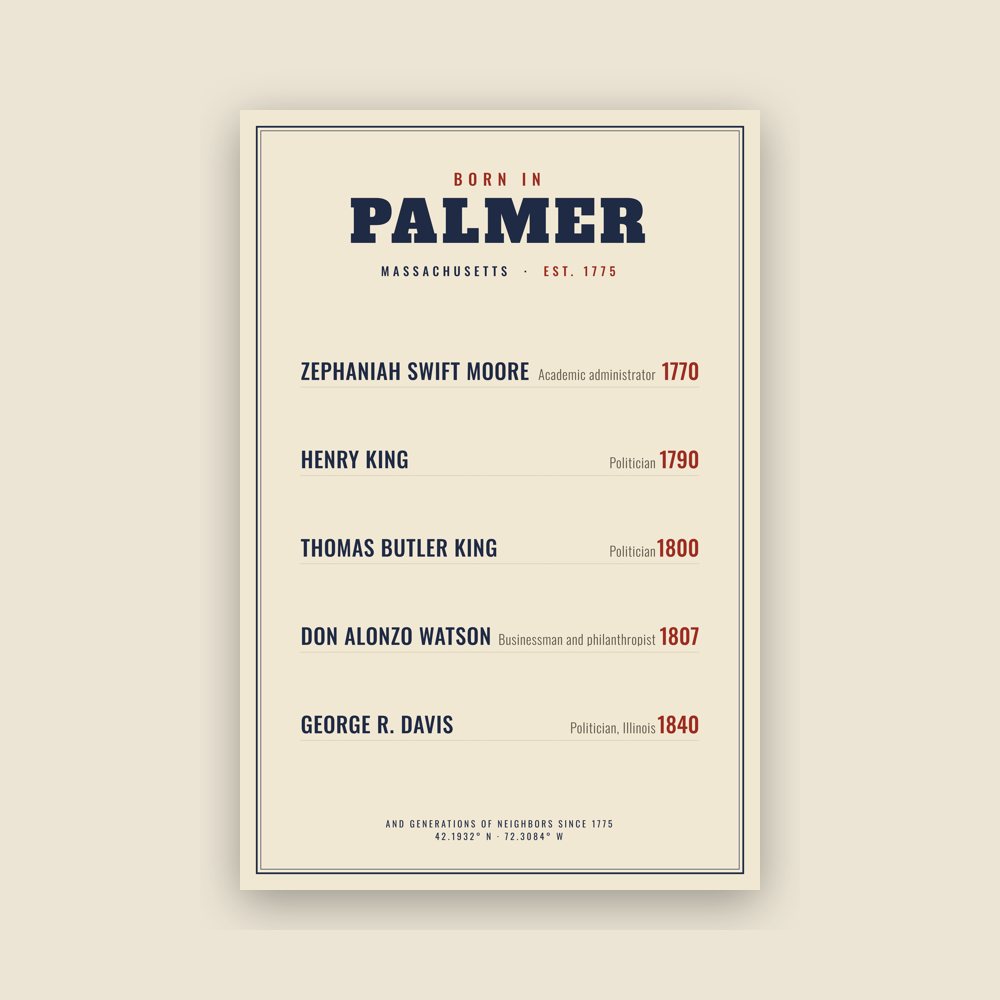
Famous natives, by birth year
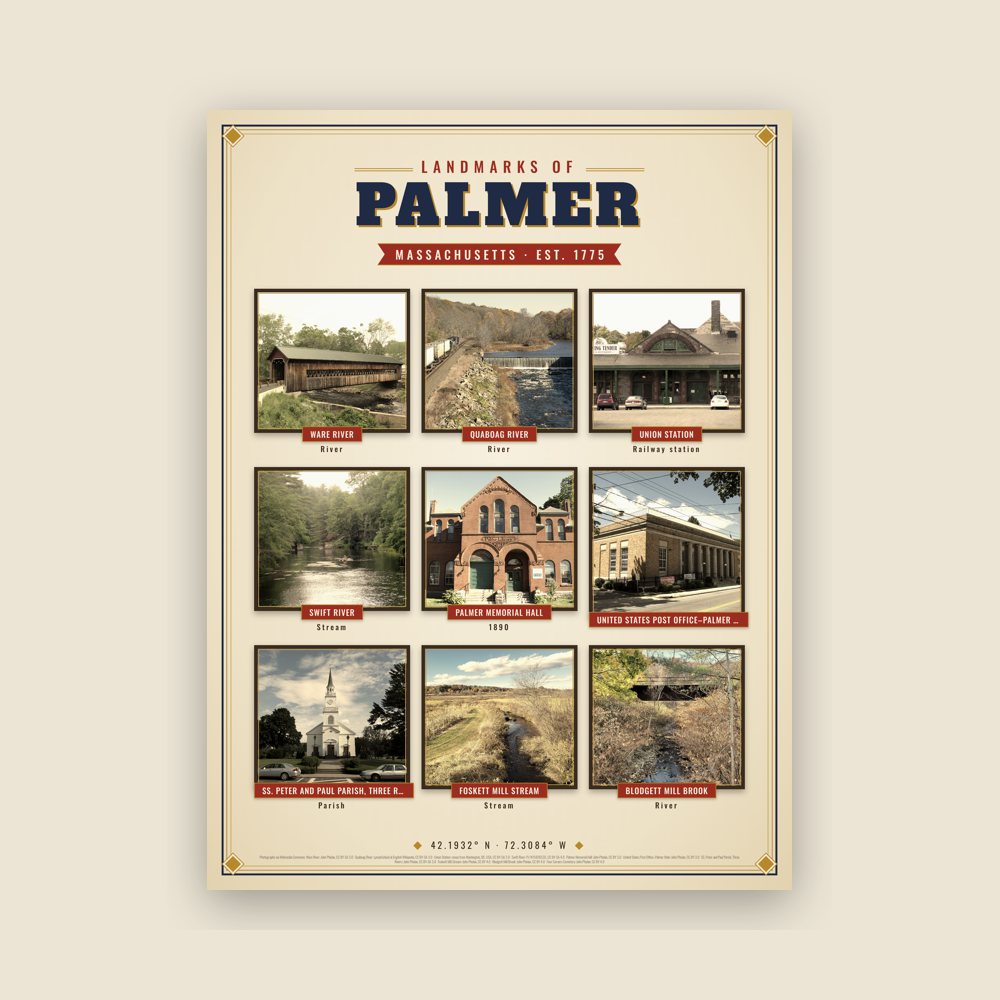
Nine local landmarks, archival matte
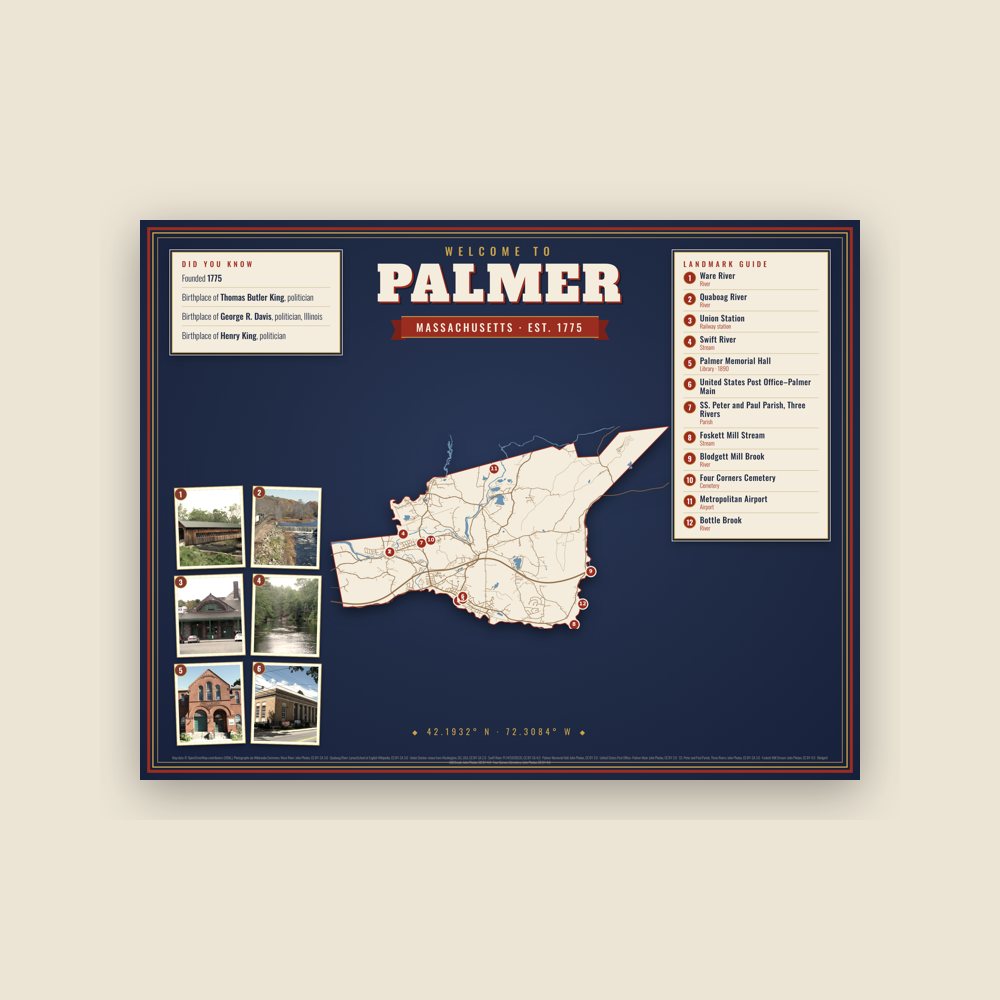
Map of local landmarks, washable fabric
Heavy-blend fleece, street map printed on the back
Soft Bella+Canvas jersey
Glossy ceramic, dishwasher safe
Ceramic keepsake, gold ribbon
Weatherproof, for the front walk
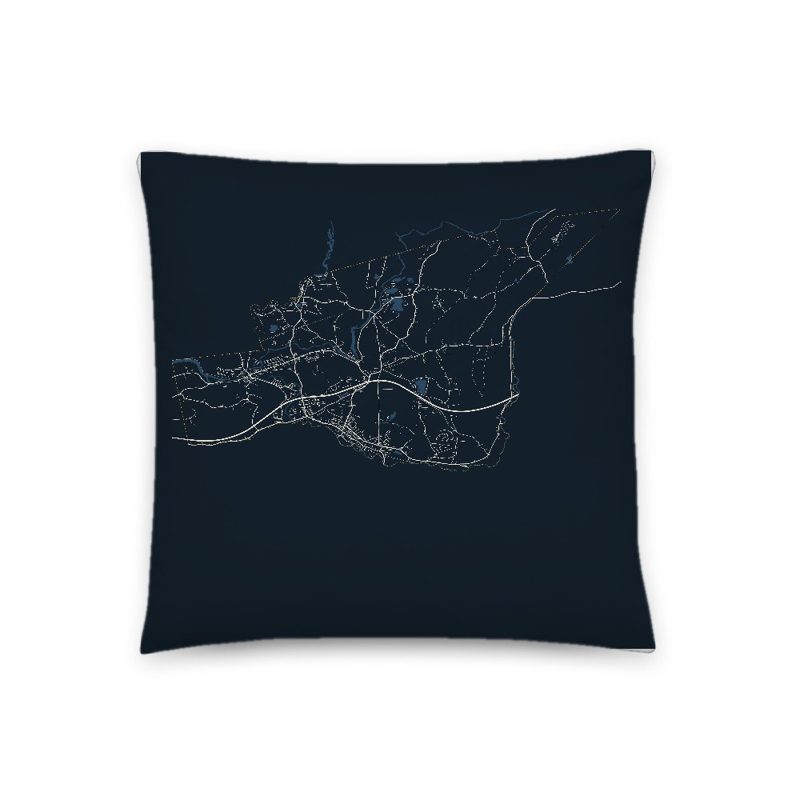
Soft-touch, zip cover
Sturdy all-over-print tote
Glossy top, cork back
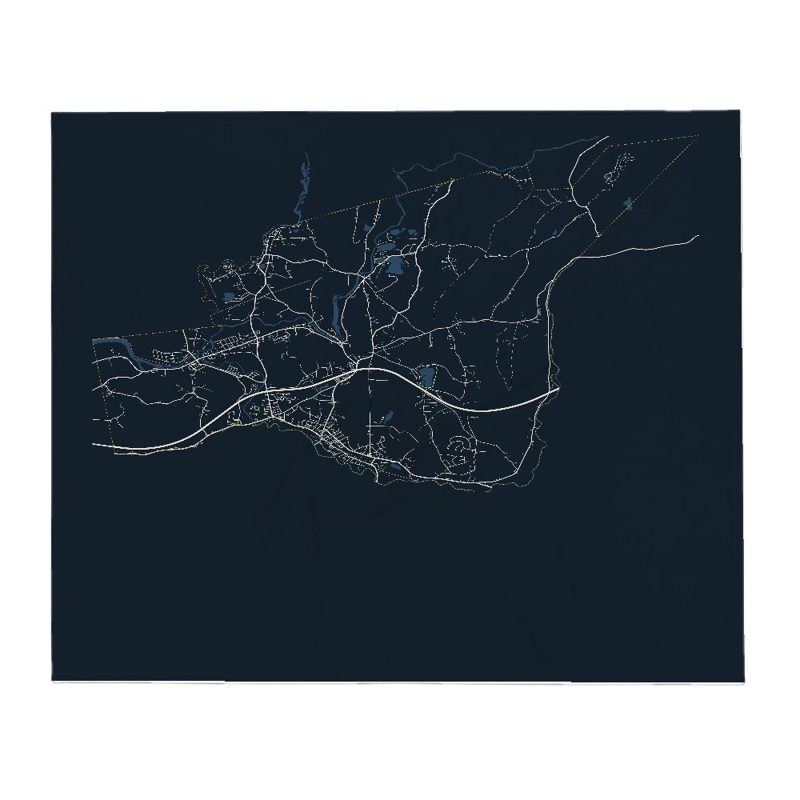
Soft fleece, 50″×60″
20 oz, double-wall stainless
Population 2000: 12,497 → 2010: 12,140 → 2020: 12,448
From Wikidata (CC0).
Palmer is composed of four separate and distinct villages: Depot Village, typically referred to simply as "Palmer" (named for the ornate Union Station railroad terminal designed by architect Henry Hobson Richardson), Thorndike, Three Rivers, and Bondsville. The villages began to develop their distinctive characters in the 18th century, and by the 19th century two rail lines and a trolley line opened the town to population growth. Today, each village has its own post office, and all but Thorndike have their own fire station.
Palmer was originally a part of Brimfield but separated after being too far from Brimfield. Palmer's first settler was John King. He was born in Edwardstone, Suffolk, England, and built his home in 1716 on the banks of the Quaboag River. The area as then known was called "The Elbow Tract". In 1731, a deed to land in today's Palmer renamed the town 'New Marlborough' after Marlborough, Massachusetts, in today's Middlesex County. In 1731, residents of the borough renamed the town 'Kingsfield', after the aforementioned John King. Though in some papers in the Massachusetts General Court, it was referred to as the Elbow. A large group of Scots-Irish Presbyterians followed, arriving in 1727. Finally in 1752, it was named Palmer after John Palmer, a Chief Justice of the Superior Court of the Dominion of New England. In 1775, Massachusetts officially incorporated Palmer.
Depot Village became Palmer's main commercial and business center during the late 19th century and remains so today. Palmer's industry developed in Bondsville. During the 18th century, saw and grist mills were established by the rivers, and by 1825 Palmer woolen mills began to produce textiles. The Blanchard Scythe Factory, Wright Wire Woolen Mills, and the Holden-Fuller Woolen Mills developed major industrial capacity, and constructed large amounts of workers' housing. By 1900, Boston Duck (which made heavy cotton fabric) had over 500 employees in the town. The 20th century brought about a shift of immigrants in Palmer from those of French and Scottish origin to those of primarily Polish and French-Canadian extraction.
Adapted (trimmed) from the Wikipedia article Palmer, Massachusetts, revision 1378784384 by its contributors, licensed CC BY-SA 4.0.
We share a part of every Palmer sale with local partners, and we'd love to print from your collection. Old photographs, maps and postcards make the best keepsakes.
Partner with us