
Ludlow is a New England town in Hampden County, Massachusetts, United States. Landmarks include Lupa Zoo, Lusitano Stadium and Christ the King Parish. Ludlow is the birthplace of Nicole Fiorentino, bass guitarist.
Every piece is drawn from Ludlow's own map data and historic archives, then printed and shipped from the USA when you order. No two towns look alike.
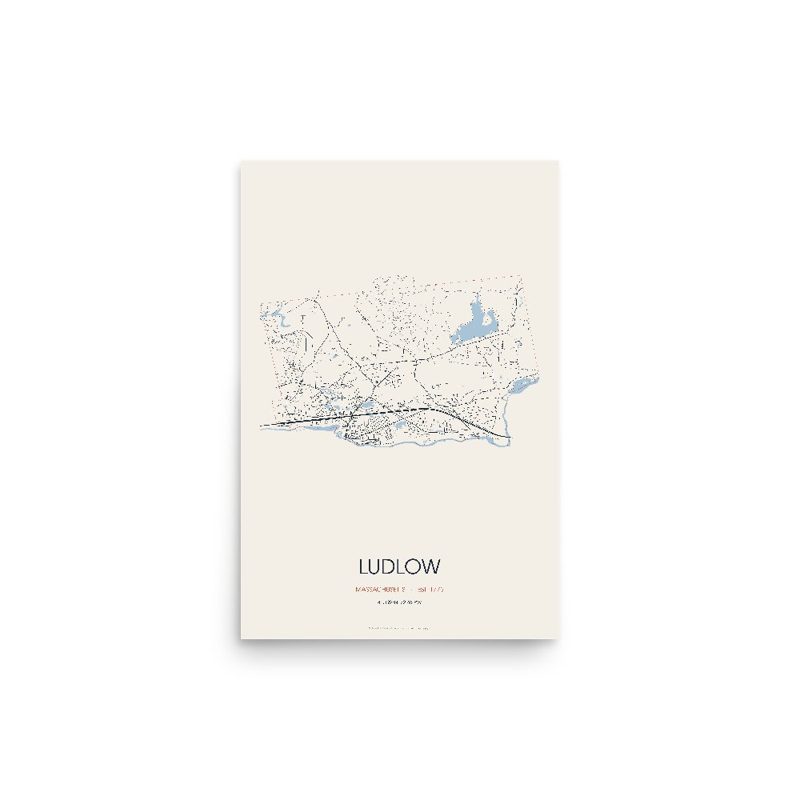
Every road in town, on archival matte paper
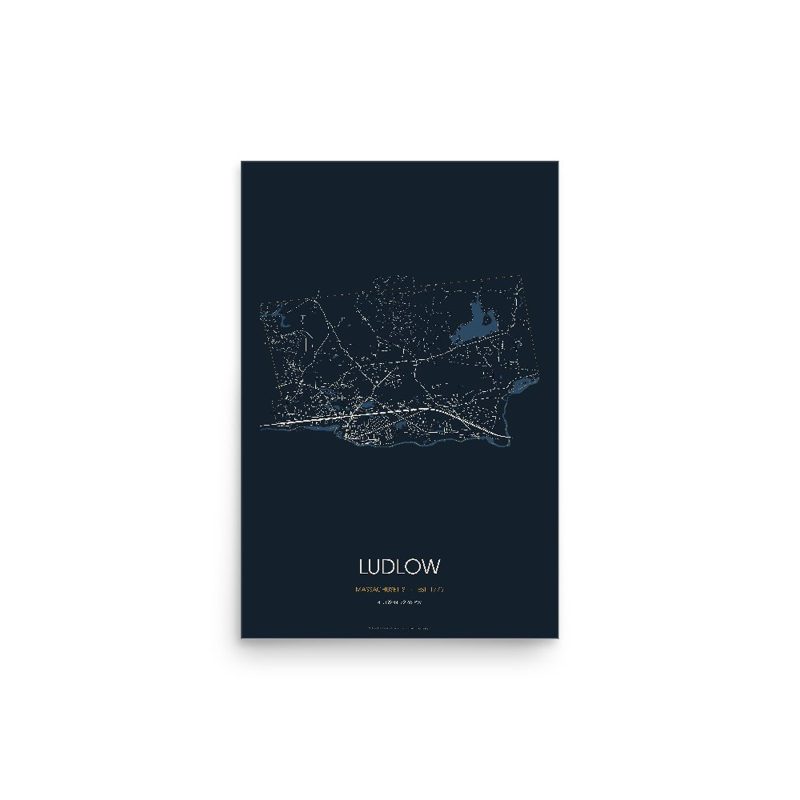
The same map, in navy and silver
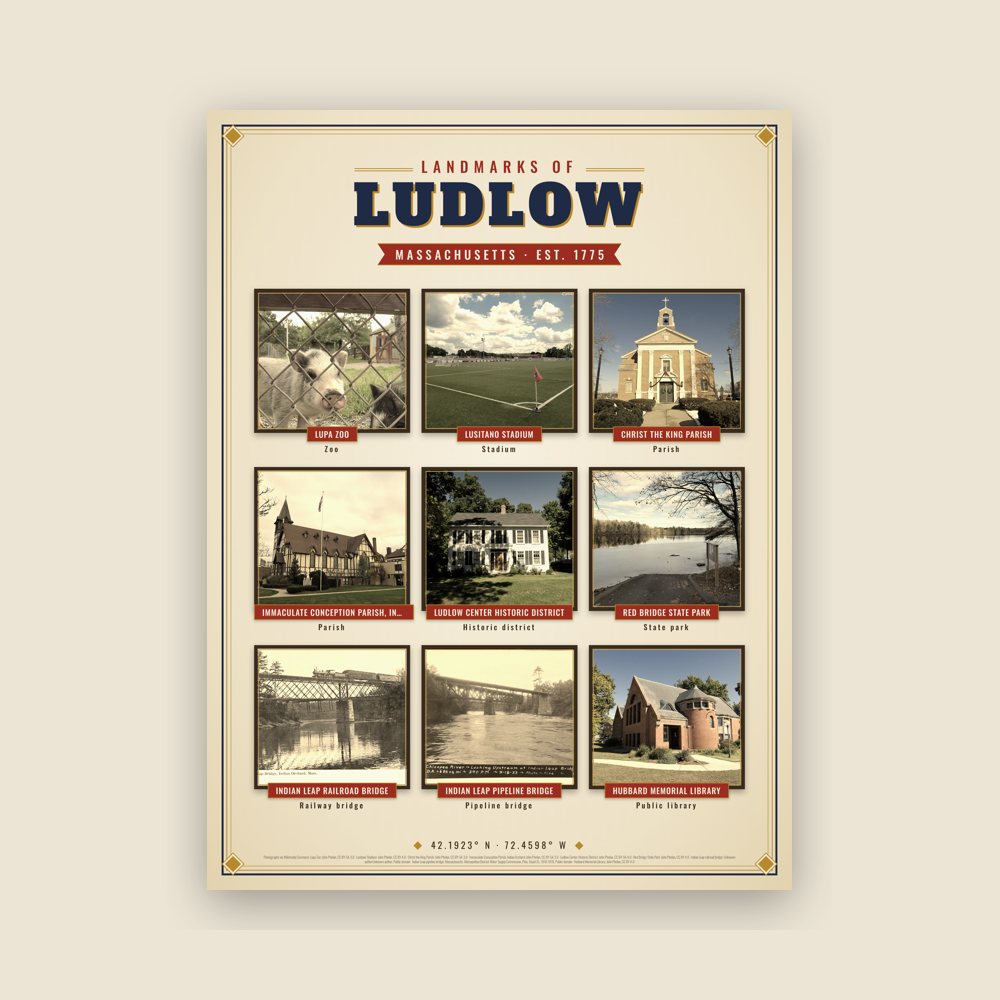
Nine local landmarks, archival matte
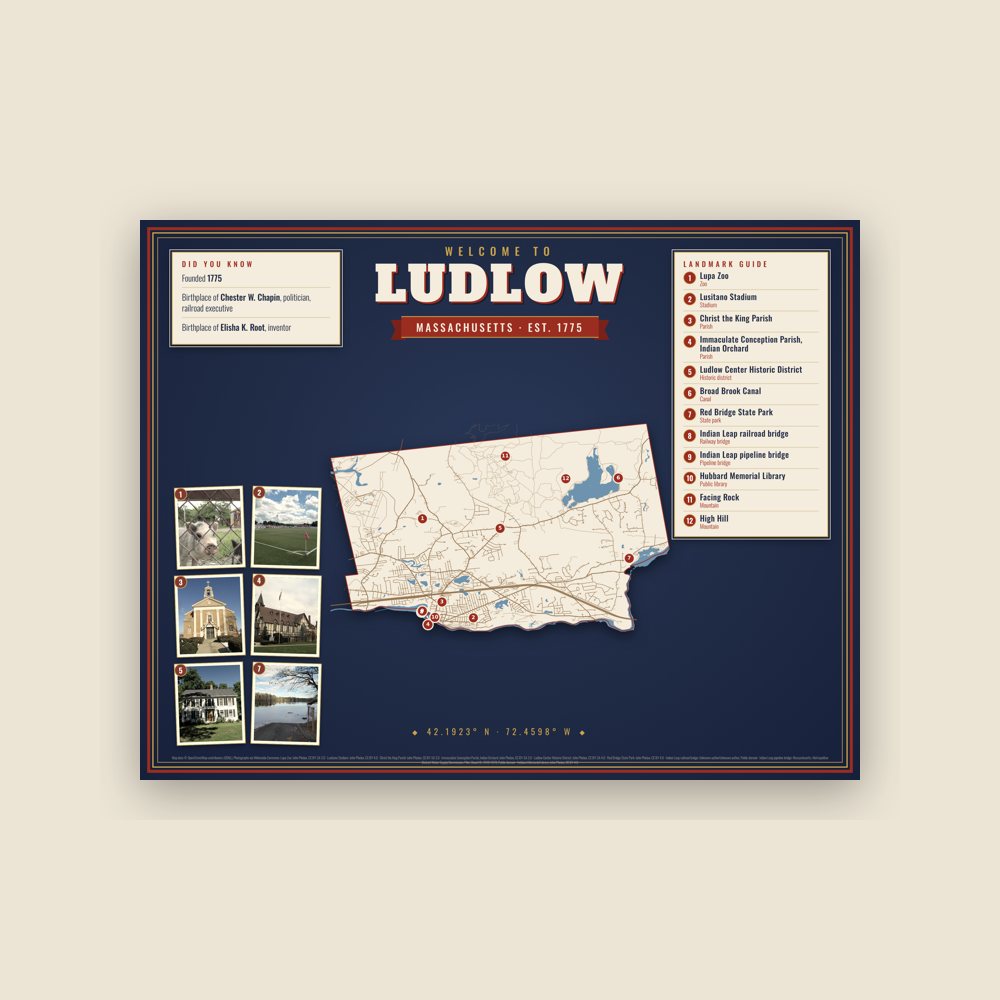
Map of local landmarks, washable fabric
Heavy-blend fleece, street map printed on the back
Soft Bella+Canvas jersey
Glossy ceramic, dishwasher safe
Ceramic keepsake, gold ribbon
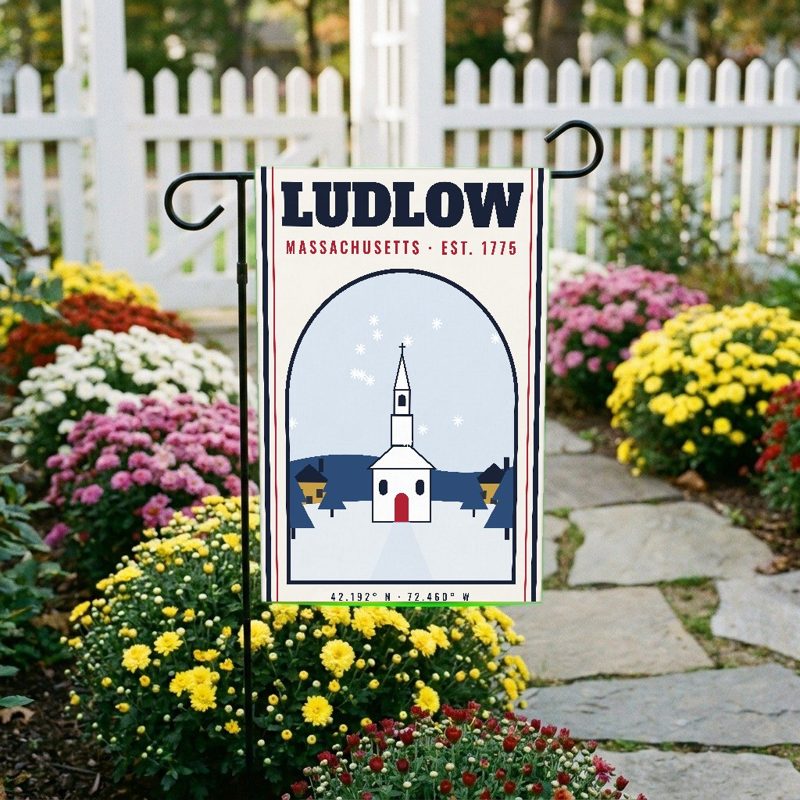
Weatherproof, for the front walk
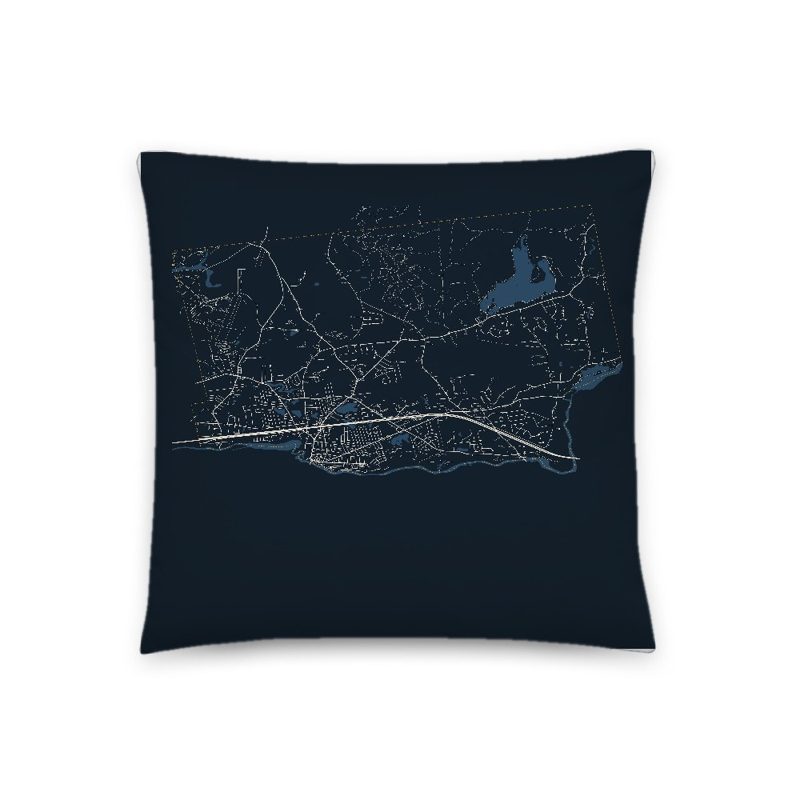
Soft-touch, zip cover
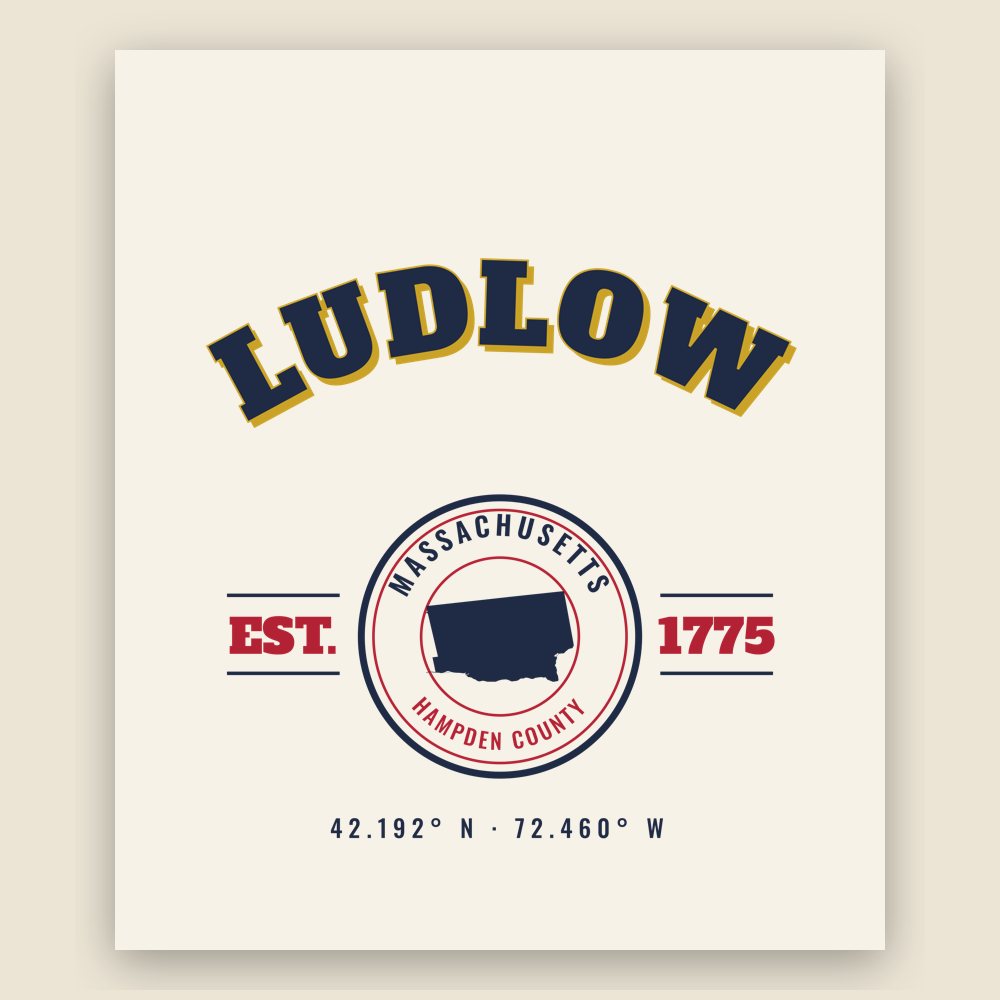
Sturdy all-over-print tote
Glossy top, cork back
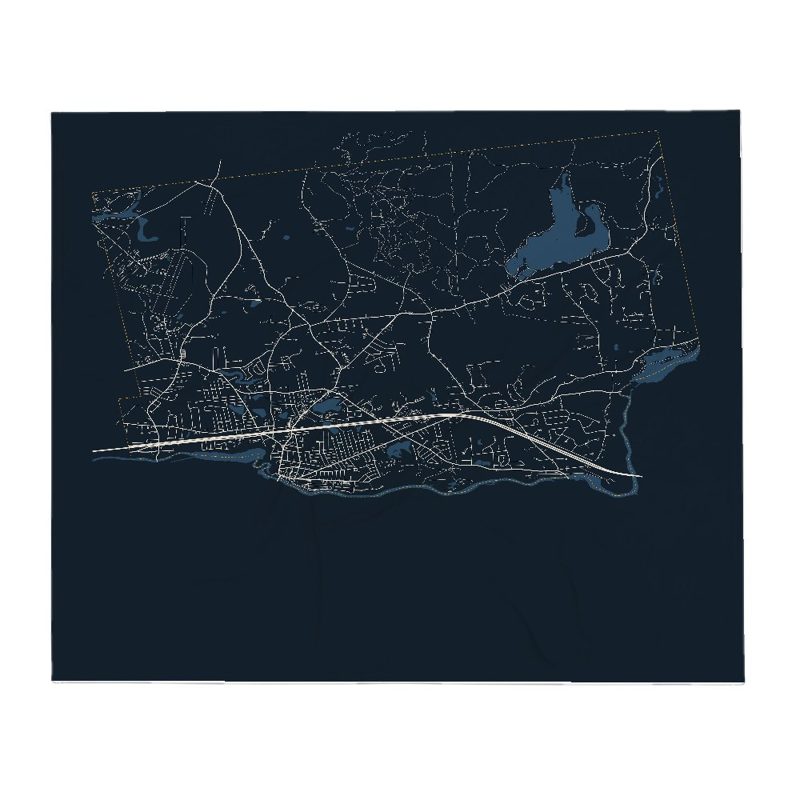
Soft fleece, 50″×60″
20 oz, double-wall stainless
Population 2010: 21,103 → 2020: 21,002
From Wikidata (CC0).
The Indigenous people along the Chicopee River, including modern-day Ludlow, were Algonquian speaking peoples. Though records are incomplete, the first inhabitants were likely the Nipmuc or Pocomtuc tribes. During King Philip’s War (1675–1676), British settlers forced a band of Indigenous people, led by Roaring Thunder, to jump to the water of the Chicopee River to escape their attackers (this place has since been called Indian Leap).
Although plans were drawn up for settlement as early as 1685, within the original boundaries of Springfield, Massachusetts, the British first settled in Ludlow in 1751 as Stony Hill Parish. However, the town was later renamed Ludlow and incorporated as a separate entity in 1774, just before the breakout of the American Revolution. For much of its early history the town was agrarian and today many of Ludlow's street names are derived from the names of these farming families (e.g. Chapin Street, Miller Street, Alden Street, Fuller Street). Ludlow was home to many sawmills and gristmills, utilizing the power from several sources of water nearby, the Chicopee River, Broad Brook, Higher Brook, and Stony Brook. Before the Civil War, the town began to develop into a mill town. This included the manufacturing of glass bottles by the many glassware companies, including John Sikes. Then Governor of Massachusetts Bay Colony, Thomas Hutchinson renamed the town from the District of Stony Hill to Ludlow. The town of Ludlow was possibly named after Roger Ludlow, one of the founders of the Connecticut Colony or named after Ludlow, Shropshire, a town in England.
In 1868, the largest mill was opened and operated by the Ludlow Company (The Ludlow Clock Tower is depicted on the town seal), who produced jute yarns, twine, and webbing. This company helped shape the town by providing housing, a library, schools, playgrounds, and even a clubhouse for the increasingly diverse community. The mills led to a large influx of immigrants. First, Irish and French Canadians, who established a Little Canada that formed a triangle from what is now Center Street (near Hubbard Library) toward West Avenue and Stebbins Street to Saint John the Baptist Church. Later, Polish immigrants came in large numbers to also work in the Mills, inhabiting housing along East Street and over the bridge in Indian Orchard. In the 20th century, this company moved to India and is now known as Ludlow Jute and Specialties of Mumbai.
In the early 20th century Ludlow developed from a mill town into a streetcar suburb of Springfield, Massachusetts, with a trolley line running over the bridge from Indian Orchard. Ludlow also had two railroads that traversed the town: the Springfield, Athol and North-eastern Railroad and the Hamden Railroad. The Hamden Railroad was closed and Interstate 90 was constructed over its former tracks. The Springfield, Athol, and Northeastern Railroad was reduced in length in the late 1930s as a result of the creation of Quabbin Reservoir. The train station for this line was at the corner of Winsor Street and Sewall Street and was the last station from Boston when the railroad closed in the 1950s. The train station was demolished in 1960. In 1981, the Stony Brook Power Plant was constructed in the town providing 517 Megawatts of electricity to 24 municipalities. In 1983, the plant became the first combined-cycle power plant in Massachusetts.
Ludlow's population boomed in the 1950s with the creation of Interstate 90, known in Massachusetts as the Massachusetts Turnpike. John F. Thompson, who was speaker of the House of Representatives in the Massachusetts General Court at the time, was influential in gaining an exit on the Turnpike for Ludlow (now Exit 54, formerly 7) and subsequently the Turnpike influenced the growth of Ludlow as a suburb of Springfield. Since the 1950s, the development of numerous subdivisions has added to Ludlow's growth.
Adapted (trimmed) from the Wikipedia article Ludlow, Massachusetts, revision 1374533849 by its contributors, licensed CC BY-SA 4.0.
We share a part of every Ludlow sale with local partners, and we'd love to print from your collection. Old photographs, maps and postcards make the best keepsakes.
Partner with us