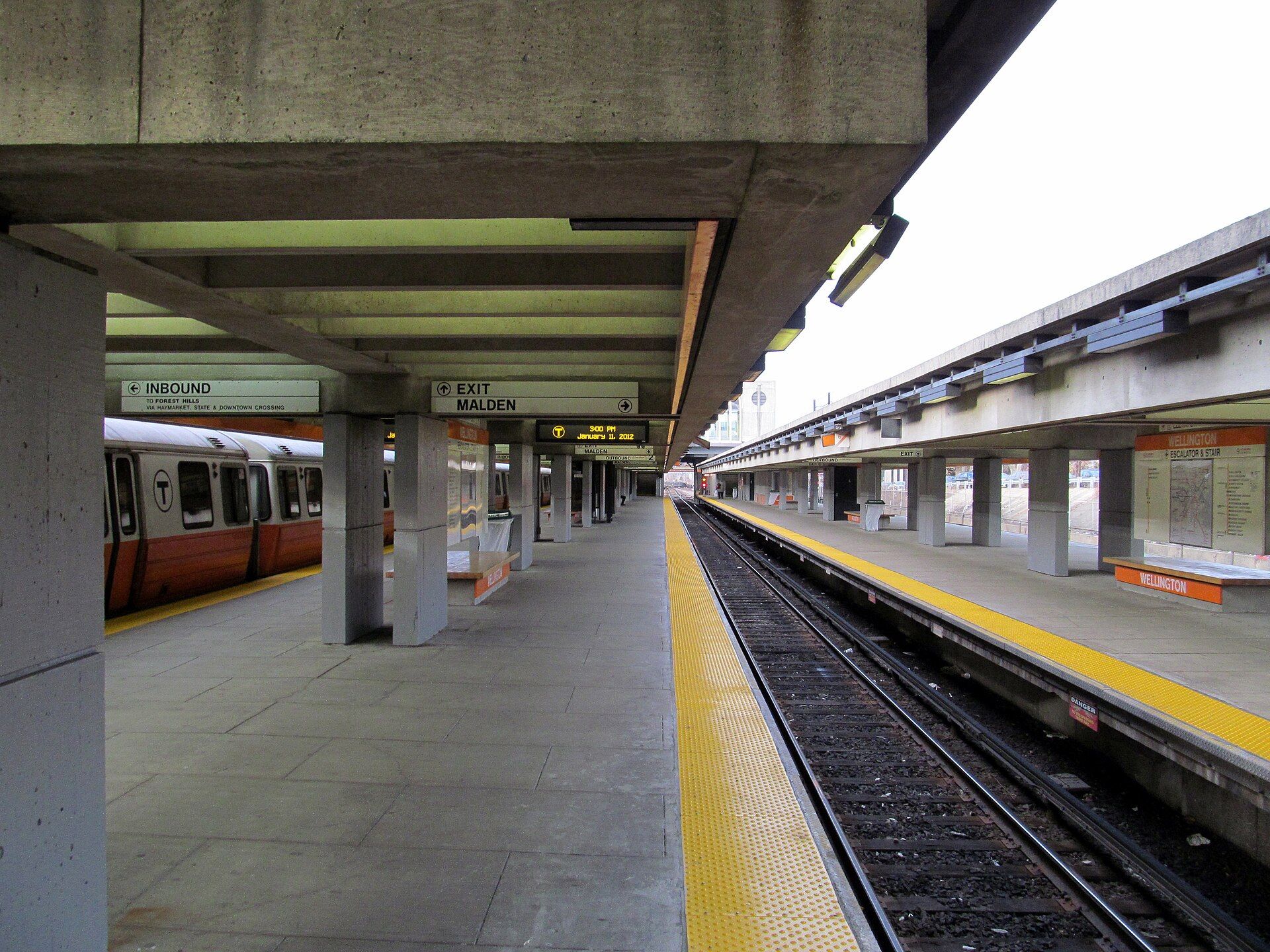
It is home to Tufts University, which has its campus on both sides of the Medford and Somerville border. Landmarks include Powder Alarm, Wellington station and Middlesex Fells Reservation. Medford is the birthplace of Lydia Maria Child, abolitionist, author and women's rights activist.
Every piece is drawn from Medford's own map data and historic archives, then printed and shipped from the USA when you order. No two towns look alike.
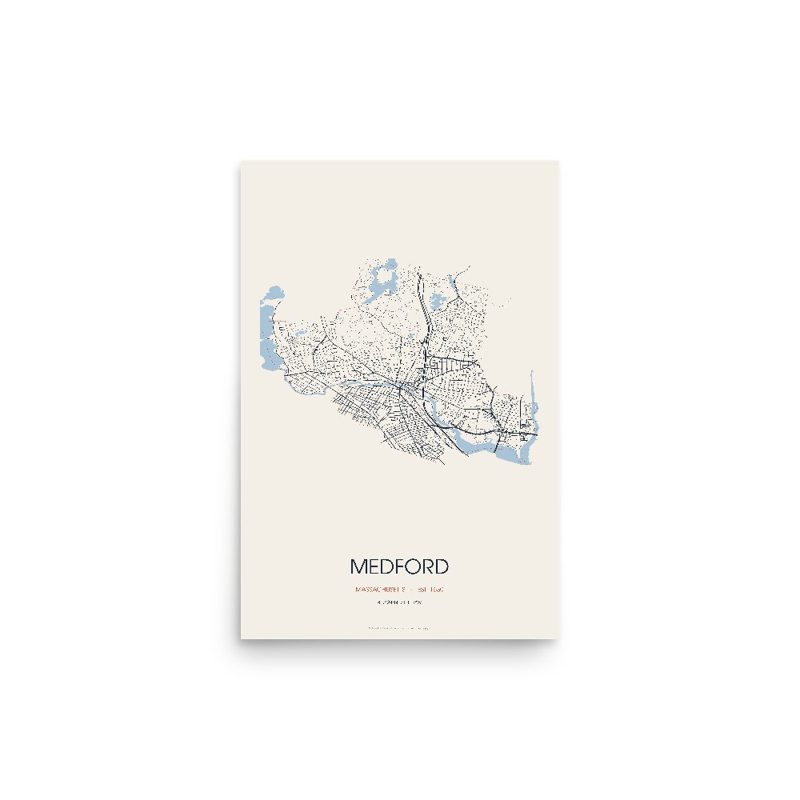
Every road in town, on archival matte paper
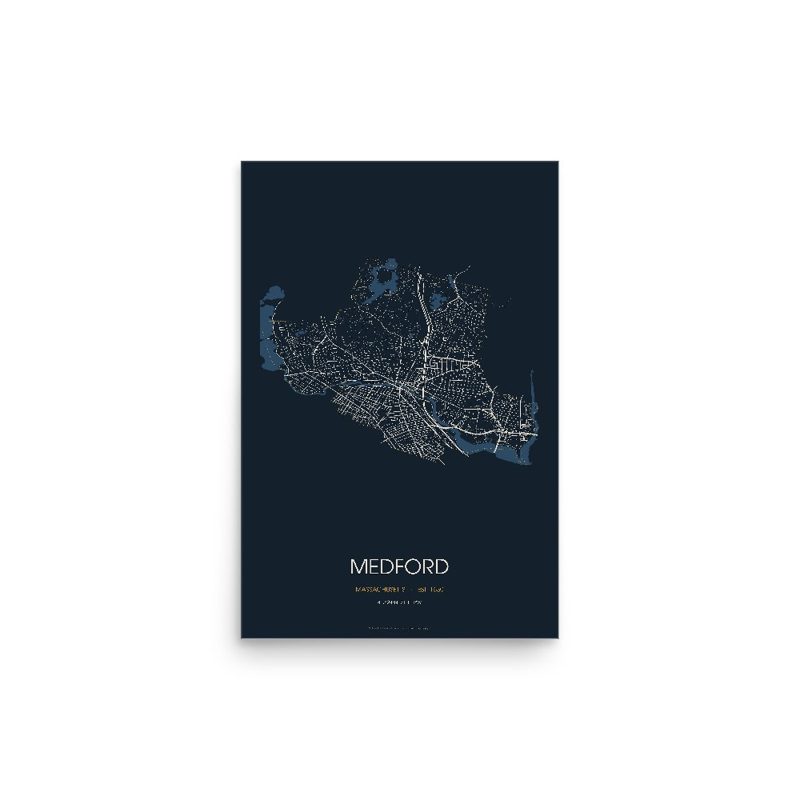
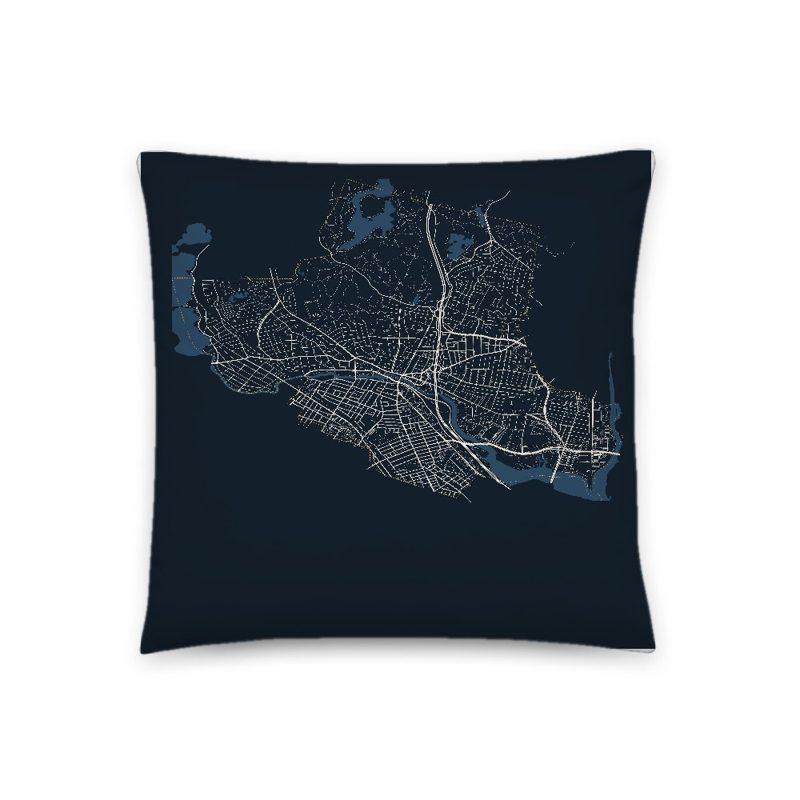
The same map, in navy and silver
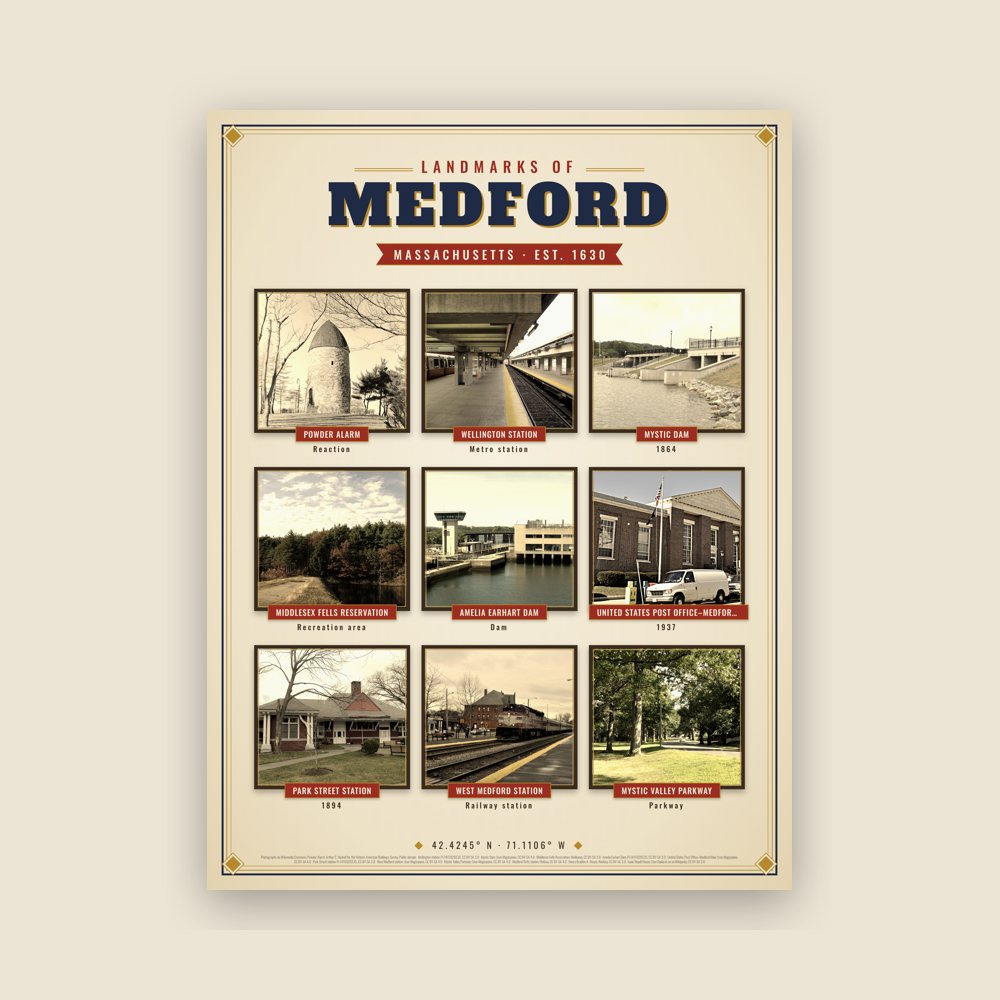
Nine local landmarks, archival matte
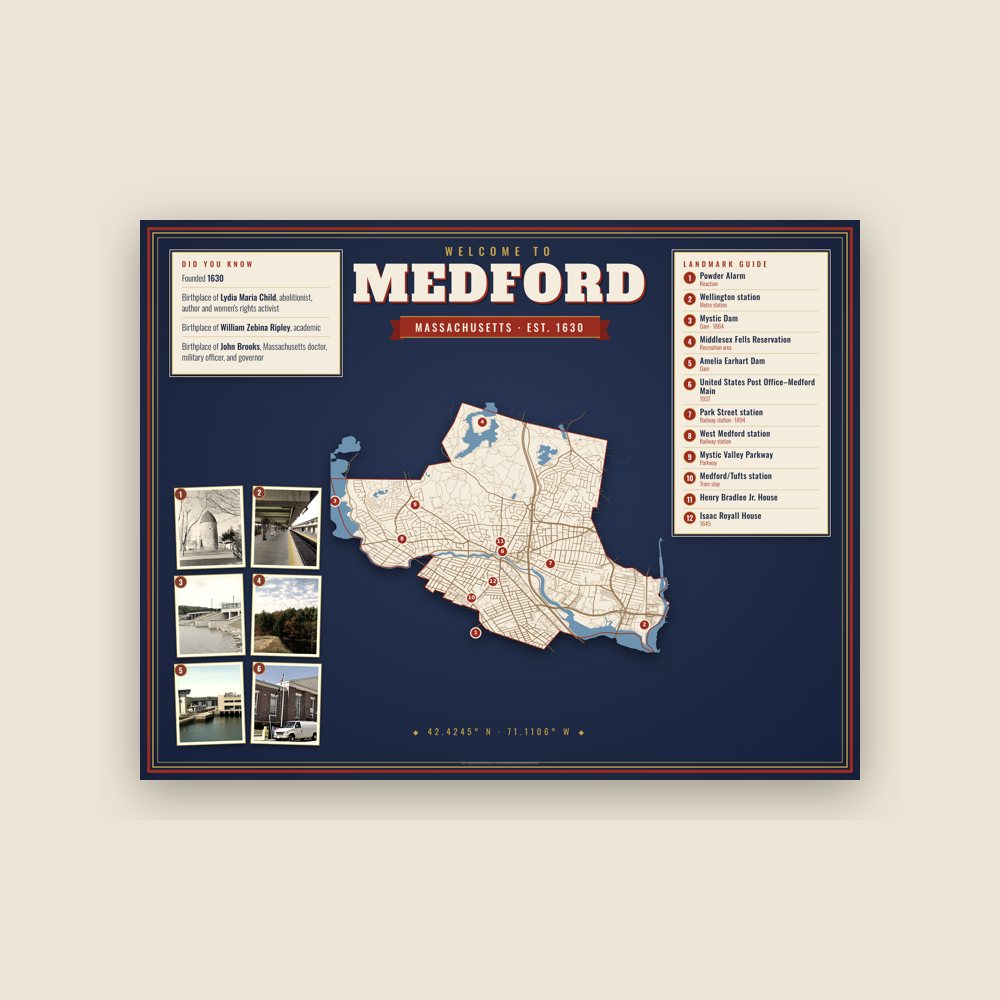
Map of local landmarks, washable fabric
Heavy-blend fleece, street map printed on the back
Soft Bella+Canvas jersey
Glossy ceramic, dishwasher safe
Ceramic keepsake, gold ribbon
Weatherproof, for the front walk
Soft-touch, zip cover
Sturdy all-over-print tote
Glossy top, cork back
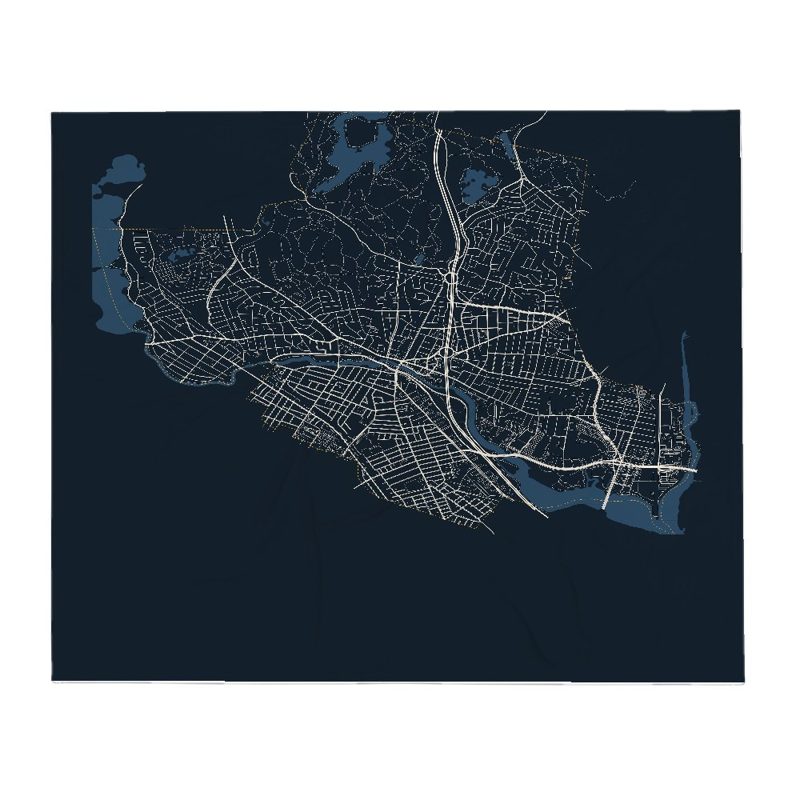
Soft fleece, 50″×60″
20 oz, double-wall stainless
Population 2010: 56,173 → 2020: 59,659
From Wikidata (CC0).
Native Americans inhabited the area that would become Medford for thousands of years prior to European colonization of the Americas. At the time of European contact and exploration, Medford was the winter home of the Naumkeag people, who farmed corn and created fishing weirs at multiple sites along the Mystic River. Naumkeag sachem Nanepashemet was killed and buried at his fortification in present-day Medford during a war with the Tarrantines in 1619. The contact period introduced several European infectious diseases which would decimate native populations in virgin soil epidemics, including a smallpox epidemic which in 1633 killed Nanepashemet's sons, sachems Montowompate and Wonohaquaham. Sagamore Park in West Medford is a native burial site from the contact period, which includes the remains of a likely sachem, either Nanepashemet or Wonohaquaham. After the 1633 epidemic, Nanepashemet's widow, known only as the Squaw Sachem of Mistick, led the Naumkeag, and over the next two decades would deed large parts of Naumkeag territory to English settlers. In 1639, the Massachusetts General Court purchased the land that would become present-day West Medford, then within the boundaries of Charlestown, from the Squaw Sachem.
Medford was settled in 1630 by English colonists as part of Charlestown, of the Massachusetts Bay Colony. The settlement was originally called "Mistick" by Thomas Dudley, based on the Massachusett name for the area's river. Thomas Dudley's party renamed the settlement "Meadford". The name may have come from a description of the "meadow by the ford" in the Mystic River, or from two locations in England that Cradock may have known: the hamlet of Mayford or Metford in Staffordshire near Caverswall, or from the parish of Maidford or Medford (now Towcester, Northamptonshire). In 1634, the land north of the Mystic River was developed as the private plantation of Matthew Cradock, a former governor. Across the river was Ten Hills Farm, which belonged to John Winthrop, Governor of the Massachusetts Bay colony.
In 1637, the first bridge (a toll bridge) across the Mystic River was built at the site of the present-day Cradock Bridge, which carries Main Street into Medford Square. It would be the only bridge across the Mystic until 1787, and as such became a major route for traffic coming into Boston from the north (though ferries and fords were also used). The bridge would be rebuilt in 1880, 1909, and 2018.
Until 1656, all of northern Medford was owned by Cradock, his heirs, or Edward Collins. Medford was governed as a "peculiar" or private plantation. As the land began to be divided among several people from different families, the new owners began to meet and make decisions locally and increasingly independently from the Charlestown town meeting. In 1674, a Board of Selectmen was elected; in 1684, the colonial legislature granted the ability to raise money independently; and in 1689, a representative to the legislature was chosen. The town got its religious meeting room in 1690 and a secular meeting house in 1696.
In 1692, the town engaged its first ordained preacher, Rev. John Hancock Sr. During his time of service, Rev. Hancock lived in Medford, serving until November 1693. One of his grandsons was John Hancock, who was a later notable figure of the American Revolutionary War and later elected as first and third governor of Massachusetts.
The land south of the Mystic River, present-day South Medford, was originally known as "Mistick Field". It was transferred from Charlestown to Medford in 1754. This grant also included the "Charlestown woodlots" (the Medford part of the Middlesex Fells), and part of what was at the time Woburn (now Winchester). Other parts of Medford were transferred from Charlestown in 1811, Winchester in 1850 ("Upper Medford"), and Malden in 1879. Additional land was transferred to Medford from Malden (1817), Everett (1875), and Malden (1877) again.
The population of Medford rose from 230 in 1700 to 1,114 in 1800. After 1880, the population rapidly expanded, reaching 18,244 by 1900. Farmland was divided into lots and sold to build residential and commercial buildings, starting in the 1840s and 1850s; government services expanded with the population (schools, police, post office) and technological advancement (gas lighting, electricity, telephones, railways). Tufts University was chartered in 1852 and the Crane Theological School at Tufts opened in 1869. In 1865, the Lawrence Rifles volunteer militia company was formed in Medford during the Civil War.
Medford was incorporated as a city in 1892, and was a center of industry, including the manufacture of tiles and crackers, bricks, rum, and clipper ships, such as the White Swallow and the Kingfisher, both built by Hayden & Cudworth.
During the 17th century, a handful of major public roads (High Street, Main Street, Salem Street, "the road to Stoneham", and South Street) served the population, but the road network started a long-term expansion in the 18th century. The Medford Turnpike Company was incorporated in 1803 and (as was reasonably common at the time) turned what is now Mystic Avenue over to the city in 1866. The Andover Turnpike Company was incorporated in 1805 and turned what is now Forest Street and Fellsway West over to Medford in 1830.
Other major commercial transportation projects included the Middlesex Canal by 1803, the Boston and Lowell Railroad in West Medford in the 1830s, and the Boston and Maine Railroad to Medford Center in 1847.
A horse-powered street railway began running to Somerville and Charlestown in 1860. The street railway network expanded in the hands of various private companies and went electric in the late 1890s when trolleys to Everett and downtown Boston were available. Streetcars were converted to buses in the 20th century. Interstate 93 was constructed between 1956 and 1963.
In 1868, a French astronomer and naturalist, Leopold Trouvelot, was attempting to breed a better silkworm using spongy moths which are native to Asia and Europe. Several moths escaped from his home at 27 Myrtle Street. Within ten years, the insect had denuded the vegetation in the neighborhood. It spread over North America.
In Simpson's Tavern, a tavern and boarding house on High Street, in the late 19th century, resident James Pierpont is rumored to have written "Jingle Bells" after watching a sleigh race from Medford to Malden. There is also a claim that Pierpont wrote it while he was the music director at Unitarian Universalist Church in Savannah, Georgia. He copyrighted the song while there.
Another resident, Lydia Maria Child (1802–1880), made a poem out of the trip across town to her grandparents' house, now the song "Over the River and Through the Wood".
Paul Revere's famous midnight ride traveled along Main Street and continued onto High Street in Medford Square. An annual re-enactment honors the historic event.
The Peter Tufts House (350 Riverside Ave.) is thought to be the oldest all-brick building in New England. Another important site is the "Slave Wall" on Grove Street, built by "Pomp", an enslaved person owned by the prominent Brooks family. The Royall House and Slave Quarters, which once belonged to one of Harvard Law School's founders, Isaac Royall, Jr., is a National Historic Landmark and a local history museum. The house was used by Continental Army troops, including George Washington and John Stark, during the American Revolutionary War.
George Luther Stearns, an American industrialist and one of John Brown's Secret Six. His passion for the abolitionist cause shaped his life, bringing him into contact with the likes of Abraham Lincoln and Ralph Waldo Emerson and starting The Nation magazine. He was given the rank of major by Massachusetts Governor John Andrew and spent most of the Civil War recruiting for the 54th and 55th Massachusetts regiments and the 5th Cavalry.
Elizabeth Short, the victim of an infamous Hollywood murder and who became known as The Black Dahlia, was born in Hyde Park (the southernmost neighborhood of the city of Boston, Massachusetts) but raised in Medford before going to the West Coast looking for fame.
Medford has sent more than its share of athletes to the National Hockey League; Shawn Bates, though born in Melrose, grew up in Medford, as did Keith Tkachuk, Mike Morrison, David Sacco and Joe Sacco. Former Red Sox pitcher Bill Monbouquette grew up in Medford, as did former Major League Baseball infielder Mike Pagliarulo.
Medford was home to Michael Bloomberg, American businessman, philanthropist, and the founder of Bloomberg L.P. He was the mayor of New York City from 2002 to 2013. Mayor Bloomberg attended Medford High School and resided in Medford until after he graduated from college at Johns Hopkins University. His mother remained a resident of Medford until her death in 2011.
The only cryobank of amniotic stem cells in the United States is located in Medford, built by Biocell Center, a biotechnology company led by Giuseppe Simoni.
Meadow Glen Mall, an enclosed shopping mall in Medford, closed on February 1, 2016, as the property was prepared for redevelopment into a retail plaza.
One of the biggest bank robberies and jewel heists in world history happened on Memorial Day weekend in 1980, when several officers of the Medford Police and Metropolitan District Commission Police forces robbed the Depositors Trust Bank in Medford Square, yielding an estimated $25 million. The book The Cops Are Robbers: A Convicted Cop's True Story of Police Corruption is based upon this event. Salvatore's Restaurant, later known as "The Vault", was located at 55 High Street in Medford Square, in partially in the same location as the bank that was robbed. The private dining room in the restaurant used the bank's vault door as an entrance way, and the hole in the corner of the ceiling that the robbers crawled through was left intact for nostalgia. The restaurant is now closed, a Chase Bank location taking its place.
An admitted Mob execution by Somerville's Winter Hill Gang of Joe "Indian-Joe" Notarangeli took place on April 19, 1973, at the "Pewter Pot" café in Medford Square, now called the "Lighthouse Cafe."
In October 1989, the FBI recorded a Mafia initiation ceremony held by the Patriarca crime family at a home on Guild St. in Medford.
Adapted (trimmed) from the Wikipedia article Medford, Massachusetts, revision 1378567762 by its contributors, licensed CC BY-SA 4.0.
We share a part of every Medford sale with local partners, and we'd love to print from your collection. Old photographs, maps and postcards make the best keepsakes.
Partner with us