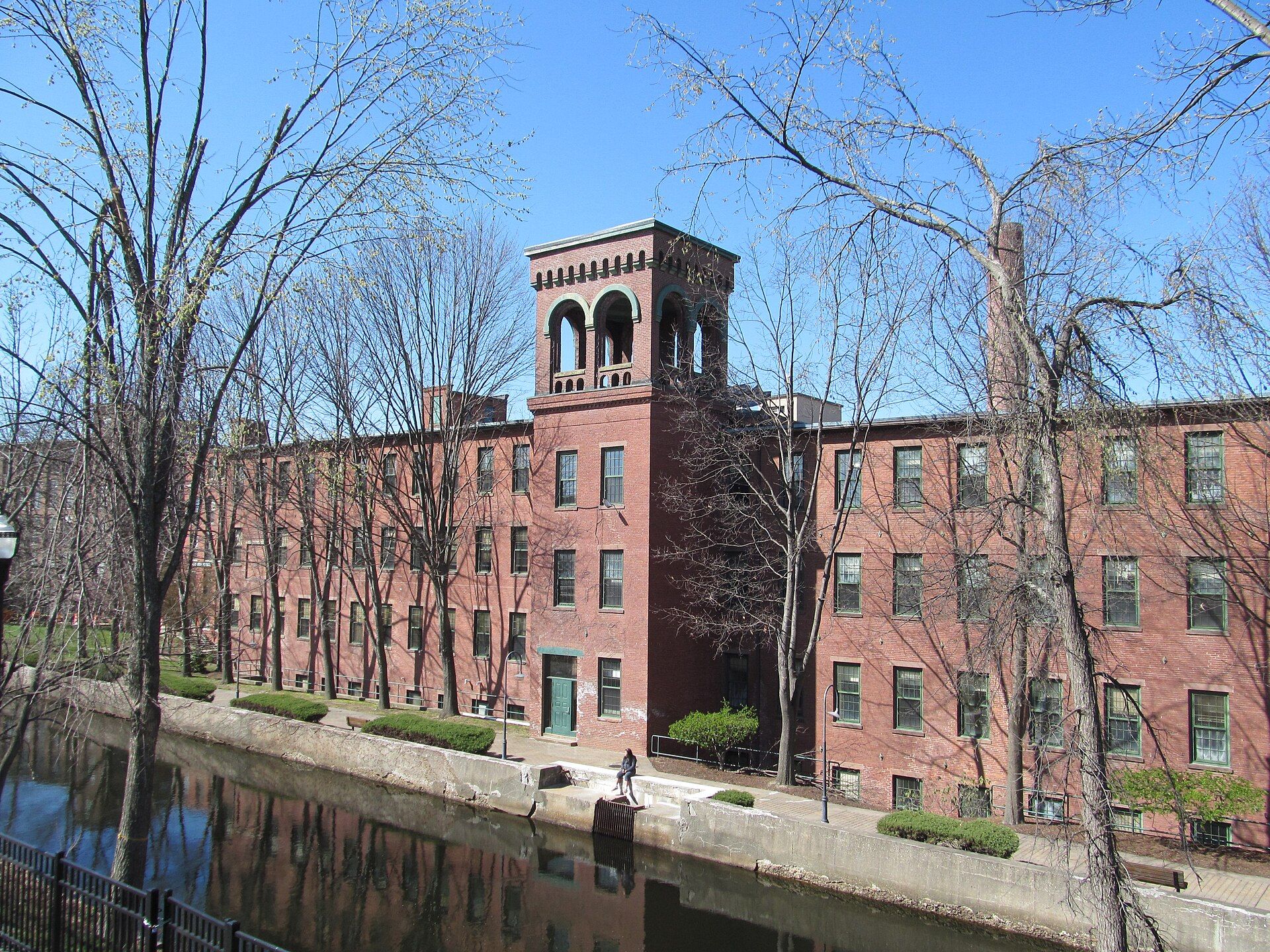
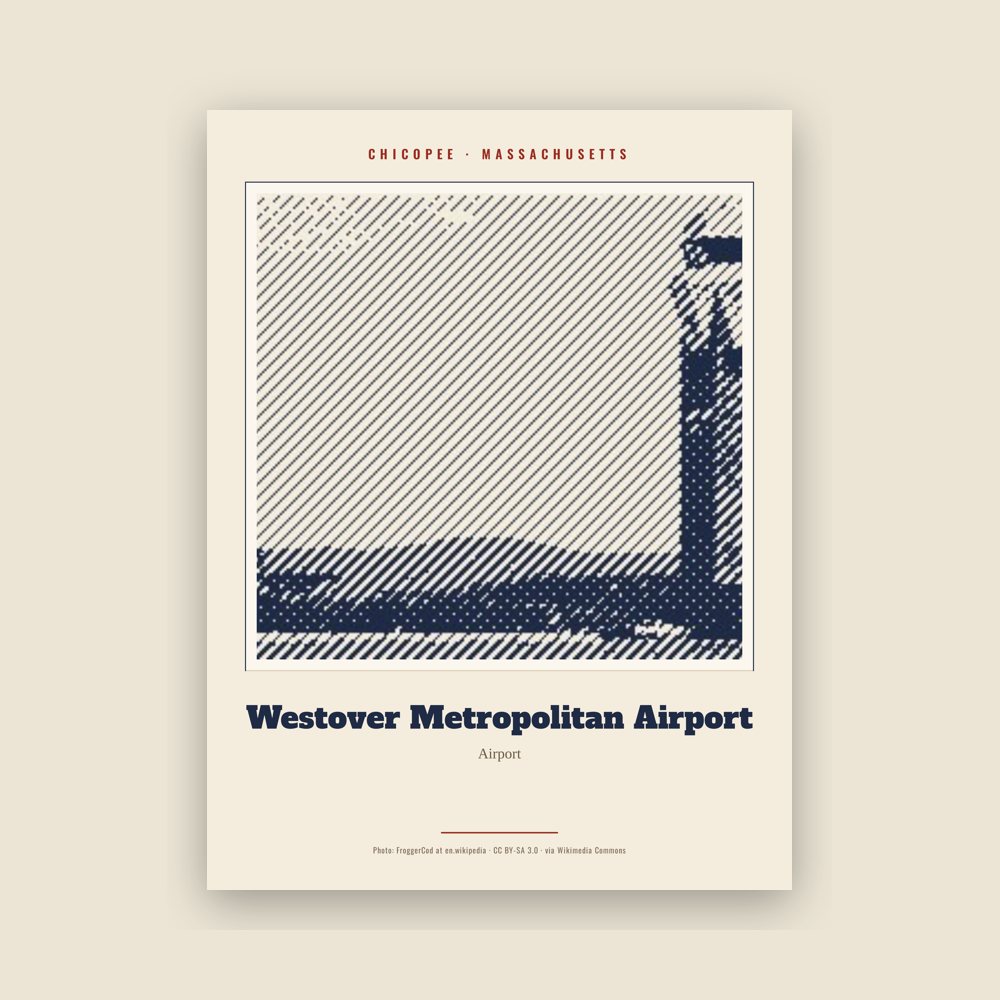
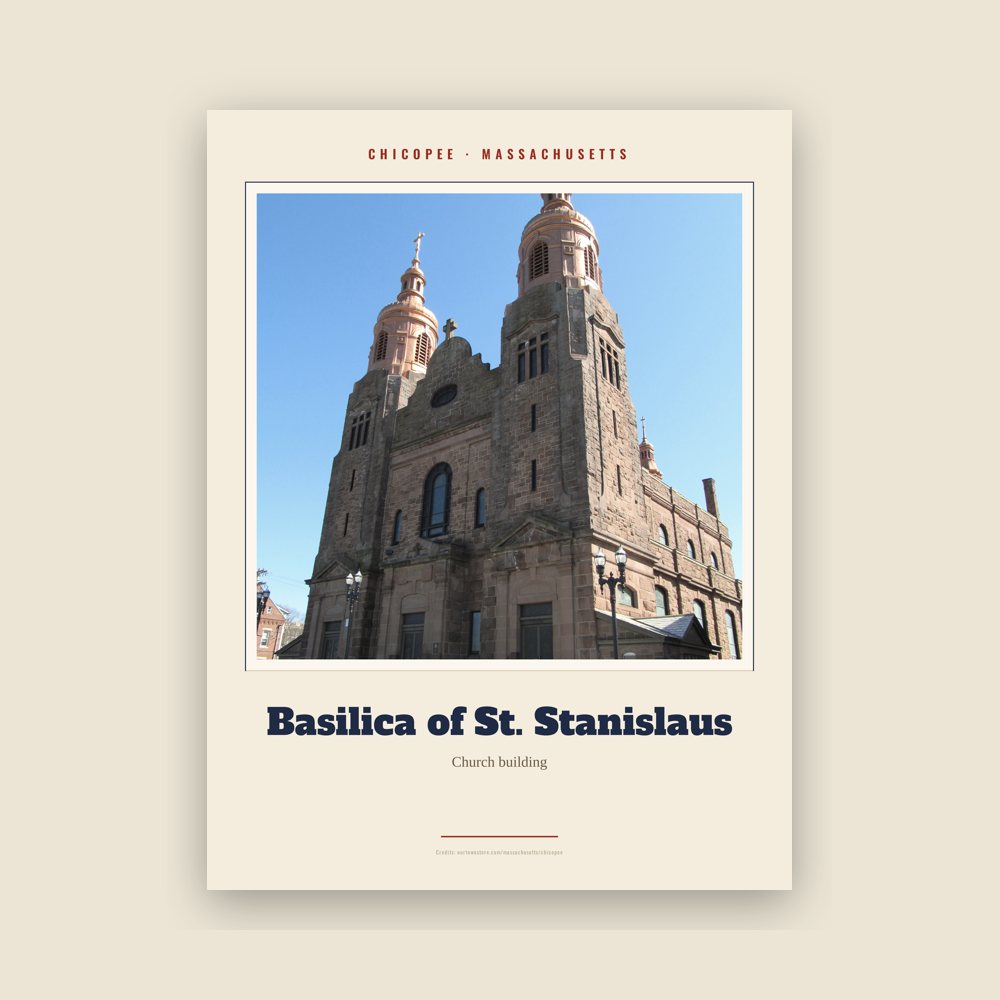
The communities of Chicopee Center, Chicopee Falls, Willimansett, Fairview, Aldenville, Burnett Road, Smith Highlands and Westover are located within the city. Landmarks include Westover Metropolitan Airport, Basilica of St. Stanislaus and Westover Air Reserve Base. Chicopee is the birthplace of Edward Bellamy, author and socialist.
Every piece is drawn from Chicopee's own map data and historic archives, then printed and shipped from the USA when you order. No two towns look alike.
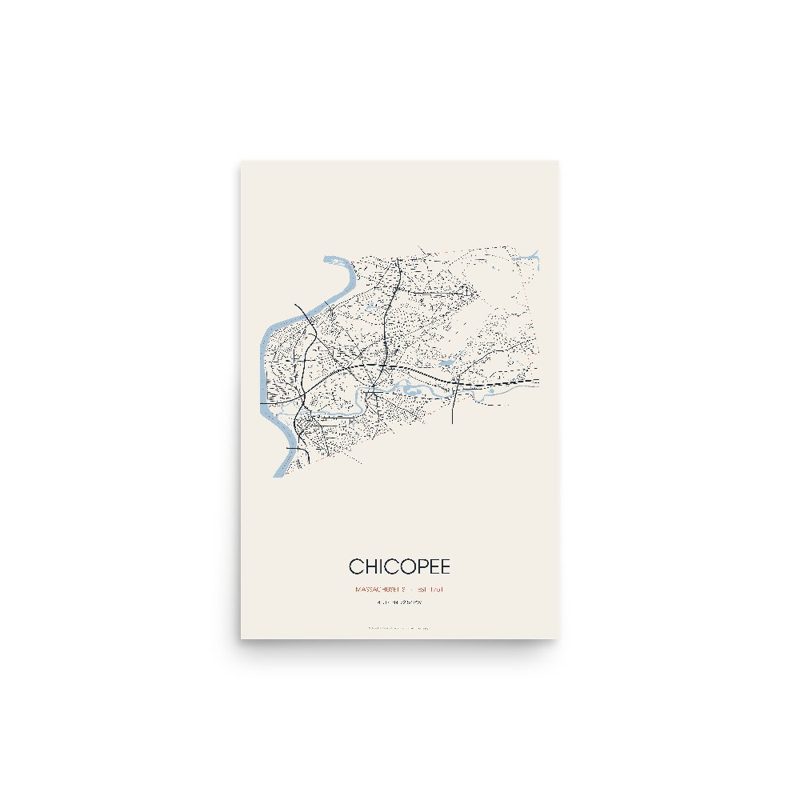
Every road in town, on archival matte paper
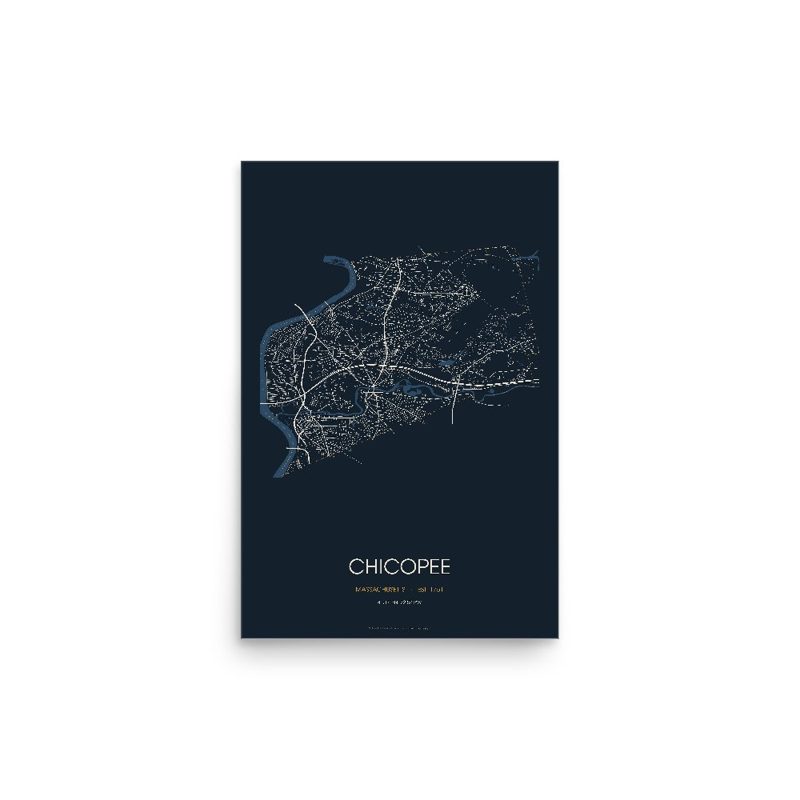
The same map, in navy and silver
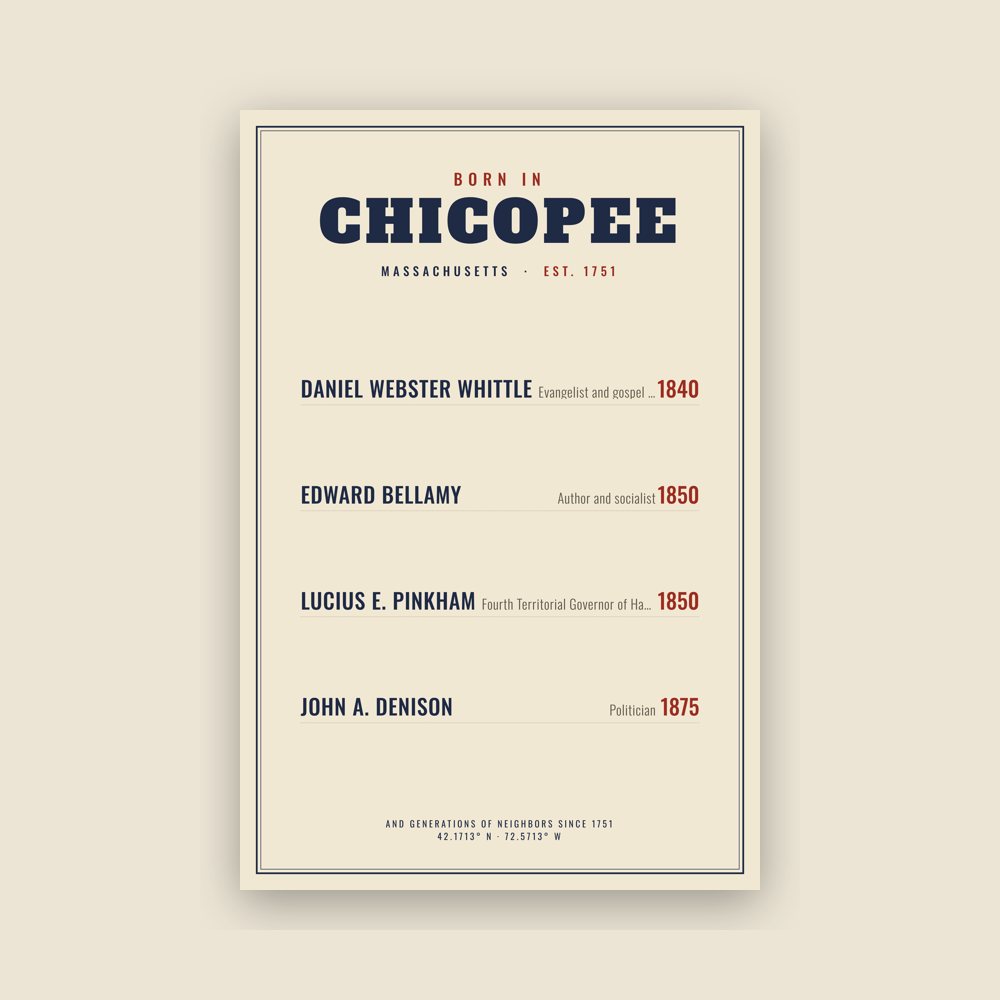
Famous natives, by birth year
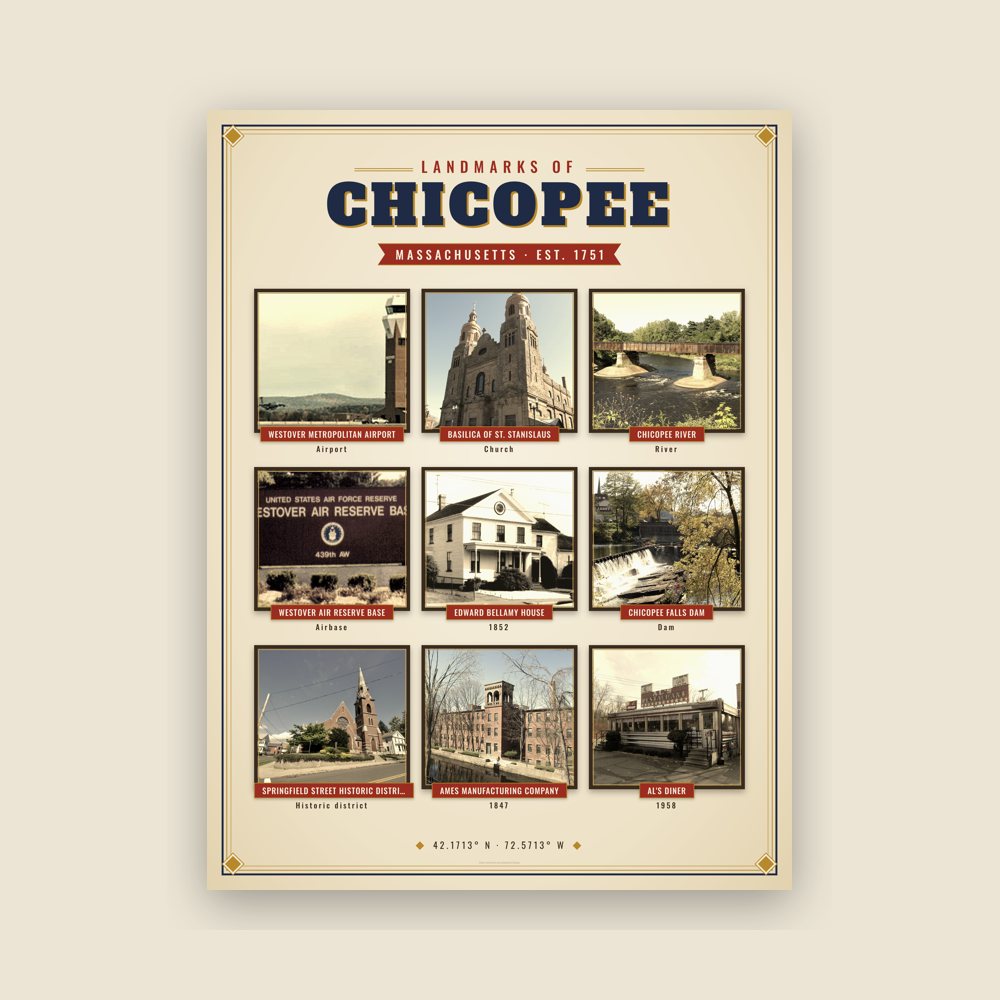
Nine local landmarks, archival matte
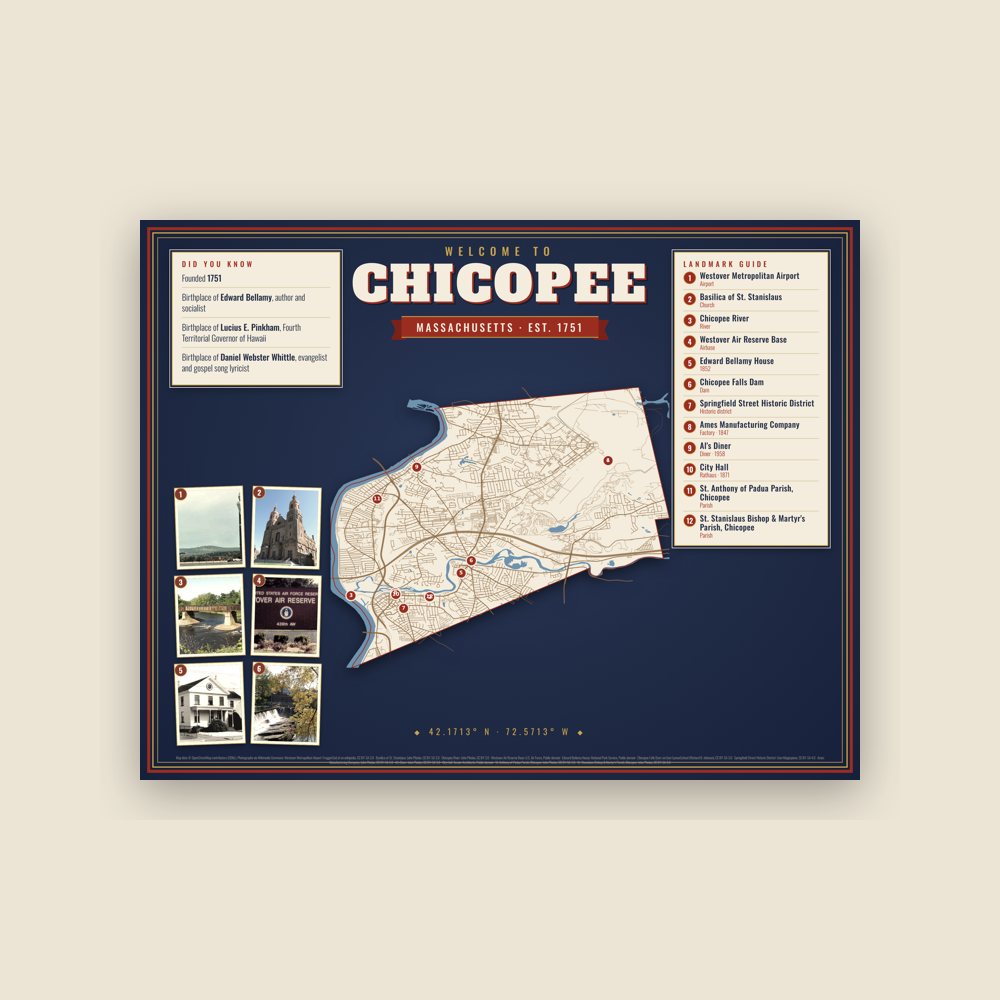
Map of local landmarks, washable fabric
Heavy-blend fleece, street map printed on the back
Soft Bella+Canvas jersey
Glossy ceramic, dishwasher safe
Ceramic keepsake, gold ribbon
Weatherproof, for the front walk
24″×16″, printed coir-look fibers, rubber back
12″×12″ printed wood, ready to hang
Soft-touch, zip cover
Sturdy all-over-print tote
Glossy top, cork back
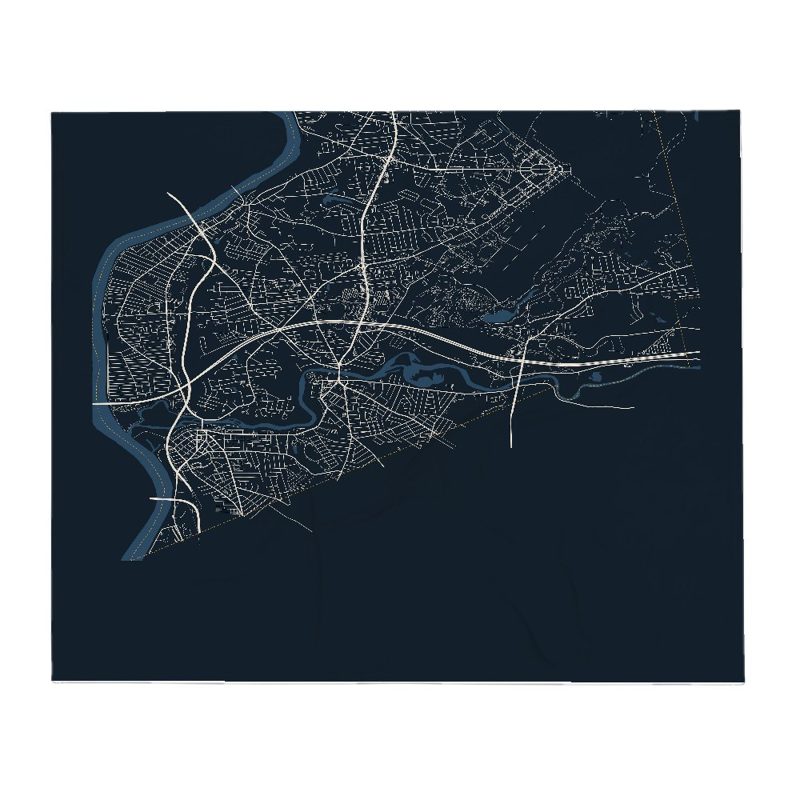
Soft fleece, 50″×60″
20 oz, double-wall stainless
Archival matte print of a local landmark, credited to its photographer
Archival matte print of a local landmark, credited to its photographer
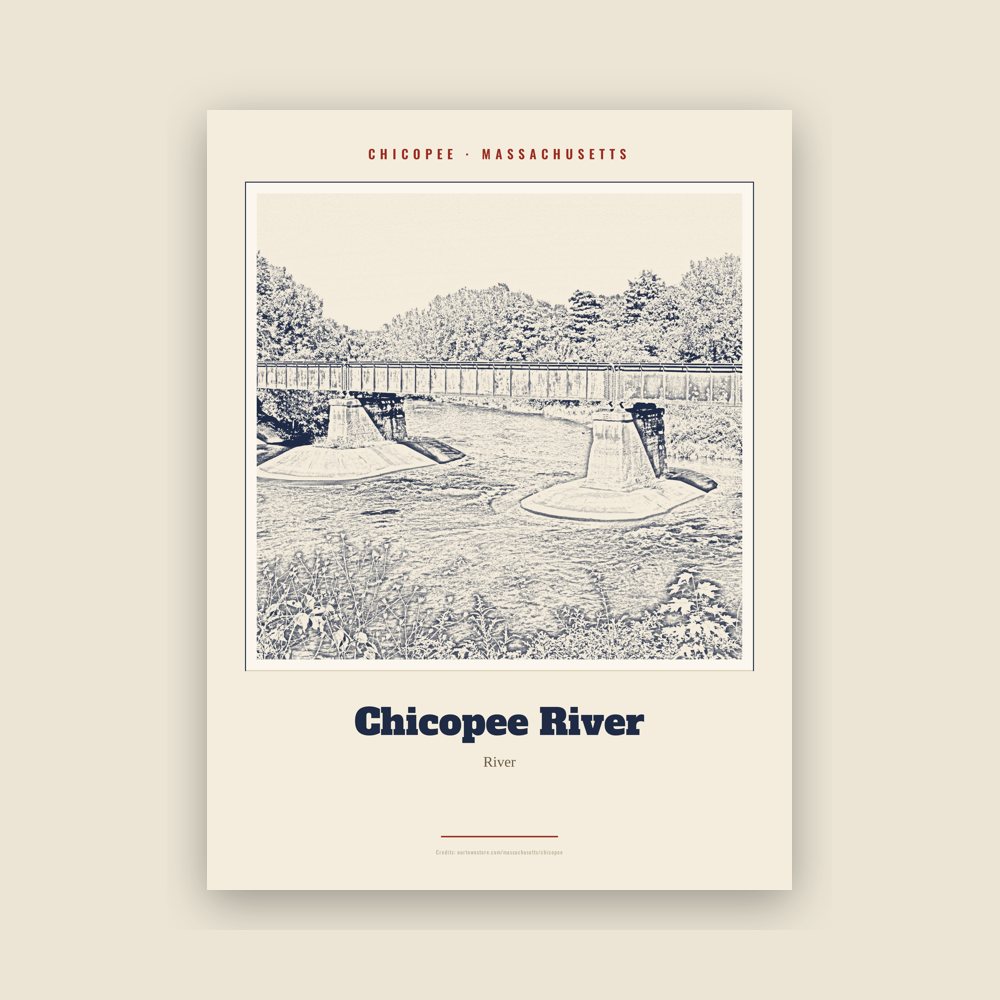
Archival matte print of a local landmark, credited to its photographer
Archival matte print of a local landmark, credited to its photographer
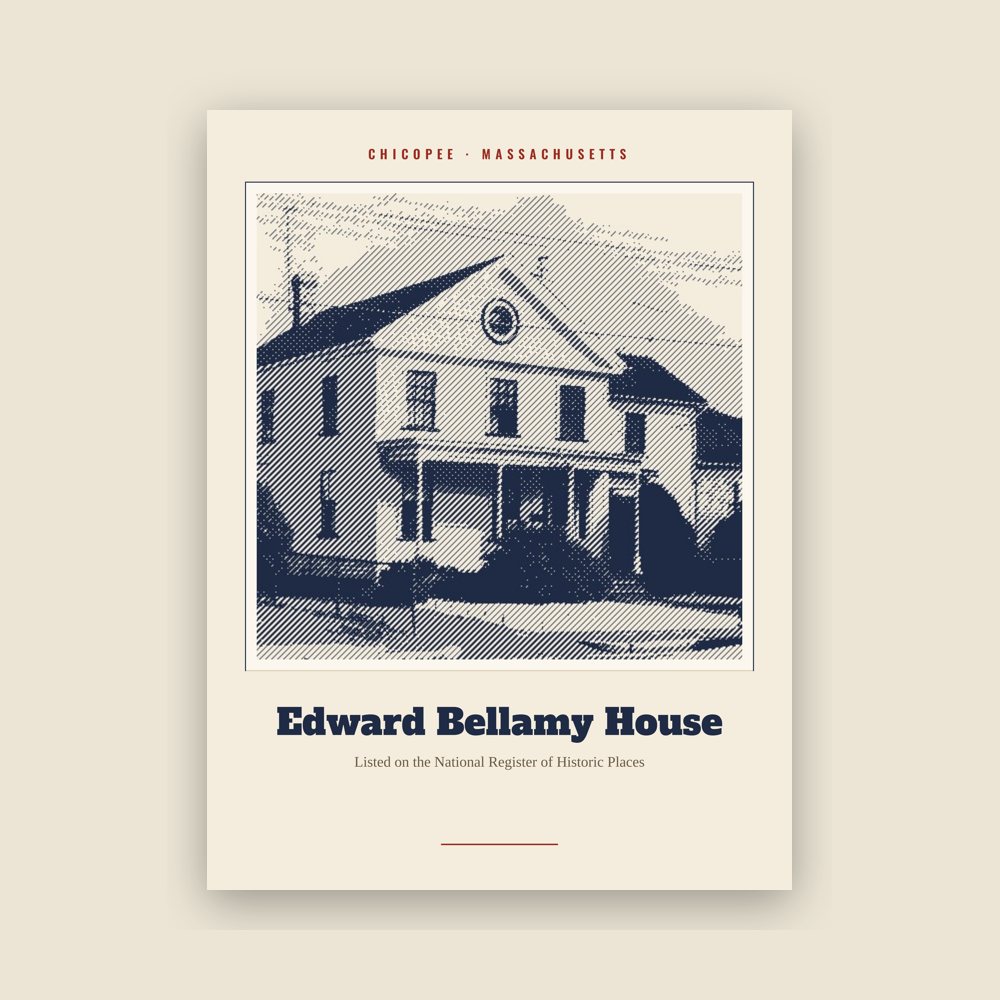
Archival matte print of a local landmark, credited to its photographer
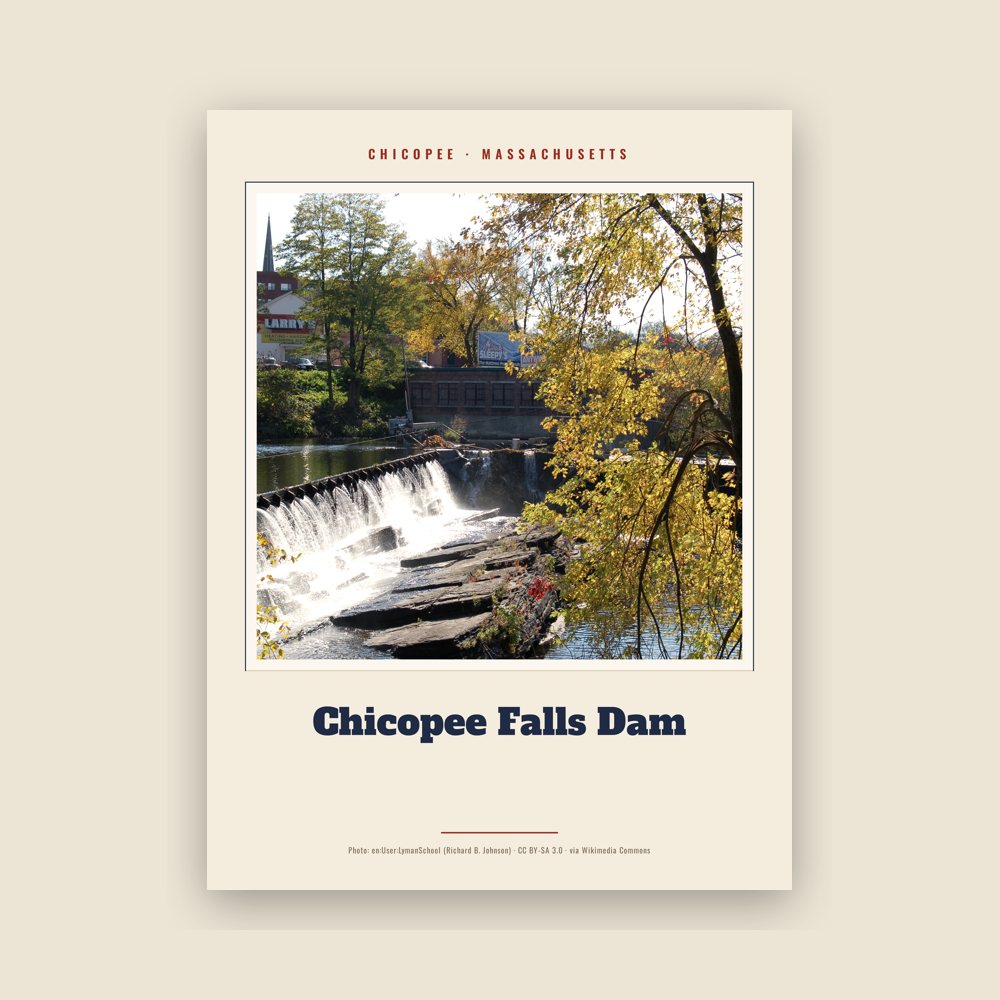
Archival matte print of a local landmark, credited to its photographer
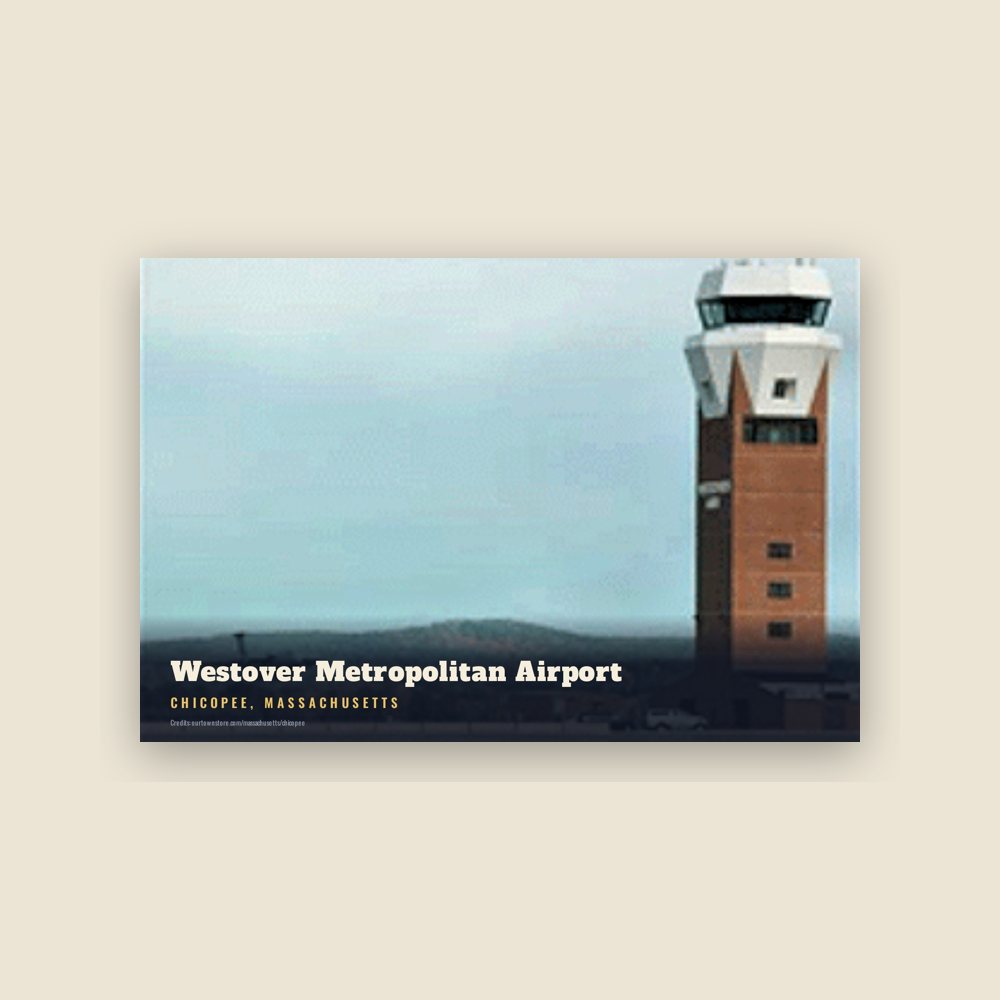
6″×4″ postcard, glossy front
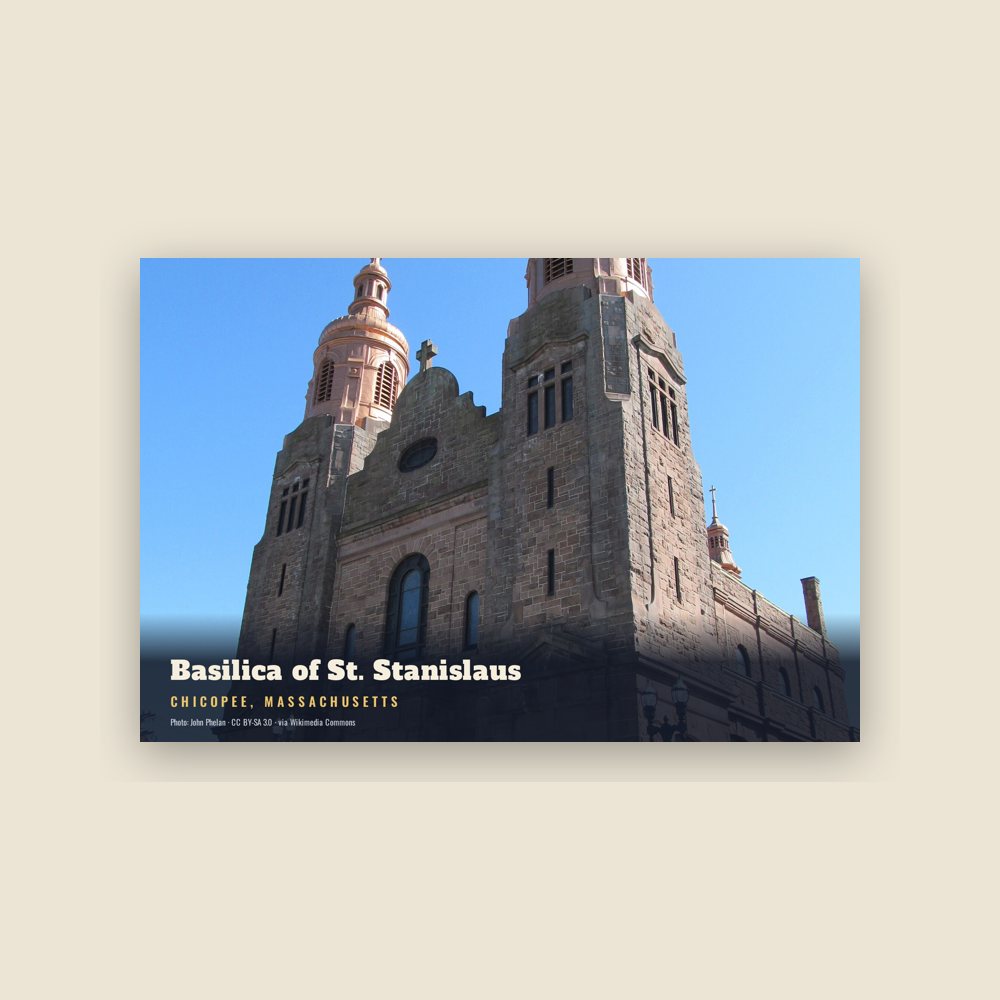
6″×4″ postcard, glossy front
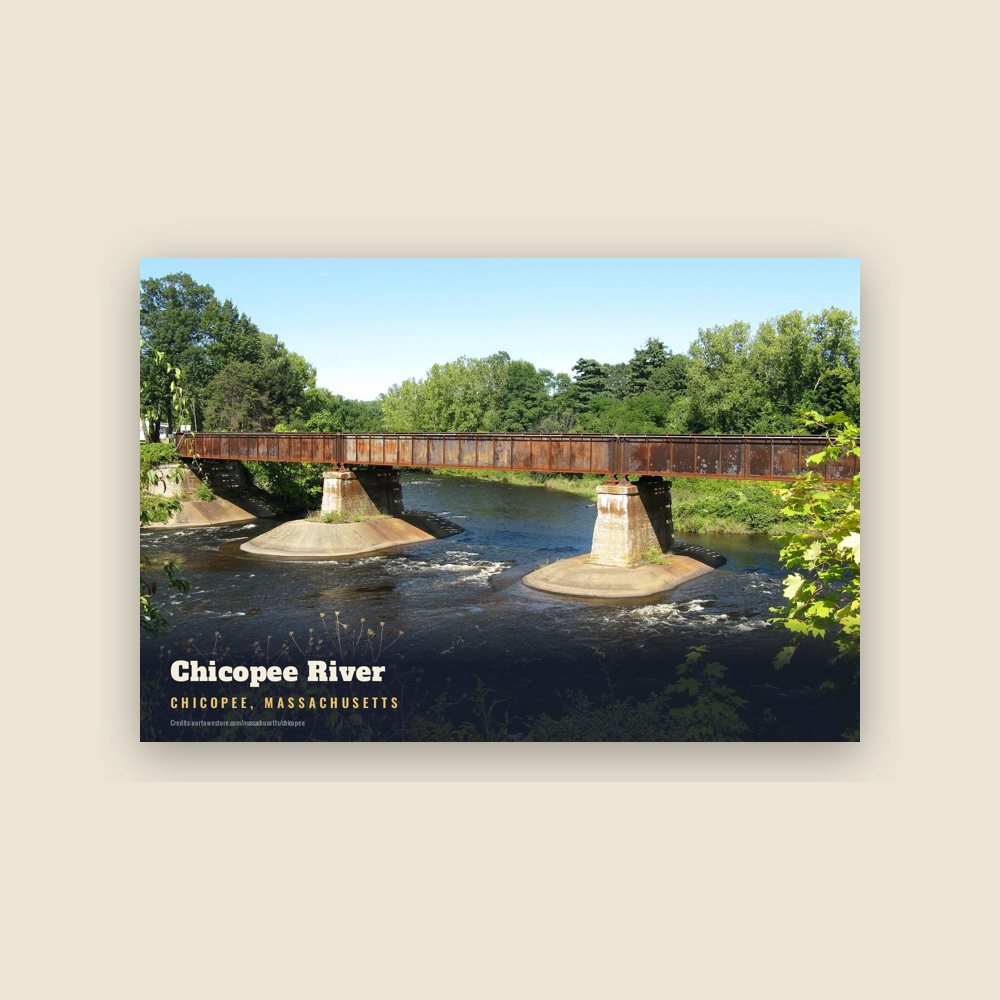
6″×4″ postcard, glossy front
6″×4″ postcard, glossy front
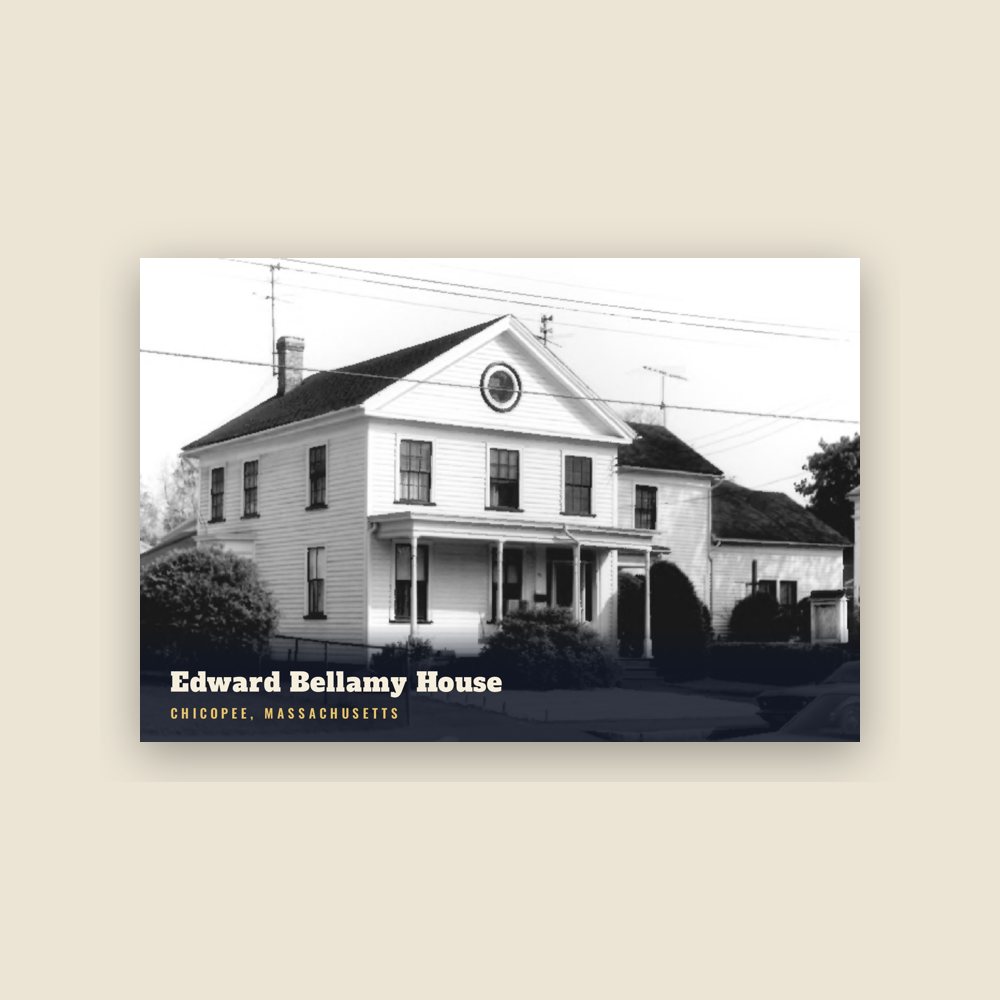
6″×4″ postcard, glossy front
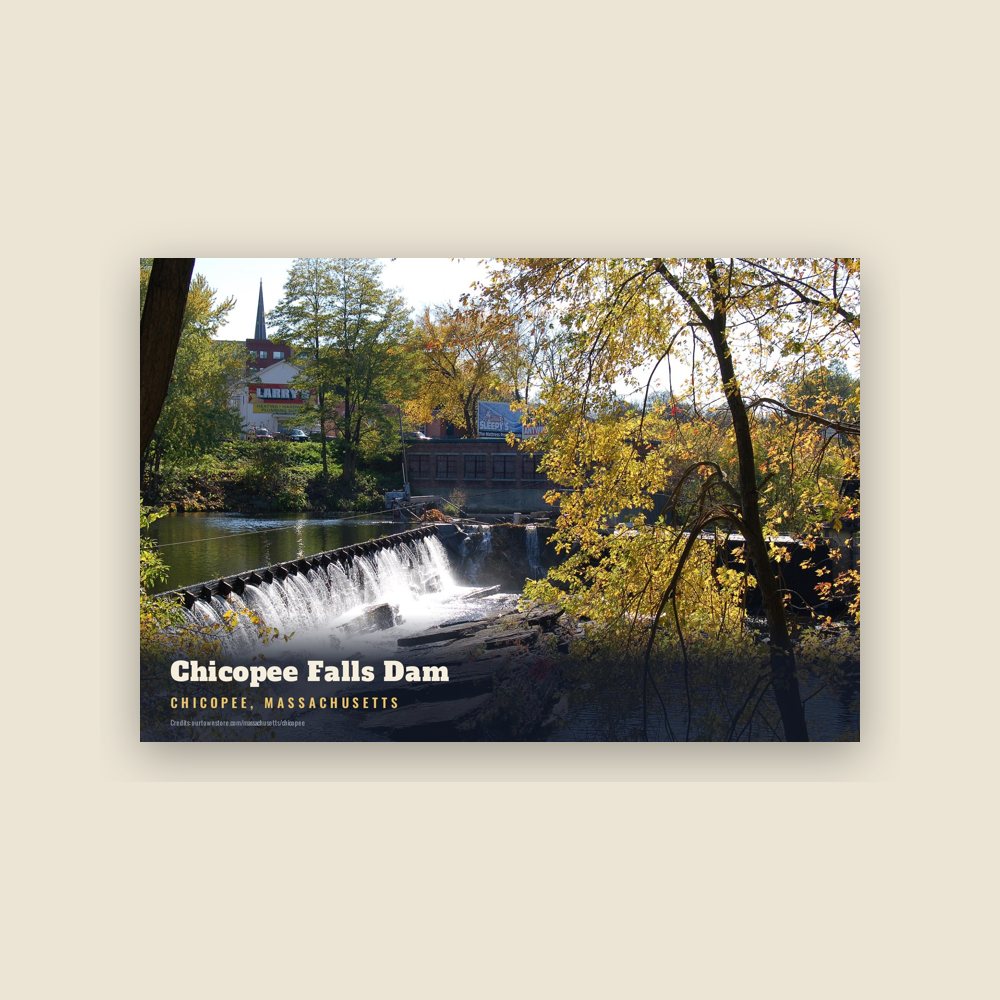
6″×4″ postcard, glossy front
Population 2010: 55,298 → 2020: 55,560
From Wikidata (CC0).
"Chicopee" is derived from the Nipmuc language. It is likely derived from chekee ("violently") and -pe (root suffix used in water place names) or chikkupee ("of red cedar"), an adjectival form of chikkup ("red cedar").
In 1636, William Pynchon purchased land from the Agawam Indians on the east side of the Connecticut River. He moved from the Town of Roxbury to Springfield to found the first settlement in the area that comprises the territory of today's Chicopee Center (Cabotville). Both Cabotville and the Falls were developed as manufacturing centers (villages).
According to local historian Charles J. Seaver, the area above the falls was first settled in 1660. The land purchased from the Indians was divided into districts. Nayasett (Nipmuc for "at the small point/angle") was the name given to the area of what are now Chicopee Center and Chicopee Falls. The settlement in the upper district was at Skipmuck (possibly based on Nipmuc Skipmaug, meaning "chief fishing place" or Shipmuck, meaning "big watery place"), a place above the falls on the south side of the river.
Colonists built a sawmill as the first industrial site along the river. The mill was built at Skenungonuck (Nipmuc for "green fields") Falls (now Chicopee Falls) in 1678 by Japhet Chapin, John Hitchcock and Nathaniel Foote.
In 1786, ten men leased two acres of land in Chicopee Falls to James Byers and William Smith of Springfield on the condition they build an iron foundry within two years. Byers and Smith built the foundry. Benjamin Belcher acquired the site by 1805 and expanded the foundry. Belcher sold water access and other holdings along the Chicopee River to the Boston Associates, including Jonathan and Edmund Dwight. Access to water power and cast iron allowed Chicopee Falls develop into a factory village, specializing in textiles, arms and agricultural tools.
Between 1823 and 1841, the Boston Associates established four textile companies along the Chicopee River, building two power canals. By 1856, the mills had consolidated, leaving the Chicopee Manufacturing Company and the Dwight Manufacturing Company in Chicopee Falls and Chicopee Center respectively. By 1875, nearly one in four people in Chicopee worked in cotton goods manufacturing, primarily at these two mills.
Before and after the partition, eight Chicopee River companies gained product recognition around the globe: Ames, Belcher, Lamb, Dwight, Stevens, Spalding, Fisk, and Duryea. Below the falls, in the bend of the river at a place called Factory Village, an important chapter of the region's industrial history was played out.
In 1716, Upper Chicopee, Lower Chicopee and Skipmunk were divided into Springfield's fourth, fifth and sixth precincts, respectively.
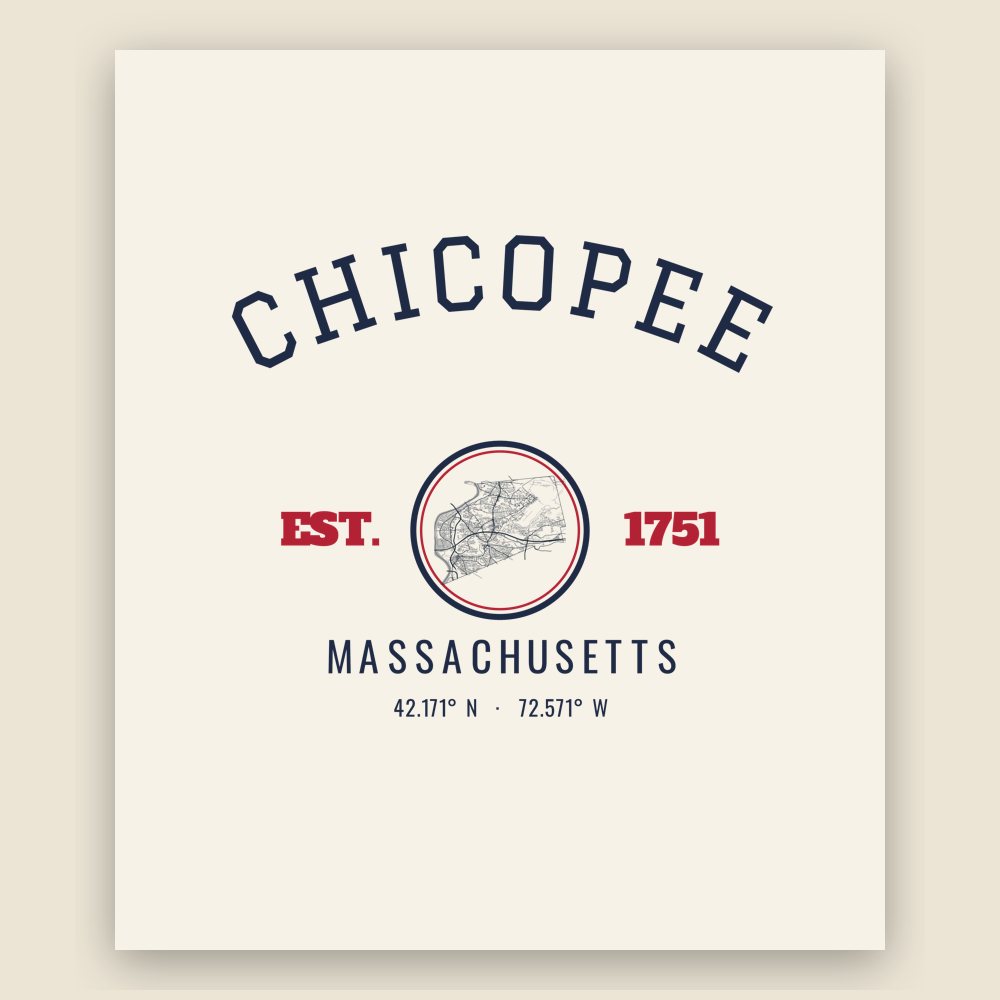
In the late 1740s, a discussion took place among members of the First Church of Springfield over whether the town should build a new meetinghouse out of brick, which would be more expensive yet durable, or timber, which would be relatively inexpensive. Residents of what is now Chicopee tended to support a timber meetinghouse, due to the time-consuming four to eight mile journey that visiting the meetinghouse would require. In 1749, residents in Springfield's fourth, fifth and sixth precincts petitioned the Massachusetts General Court to form their own parish, with their own church and meetinghouse. Facing opposition from Springfield, the petition was rejected by the General Court. In 1750, the petition was filed again by Japhet Chapin, signed by 49 residents of what are now Chicopee and Holyoke, and was approved by the General Court. This created Springfield's Fifth Parish. The boundaries of the new parish were laid out on June 11, 1751. The first service took place on July 21, 1751. This marked the earliest move toward political separation by Chicopee and Holyoke from Springfield.
In 1844, Springfield's Second Parish, now containing only Chicopee, petitioned the General Court to separate as its own municipality. Once again opposed by Springfield's First Parish, their petition was rejected. In 1848, Springfield began to seek a city charter. Second Parish residents tended to oppose a city charter on the grounds of increased expenditures. In response, 700 residents of Chicopee's neighborhoods of Cabotville, Chicopee Falls, Chicopee Street and Willimansett signed a petition to form their own municipality.
The General Court approved Chicopee's Act of Incorporation on April 25, 1848. Governor George N. Briggs signed the act on April 29, 1848, creating the Town of Chicopee. Chicopee's first municipal elections took place at Chicopee's first town meeting on May 17, 1848, at 1:00 p.m. When electing State Representatives and State Senators, the Town of Chicopee would be treated as a district of Springfield until after the 1850 U.S. census.
On April 18, 1890, the community was granted a charter as a city by the Massachusetts General Court. George Sylvester Taylor (1822–1910) became Chicopee's first mayor on January 5, 1891.
Westover Field was created by a war-readiness appropriation signed by president Franklin D. Roosevelt in 1939. The site used to be tobacco crop fields east of and part of Fairview, east of Aldenview, and northern Willimansett. It was assigned to the United States Army Air Corps Northeast Air District. It was renamed Westover Air Force Base in 1948 after that Air Force's creation as a separate service. In 1974 SAC leadership turned the base over to the Air Force Reserve.
In 1991, St. Stanislaus Bishop and Martyr Church, located on Front Street, was proclaimed a minor basilica by Pope John Paul II.
Chicopee adopted the motto "Industriae Variae", which means "Various Industries". Chicopee's industries included cotton mills, woolen mills, textiles, brass and iron foundries, paper making, footwear factories, for leather boots and shoes, the first friction matches, and ship building. In nearby South Hadley Canal, the firearms company Crescent-Davis specialized in producing double-barrel shotguns.
The Ames Manufacturing Company made many machines and bronze cannons, and more swords than any other American manufacturer at the time. Ames cast a number of bronze statues, including Thomas Ball's monumental equestrian statue of President George Washington, installed in Boston's Public Garden. Ames was a major provider of cannon to the Union army during the Civil War. The Stevens Arms plant (later Savage) was responsible for most of the No. 4 Enfields manufactured for the British under Lend-Lease. Chicopee was home to production of the first gasoline-powered automobile made in the United States, the Duryea.
During the late nineteenth century, Chicopee Falls became a major manufacturing center of bicycles. The town was the site of at least two bicycle factories: The Overman Wheel Company (1882 to about 1899), and the Spalding sporting goods company.
Albert H. Overman moved his bicycle production from Hartford, Connecticut, to Chicopee Falls in 1883. The Overman company benefited from the surging popularity of the safety bicycle during the bicycle boom of the 1890s. At its height in 1894, Overman's factory employed over 1,200 workers. The boom eventually went bust, as overproduction drove the price of bicycles down. By 1901 the Overman firm was out of business.
The Chicopee Public Library developed from the Cabot Institute, a literary society organized in 1846. The society voted on April 4, 1853, to donate its books to the town. It was the first locally funded public library in Western Massachusetts.
Adapted (trimmed) from the Wikipedia article Chicopee, Massachusetts, revision 1373602467 by its contributors, licensed CC BY-SA 4.0.
We share a part of every Chicopee sale with local partners, and we'd love to print from your collection. Old photographs, maps and postcards make the best keepsakes.
Partner with us