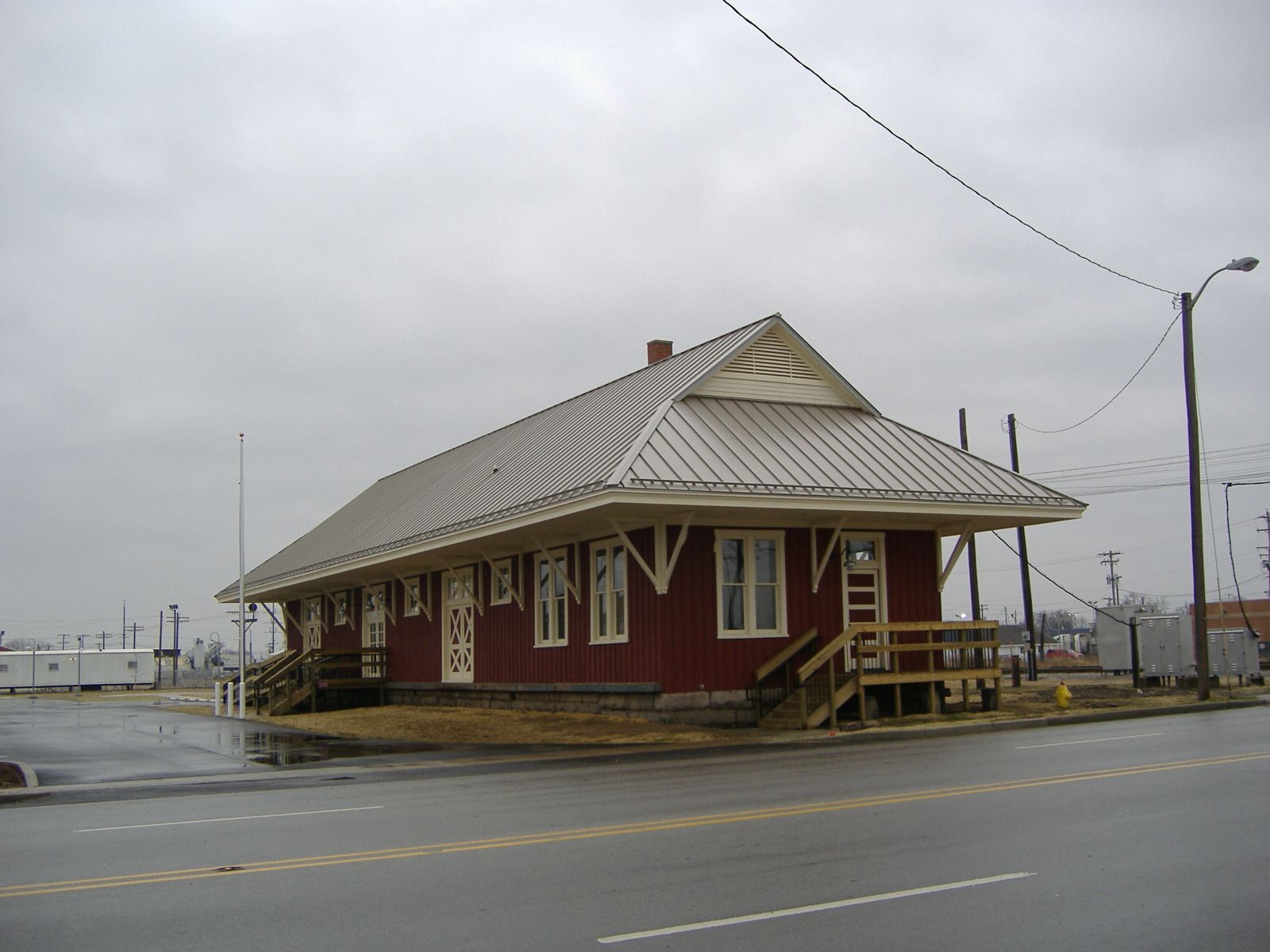
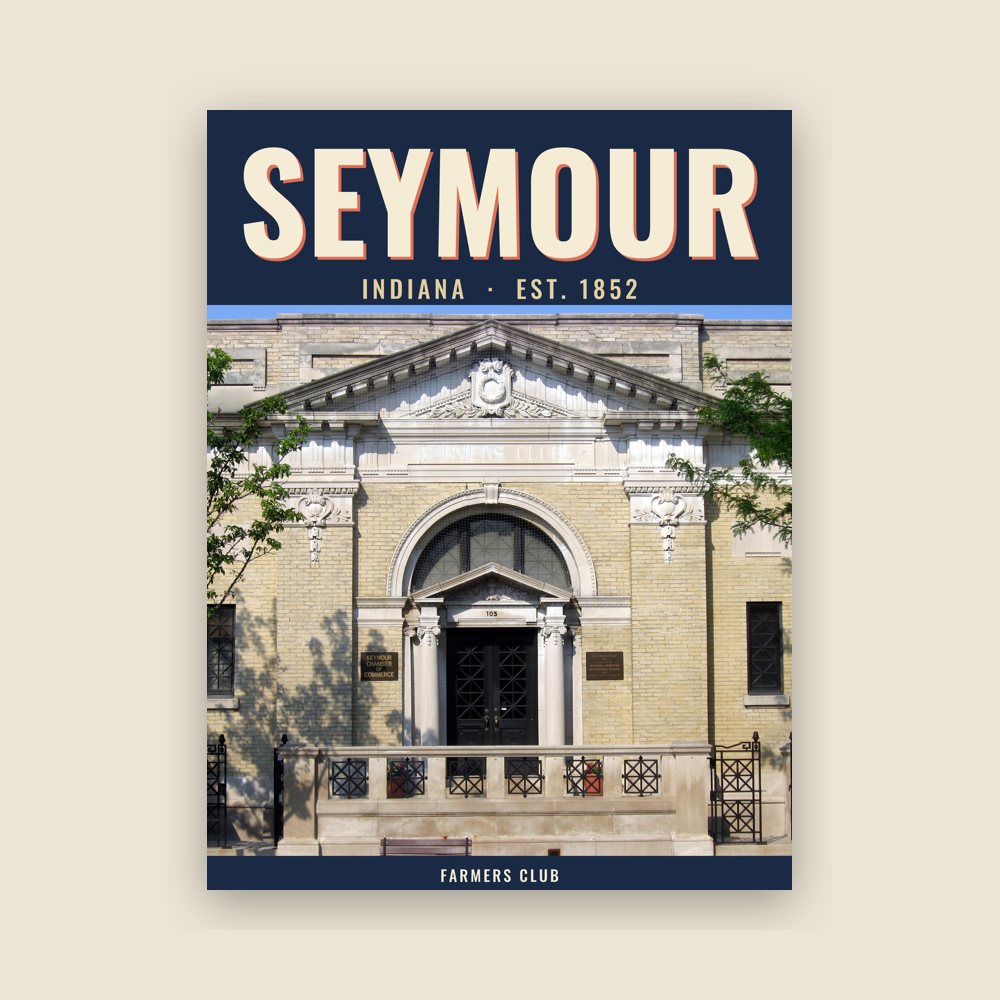
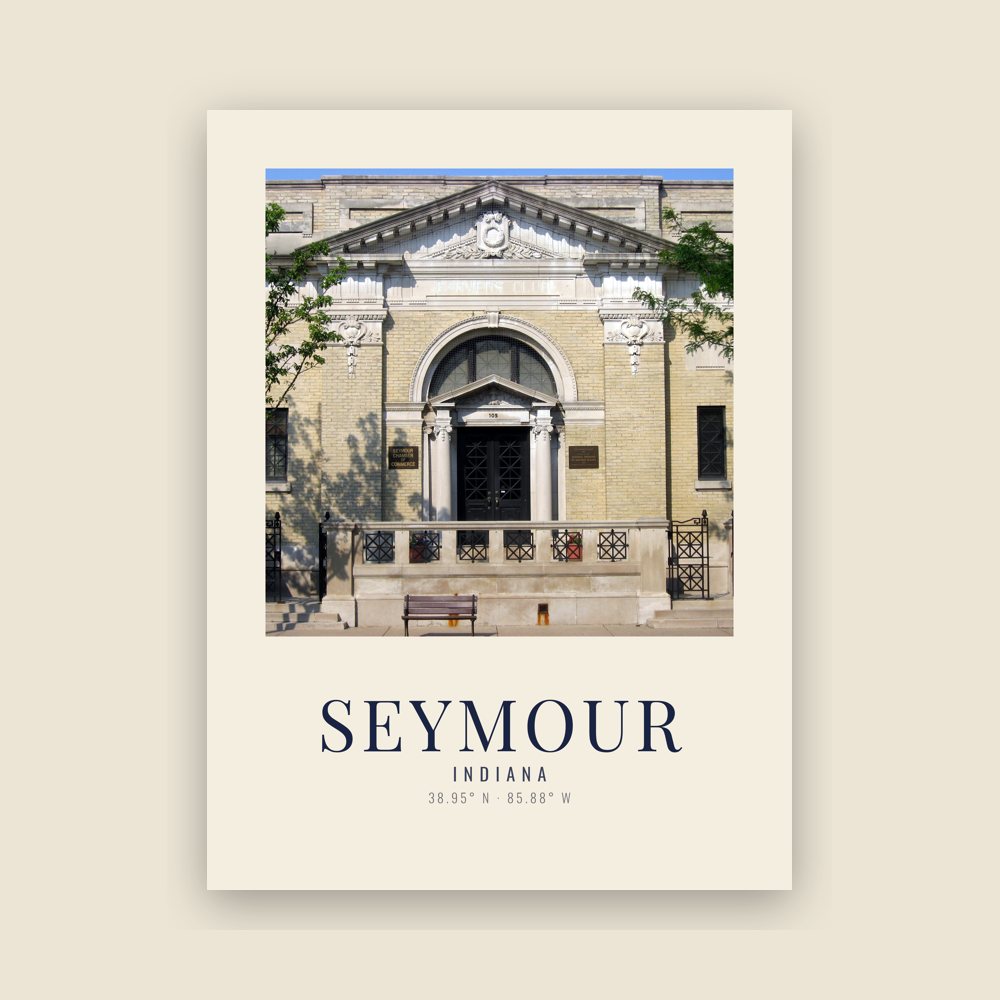
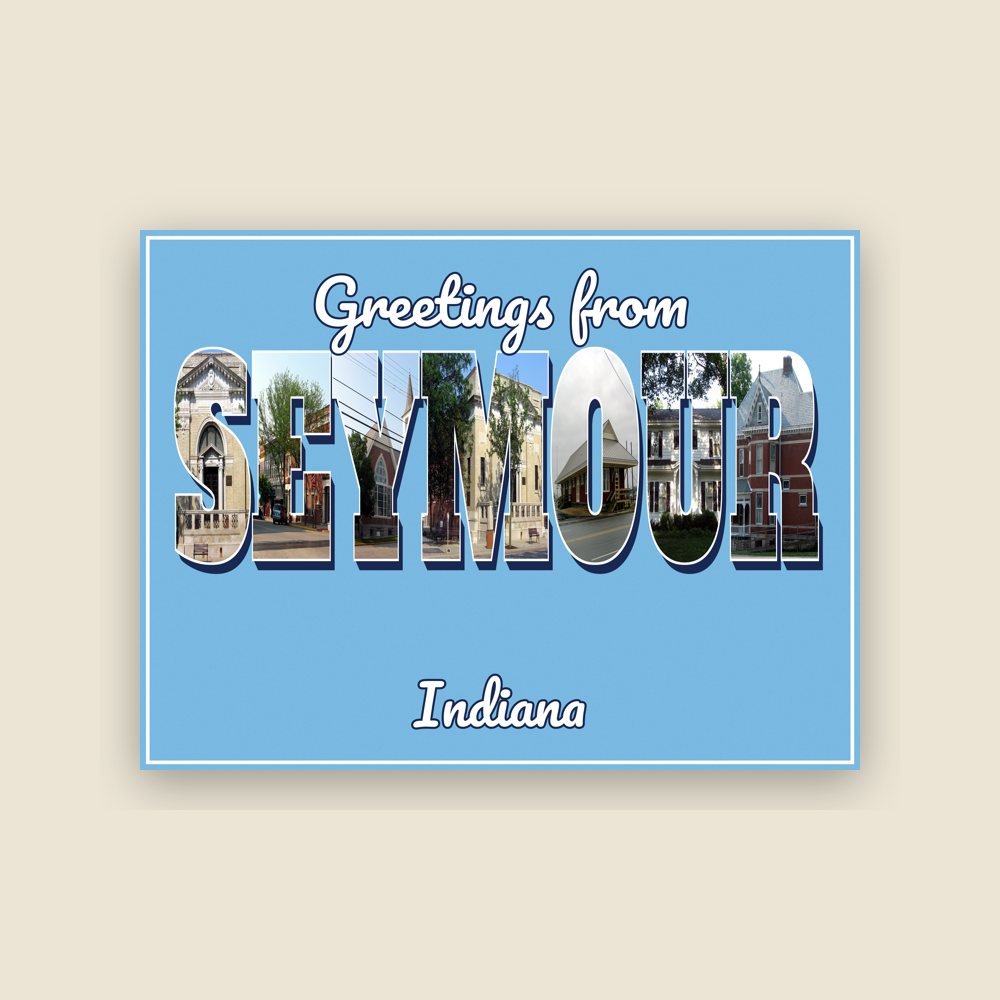
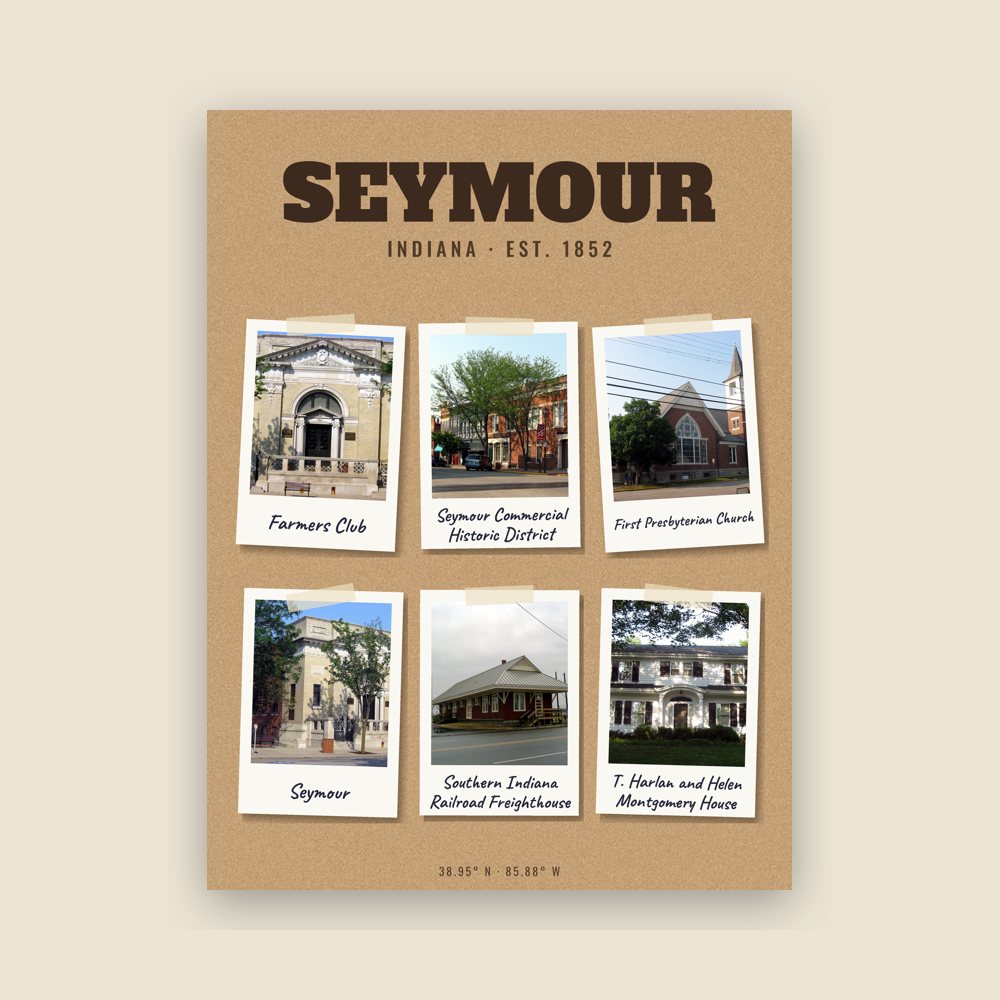
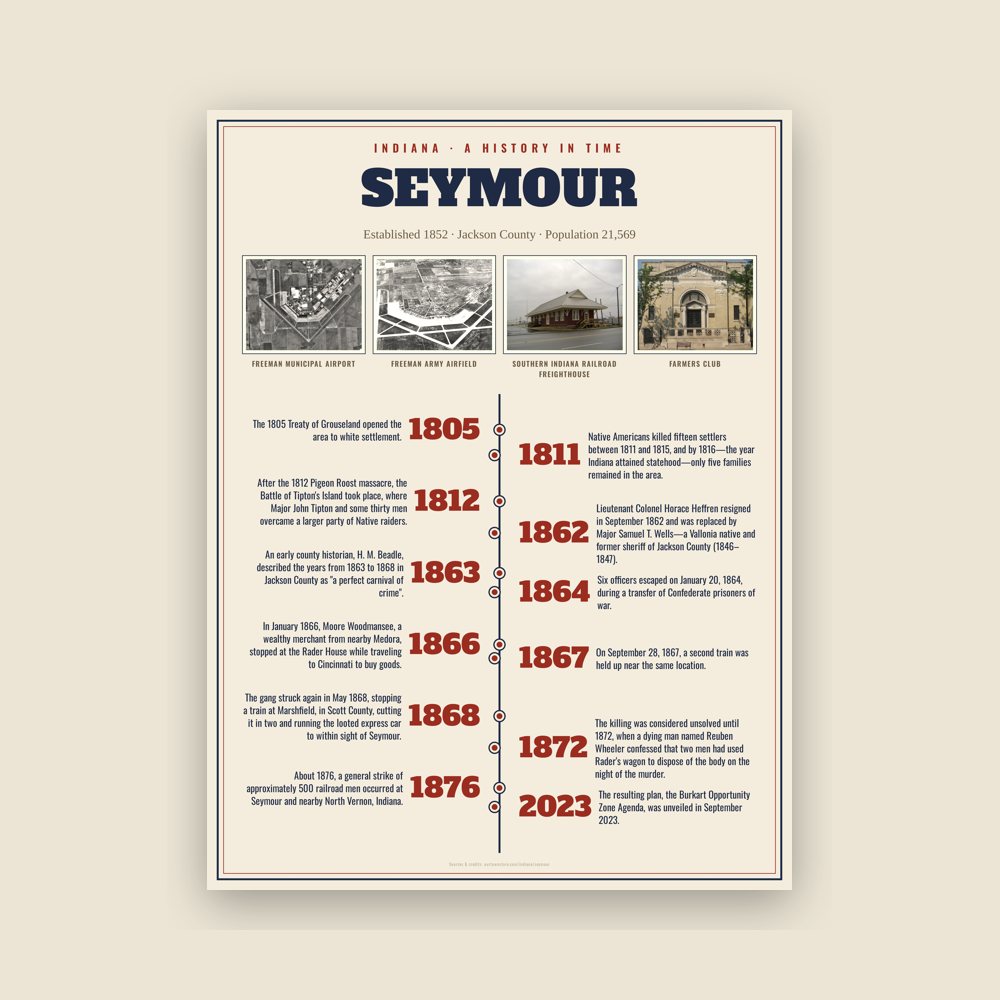
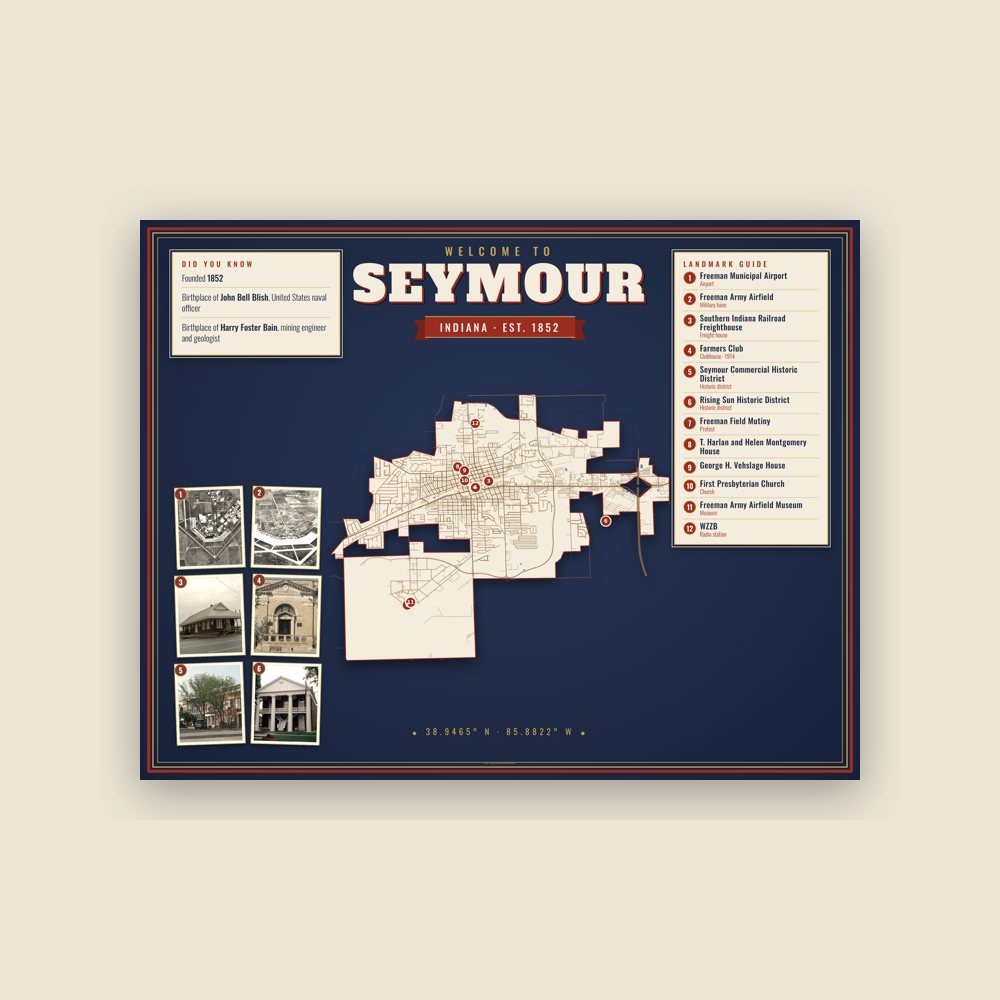
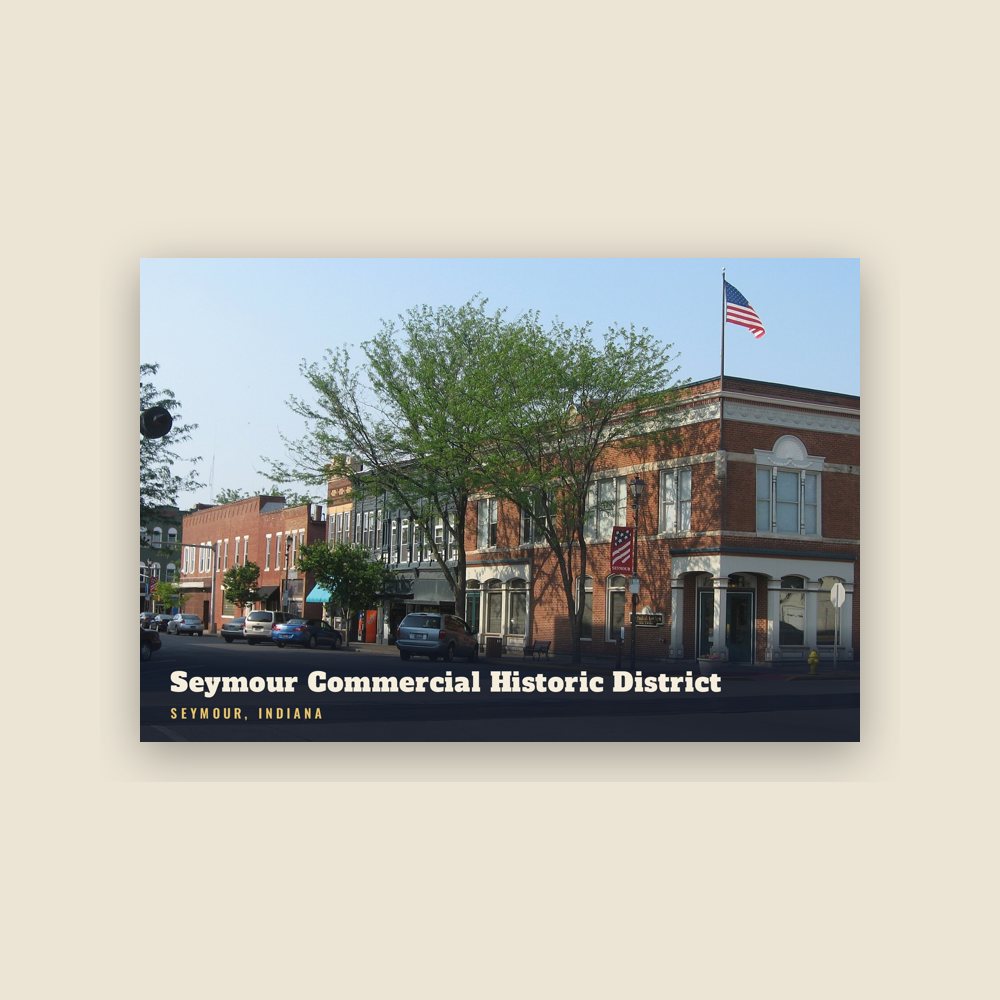
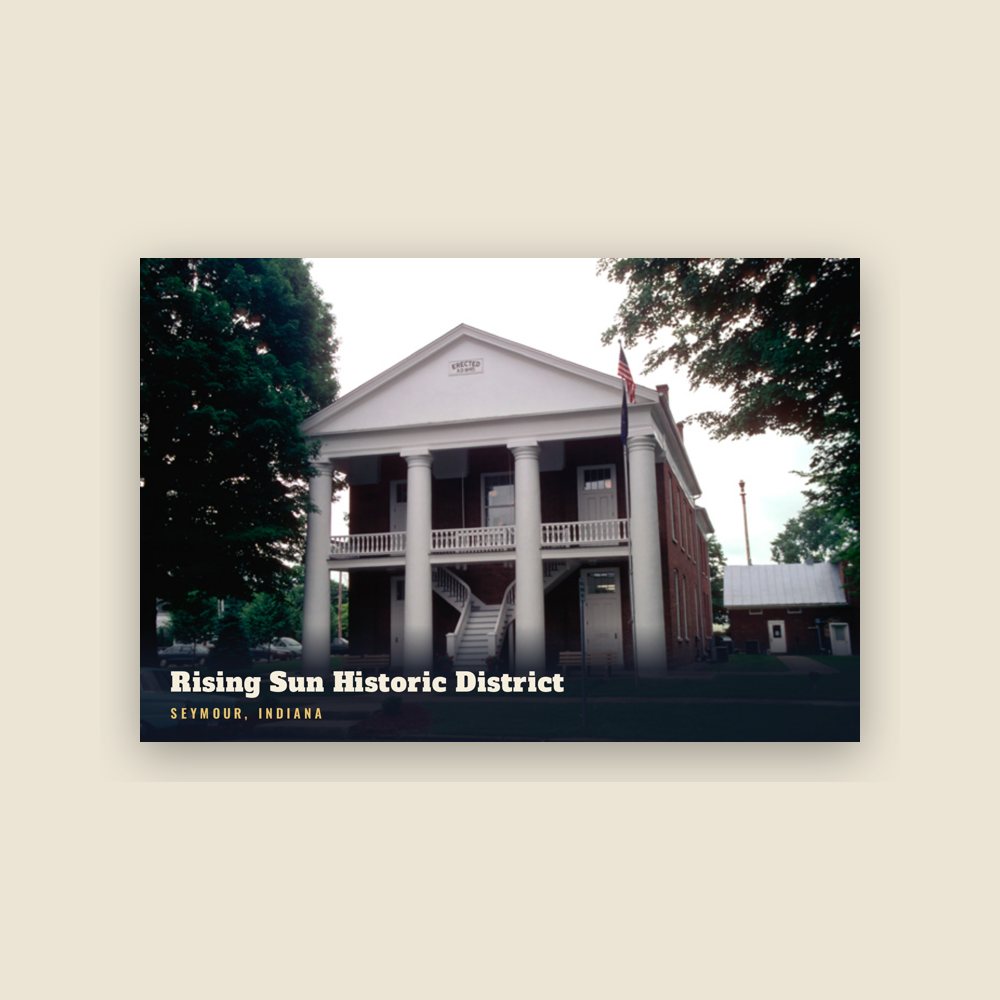
The land around Seymour was inhabited by the Lenape (Delaware), who had been displaced westward from the Delaware River valley. The 1805 Treaty of Grouseland opened the area to white settlement. After the 1812 Pigeon Roost massacre, the Battle of Tipton's Island took place, where Major John Tipton and some thirty men overcame a larger party of Native raiders. Native Americans killed fifteen settlers between 1811 and 1815, and by 1816—the year Indiana attained statehood—only five families remained in the area. In 1817 the state built a blockhouse to trade with the Lenape until they ceded the land under the 1818 Treaty of St. Mary's, after which the county saw significant depopulation between 1822 and 1832.
The first settler on the land that became Seymour was James Shields, who arrived with his family in 1816 and built on the property that is now the old city cemetery. In 1820, Shields received a land patent for his homestead. His son, Captain Meedy W. Shields, inherited the land and developed it into a prosperous farm. The site later became known as "Mule Crossing": according to an 1881 account, the first shipment of goods sent over the newly completed railroad was marked "Mule Crossing" because Shields kept a great many mules that gave the railroad's engineers trouble, and the engineers bestowed the name on the place.
Meedy Shields and his wife, platted Seymour on April 27, 1852, near the 1809 Indian treaty corner. A north–south railroad linking the Ohio River at Jeffersonville to Indianapolis had been built across the Shields farm in the late 1840s. When the east–west Ohio and Mississippi Railroad was surveyed through the county in 1852, Shields persuaded it to cross the first line on his land and, in return, agreed to name the town for the railroad's civil engineer. The earliest county history, published in 1886, identifies him only as "the chief contractor and civil engineer, Mr. Seymour," who was the superintendent over the construction of the Ohio and Mississippi Railway from North Vernon to St. Louis. Later accounts name him Hezekiah C. Seymour, while others instead credit a surveyor named J. Seymour. Hezekiah C. Seymour, formerly state engineer and surveyor of New York and superintendent of the New York and Erie Railroad, had become a principal contractor of the Ohio and Mississippi in the spring of 1852, when he took up railroad construction contracts exceeding $35 million. Seymour's first newspaper, the Seymour Times, was established in 1857 by Dr. Jasper R. Monroe, who brought the paper from Rockford. The Times was published as a Republican paper.
Read the full history
The Civil War
Seymour was an important waypoint for the movement of men and supplies during the war due to the rail lines connecting with larger cities such as Indianapolis, Chicago, Detroit, and St. Louis. Despite southern Indiana's strong Copperhead political sentiment, the city of Seymour and the surrounding area raised three separate infantry units for service in the Union Army. Volunteers were organized at Camp Heffren in Seymour. These included the 50th Indiana Infantry Regiment, commanded by former Indiana Secretary of State Colonel Cyrus L. Dunham, as well as Company C of the 10th Indiana Cavalry Regiment. The 50th Indiana was present at the Battle of Parker's Crossroads against Nathan Bedford Forrest, as was the 10th Indiana Cavalry in skirmishes near Pulaski and during the 1864 Nashville Campaign. Company H of the 6th Indiana Infantry Regiment was also raised in Seymour and commanded by Captain Fielder A. Jones. These men fought at Shiloh (2nd Day), Stones River, Chickamauga, Missionary Ridge, and through the Atlanta Campaign, ending in the capture of that city.
The area's divided politics produced a notable incident on September 5, 1862, when Jason B. Brown—a Brownstown lawyer, Democrat, and later a three-term U.S. representative from the district—delivered a speech at Seymour after which a recruiting officer of the 15th Indiana Volunteers filed a charge with the state adjutant general accusing him of using "treasonable language" in public against the government. Brown was taken to Indianapolis, where the deputy United States marshal declined to entertain the charge, and it was dismissed without trial; the Democratic press presented the arrest as part of an effort to intimidate Democratic voters before the fall election. Elected to the Indiana House of Representatives the following month, Brown offered the resolutions creating the House's select Committee on Arbitrary Arrests in January 1863 and led its investigation.
Captain Fielder A. Jones, was wounded early in the war and later raised an additional company of Jackson County men, who elected him colonel. By 1865 he had transferred to the 8th Indiana Cavalry and had been promoted to colonel, shortly before being brevetted to brigadier general. After his discharge, he moved to Missouri to practice law.
On July 10, 1863, as Confederate Brigadier General John Hunt Morgan and his cavalry sacked nearby Salem, Major General John Love of the Indiana Legion (militia) arrived in Seymour from New Albany to take command of the city defenses. Over the next day, Love used Seymour as a staging ground to gather a force to repel Morgan's next attack, which they believed would target the Ohio & Mississippi Railroad at Mitchell, Seymour, or Vernon. His force included elements of the 63rd Indiana and 69th Indiana Volunteer Infantry Regiments, the 1st Michigan Sharpshooters, the 15th Indiana (Von Sehlen's) Battery of Light Artillery, and a few Indiana Legion militia units. As Morgan moved on Vernon on July 11, Love took his force of about 1,000 men to meet him, placing Captain Meedy Shields in charge of the Seymour defenses in his absence. Shields, who had organized and trained many local mounted militia units, in Love's words "rendered invaluable service" during the Morgan's Raid crisis.
Six officers escaped on January 20, 1864, during a transfer of Confederate prisoners of war. One was later recaptured in town. The New York Times reported that on January 22, 1864, a "soldiers' riot" took place, in which two soldiers were killed and several others were injured.
During the war, the 50th Indiana Infantry lost 3 officers and 54 enlisted men due to being killed or mortally wounded, and 3 officers and 158 enlisted men to disease, for a total of 218 dead. Colonel Dunham, a Democrat, faced wartime accusations of disloyalty and was criticized for his conduct at the September 1862 surrender of Munfordville, Kentucky. He left the regiment in 1863. Lieutenant Colonel Horace Heffren resigned in September 1862 and was replaced by Major Samuel T. Wells—a Vallonia native and former sheriff of Jackson County (1846–1847). Wells commanded the regiment after Dunham's departure until the 50th was consolidated into the 52nd Indiana Infantry Regiment, through the war's end.
The Reno era
The Rader House is described in early county histories as one of Seymour's leading hotels. It became a haven for the Reno Gang during the mid-1860s and travelers who lodged there were frequently robbed.
In January 1866, Moore Woodmansee, a wealthy merchant from nearby Medora, stopped at the Rader House while traveling to Cincinnati to buy goods. He disappeared from his room. That October, his body—the head severed—was recovered from the East Fork of the White River. A hotel employee, Gordon Kinney, was suspected and was shot dead during the investigation. The proprietor, Captain George Rader, was arrested but acquitted. The killing was considered unsolved until 1872, when a dying man named Reuben Wheeler confessed that two men had used Rader's wagon to dispose of the body on the night of the murder.
After the war, local veterans organized the Ellsworth Post 20 of the G.A.R. At its peak, the post included two hundred and twenty-two local citizens who had served the Union during the war as members. The Ellsworth Post was active in local charities, organized burial services for local veterans, and conducted official observances on Decoration Day. The final member of the post, James H Boak, lived to be 98 years old. He died in 1942, closing one of the longest-running G.A.R. chapters.
A robbery of the Adams Express Car on the east-west Ohio and Mississippi line near Brownstown was reported in July 1866. That night, the perpetrators were chased by a local vigilance committee of 300 men that continued into the Rockford area. Three days later, the Reno brothers had been identified as the gang's leaders and newspapers were recounting the family's crimes. On October 6, 1866, the local Reno Gang robbed an Ohio and Mississippi Railroad train. The holdup is often described as the first robbery of a moving train in the United States during peacetime. The 1886 county history records that the gang boarded the train a short distance east of Seymour, rifled one safe of about $15,000, and rolled a second safe holding roughly $30,000 from the moving car. The second safe and its contents were recovered intact after the robbers were pursued. Some members of the gang were later lynched at Hangman's Crossing outside town.
The gang struck again in May 1868, stopping a train at Marshfield, in Scott County, cutting it in two and running the looted express car to within sight of Seymour. An early county historian, H. M. Beadle, described the years from 1863 to 1868 in Jackson County as "a perfect carnival of crime". In response, citizens masked in red organized a vigilance committee that carried out the lynchings of suspected gang members.
On September 28, 1867, a second train was held up near the same location. Initially blamed on the Renos, the copycat robbery was the work of two local men, Walker Hammond and Michael Colleran, who escaped with as much as $8,000. John Reno tracked Hammond down, beat him, and turned him over to the sheriff. Hammond and Colleran were indicted in February 1868.
Vigilante retribution peaked in 1868. On July 10, three gang members being transported by train were seized near Seymour and hanged from a beech tree by masked men of the Jackson County Vigilance Committee. Days later, three more members—Henry Jerrell, Frank Sparks, and John Moore—were captured in Illinois, returned, and hanged from the same tree. On the night of December 11, 1868, a darkened train left the Seymour depot of the Jeffersonville, Madison and Indianapolis Railroad carrying roughly 100 vigilantes in scarlet masks. They reached New Albany before dawn and the men marched to the Floyd County jail where they lynched Frank, William, and Simeon Reno along with gang member Charlie Anderson. Frank Reno and Anderson had been extradited from Canada and were in federal custody when they were killed. The lynchings drew protests from Canada and Great Britain, an apology from U.S. Secretary of State William H. Seward, and international press coverage. No one involved with the lynchings were charged for the crime.
About 1876, a general strike of approximately 500 railroad men occurred at Seymour and nearby North Vernon, Indiana. It was led by armed brakemen, engineers, and other railroad employees who had not been paid for two and a half months by the Ohio and Mississippi Railroad. A paper reported that the communities of Seymour and North Vernon were armed and in revolt. A contingent of US Marshals and detectives was sent from Cincinnati to end the strike. All passenger and cargo service through Seymour and North Vernon was suspended during the strike.
Vigilante violence, including "White Cap" regulators, remained active in rural Jackson County through 1901, with documented attacks at Shields in 1897 and near Maumee in 1901.
The town's first high school was built in 1871 on the vacant lot of the disbanded civil war encampment. Frank B Shields, a Seymour native, former MIT professor, and inventor of Barbasol shaving cream, subsequently donated the adjacent land needed for the construction of the James Shields Memorial Gym.
In 1880, the Seymour Weekly Democrat noted that Seymour's population was nearly 5,000. There were four schools with 700 students, and four hotels.
During the years prior to the turn of the 20th century, Seymour saw an influx of Dutch and German migrants of the Lutheran faith. These migrants established many local farms and businesses. Their influence continues to be seen in the city's annual Oktoberfest celebration.
20th century
Seymour fielded its own minor-league team, the Seymour Reds, beginning in 1900. The future Hall of Famer Pee Wee Reese played for the club before reaching the majors. The team played at Redlands Park.
The Seymour Public Library opened in January 1905 after a $10,000 grant from the Carnegie library program in 1903. Earlier collections had been kept in a local bookshop and at Shields High School. The new building was among more than 160 Carnegie libraries funded in Indiana—more than in any other state.
On October 22, 1908, William Howard Taft, the Republican nominee for president, drew a crowd of about 10,000 people to a campaign speech at the Chestnut Street railroad crossing during a whistle-stop tour of Indiana two weeks before he won the election.
In 1913 the Great Flood struck Seymour. It was the deadliest natural disaster in the area's history, as the East Fork of the White River crested 27.50 feet (8.38 m) above the level of the 1884 flood.
World wars
On May 7, 1915, the Seymour industrialist Elbridge Blish Thompson died in the sinking of the RMS Lusitania. His family endowed a memorial scholarship at Shields High School for any student admitted to Yale University.
The 1918–19 influenza pandemic struck Jackson County in two waves. After the first wave began in October 1918, county officials were under public pressure to reopen schools, churches, and businesses. Citing local health authorities' view that the danger had passed, officials reopened the county on November 2, while thirty other Indiana counties remained closed. The second wave struck within ten days. By mid-December, the county had recorded 1,547 cases, about 6.5% of its population, and the county health officer estimated the true figure was likely double that.
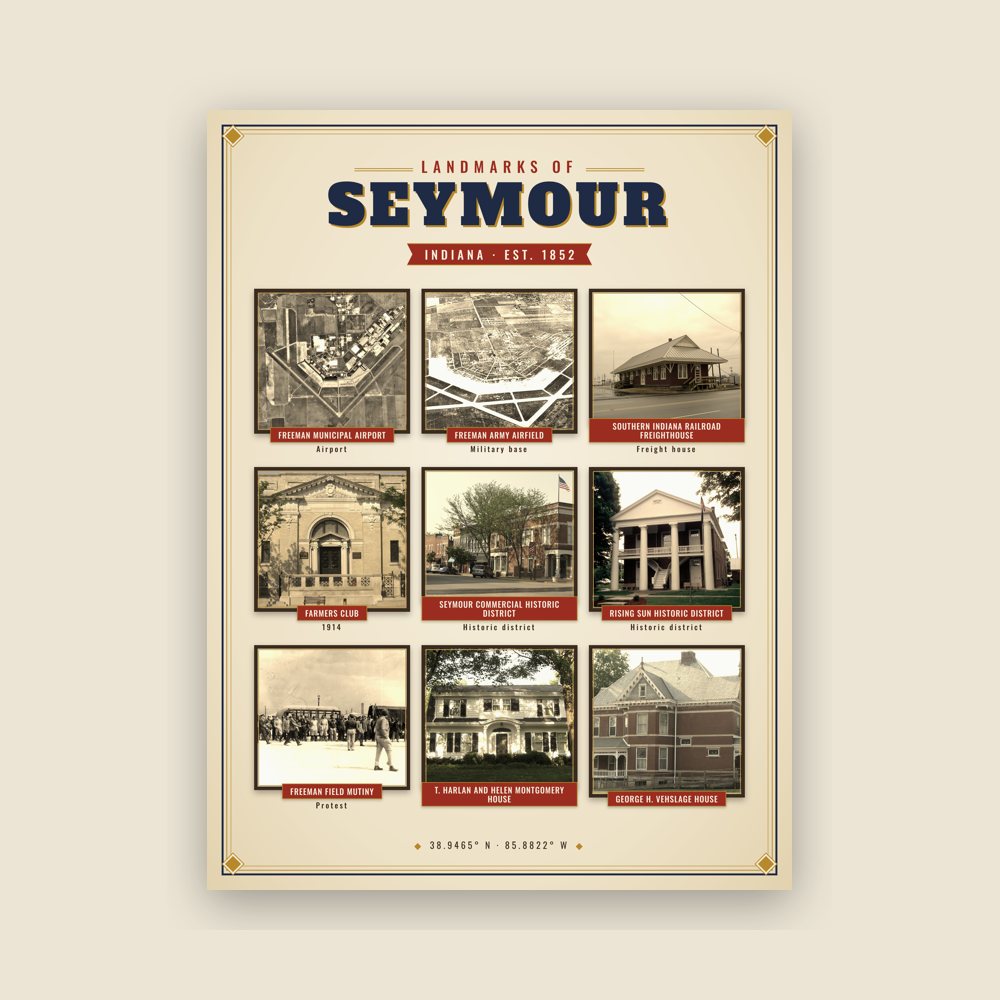
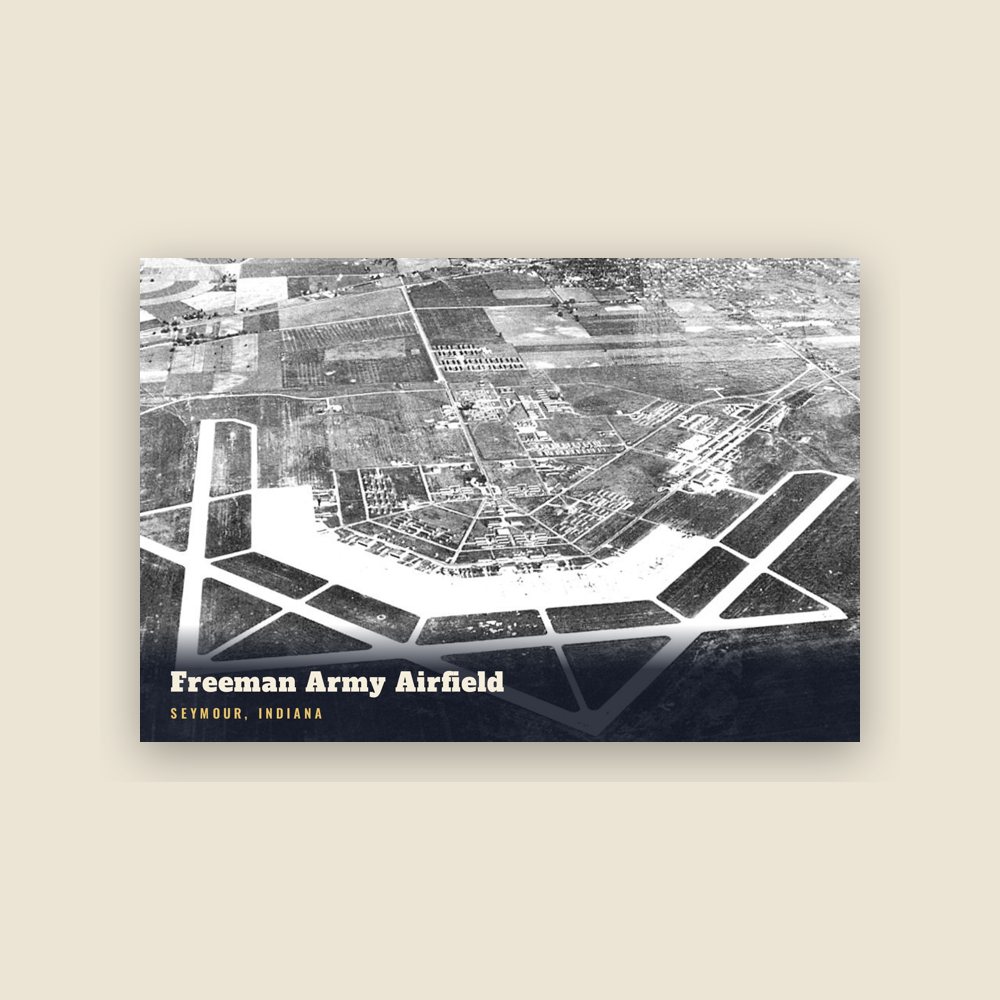
During World War II the federal government bought 2,500 acres (1,000 ha) southwest of town for an airfield. Local veterans had proposed naming it for a Seymour sailor killed at Pearl Harbor, but it became Freeman Army Airfield. It operated from 1942 to 1946. Construction of 413 structures and four 5,500-foot runways was supervised by the U.S. Army Corps of Engineers. The base trained pilots on twin-engine aircraft on Beechcraft AT-10 Wichita. There were 19 graduating classes with 4,245 cadets trained before the last class in May 1944. The training was commanded by Colonel Elmer T. Rundquist, a former University of Illinois football player who had served as the base's project officer before taking command.
Freeman Field also became the first helicopter training base in the United States. Preparations were made in secrecy in 1944, when the aircraft were still new. Six Sikorsky R-4 helicopters were flown in directly from the Sikorsky plant at Bridgeport, Connecticut, in what was then the longest-distance formation flight of helicopters.
In 1945 the base was the site of the Freeman Field mutiny, in which African American officers of the 477th Bombardment Group sought to integrate an all-white officers' club. The protest was directed at the segregated clubs enforced by the group's commander, Colonel Robert R. Selway Jr., who was subsequently relieved of command and replaced by Colonel Benjamin O. Davis Jr. Historians of the Civil Rights Movement regard the episode as an important step toward desegregation of the U.S. military.
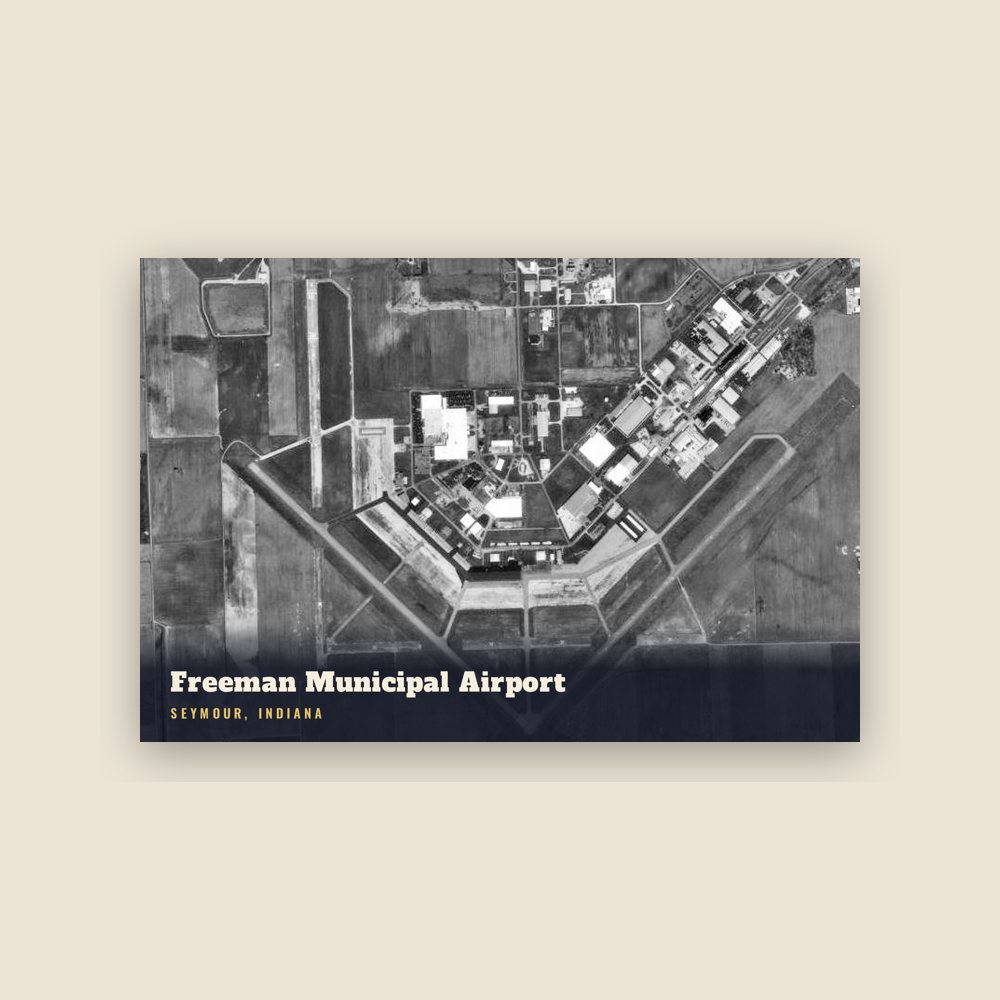
Near the war's end, Freeman Field served as the Foreign Aircraft Evaluation Center. It received captured German and Italian aircraft gathered under "Operation Lusty." Arriving aircraft were assigned "FE" (Foreign Evaluation) numbers, and the collection was kept from the public until September 1945, when the field was opened to the press. These operations were soon relocated, and the field was deactivated and deeded to the city in 1946. When the War Assets Administration disposed of the surplus base, 2,241 acres became a municipal airport, more than 240 acres went to Seymour Community Schools for agricultural training, and more than 60 acres went to the Seymour Industrial Association to develop an industrial park. This became the city's postwar industrial district. The property was formally sold in November 1948.
Mid-century
During the last week of June 1952, Seymour held a week-long centennial celebration featuring concerts, parades, a play titled "The Seymour Story," and a re-enactment of the Reno brothers' train robbery, for which the B&O Railroad loaned a vintage engine and cars from its Baltimore museum. Local businesses paid employees in silver dollars during the festivities to mark the occasion.
Beginning in 1959, the old Shields High School closed and students transferred to the new Seymour High School. By 1970 the district had completed what was then the second-largest high-school gymnasium in the United States. It was renamed the Lloyd E. Scott Gymnasium in 1981 for the Indiana Basketball Hall of Fame coach.
During the 1960 presidential campaign, Senator John F. Kennedy stopped at Freeman Field on April 29, 1960, days before the Indiana primary. Suffering from laryngitis and unable to speak, Kennedy greeted the several hundred people who had gathered by handing out cards that read, "Sorry, I have a bad throat and cannot talk, but please vote for me anyway."
Late century
In the 1970s, several deaths in the Seymour area were linked to the egg producer Rose Acre Farms. Three employees connected to founder David Rust died under circumstances that remained unresolved. One of the bodies was found in the trunk of her burned car weeks after she disappeared. Despite investigations and reporting by the Louisville Courier Journal, no charges were brought against Rust.
Mayor Christopher D. Moritz resigned on March 29, 1983, after being convicted of four counts of accepting bribes while in office. Moritz was sentenced to five years in prison and barred from public office for ten years. His sentence began in December 1984. Donald Scott served the remainder of the term until William Bailey took office.
The Stardust Theater, a 550-car drive-in that had opened on May 19, 1949, closed in 1989. The operators called the decision purely economic, and the site was redeveloped into an outlet mall.
Three historic downtown buildings were lost during the 1990s. The former Lynn Hotel, which opened in 1883, collapsed from neglect on July 8, 1991, after the city had bought it for $35,000 with hopes of converting it to offices. The 1910 Shields High School building was razed in 1997 after a botched partial demolition left it unsafe. On Christmas Day 1998, the 1854 building previously known as the Rader House—later the Walton—burned in an accidental fire that killed one person while it was being restored for low-income housing.
21st century
With support from then–Lieutenant Governor John Mutz and the Jackson County Industrial Development Corporation, the automotive-parts manufacturer Aisin built a plant in Seymour in 1986 and began production in 1989. Early estimates suggested that about 200 jobs would be created. By 2020 the plant employed more than 2,000 people and supplied components to Honda, General Motors, Mitsubishi, Nissan, and Toyota. The announcement was welcomed locally. Residents interviewed by The Tribune cited the prospect of more jobs, and Seymour principal Gary Gilbert called it the result of "a lot of people work[ing] long and hard to bring industry to Seymour".
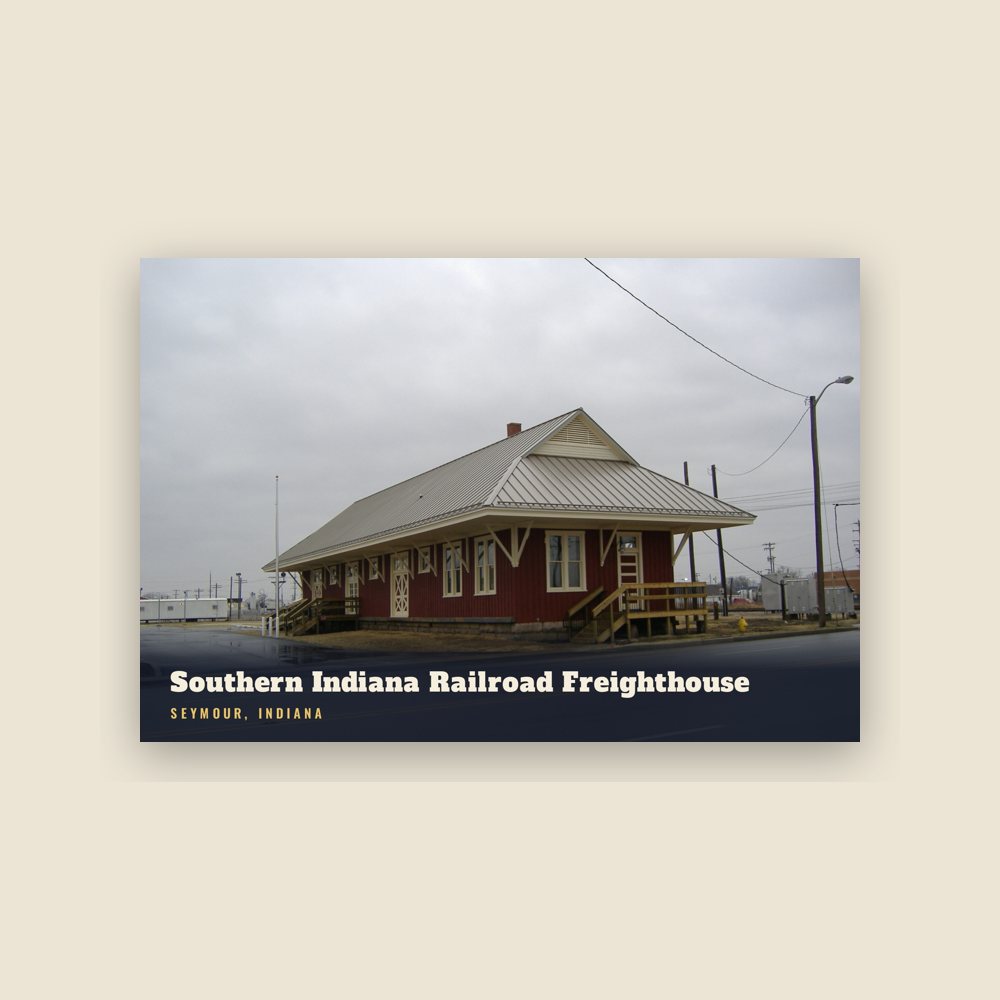
The 106-mile (171 km) north–south rail line through Seymour was bought by the Louisville and Indiana Railroad from Conrail in 1994 and operates as a short line connecting to the CSX east–west route, which CSX upgraded in 2016 for higher-speed operation.
On June 8, 2008, the East Fork of the White River crested at 20.92 feet near Seymour—an inch below the record set in the Great Flood of 1913—after a flood wave moved downstream from the Columbus area. Floodwaters covered thousands of acres of farmland, washed out roads and railroads, and flooded or threatened numerous homes in the Seymour, Brownstown, and Medora areas, with damage in the millions of dollars. There are no flood-control reservoirs upstream of Seymour.
Beginning around 1989, Seymour drew immigrants from San Sebastián Coatán in highland Guatemala, many of them members of the indigenous Chuj people. As word of work in the city reached relatives and neighbors in their hometown, chain migration followed, and by 2020 residents of Guatemalan origin made up more than 10 percent of the city's population.
In November 2019, the city unveiled a mural of John Mellencamp on the side of a local guitar store. The mural was painted by Indianapolis muralist Pamela Bliss and depicts Mellencamp at two stages of his life alongside the lyric "I was born in a small town". The Mellencamp family donated $50,000 to convert the adjacent lot into a green space. The space was dedicated in June 2021.
In 2022, Seymour accepted an invitation from the Indiana Economic Development Corporation to develop a long-term economic development strategy in partnership with the Brookings Institution and the Local Initiatives Support Corporation. The resulting plan, the Burkart Opportunity Zone Agenda, was unveiled in September 2023. Its proposals included workforce training, expanded housing, new recreational facilities, and an immigrant welcome and resource center.
The agenda drew organized public opposition centered on the proposed welcome center, which critics contended would attract illegal immigration and make Seymour a de facto sanctuary city. At a city council meeting on March 25, 2024, residents filled the council chambers and lined the streets outside city hall, and the council passed a resolution opposing the agenda by a 5–1 vote. That May, the council asked Mayor Matt Nicholson to develop a replacement economic agenda with no connection to the Brookings Institution. At the same meeting, residents submitted petitions calling for Nicholson's resignation, which the city attorney said had no legal effect under Indiana law.
In October 2024, Indiana Attorney General Todd Rokita issued a civil investigative demand to the Seymour Police Department to determine whether its immigration-related policies complied with a state statute, effective July 1, 2024, that bars local governments from restricting cooperation with federal immigration enforcement. Seymour was the first majority-Republican municipality to be investigated. City Attorney Christina Engleking responded that the police department and its officers were committed to fulfilling their duties and oaths of office.
The civil investigative demand followed a period of rapid demographic change. Census Bureau data showed the city's Hispanic or Latino population rose over the preceding two decades, while the overall population grew by about 3,000. On the day the demand was announced, Mayor Matt Nicholson canceled a scheduled city council meeting and council member Drew Storey held an informal community meeting on residents' concerns about the city's growth. State Representative Jim Lucas, said the pace of growth was outstripping the community's capacity to manage it.
In early March 2026, heavy rainstorms across central and southern Indiana pushed the East Fork of the White River into moderate flooding, with the Seymour gauge cresting 19.5 feet (5.9 m) against a flood stage of 12 feet (3.7 m). The National Weather Service reported that roughly seventy percent of the flood plain in Jackson County was underwater. One man drowned and his body was recovered two days later following a search by the Indiana Department of Natural Resources.