Stanford was platted, under the name of "Allin", on December 14, 1867.
- CountyMcLean County
- Population600 (2020 U.S. Census)
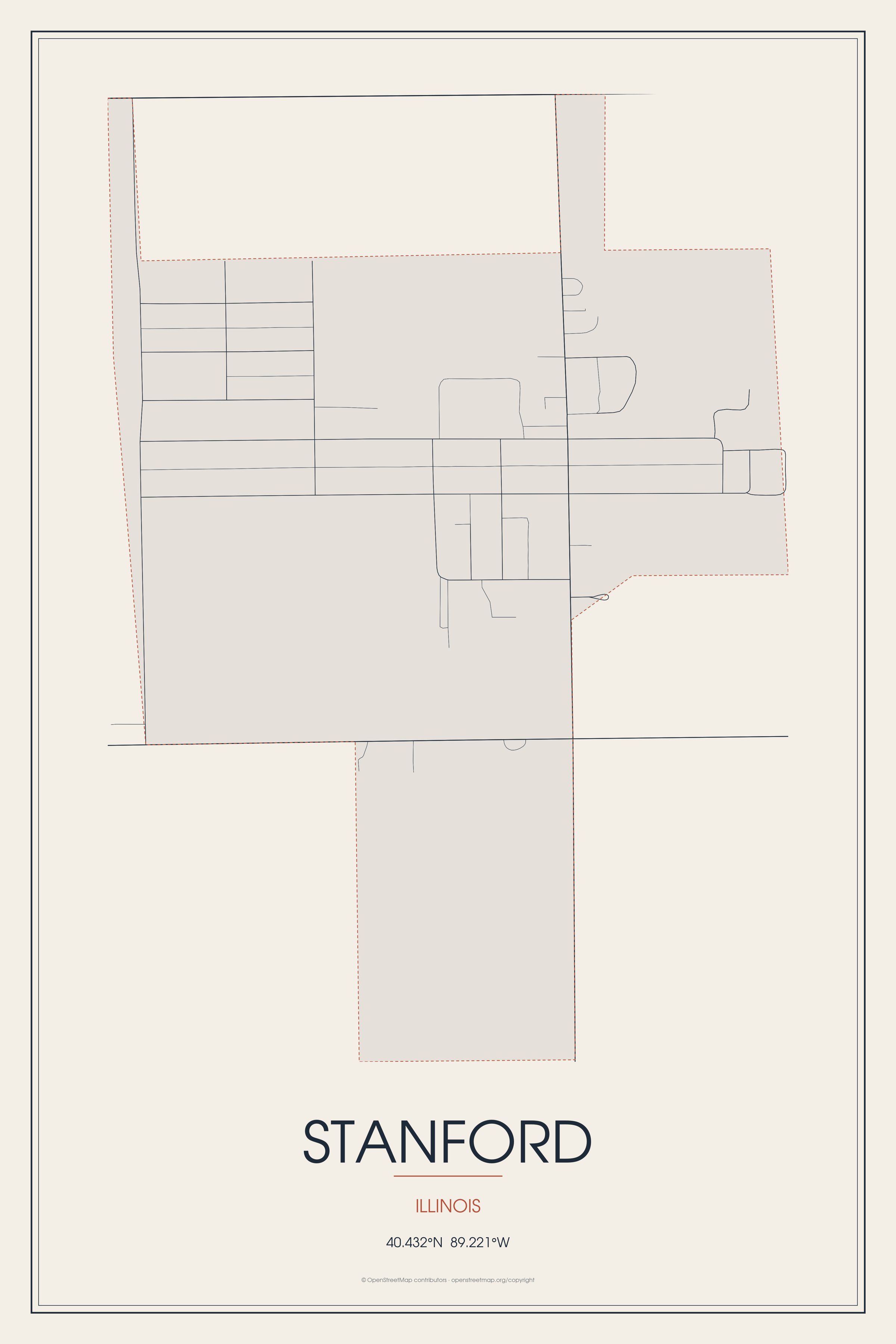
Stanford, Illinois gifts and souvenirs: 15 designs made from Stanford's own map, landmarks and history, from $16 to $95. Printed to order and shipped free in the USA.
| Popular | Price |
|---|---|
| Stanford Hometown Ornament | $23 |
| Stanford Varsity Crewneck | from $57 |
| Stanford Est. Tee | from $33 |
| Stanford Town Line Mug | from $26 |
| Stanford Market Tote | $37 |
Ceramic keepsake, gold ribbon

Heavy-blend fleece, street map printed on the back

Soft Bella+Canvas jersey
Kids' Bella+Canvas jersey, youth sizes

Bella+Canvas toddler jersey
Bella+Canvas baby bodysuit
Glossy ceramic, dishwasher safe
Weatherproof, for the front walk
24″×16″, printed coir-look fibers, rubber back
12″×12″ printed wood, ready to hang

Soft-touch, zip cover

Sturdy all-over-print tote
Glossy top, cork back
Soft fleece, 50″×60″
20 oz, double-wall stainless
Stanford was platted, under the name of "Allin", on December 14, 1867.
Stanford was platted, under the name of "Allin", on December 14, 1867. Its founder was John Armstrong (1820–1912). It was founded when the Jacksonville Division of the Chicago Alton and St. Louis Railroad was extended westward from Bloomington. The McLean County town of Covell was founded, within a few months of Allin, as a station on the same railroad. In 1870 the name of Allin was changed to "Stanford". It was incorporated as a village in June 1874. The town's founder, John Armstrong, was born in Posey County, Indiana. He was first a farmer and then ran a grocery in Stanford, where he continued to live until his death in 1912. For many years after the town was founded, John Armstrong ran a grocery in Stanford.
The original town of what would soon become Stanford had an unusual L-shaped design, with the leg of the "L" extending to the east along the railroad tracks. The large area in the crook of the "L" was not platted, but remained in the hands of John Armstrong, the town founder, whose residence was near the tracks on the north side of the railroad. Rather than a central square, the original plat of Stanford, like many towns laid out in the 1850s and 1860s, featured two rectangular public areas labeled as "Depot Grounds" which extended along either side of the tracks. The depot itself was on the north side of the tracks and, in 1874, the grain elevator on the south side. As the town developed, most businesses were located south of the tracks. By 1895 these included a hotel, a bank, the Masonic Hall, and several stores. Except for the depot, most of the railroad-related facilities were on the depot ground south of the railroad. These included a stock yard, a lumber yard, and several elevators. This area also held a bandstand. There were two early churches in Stanford: the Christian Church on Boundary Street south of the business district and the Presbyterian Church in the southeastern part of town.
Adapted (trimmed) from the Wikipedia article Stanford, Illinois, revision 1379135773 by its contributors, licensed CC BY-SA 4.0.
We share a part of every Stanford sale with local partners, and we'd love to print from your collection. Old photographs, maps and postcards make the best keepsakes.
Partner with usA favorite landmark, your street, a school or team, an anniversary gift, a different product. Tell us and we'll get back to you by email.
Stanford's population was 600 in the 2020 U.S. Census, up from 596 in 2010.