Prior to settlement by European Americans, the Skykomish people had many villages along the Skykomish River between Sultan and Index. One large and important village of the bəsx̌əx̌əx̌alč band was at x̌əx̌aʔusalʔtxʷ (derived from sx̌aʔus, meaning "sawbill duck") in modern-day Index. At the village were several longhouses, including a large potlatch house. x̌əx̌aʔusalʔtxʷ was the base camp for people traveling into the Cascades for hunting and gathering. The Skykomish people were signatories of the 1855 Treaty of Point Elliott and many were moved to the Tulalip Indian Reservation, where they later amalgamated with the Snohomish and Snoqualmie tribes. Some members of the tribe elected to stay in the Skykomish Valley, primarily near Gold Bar and Sultan.
The first non-native settlers in the area were prospectors who placed individual mineral rights for claims in the Cascades, beginning with a gold rush in 1874 along Silver Creek near what later became the community of Galena. Amos Gunn, a Civil War veteran from Illinois, arrived at the fork of the Skykomish River with his wife and six children in 1889 and bought a squatter's claim to establish a homestead. He constructed a home that also served as a hotel for prospectors and railroad workers on the Great Northern Railway. His wife Persis named their site "Index" for nearby Mount Index (later renamed Baring Mountain), itself named for its resemblance to an index finger. Mount Persis and Gunn's Peaks were also named for the family. Mines in the area yielded gold, silver, copper, and galena among other minerals, which spurred further settlement around the North Fork Skykomish River.
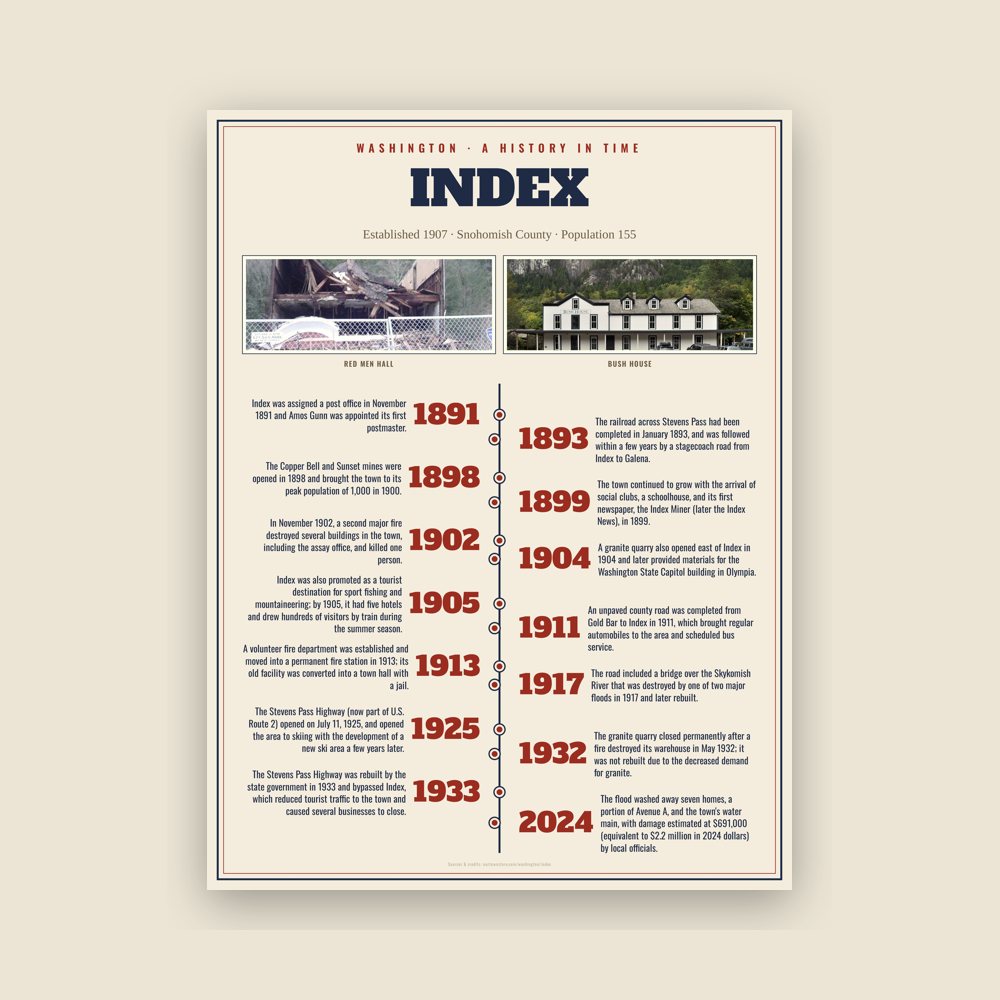
Index was assigned a post office in November 1891 and Amos Gunn was appointed its first postmaster. He initially delivered mail and parcels by horseback from Wallace (now Startup) on a 12-mile (19 km) overland trail. The Gunns' hotel was expanded two years later to accommodate an increasing number of prospectors who arrived on the Great Northern and traveled onward towards Galena and Mineral City. The railroad across Stevens Pass had been completed in January 1893, and was followed within a few years by a stagecoach road from Index to Galena. The town plat for Index was filed by Amos Gunn on April 25, 1893, shortly after a controlling interest in the settlement was acquired by the Everett Terminal Land and Milling Company. The plat reserved 100 feet (30 m) for the main street, which had been surfaced with gravel due to frequent flooding from the Skykomish River and was sought for use for a branch railroad to Galena. A fire destroyed the Gunns' hotel, general store, and several residences in the town on July 22 of that year, but had not damaged the Great Northern depot. The town's buildings were rebuilt as mining activity had temporarily subsided due to the Panic of 1893 and was eclipsed by logging and farming as the main local industry. The Copper Bell and Sunset mines were opened in 1898 and brought the town to its peak population of 1,000 in 1900. The Sunset Mine was the largest in the area and produced 1,500 ounces (43 kg) of gold, 156,000 ounces (4,400 kg) of silver, and 12.9 million pounds (5.9 million kg) of copper during its lifetime.
Read the full history
Early 20th century
Amos Gunn sold his properties in Index in 1899 shortly after the death of his wife Persis. The town continued to grow with the arrival of social clubs, a schoolhouse, and its first newspaper, the Index Miner (later the Index News), in 1899. In November 1902, a second major fire destroyed several buildings in the town, including the assay office, and killed one person. A granite quarry also opened east of Index in 1904 and later provided materials for the Washington State Capitol building in Olympia. It became one of the main employers in the area, along with logging to supply a new sawmill that was later acquired by the Index-Galena Lumber Company. Plans to build a hydroelectric dam and a pulp mill at sites along both forks of the Skykomish River were proposed but never began construction. Index was also promoted as a tourist destination for sport fishing and mountaineering; by 1905, it had five hotels and drew hundreds of visitors by train during the summer season.
Index was incorporated as a fourth-class city on October 11, 1907, with several hundred residents. A volunteer fire department was established and moved into a permanent fire station in 1913; its old facility was converted into a town hall with a jail. An unpaved county road was completed from Gold Bar to Index in 1911, which brought regular automobiles to the area and scheduled bus service. The road included a bridge over the Skykomish River that was destroyed by one of two major floods in 1917 and later rebuilt. The Stevens Pass Highway (now part of U.S. Route 2) opened on July 11, 1925, and opened the area to skiing with the development of a new ski area a few years later. The Great Northern's local trains, nicknamed the "Dinkies", made daily stops in every Skykomish Valley settlement and provided Index with passenger and postal service until they were discontinued in 1925 after the highway opened. The Stevens Pass Highway was rebuilt by the state government in 1933 and bypassed Index, which reduced tourist traffic to the town and caused several businesses to close.
The town's major industries saw reduced business during the early years of the Great Depression, which resulted in the shutdown of lumber mills and mines in the area. The granite quarry closed permanently after a fire destroyed its warehouse in May 1932; it was not rebuilt due to the decreased demand for granite. A Civilian Conservation Corps camp was established east of Index in 1934 to provide jobs for unemployed men and improve lands owned by the United States Forest Service in the Cascades. On August 16, 1939, a wildfire that formed west of Index swept into the town and destroyed the church and seven residences; hundreds of firefighters from the United States Forest Service and local fire departments in the region prevented the fire from causing further damage before it retreated into the forests. The Sunset Mine, the last remaining copper mine in the area, had financial issues and was taken over by its workers after a dispute over unpaid wages; it was shut down in 1942 by a federal order to halt mining of non-essential materials during World War II. A natural hot springs near the town continued to draw tourists and was developed into a major resort named the Garland Mineral Springs; during World War II, it was converted into a Coast Guard training camp.
Post-mining era
Index entered a period of economic stagnation and reduced employment following the Great Depression and World War II, as most of its industries had closed and were not replaced. Local families left the town and were replaced by a population of retirees and urban residents who maintained vacation homes; by 1975, there was a permanent population of 171 residents in Index and the surrounding area. After Index's high school closed in 1942, students were moved to Sultan Senior High School. The other school buildings were condemned by the state fire marshal in 1952 and replaced three years later by a new consolidated school. From 1962 to 1964, Great Northern rebuilt its railroad through Index on an embankment with a wider curve that cut off several streets and split the town into two halves. The original railroad depot in the town was also demolished and the lone grade crossing was made steeper, creating a blind hill.
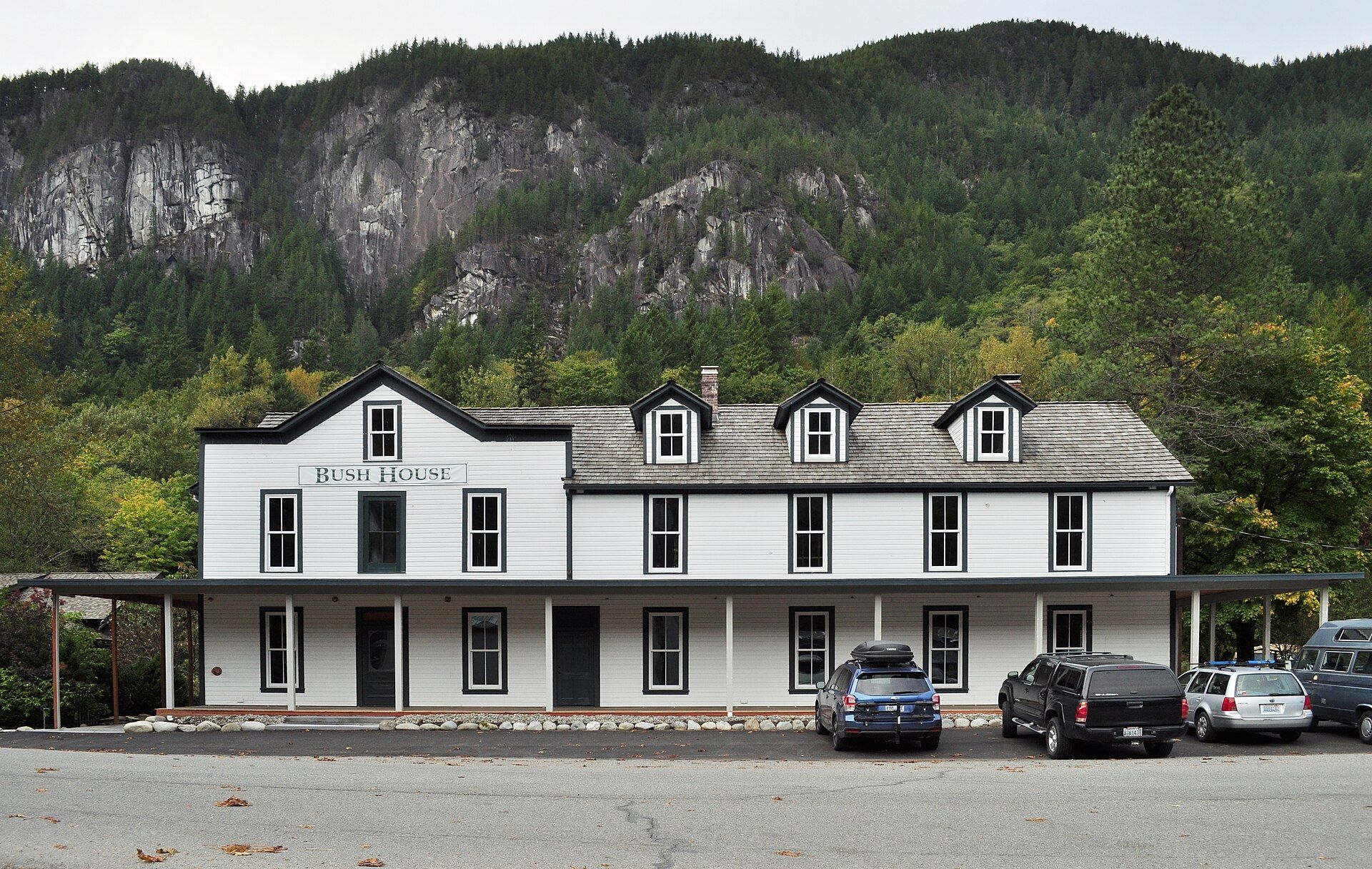
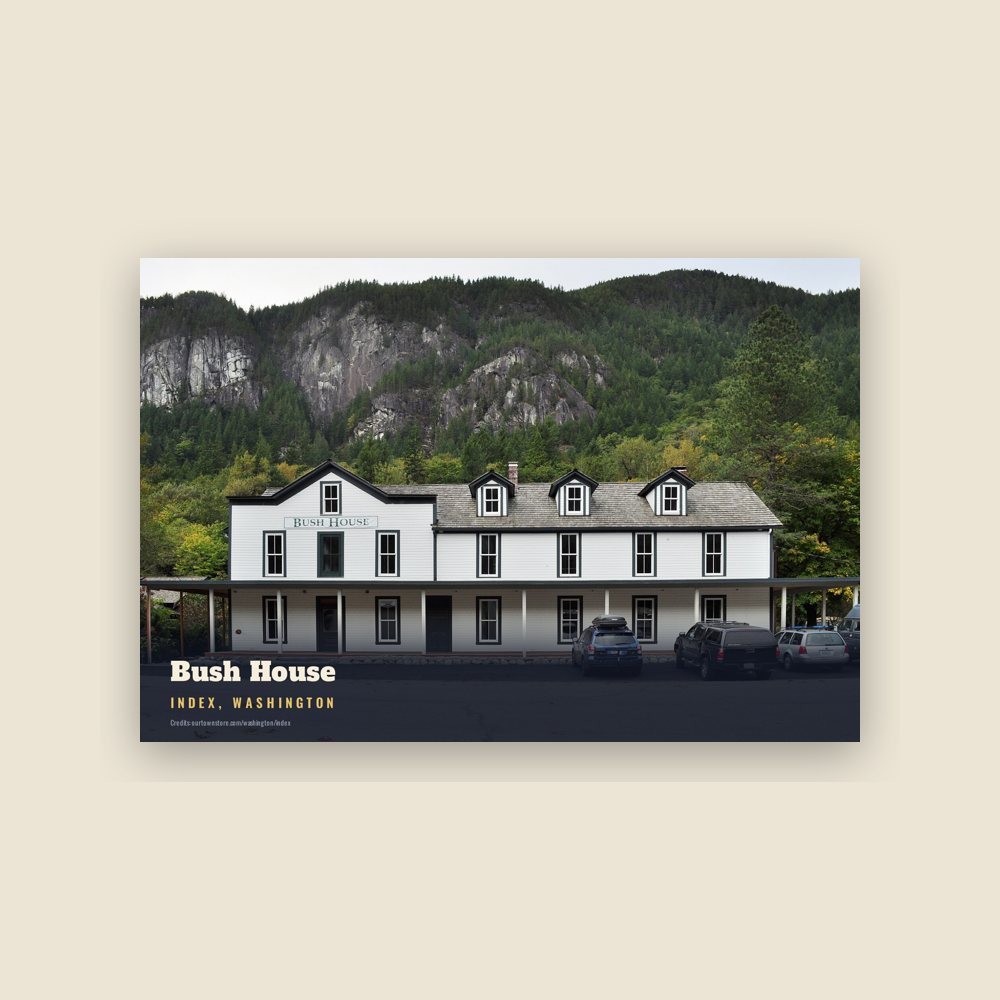
The town has been frequented by rock climbers since routes on the Index Town Wall, a set of granite cliffs that face the Skykomish River, were mapped in the 1950s and developed in the early 1970s by enthusiasts from Seattle. A replacement of Index's wooden water main and reservoir system, which are supplied by a mountain spring, began in 1967 and was completed a decade later by the town government using federal and state grants. The Bush House, a historic hotel that opened in 1898 and closed in the 1930s, was renovated and reopened as a restaurant in 1975 and for lodging two years later. It was among the few active businesses in Index along with a general store and tavern; the town had become a destination for retirees and vacationers by the 1970s and had few permanent residents. The Red Men Hall, traditionally a meeting place for the local chapter of the Independent Order of Red Men, was listed on the National Register of Historic Places in 1973.
On December 26, 1980, heavy rainfall caused the North Fork Skykomish River to flood Index and the surrounding area with up to 24 feet (7.3 m) of water. The flood washed away seven homes, a portion of Avenue A, and the town's water main, with damage estimated at $691,000 (equivalent to $2.2 million in 2024 dollars) by local officials. Buildings and roads were later rebuilt by residents, while a temporary riprap was installed by the U.S. Army Corps of Engineers. The town government had previously requested aid to repair an existing riprap along Avenue A that had been damaged in a 1975 flood as well as remove a 100-foot (30 m) log jam that had formed in the river upstream from Index. The Army Corps of Engineers constructed a new, 500-foot (150 m) riprap along Avenue A in April 1981 but denied responsibility for the flood damage, which it described as a "natural occurrence".
Transition to recreation economy
The town recovered from the 1980 flood and had organized emergency medical services and a new historical society within a few years. A total of 19 business licenses were issued by the town government, mostly to cottage industries and home businesses, in 1984. The reopening of the Bush Hotel was credited with the increase in local businesses, but the nearest gas station and medical clinics remained further west on U.S. Route 2. After Burlington Northern Railroad proposed the use of herbicide 2,4-D along their tracks through the town, local residents protested by blocking access until the railroad agreed to not spray near Index. A total of 11 residents were randomly selected by the Washington State Department of Social and Health Services for urine testing, which found the herbicide was not present in their bodies. The town council adopted a resolution to support the Nuclear Freeze campaign, which proposed a halt to development of new nuclear weapons, in 1983 amid rumors that some nuclear warheads would be transported on the railroad through Index.
The Index Town Wall was the site of a drilling experiment in 1984 for a local company that planned to supply a new machine to an Australian diamond mine. The experiment created a 12-foot (3.7 m) tunnel that ran 200 feet (61 m) deep into the granite face of the Town Wall; the tunnel was later repurposed by the University of Washington for physics experiments. The use of the Town Wall for the experiment and the expedited environmental review process for the project was criticized by The Mountaineers and other outdoor recreation groups. The Skykomish River around Index began to attract rafting excursions and operators in the 1980s, which led to conflicts with local residents due to increased traffic and litter as well as the use of town facilities without payment. In 1986, the town government approved a plan to build a paid boat ramp and parking facilities for rafting companies as part of a compromise to address the traffic and litter issues.
From 1980 to 1990, the town's population declined by 5.4 percent despite a boom in the number of new vacation homes built in Index and the surrounding area. Most permanent residents continued to commute out of Index to job centers in western Snohomish and King counties. The town's lone road crossing over the Skykomish River, a one-lane timber bridge, was replaced in September 1999 by a modern concrete bridge. The $4 million project (equivalent to $7.06 million in 2024 dollars) was primarily funded by the county and federal governments and had been initially opposed by local residents. Index's population had declined to approximately 150 by 1997, but the town government began planning infrastructure projects that would accommodate future population growth, including the replacement of septic tanks with a modern sewage system and a wastewater treatment plant. A new hiking trail to Lake Serene was constructed by the United States Forest Service with a large parking lot and other amenities in anticipation of high demand.
The state government began purchasing land around the Index Town Wall in the early 1990s and formally proposed the creation of a new 1,300-acre (530 ha) state park. It was named Forks of the Sky State Park and the Town Wall was donated to expand the park in 2010. A nearby portion of the Mount Baker–Snoqualmie National Forest was designated as the Wild Sky Wilderness by the federal government in 2008 to protect over 106,000 acres (43,000 ha) of alpine habitat for wildlife. The Skykomish River flooded portions of Index on November 6, 2006, and caused $7 million in recorded damage locally, including washouts on portions of Index–Galena Road that were not fully repaired until 2023. Additional recreation areas around the town were developed in the 2000s through a nonprofit conservation group that was organized in response to a 2006 proposal to begin clearcutting for timber harvesting on Heybrook Ridge. The group raised $600,000 to acquire the land and partnered with the county government to develop Heybrook Ridge County Park, which opened in 2017.
The Washington Department of Fish and Wildlife, in a partnership with the Tulalip Tribes, published plans in 2021 to construct a fish hatchery near Sunset Falls. The hatchery aims to increase the population of native steelhead trout in the Skykomish River, which had been stocked with imported trout from the Columbia River basin.
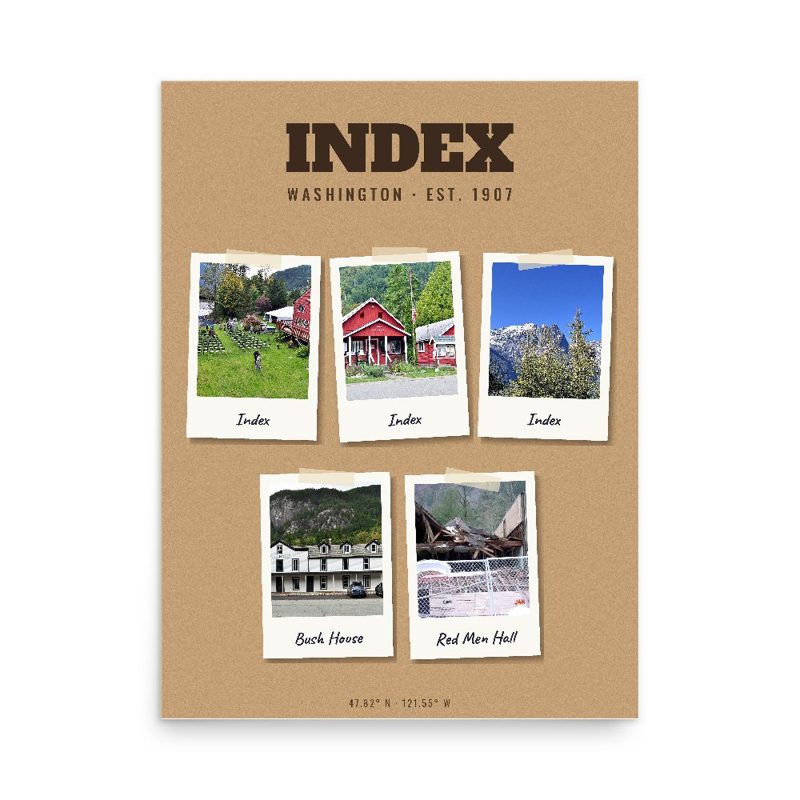
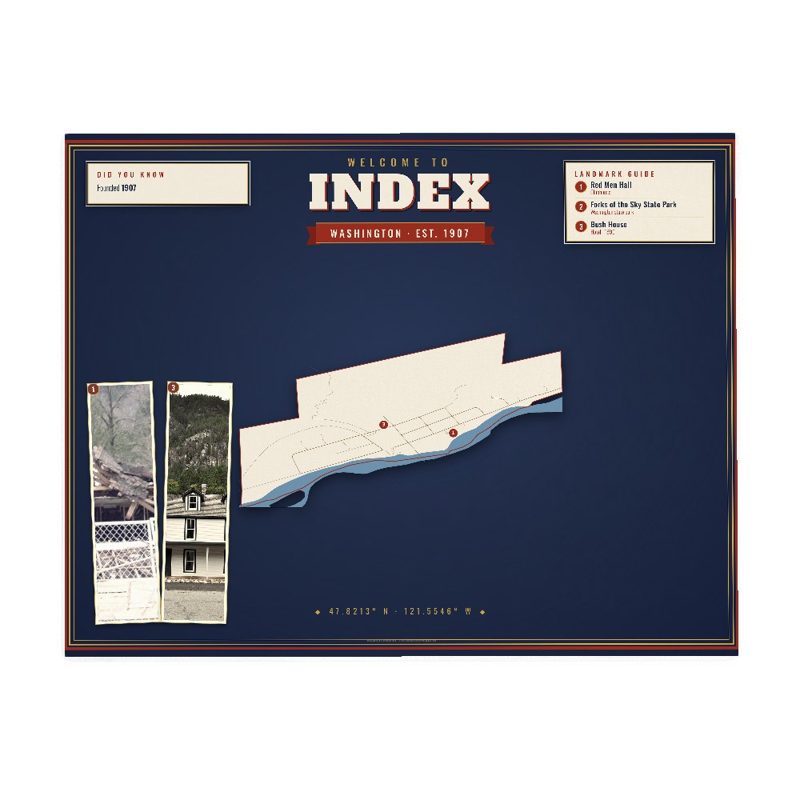







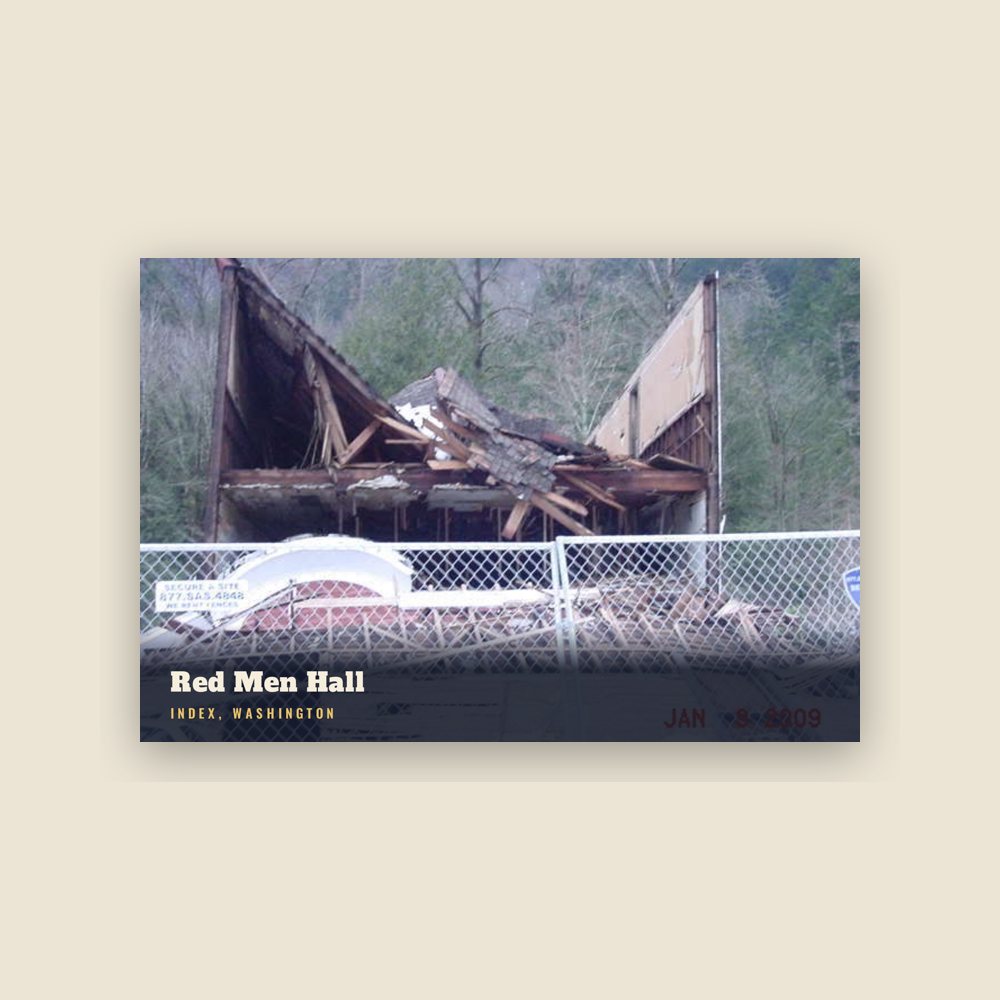
 Red Men Hall
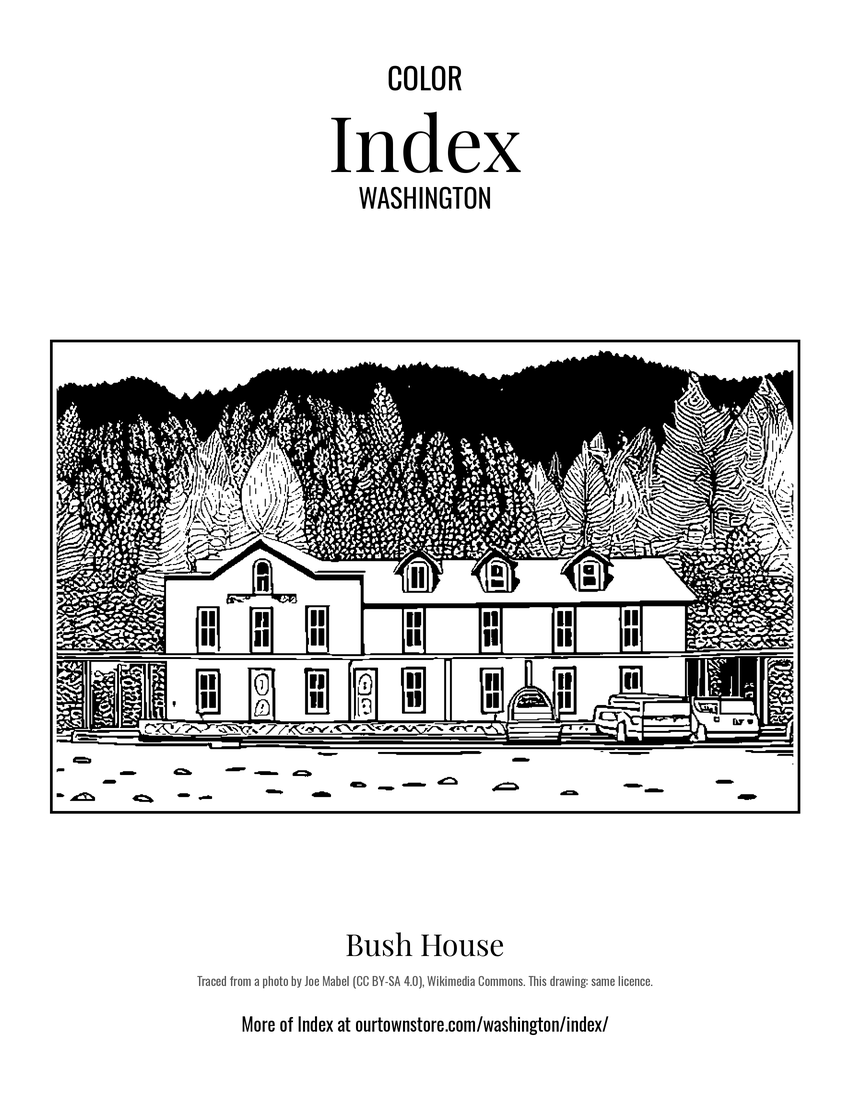 Bush House
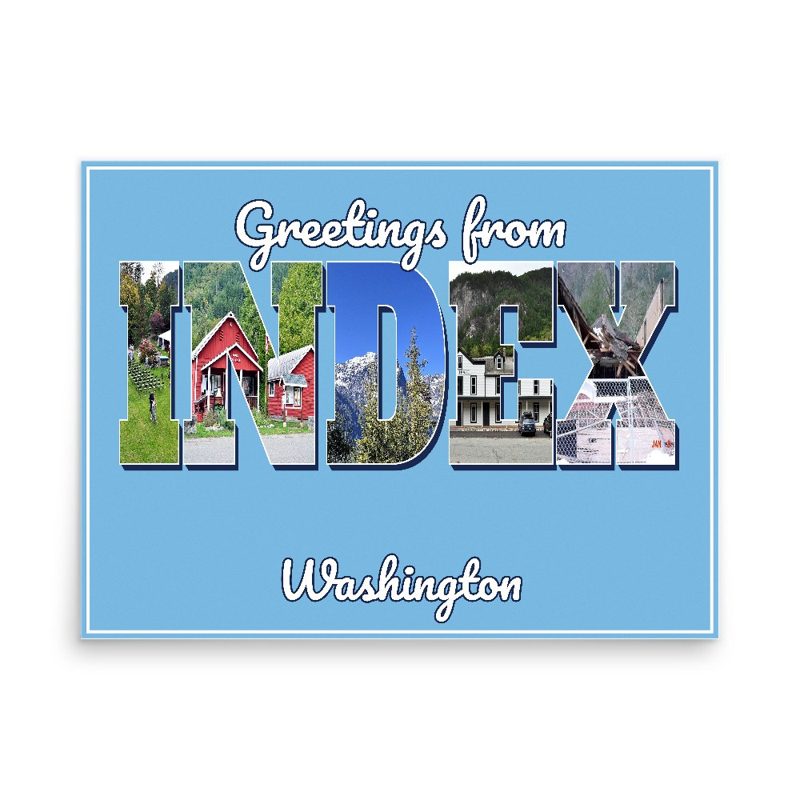
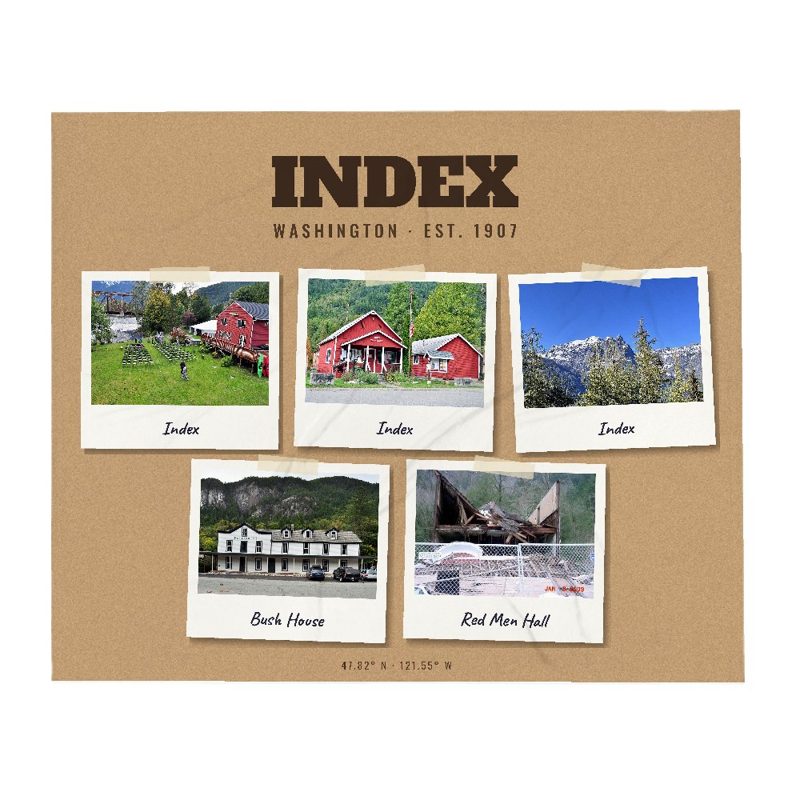
 A view of Index
 A view of Index