Sweeny's settlement, though not under this name, began before Texas was even a Republic. Sweeny is the birthplace of Johnnie Lee Higgins, football player, wide receiver, return specialist.
- CountyBrazoria County
- Population3,626 (2020 U.S. Census)
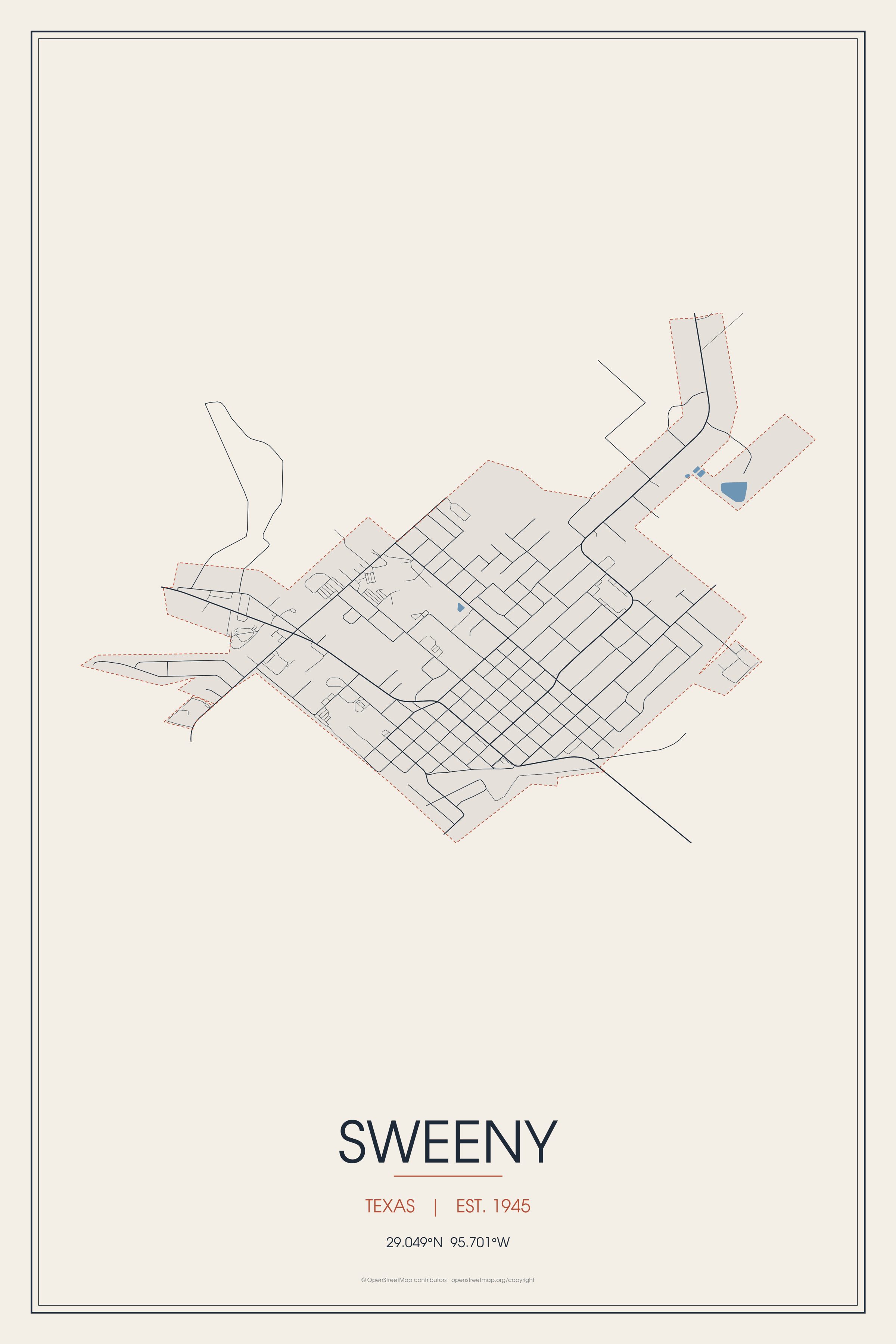
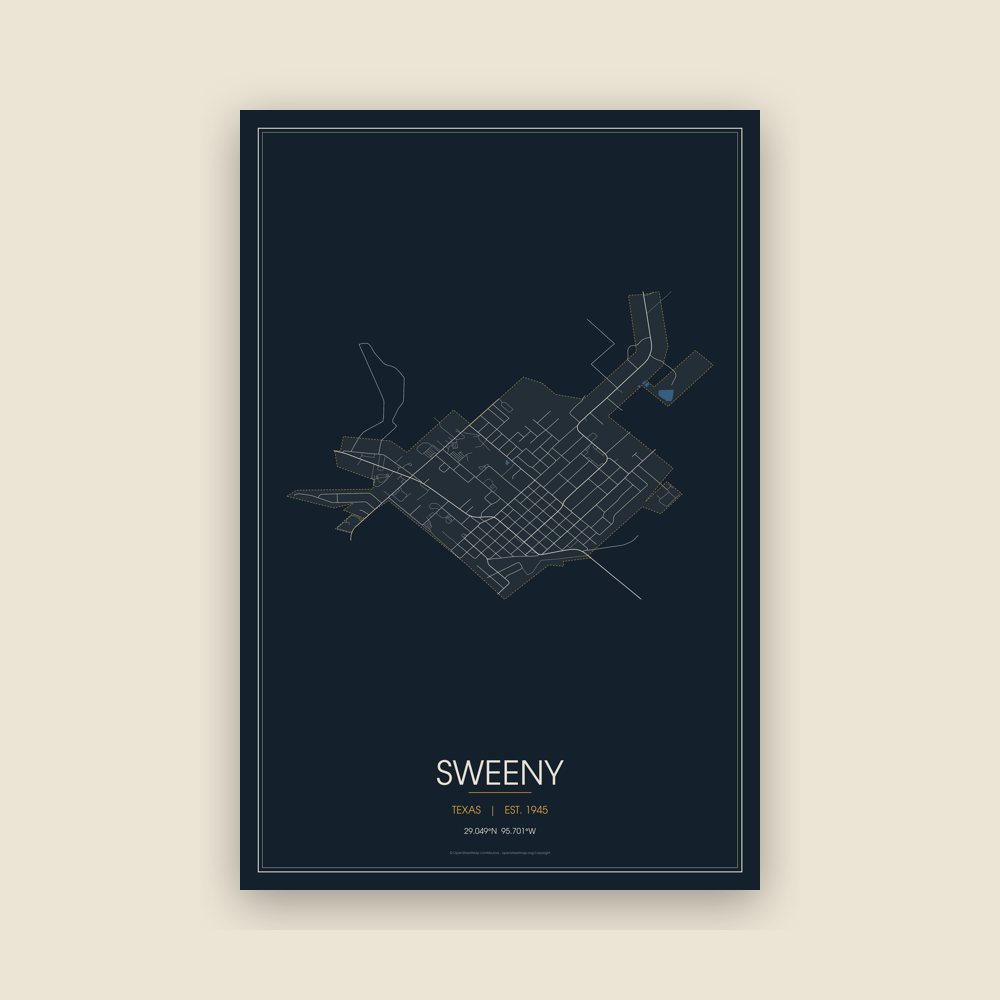
Sweeny, Texas gifts and souvenirs: 17 designs made from Sweeny's own map, landmarks and history, from $16 to $95. Printed to order and shipped free in the USA.
| Popular | Price |
|---|---|
| Sweeny Hometown Ornament | $23 |
| Sweeny Varsity Crewneck | from $57 |
| Sweeny Est. Tee | from $33 |
| Sweeny Town Line Mug | from $26 |
| Sweeny Market Tote | $37 |
Ceramic keepsake, gold ribbon
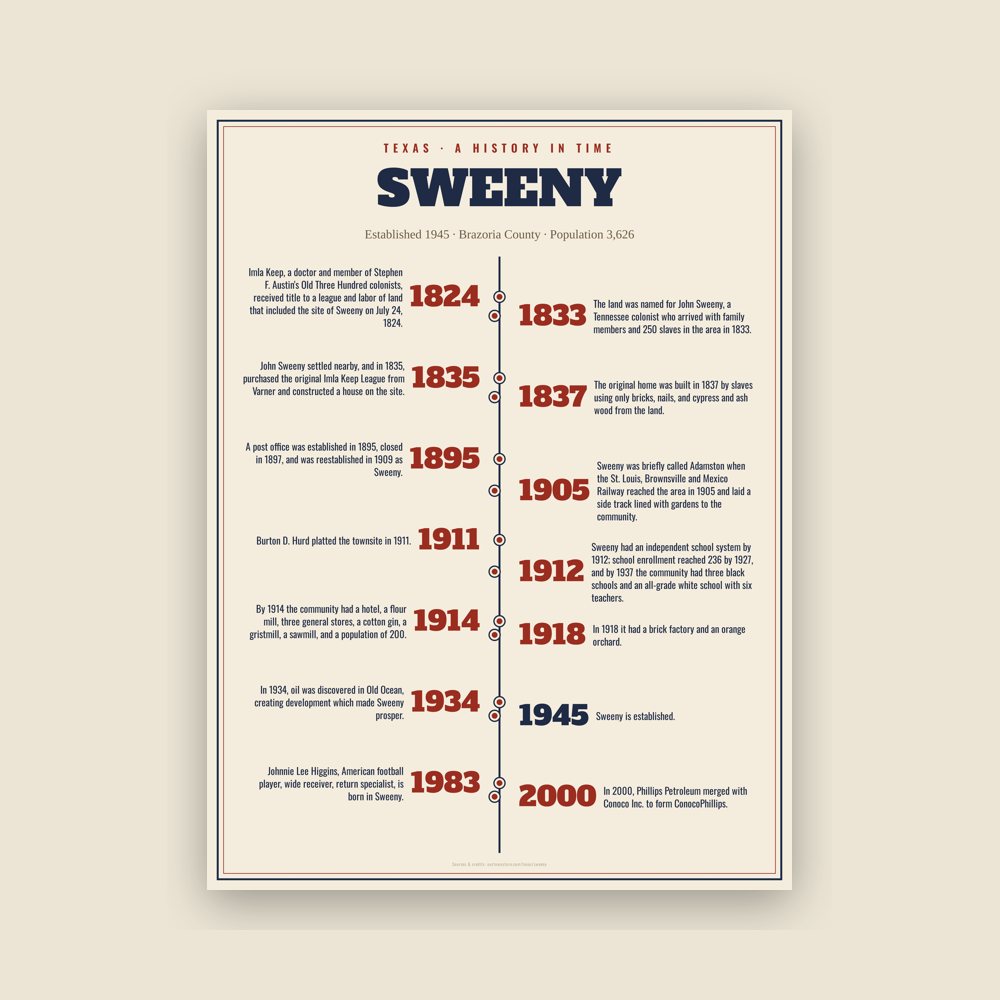
The town's story in dates, from its own records, for home or classroom
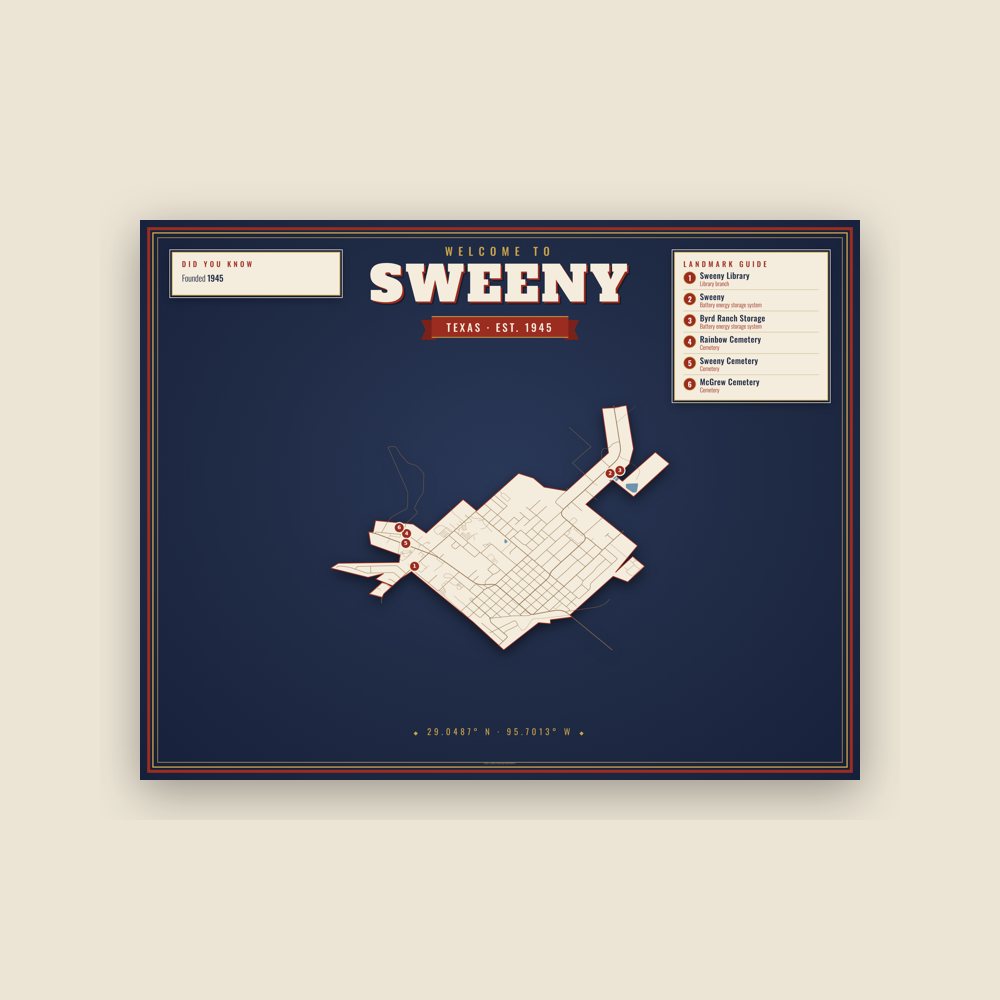
Map of local landmarks, washable fabric
Heavy-blend fleece, street map printed on the back
Soft Bella+Canvas jersey
Kids' Bella+Canvas jersey, youth sizes
Bella+Canvas toddler jersey
Bella+Canvas baby bodysuit
Glossy ceramic, dishwasher safe
Weatherproof, for the front walk
24″×16″, printed coir-look fibers, rubber back
12″×12″ printed wood, ready to hang
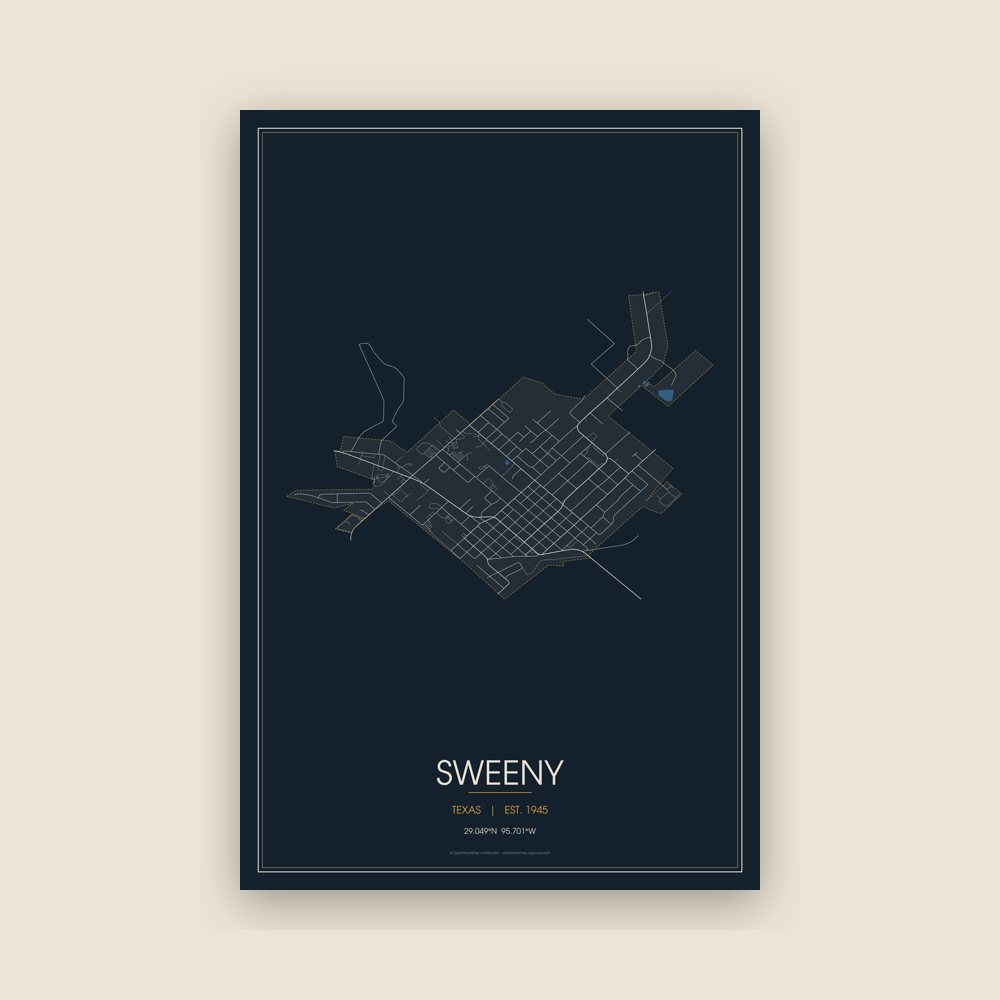
Soft-touch, zip cover
Sturdy all-over-print tote
Glossy top, cork back
Soft fleece, 50″×60″
20 oz, double-wall stainless
Sweeny's settlement, though not under this name, began before Texas was even a Republic. Sweeny is the birthplace of Johnnie Lee Higgins, football player, wide receiver, return specialist.
Sweeny's settlement, though not under this name, began before Texas was even a Republic. Imla Keep, a doctor and member of Stephen F. Austin's Old Three Hundred colonists, received title to a league and labor of land that included the site of Sweeny on July 24, 1824. Keep eventually returned to Louisiana, and Martin Varner acquired the land. The land was named for John Sweeny, a Tennessee colonist who arrived with family members and 250 slaves in the area in 1833. He came after his sons, William Burrell and Thomas Jefferson Sweeny, had purchased land grants near the townsite. They purchased the land grants for the price of a load of mules, and came to examine their new land holdings in 1831. John Sweeny settled nearby, and in 1835, purchased the original Imla Keep League from Varner and constructed a house on the site. The home, today the Sweeny Plantation, a Recorded Texas Historic Landmark, was occupied by original family members through the 1990s. The original home was built in 1837 by slaves using only bricks, nails, and cypress and ash wood from the land. There were also 30 slave cabins made of cypress wood. The plantation had its own sawmill, sugar house, cotton gin, blacksmith shop, commissary, and a kiln for brick manufacture.
The original town stood in a forest of hardwoods with soil twenty feet deep. Sweeny was briefly called Adamston when the St. Louis, Brownsville and Mexico Railway reached the area in 1905 and laid a side track lined with gardens to the community. A post office was established in 1895, closed in 1897, and was reestablished in 1909 as Sweeny. Sweeny's cotton gin and general store were built by 1908, a school was organized in 1911 with eleven students, and church services were held in 1912, when a Civic Club was founded to promote civic and social improvements. Around 1910 the R. D. McDonald Bernard River Land Development Company, which later gave a plot of land to each church denomination, purchased acreage in the area, cut it into lots, and sold it.
Burton D. Hurd platted the townsite in 1911. His Burton D. Hurd Industrial Land Company promoted ten-acre suburban garden farms in the area with the slogan, "Soil Richer Than the Valley of the River Nile" to prospective settlers.
By 1914 the community had a hotel, a flour mill, three general stores, a cotton gin, a gristmill, a sawmill, and a population of 200. In the 1920s Sweeny shipped cotton, vegetables, live-oak parts for ships, and, for a time, bullfrogs raised by area farmers. In 1918 it had a brick factory and an orange orchard. Sweeny had an independent school system by 1912; school enrollment reached 236 by 1927, and by 1937 the community had three black schools and an all-grade white school with six teachers. The Ku Klux Klan operated briefly and held one cross-burning in the community.
In 1934, oil was discovered in Old Ocean, creating development which made Sweeny prosper. In 1942, a government carbon black plant was built which was taken over by Phillips Petroleum, which developed the facilities into a refinery, natural gas liquids center, and petrochemicals complex with pipelines to markets in the eastern United States. In 2000, Phillips Petroleum merged with Conoco Inc. to form ConocoPhillips. Sweeny's population in the latter 20th century has fluctuated from 3,087 to 3,699.
Adapted (trimmed) from the Wikipedia article Sweeny, Texas, revision 1376910012 by its contributors, licensed CC BY-SA 4.0.
We share a part of every Sweeny sale with local partners, and we'd love to print from your collection. Old photographs, maps and postcards make the best keepsakes.
Partner with usA favorite landmark, your street, a school or team, an anniversary gift, a different product. Tell us and we'll get back to you by email.
Sweeny's population was 3,626 in the 2020 U.S. Census, down from 3,684 in 2010.