A short history of Portland
Founding and Early Development
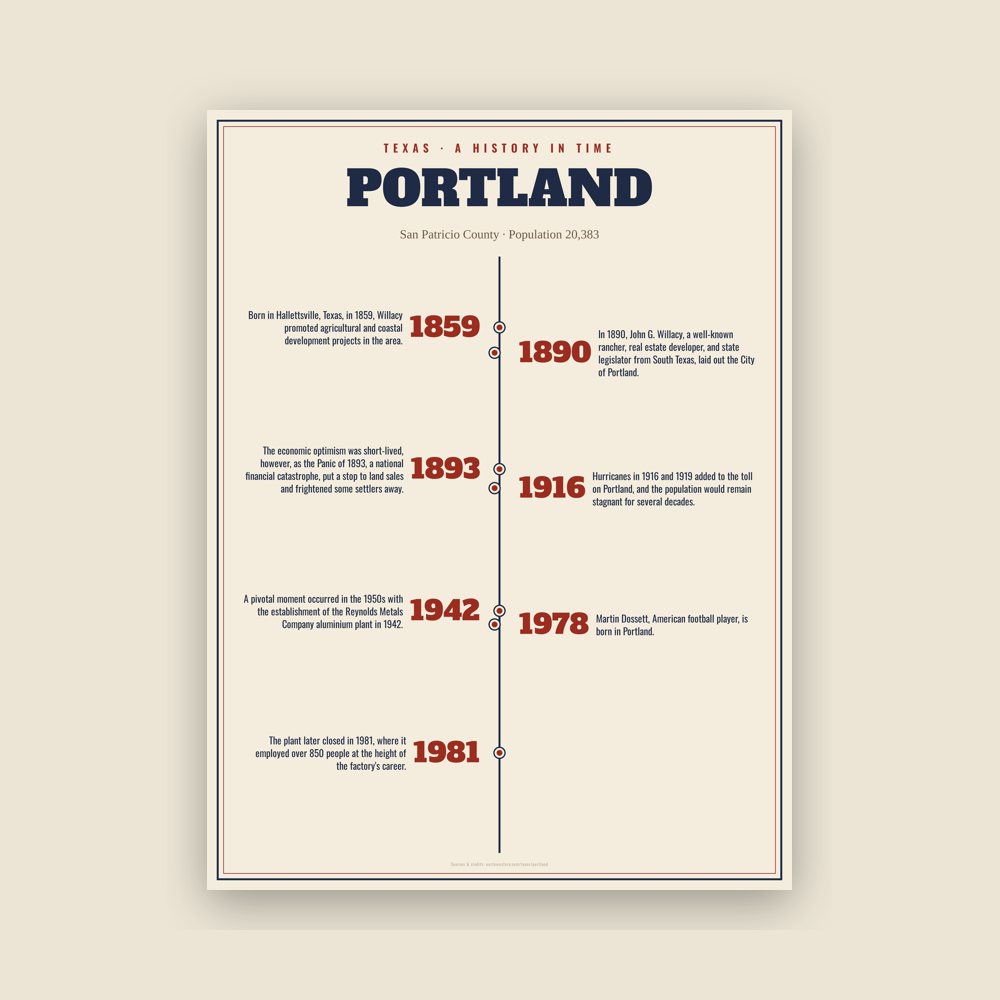
In 1890, John G. Willacy, a well-known rancher, real estate developer, and state legislator from South Texas, laid out the City of Portland. Born in Hallettsville, Texas, in 1859, Willacy promoted agricultural and coastal development projects in the area. He had purchased land from the Coleman-Fulton Pasture Company on a high bluff overlooking Nueces Bay, which he believed to be the perfect location for a settlement, given its high-quality land and access to the Bayfront for shipping. Willacy invited investors from Maine and Kansas to join him in forming the Portland Land and Improvement Company, which marketed this new town as a viable coastal port and agricultural site.
Willacy's impact reached well beyond Portland. Subsequently, he was elected as a Texas State representative from 1899 to 1903 and a state senator from 1903 to 1915, where he advocated for land and tax reform in South Texas and sponsored legislation supporting fence laws, county reorganization, and road construction. Willacy also helped establish Willacy County, which was named for him upon its establishment in 1911.
In his push to encourage settlers to Portland, Willacy was put in charge of building a large hotel and running extensive promotional campaigns. He arranged for steamboats and railroad lines to bring people in from the surrounding area for a large land sale sponsored in July 1891, which attracted hundreds of prospective buyers. The early advertisements highlighted the ocean breezes and fertile soil. Within a few months, many lots had been sold, and the young settlement had several storefronts, a newspaper, and new houses.
The economic optimism was short-lived, however, as the Panic of 1893, a national financial catastrophe, put a stop to land sales and frightened some settlers away. Willacy's once grand hotel, was later converted to Bay View College until it burned in a hurricane in the early 1900s. Hurricanes in 1916 and 1919 added to the toll on Portland, and the population would remain stagnant for several decades.
Read the full history
Incorporation and Early Industry
The next growth for Portland happened in the 1910s when the Portland Development Company extended rail linkages, improved access to water resources, and provided assistance with shipping cotton and other agricultural commodities to neighboring ports. The community was slowly beginning, but the groundwork had been laid for future urban and industrial growth.
A pivotal moment occurred in the 1950s with the establishment of the Reynolds Metals Company aluminium plant in 1942. This plant created hundreds of jobs and drew new families to the area, changing Portland from a small farming community into a growing residential and commercial area closely tied to Corpus Christi's industrial economy. The plant later closed in 1981, where it employed over 850 people at the height of the factory's career. Officials claimed that the closing was due to high energy costs that would cut the company's primary aluminium production by 114,000 tons annually.
Mid-20th Century Industrial Expansion
Portland became even more connected to the expanding industrial base in the Coastal Bend. Businesses, such as Sherwin Alumina, OxyChem, and Gulf Marine Fabricators. These factories had facilities in or near the City, increasing Portland's place in the Corpus Christi portion of the Metropolitan area. Portland's location near the Port of Corpus Christi and major highway routes allowed for a variety in manufacturing, energy, and petrochemical industries.
By the century's end, Portland had grown south into Nueces County and had established a reputation as a prosperous, family-friendly community with a rising population, modern infrastructure, and scenic views along the waterfront of Nueces and Corpus Christi Bays.
Adapted (trimmed) from the Wikipedia article Portland, Texas, revision 1384884506 by its contributors, licensed CC BY-SA 4.0.