A short history of Point
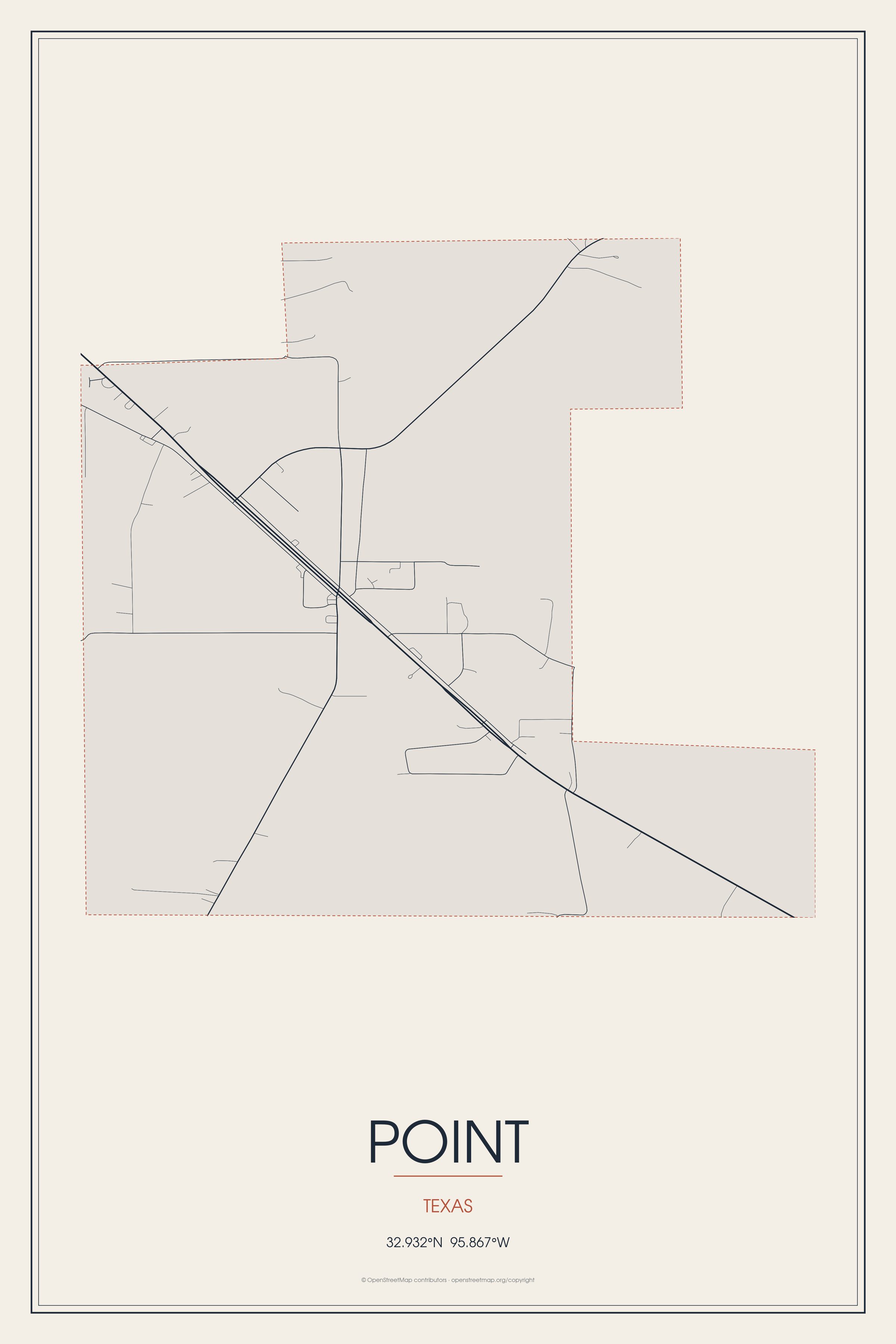
Settled circa 1880 as a flag station on a section of the Missouri–Kansas–Texas Railroad (MKT) being built from Mineola to Greenville, the name submitted for a post office was initially Rice's Point, in honor of early area settler William Rice. When that was rejected, the name Point was accepted.
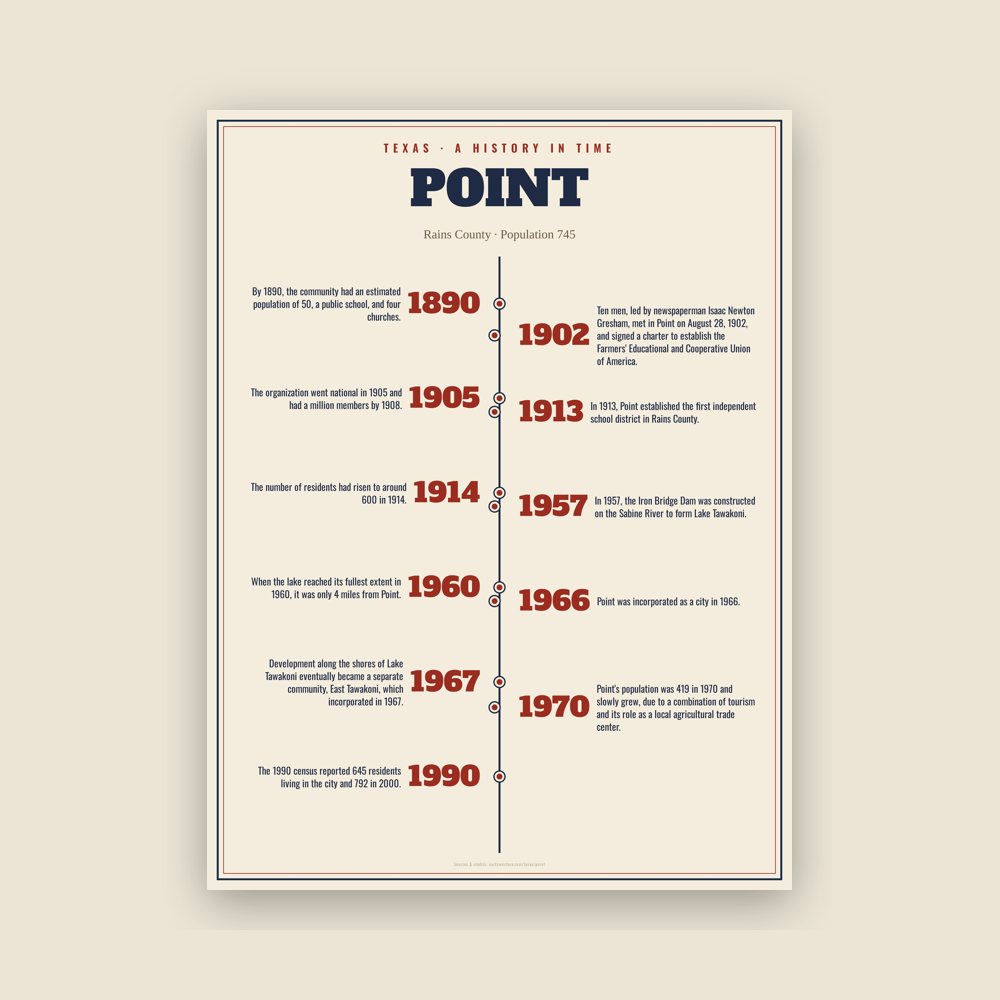
By 1890, the community had an estimated population of 50, a public school, and four churches. Ten men, led by newspaperman Isaac Newton Gresham, met in Point on August 28, 1902, and signed a charter to establish the Farmers' Educational and Cooperative Union of America. The organization went national in 1905 and had a million members by 1908. In 1913, Point established the first independent school district in Rains County. The number of residents had risen to around 600 in 1914.
The Great Depression severely impacted the community, leading to a rapid decline in population and the number of businesses in Point. The paving of U.S. Route 69 in the early 1940s bolstered the population to around 420, but that figure had again declined to 350 by the end of that decade. The MKT line was abandoned in the mid-1950s. In 1957, the Iron Bridge Dam was constructed on the Sabine River to form Lake Tawakoni. When the lake reached its fullest extent in 1960, it was only 4 miles from Point. Point was incorporated as a city in 1966. Development along the shores of Lake Tawakoni eventually became a separate community, East Tawakoni, which incorporated in 1967. Point's population was 419 in 1970 and slowly grew, due to a combination of tourism and its role as a local agricultural trade center. The 1990 census reported 645 residents living in the city and 792 in 2000.
Adapted (trimmed) from the Wikipedia article Point, Texas, revision 1377382871 by its contributors, licensed CC BY-SA 4.0.