A short history of Ore City
The arrival of European settlers in the 18th and 19th centuries led to significant changes in the region, including the forced removal of the Indigenous peoples.
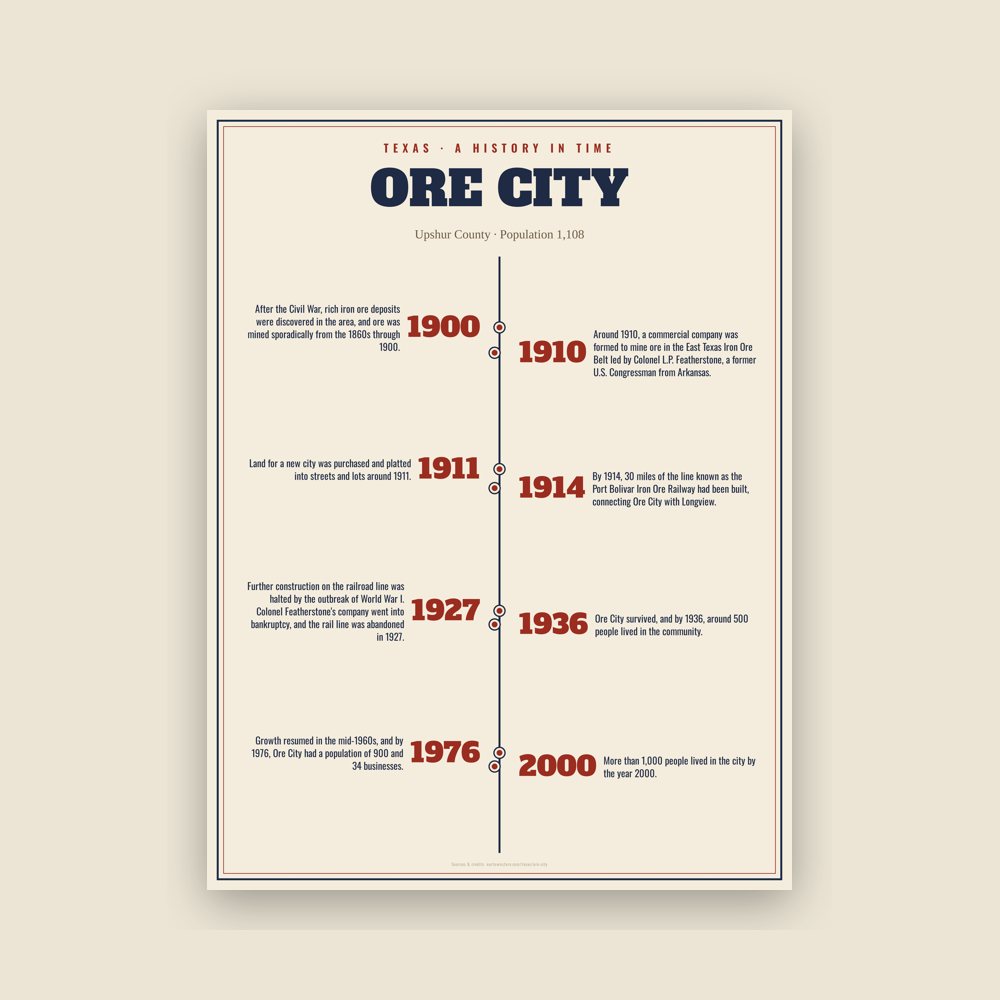
Originally part of the William Murray League, the area was first settled in the early 1850s by a group from Haywood County, Tennessee. They immediately started The Murray League Methodist Episcopal Church, South as well as the Murray League Institute. After the Civil War, rich iron ore deposits were discovered in the area, and ore was mined sporadically from the 1860s through 1900.
Around 1910, a commercial company was formed to mine ore in the East Texas Iron Ore Belt led by Colonel L.P. Featherstone, a former U.S. Congressman from Arkansas. He persuaded the Santa Fe Railway line to finance a rail link with Port Bolivar. Land for a new city was purchased and platted into streets and lots around 1911. The town was named Ore City, and a post office was established soon after. By 1914, 30 miles of the line known as the Port Bolivar Iron Ore Railway had been built, connecting Ore City with Longview. The newly founded community had an estimated population of 400. Further construction on the railroad line was halted by the outbreak of World War I. Colonel Featherstone's company went into bankruptcy, and the rail line was abandoned in 1927. Ore City survived, and by 1936, around 500 people lived in the community. During World War II, the federal government built a steel plant 10 miles north of Ore City to mine the same ore that previously brought Colonel Featherstone to the area. The plant was completed just as the war ended and was sold to a Texas group as surplus property. They operated it as the Lone Star Steel Company.
Growth resumed in the mid-1960s, and by 1976, Ore City had a population of 900 and 34 businesses. More than 1,000 people lived in the city by the year 2000.
Read the full history
Decline and Stabilization
As in many other mining towns, resource depletion led to population decline and economic stagnation. By the mid-20th century, mining operations had slowed considerably, and Ore City's growth stabilized as a small, rural community, falling short of becoming a potential Boomtown.
Adapted (trimmed) from the Wikipedia article Ore City, Texas, revision 1384021809 by its contributors, licensed CC BY-SA 4.0.