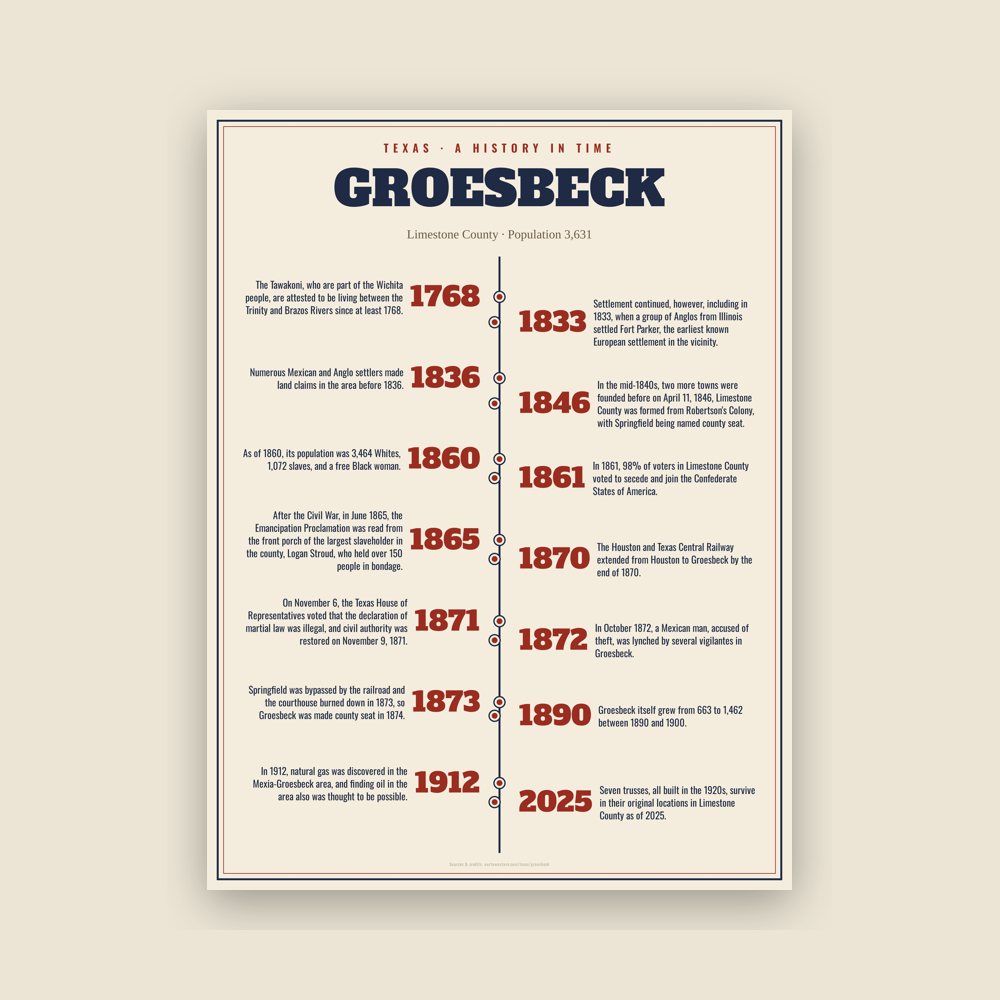
The Tawakoni, who are part of the Wichita people, are attested to be living between the Trinity and Brazos Rivers since at least 1768.
Read the full history
European colonization
Limestone County was a part of the empresario grants given out by the government of Coahuila y Tejas, with Haden Edwards given permission to settle an area including most of Limestone County in 1825, but the Mexican government legally forbade Anglo-Americans from settling into Mexican Texas after the Law of April 6, 1830. Settlement continued, however, including in 1833, when a group of Anglos from Illinois settled Fort Parker, the earliest known European settlement in the vicinity. Numerous Mexican and Anglo settlers made land claims in the area before 1836. After 1836, due in part to the Fort Parker massacre and ongoing violence in between settlers and natives in Limestone County, the newly established Republic of Texas forbade new settlement until the Treaty of Tehuacana Creek in 1844. In the mid-1840s, two more towns were founded before on April 11, 1846, Limestone County was formed from Robertson's Colony, with Springfield being named county seat. As of 1860, its population was 3,464 Whites, 1,072 slaves, and a free Black woman. In 1861, 98% of voters in Limestone County voted to secede and join the Confederate States of America.
Fort Parker
Fort Parker State Park, located north of Groesbeck, is preserved to tell the story of Cynthia Ann Parker, who was captured by Comanches, and became the mother of Quanah Parker, the last Comanche chief.
Reconstruction
After the Civil War, in June 1865, the Emancipation Proclamation was read from the front porch of the largest slaveholder in the county, Logan Stroud, who held over 150 people in bondage. Four future African-American Texas legislators were freed in Limestone County that day, Ralph Long, Sheppard Mullins, and David Medlock Jr., and Giles Cotton, who were freed from Stroud's estate.
"Ecstasy! Banjos twanged as couples danced and women laughed and children shouted. Grown men wept and jubilation reigned. Release! Liberty! Deliverance!"
Juneteenth has been celebrated since then in Booker T. Washington Park along Lake Mexia, with early crowds reaching 20,000 as they listened to passionate speeches by local preachers and politicians. Separately, White veterans of the Civil War began their own summer gathering nearby at Confederate Reunion Grounds State Historic Site, with theirs peaking at 5,000 in attendance.
During the Reconstruction era, Limestone County experienced heightened racial tensions. In June 1867, Limestone County was assigned a Freedmen's Bureau agent, who was shot and killed within 6 months of his arrival. In October 1872, a Mexican man, accused of theft, was lynched by several vigilantes in Groesbeck.
Early days
The Houston and Texas Central Railway extended from Houston to Groesbeck by the end of 1870. Groesbeck was incorporated in April 1871, and by the end of 1872, Groesbeck had rail connections to Waco and Dallas, and trains on the way from St. Louis to Houston began passing through in 1880. Springfield was bypassed by the railroad and the courthouse burned down in 1873, so Groesbeck was made county seat in 1874. Railroads in the late 19th century were a booming industry. The end of reconstruction and the advent of the railroad began an era of growth for the county. The population in Limestone County was 9,000 in 1870, and 32,000 in 1900. Groesbeck itself grew from 663 to 1,462 between 1890 and 1900.
Discovery of oil and natural gas
In 1912, natural gas was discovered in the Mexia-Groesbeck area, and finding oil in the area also was thought to be possible. In October 1920, Col. A.E. Humphreys completed an oil well begun by the Mexia Oil and Gas Company and discovered oil at a depth of 3100 feet. A proper well was set up and producing 4000 barrels a day by the summer of 1921. The discovery was notable because it was the first discovery of oil fields formed by the Cenomanian-era Woodbine Group geologic formation. This encouraged future exploration in the Woodbine sand, leading to the discovery of many other Woodbine fields, including the giant East Texas Oil Field, which was discovered in 1930. By January 1922, $5 million had been invested in Mexia and 5 million barrels of oil had been extracted. On January 12, martial law was declared for the second time in Limestone County history due to open and flagrant violation of the law, highway robberies, open gambling, and selling of liquor.
The oil discovery brought wealth to the area, but in Groesbeck, natural gas was more commonly extracted due to the lack of suitable oil deposits. After 1922 however, production of oil and natural gas declined rapidly. By 1927 most of the heavy oil extraction was finished in Limestone county, but the formations remain useful for paleobiologists.
The oil boom led to many trusses being built in the area. This type of bridge, popular among Texans in the early 20th century, is a rare sight now. Seven trusses, all built in the 1920s, survive in their original locations in Limestone County as of 2025.
The Great Depression
The Great Depression had a major effect on Groesbeck. In 1930, the population of Limestone County had reached its peak of nearly 40,000, with over 6,000 farms. By 1940, however, that had fallen to 34,000 people and 3,400 farms, and the number of businesses was cut in half. The Civilian Conservation Corps and Works Progress Administration helped ease unemployment and built Fort Parker State Park.
Postwar years
In 1960, the population of Groesbeck was 2,500. The housing situation was critical since over 55% of citizens were low-income, and with only 34 vacant housing units. In 1962, the Groesbeck Housing Authority was created by mayor George Koch, and the city began plans to construct low-income housing. In August 1964, the Groesbeck Housing Authority approved plans for Liberty Village and Liberty Square apartments, affordable housing units that were built on opposite ends of town.
The project was finished with 12 units in July 1965, and a policy of segregation was revealed to have been used in selecting tenants. The exact date of desegregation is not known, but it likely happened in response to the Fair Housing Act of 1968. The apartments were successful at housing elderly and low-income individuals, so the apartments were expanded and 15 more units finished construction in 1973. Both sites still function as government housing.
In August 1966, a team sent by the federal HEW Department investigated Groesbeck ISD and found they had maintained a segregated school system for 12 years after Brown v. Board of Education, and that facilities in the all-White school were "vastly superior". Within two weeks of federal intervention, 22 Black students transferred within the district. Longtime district superintendent H.O. Whitehurst resigned the same year, after 35 years. Full integration was not achieved until the 1969–70 school year. The 1969 class of Washington High School was the last segregated graduating class in Groesbeck.
In 1979, NRG Energy proposed construction of a $1.6 billion coal-burning power plant near Groesbeck. It finished construction in 1985. The power plant increased the tax base and brought many jobs to Groesbeck. Between 1985 and 1989, Groesbeck ISD spent $18 million constructing new elementary and high schools, and in 1991, the high school football team went undefeated and claimed the 3-A championship. After 1993, the Texas Legislature enacted the Robin Hood plan, which redistributes the taxes earned from the power plant more equitably across Texas school districts.
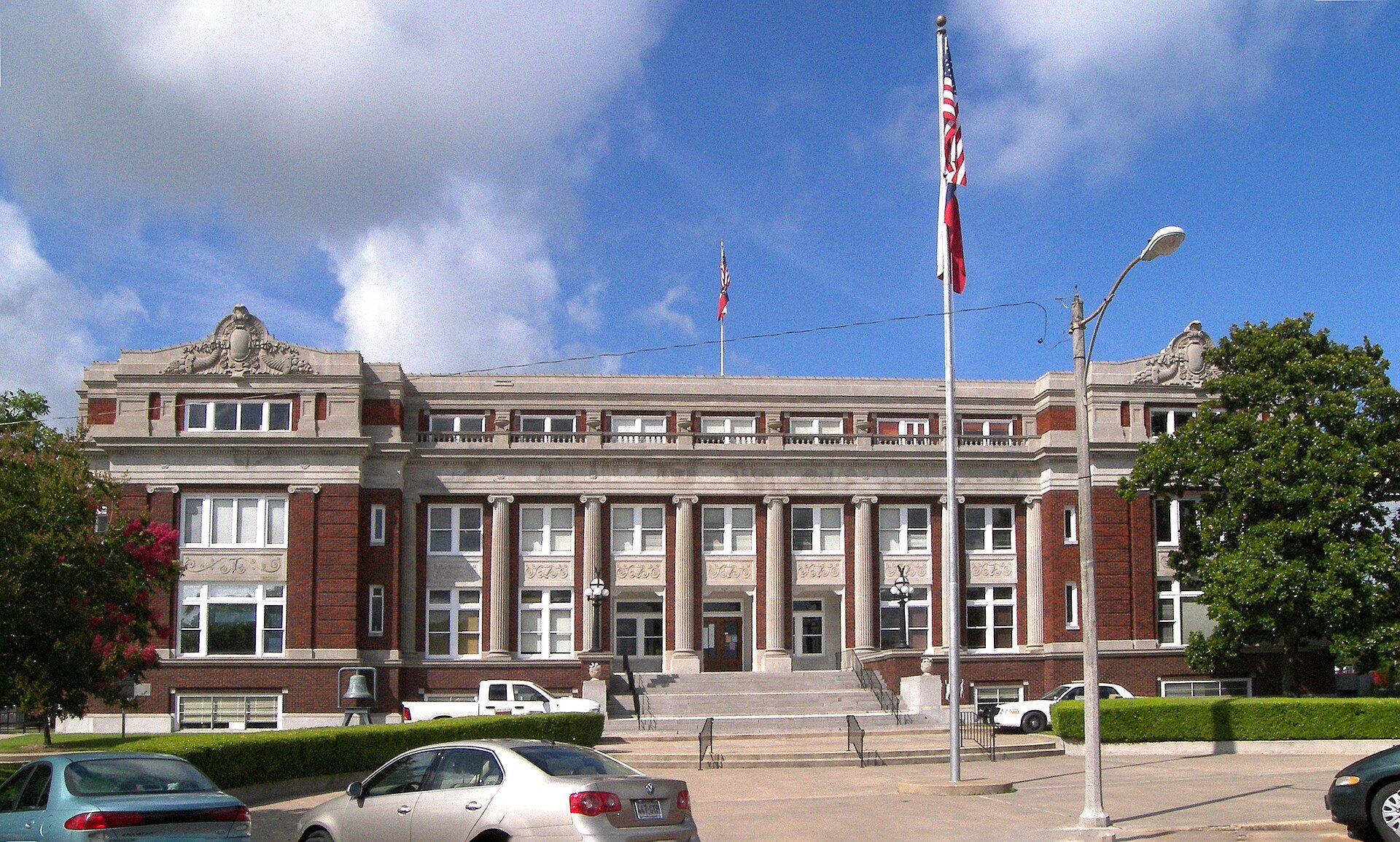























 A view of Groesbeck
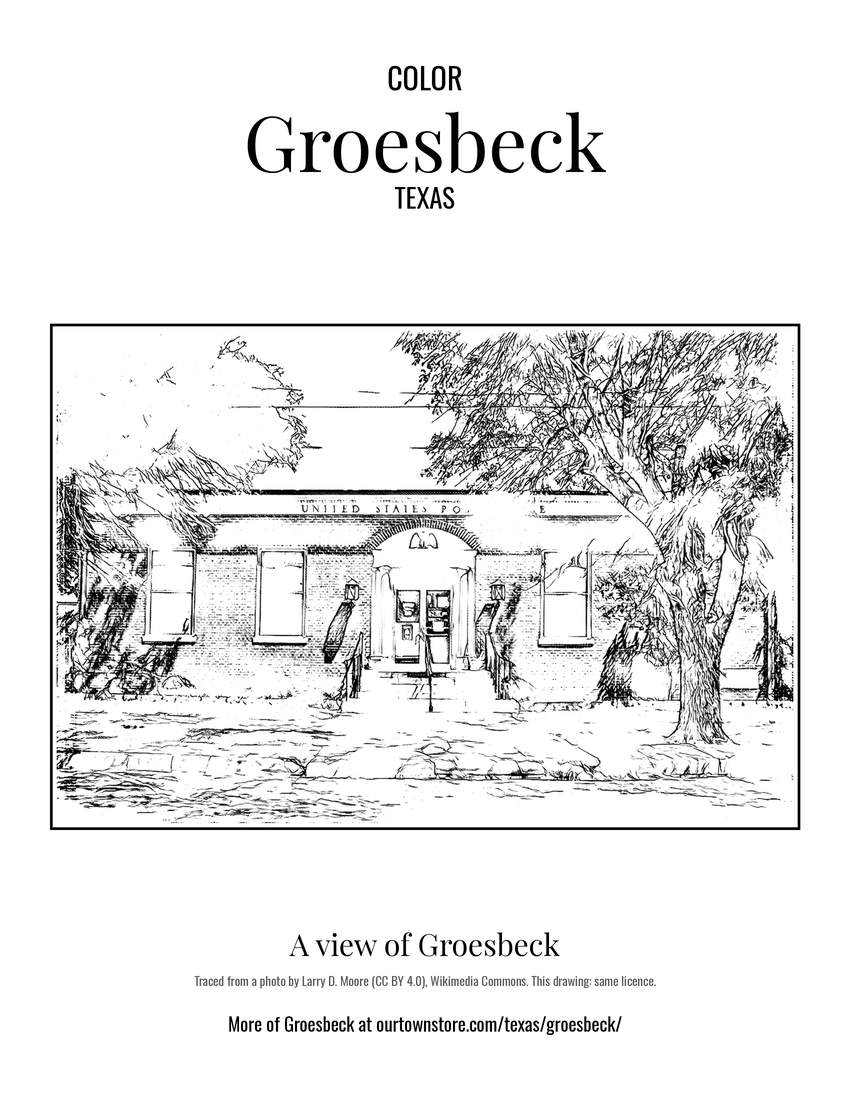 A view of Groesbeck
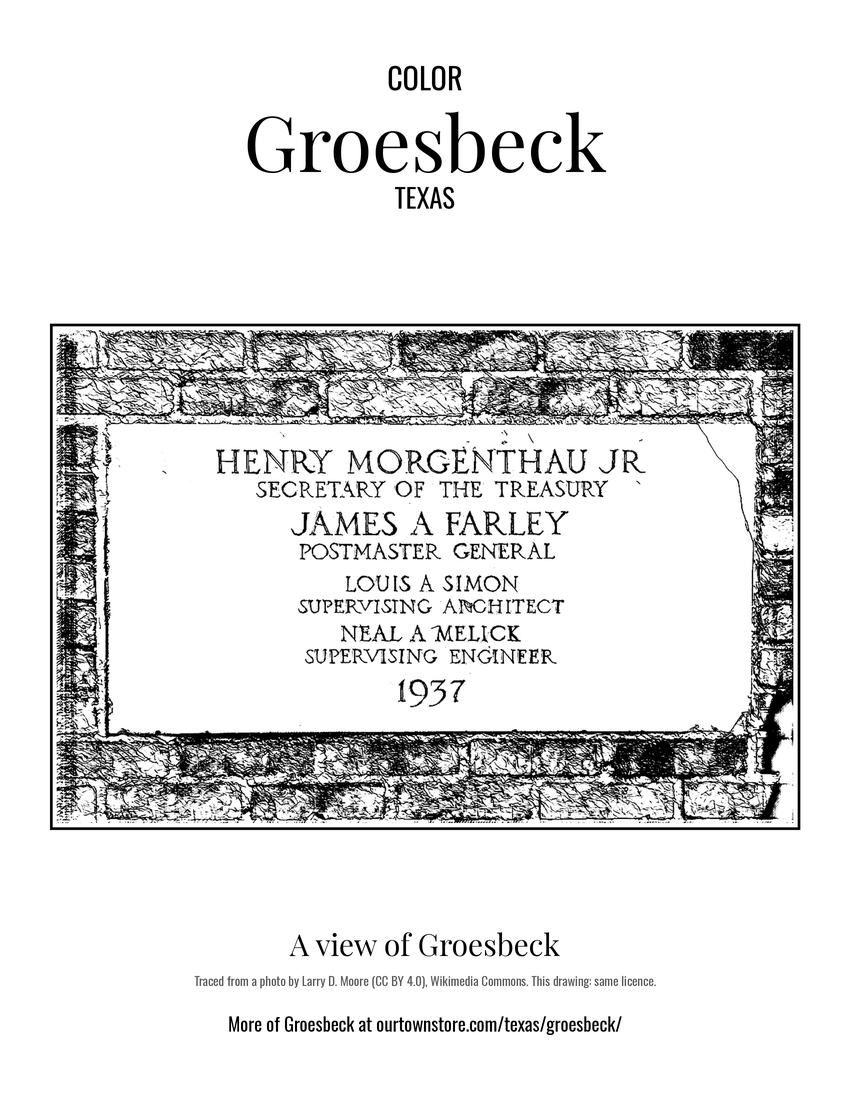 A view of Groesbeck