A short history of Duncanville
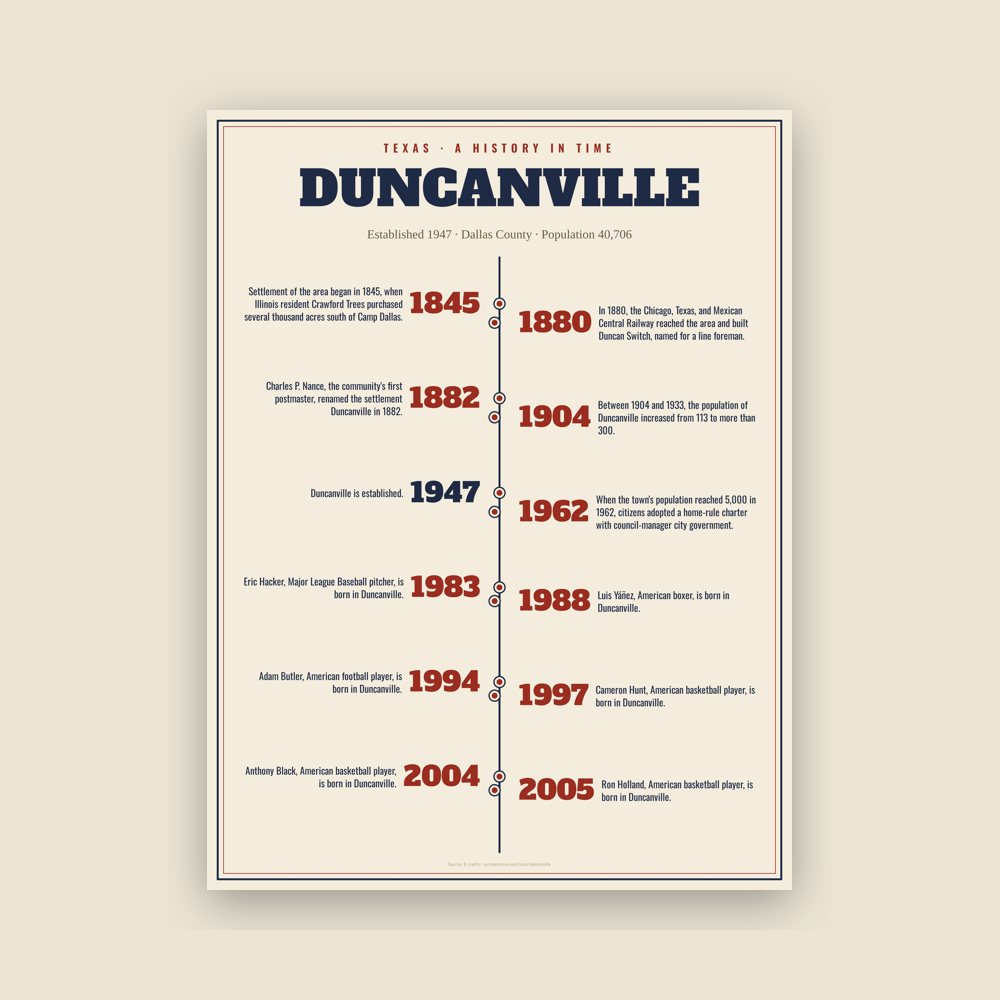
Settlement of the area began in 1845, when Illinois resident Crawford Trees purchased several thousand acres south of Camp Dallas. In 1880, the Chicago, Texas, and Mexican Central Railway reached the area and built Duncan Switch, named for a line foreman. Charles P. Nance, the community's first postmaster, renamed the settlement Duncanville in 1882. By the late 19th century, Duncanville was home to a dry-goods stores, a pharmacy, a domino parlor, and a school. Between 1904 and 1933, the population of Duncanville increased from 113 to more than 300.
During World War II, the Army Air Corps established a landing field for flight training on property near the present-day intersection of Main St and Wheatland Road.
Duncanville residents incorporated the city on August 2, 1947. During the postwar years, the military developed the Army's old landing field into the Duncanville Air Force Station, which was the headquarters for the four Nike-Hercules missile launch sites guarding Dallas/Fort Worth from Soviet bomber attack. It also housed the Air Force tracking radars for the region.
When the town's population reached 5,000 in 1962, citizens adopted a home-rule charter with council-manager city government. Sometimes regarded as a "white flight" suburb in the 1960s and 1970s, the city is now known for its racial diversity. Its population increased from about 13,000 in 1970 to more than 31,000 in 1988.
Read the full history
Historic preservation
Duncanville recognizes the importance of the former Duncanville Air Force Station, which closed on July 1, 1964, but the Army continued to operate the Nike Missile air defense operations until 1969, when the facility was turned over to the city. The WWII-era barracks and some other structures were initially repurposed for civic and community use. Over time, the buildings were systematically demolished, removing all signs of the historic base, but the history of the facility lives on in a monument that stands outside the library and community center.
The "stone igloo", a spring house originally located near the intersection of Center Street and Cedar Ridge Road, was preserved in a unique way. In the late 1960s or early 1970s, it was demolished, thereby producing a supply of rocks used to build a replica of the structure at a nearby park and paving the way for the construction of a neighborhood retail center.
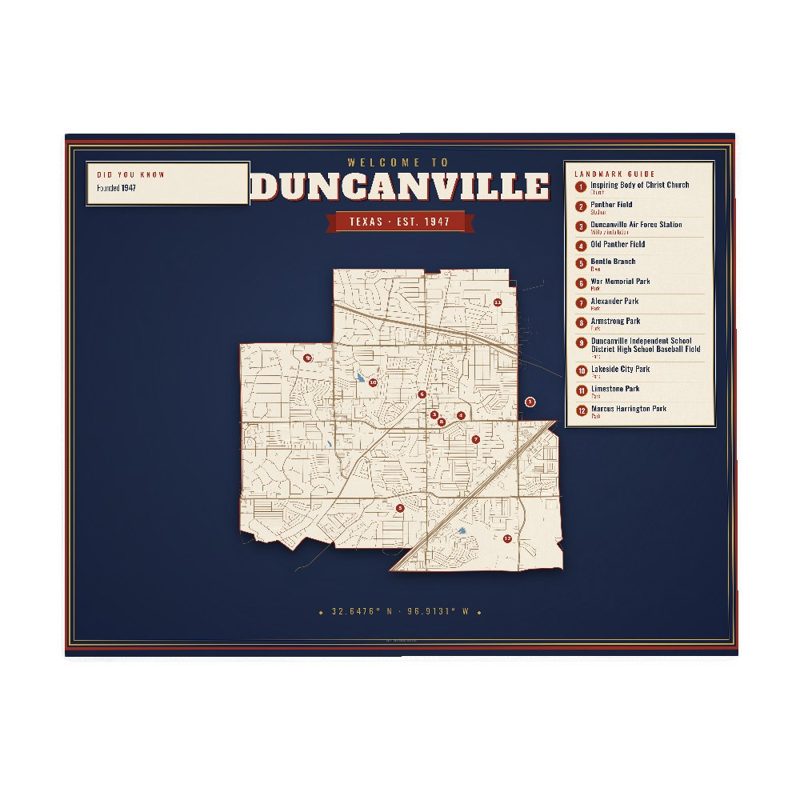
Various pieces of the city's history are preserved at the Duncanville Historical Park, which is located on Wheatland Road in Armstrong Park on land that was once a part of the Duncanville Air Force Station. Historic buildings include the city's first Music Room.
Adapted (trimmed) from the Wikipedia article Duncanville, Texas, revision 1378772380 by its contributors, licensed CC BY-SA 4.0.