A short history of Sparta
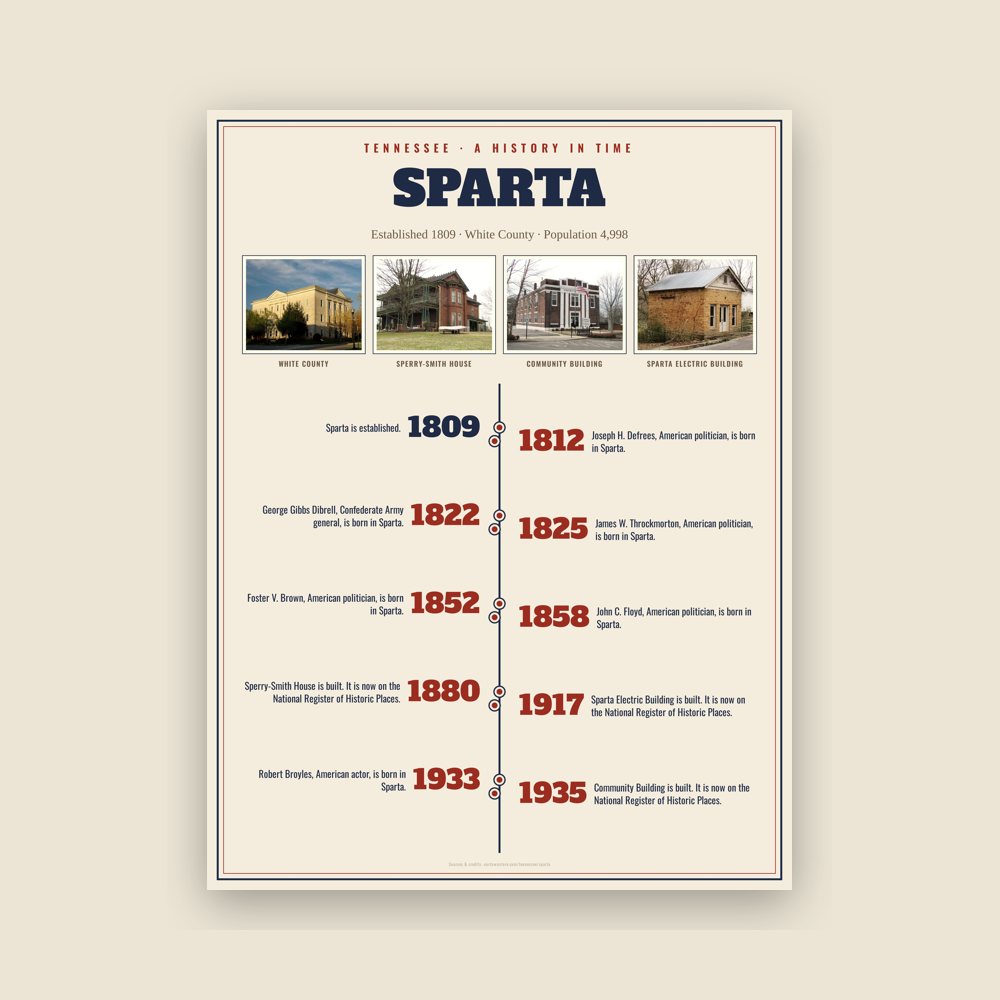
Sparta was established in 1809 as a county seat for White County, which had been created in 1806. The city was named after the ancient Greek city-state Sparta.
Sparta nearly became the capital of the state of Tennessee, as, early in the history of Tennessee, the state legislature voted to choose a location for the permanent state capital. The final vote resulted in a near tie between Sparta and Nashville. Sparta lost to Nashville by one vote.
Sparta grew quickly due to its location along the stage road between Knoxville and Nashville. In the 1830s, brothers Barlow and Madison Fisk built the Sparta Rock House, which served as an inn along the stage road. The Rock House, strategically situated in an area where the Cumberland Plateau gives way to the Calfkiller valley, was a common stopover for figures important to the early history of the state, including Andrew Jackson and Sam Houston. The building is now a state historic site and is listed on the National Register of Historic Places.
Sparta is notable as a place where two renowned airmen lost their lives. Hawthorne C. Gray, an aviation record holder, died in a balloon-basket mishap over Sparta in 1927, and Lansing Colton Holden Jr., a World War I flying ace, crashed his plane near Sparta in 1938.
Teenagers Erin Foster and Jeremy Bechtel went missing in Sparta in 2000, and were not discovered until February 2022 when scuba diver Jeremy Sides found Foster's vehicle in the Calfkiller River.
Adapted (trimmed) from the Wikipedia article Sparta, Tennessee, revision 1379224034 by its contributors, licensed CC BY-SA 4.0.