The Catawba Indians are the earliest known inhabitants of the Charlotte area. They were first encountered in the region in 1567 by the Spanish Conquistador Juan Pardo.
Read the full history
18th century
The area that is now Charlotte was first settled by European colonists around 1755 when Thomas Spratt and his family settled near what is now the Elizabeth neighborhood. Thomas Polk (great-uncle of President James K. Polk), who later married Thomas Spratt's daughter, built his house by the intersection of two Native American trading paths between the Yadkin and Catawba rivers. One path ran north–south and was part of the Great Wagon Road; the second path ran east–west along what is now Trade Street.
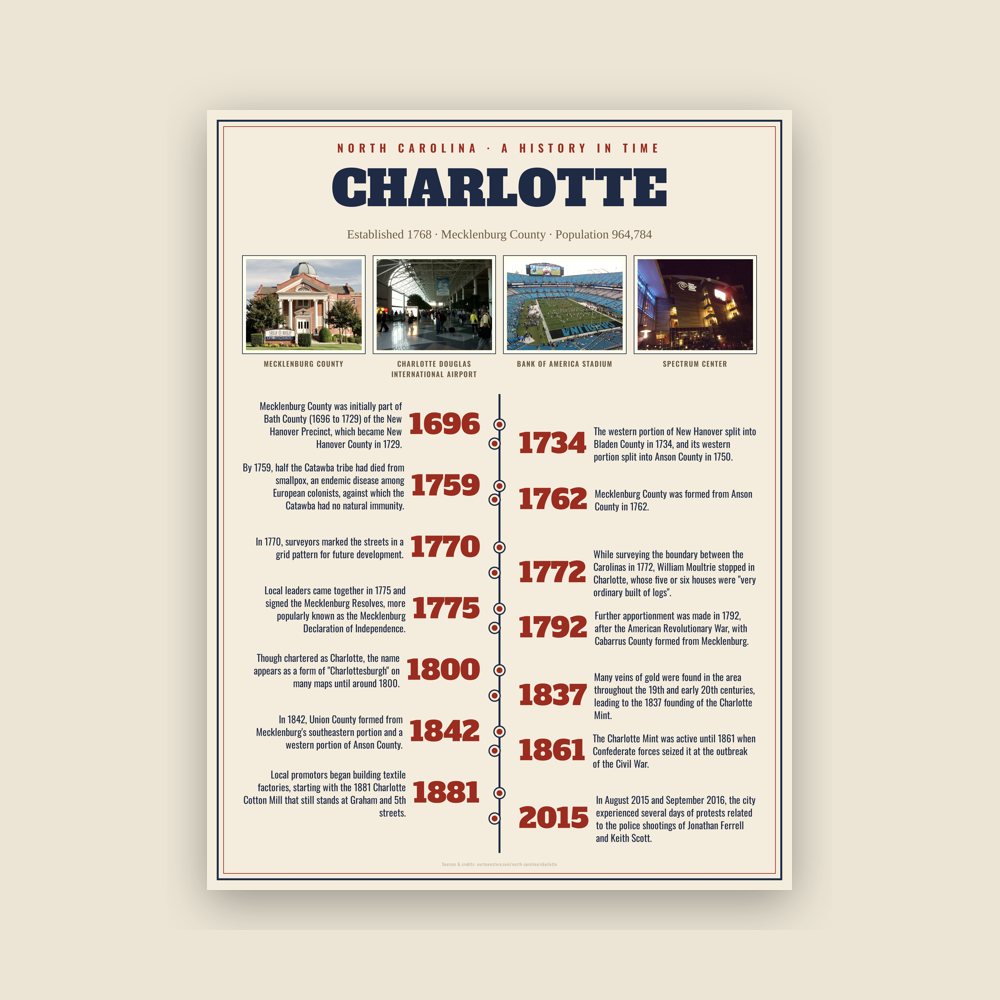
By 1759, half the Catawba tribe had died from smallpox, an endemic disease among European colonists, against which the Catawba had no natural immunity. At its peak, the Catawba population was 10,000. But by 1826, the Catawba population dropped to 110.
The city of Charlotte was developed first by a wave of migration of Scots-Irish Presbyterians, or Ulster-Scot settlers from Ulster, who dominated the culture of the Southern Piedmont Region and made up the principal founding population in the backcountry. German immigrants also settled in the area before the American Revolutionary War, but in smaller numbers. They still contributed greatly to the early foundations of the region.
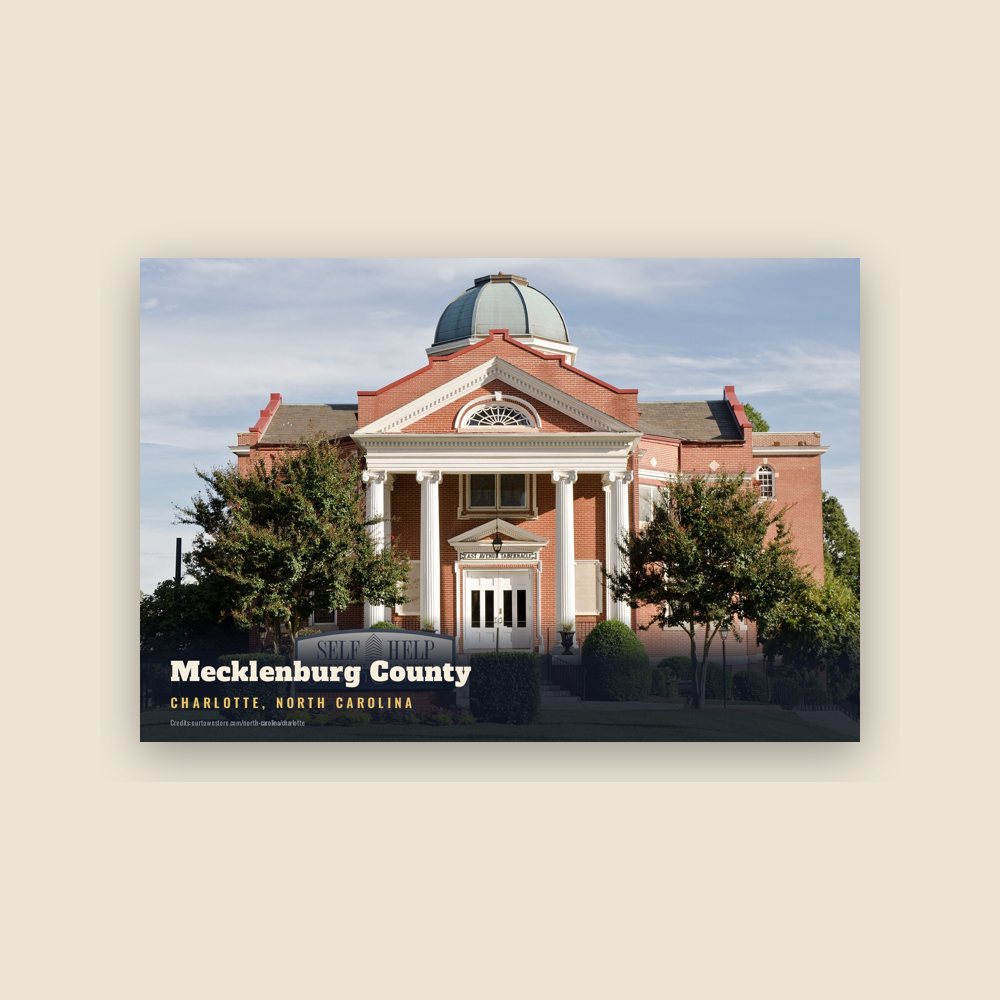
Mecklenburg County was initially part of Bath County (1696 to 1729) of the New Hanover Precinct, which became New Hanover County in 1729. The western portion of New Hanover split into Bladen County in 1734, and its western portion split into Anson County in 1750. Mecklenburg County was formed from Anson County in 1762. Further apportionment was made in 1792, after the American Revolutionary War, with Cabarrus County formed from Mecklenburg.
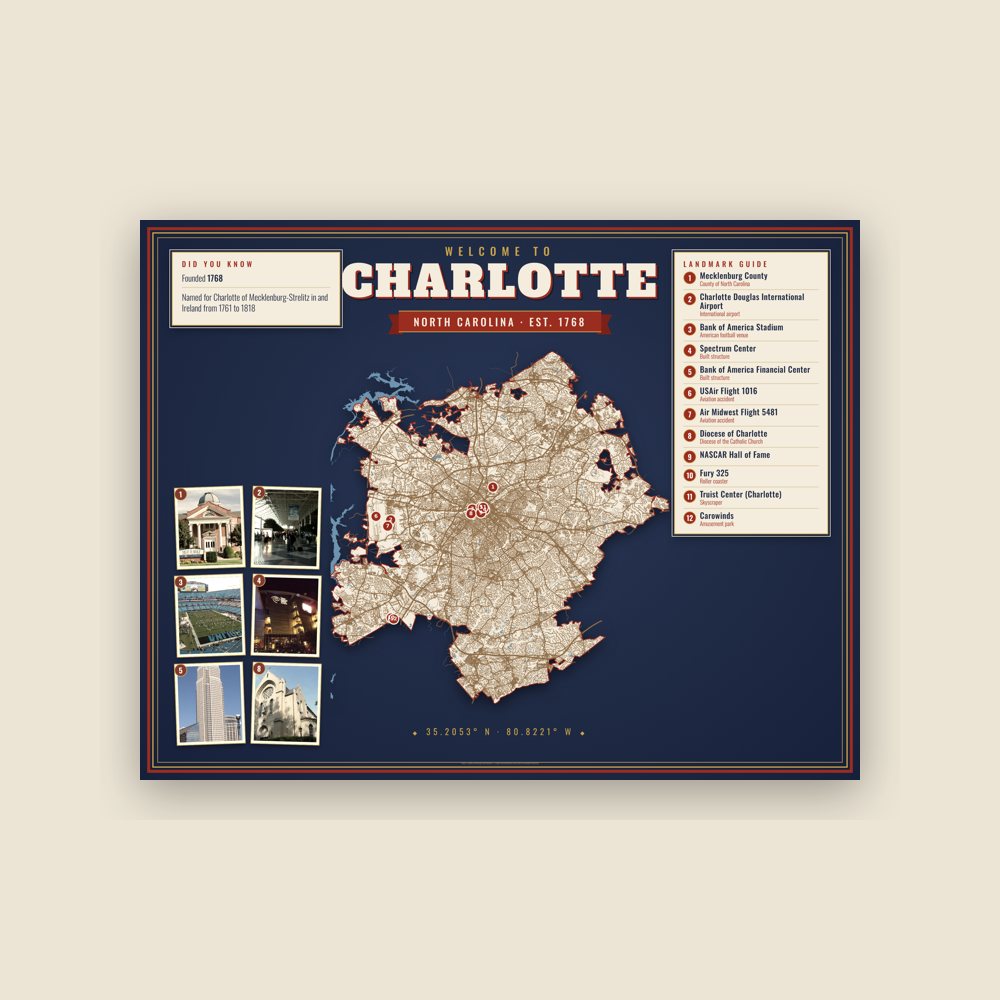
Nicknamed the "Queen City", like its county a few years earlier, Charlotte was named in honor of Charlotte of Mecklenburg-Strelitz, who had become the queen consort of Great Britain and Ireland in 1761, seven years before the town's incorporation. A second nickname derives from the American Revolutionary War, when British commander General Charles Cornwallis, 1st Marquess Cornwallis occupied the city but was driven out by hostile residents. He wrote that Charlotte was "a hornet's nest of rebellion", leading to the historical nickname "The Hornet's Nest".
Within decades of Polk's settling, the area grew to become the Town of Charlotte, incorporated in 1768. Though chartered as Charlotte, the name appears as a form of "Charlottesburgh" on many maps until around 1800. A form of "Charlottetown" also appears on maps of British origin depicting General Cornwallis' route of invasion. The crossroads in Piedmont became the heart of Uptown Charlotte. In 1770, surveyors marked the streets in a grid pattern for future development. The east–west trading path became Trade Street, and the Great Wagon Road became Tryon Street, in honor of William Tryon, a royal governor of colonial North Carolina.
The intersection of Trade and Tryon is commonly known today as "Trade and Tryon", or simply "The Square", and formally as "Independence Square".
While surveying the boundary between the Carolinas in 1772, William Moultrie stopped in Charlotte, whose five or six houses were "very ordinary built of logs".
Local leaders came together in 1775 and signed the Mecklenburg Resolves, more popularly known as the Mecklenburg Declaration of Independence. While not a true declaration of independence from British rule, it is among the first such declarations that eventually led to the American Revolution. May 20, the traditional date of the signing of the declaration, is celebrated annually in Charlotte as "MecDec", with musket and cannon fire by reenactors in Independence Square. North Carolina's state flag and state seal also bear the date.
In 1799, in nearby Cabarrus County, 12-year-old Conrad Reed found a 17- pound rock, which his family used as a doorstop. Three years later, a jeweler determined it was nearly solid gold, paying the family a paltry $3.50. The first documented gold find in the United States of any consequence set off the nation's first gold rush. Many veins of gold were found in the area throughout the 19th and early 20th centuries, leading to the 1837 founding of the Charlotte Mint. North Carolina was the chief producer of gold in the United States, until the Sierra Nevada was found in 1848, although the volume mined in the Charlotte area was dwarfed by subsequent rushes.
19th century
In 1842, Union County formed from Mecklenburg's southeastern portion and a western portion of Anson County. These areas were all part of one of the original six judicial/military districts of North Carolina known as the Salisbury District.
Charlotte is traditionally considered the home of Southern Presbyterianism, but in the 19th century, numerous churches, including Presbyterian, Baptist, Methodist, Episcopal, Lutheran, and Roman Catholic formed, eventually giving Charlotte the nickname, "The City of Churches".
Some groups still pan for gold occasionally in local streams and creeks. The Reed Gold Mine operated until 1912. The Charlotte Mint was active until 1861 when Confederate forces seized it at the outbreak of the Civil War. The mint was not reopened at the war's end, but the building, albeit in a different location, now houses the Mint Museum of Art.
The city's first boom came after the Civil War, as Charlotte became a cotton processing center and railroad hub. By the 1880s, Charlotte sat astride the Southern Railway mainline from Atlanta to Washington, D.C. Farmers from miles around would bring cotton to the railroad platform in Uptown. Local promotors began building textile factories, starting with the 1881 Charlotte Cotton Mill that still stands at Graham and 5th streets.
20th century
The population grew again during World War I, when the U.S. government established Camp Greene, north of present-day Wilkinson Boulevard. The camp supported 40,000 soldiers, with many troops and suppliers staying after the war, launching urbanization that eventually overtook older cities along the Piedmont Crescent. In the 1920 census, Charlotte fell to being the state's second largest city, Winston-Salem with 48,395 people, had two thousand more people than Charlotte. Charlotte would pass Winston-Salem in population by the 1930 census, and has remained North Carolina's largest city since.
Until 1958, the Seaboard Air Line Railroad operated a daily passenger train from its own station (which had opened in 1896) to Wilmington.
The city's modern-day banking industry achieved prominence in the 1970s and 1980s, largely under the leadership of financier Hugh McColl. McColl transformed North Carolina National Bank (NCNB) into a formidable national bank that through aggressive acquisitions eventually merged with BankAmerica to become Bank of America. First Union, later Wachovia in 2001, experienced similar growth before it was acquired by San Francisco–based Wells Fargo in 2008. Measured by control of assets, Charlotte became the second largest banking headquarters in the United States after New York City.
On September 22, 1989, the city was hit by Hurricane Hugo. With sustained winds of 69 mph (111 km/h) and gusts of 87 mph (140 km/h), Hugo caused massive property damage, destroyed 80,000 trees, and knocked out electrical power to most of the population. Residents were without power for weeks, schools were closed for a week or more, and the cleanup took months. The city was caught unprepared; Charlotte is 200 miles (320 km) inland, and residents from coastal areas in both Carolinas often wait out hurricanes in Charlotte.
21st century
In December 2002, Charlotte and much of central North Carolina were hit by an ice storm that resulted in more than 1.3 million people losing power. During an abnormally cold December, many were without power for weeks. Many of the city's Bradford pear trees split apart under the weight of the ice. Between 2004 and 2014, Charlotte was among the country's fastest-growing metropolitan areas, with 888,000 new residents. Based on U.S. census data from 2005 to 2015, Charlotte tops the U.S. in millennial population growth.
In August 2015 and September 2016, the city experienced several days of protests related to the police shootings of Jonathan Ferrell and Keith Scott.