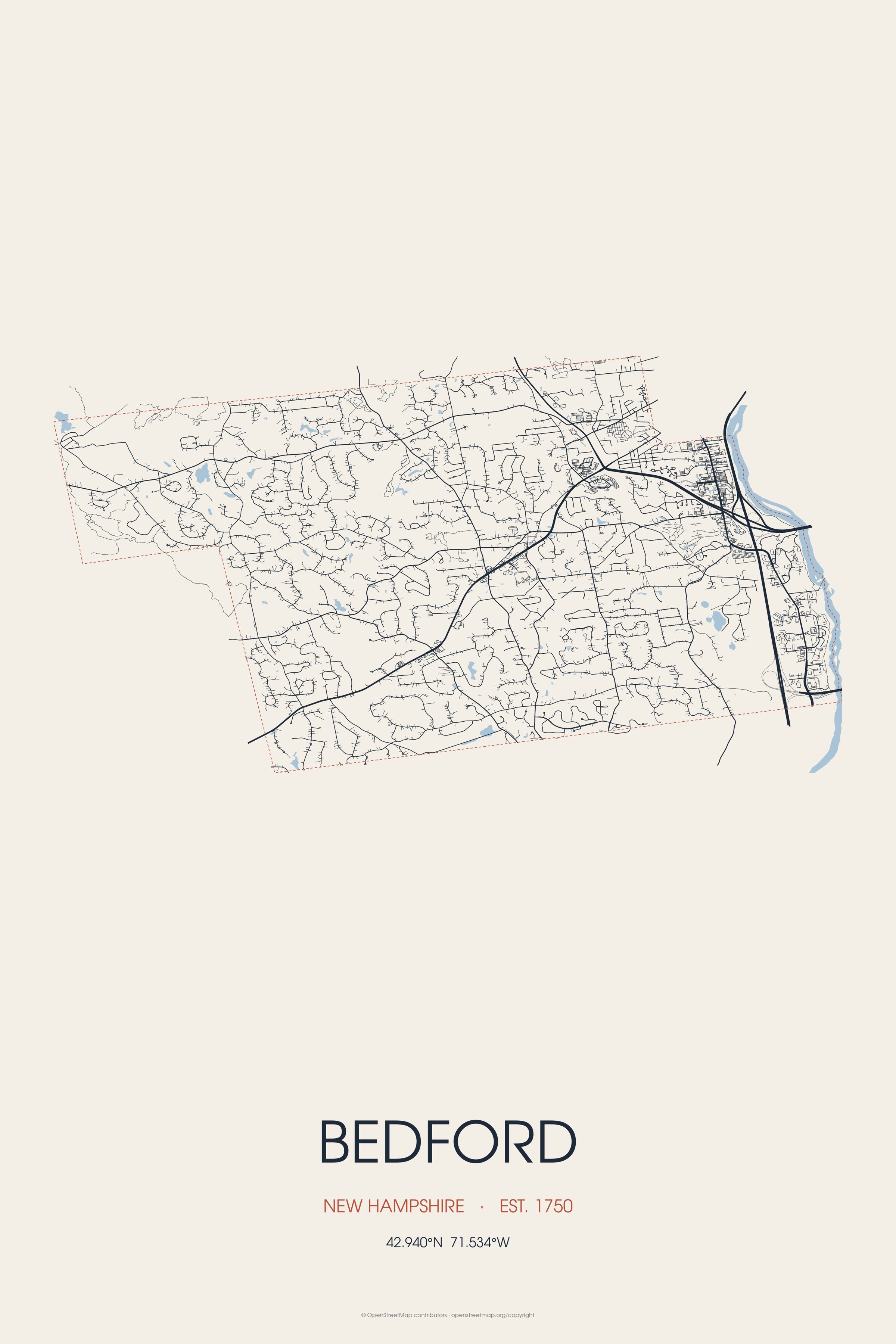
Bedford is a suburb of Manchester, New Hampshire's largest city. Landmarks include Bedford Presbyterian Church, Bedford Town Hall and WFEA. Bedford is the birthplace of Sarah Silverman, comedian, actress, and writer.
Every piece is drawn from Bedford's own map data and historic archives, then printed and shipped from the USA when you order. No two towns look alike.
Every road in town, on archival matte paper
The same map, in navy and silver
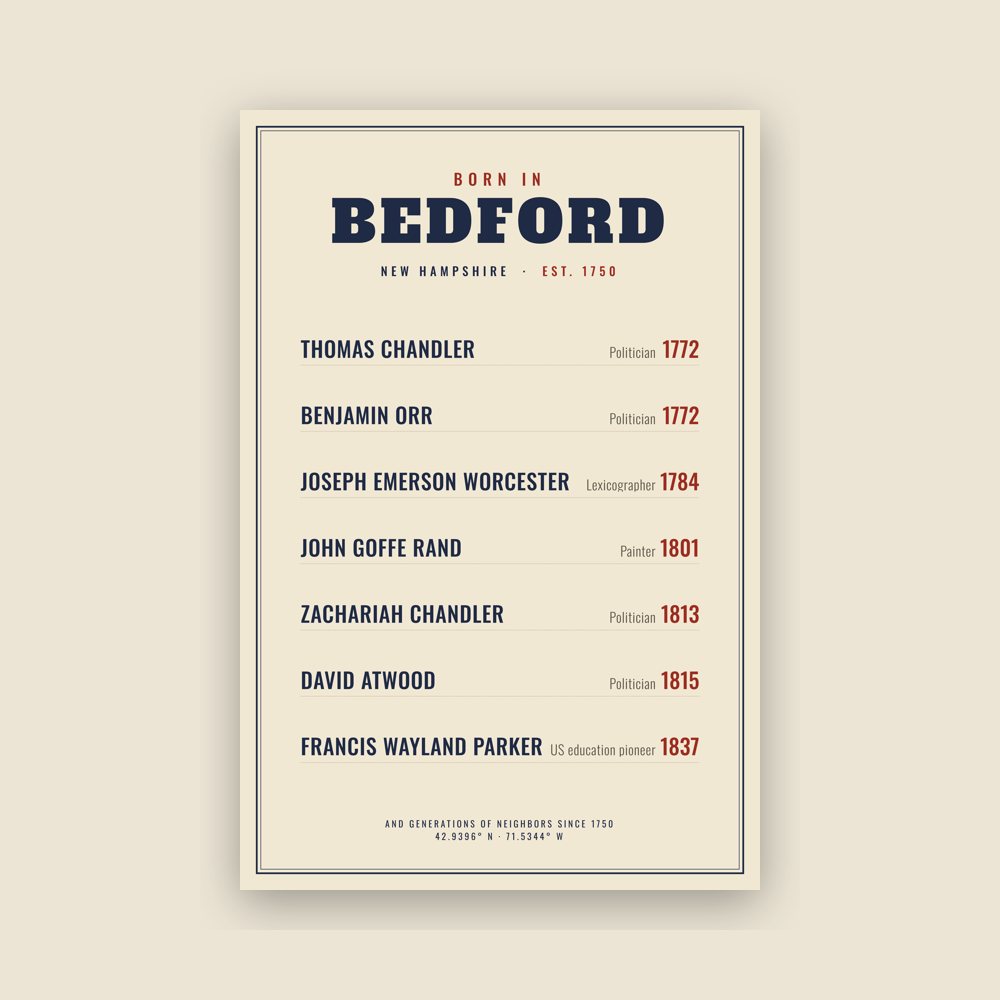
Famous natives, by birth year
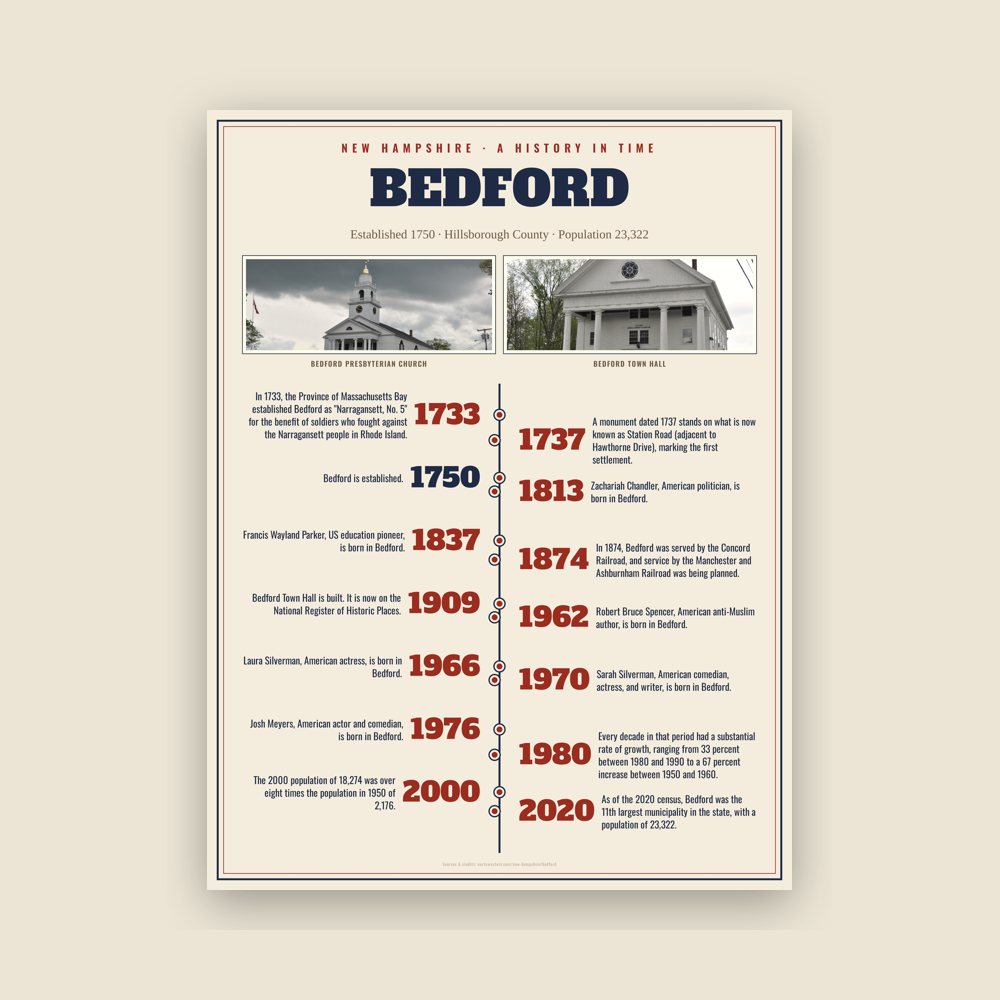
The town's story in dates, from its own records, for home or classroom
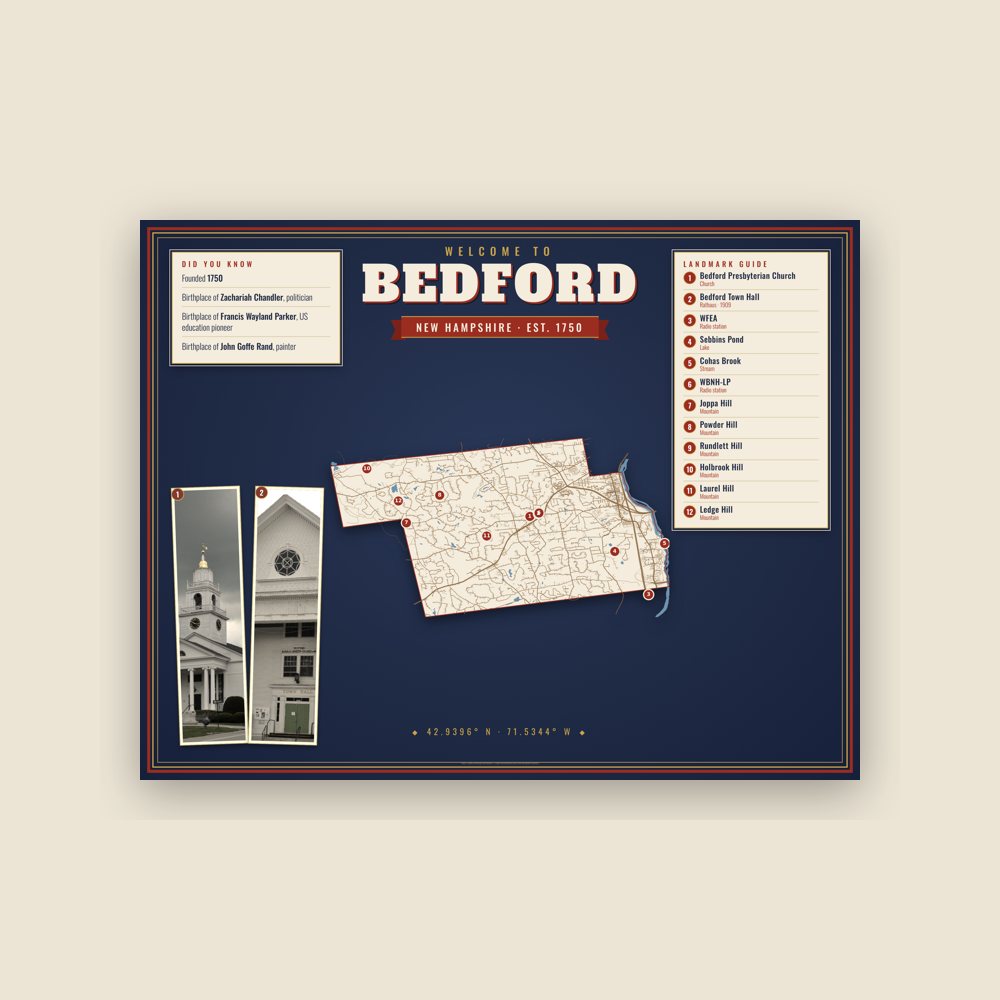
Map of local landmarks, washable fabric
Heavy-blend fleece, street map printed on the back
Soft Bella+Canvas jersey
Glossy ceramic, dishwasher safe
Ceramic keepsake, gold ribbon
Weatherproof, for the front walk
24″×16″, printed coir-look fibers, rubber back
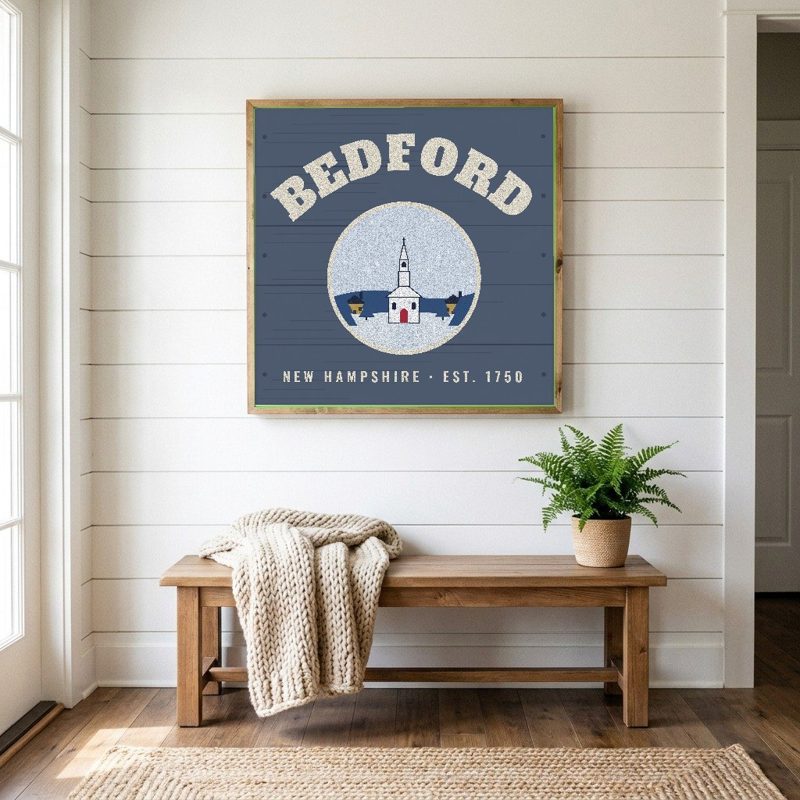
12″×12″ printed wood, ready to hang
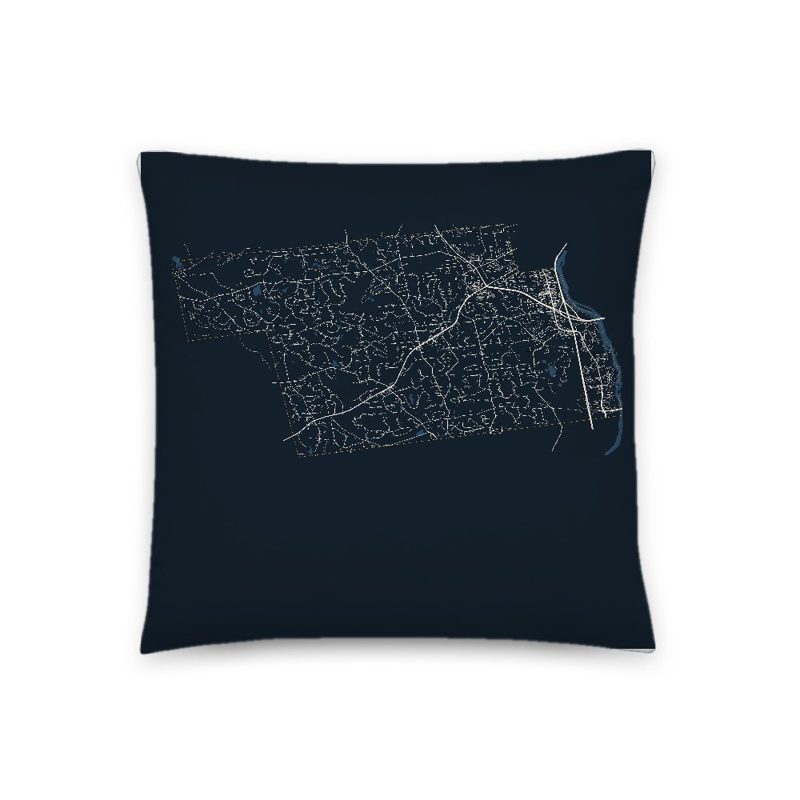
Soft-touch, zip cover
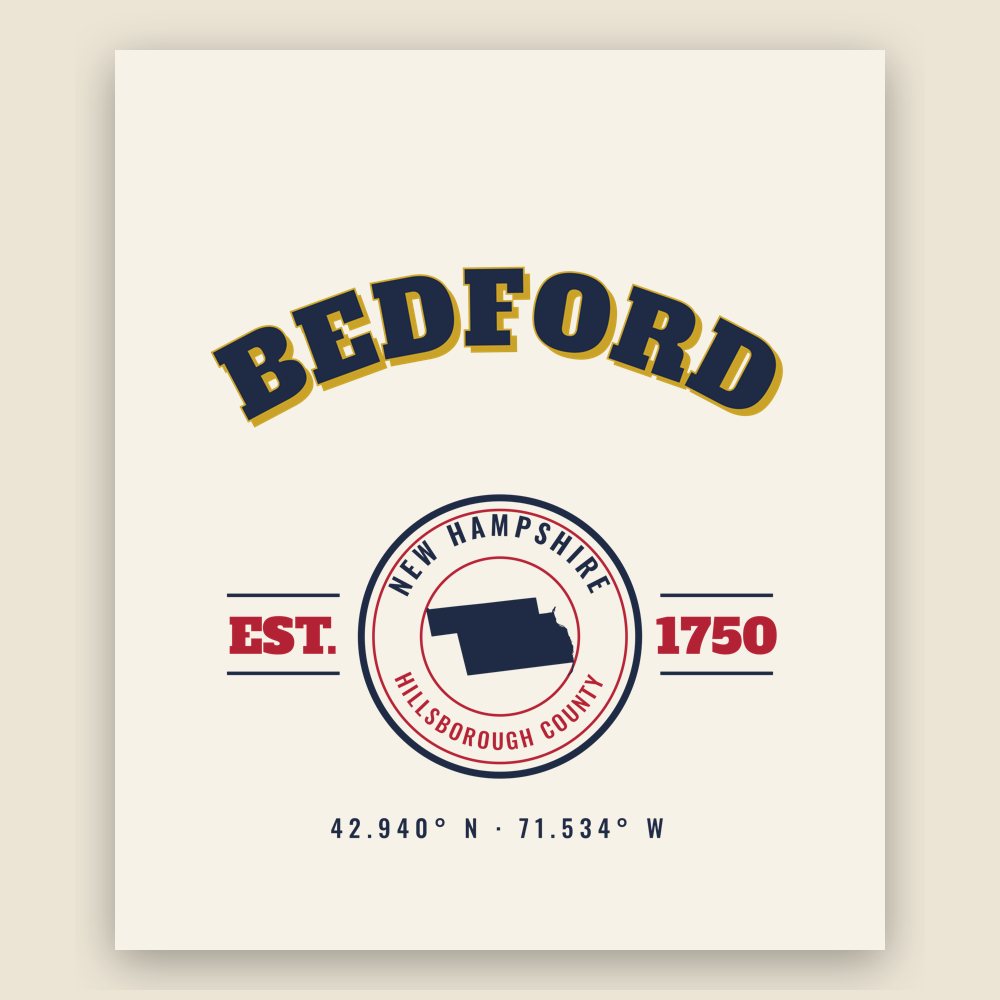
Sturdy all-over-print tote
Glossy top, cork back
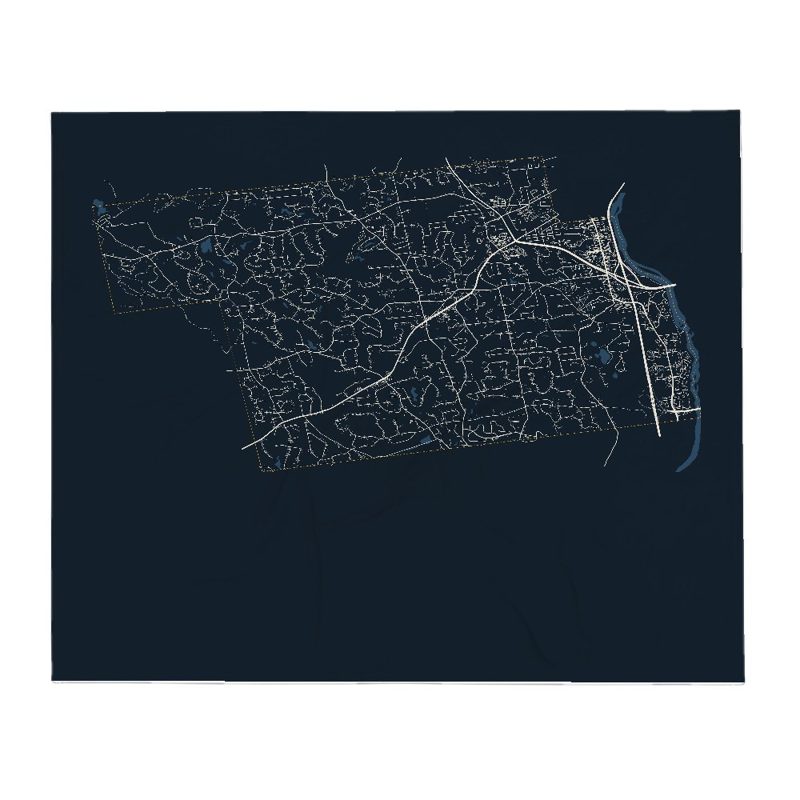
Soft fleece, 50″×60″
20 oz, double-wall stainless
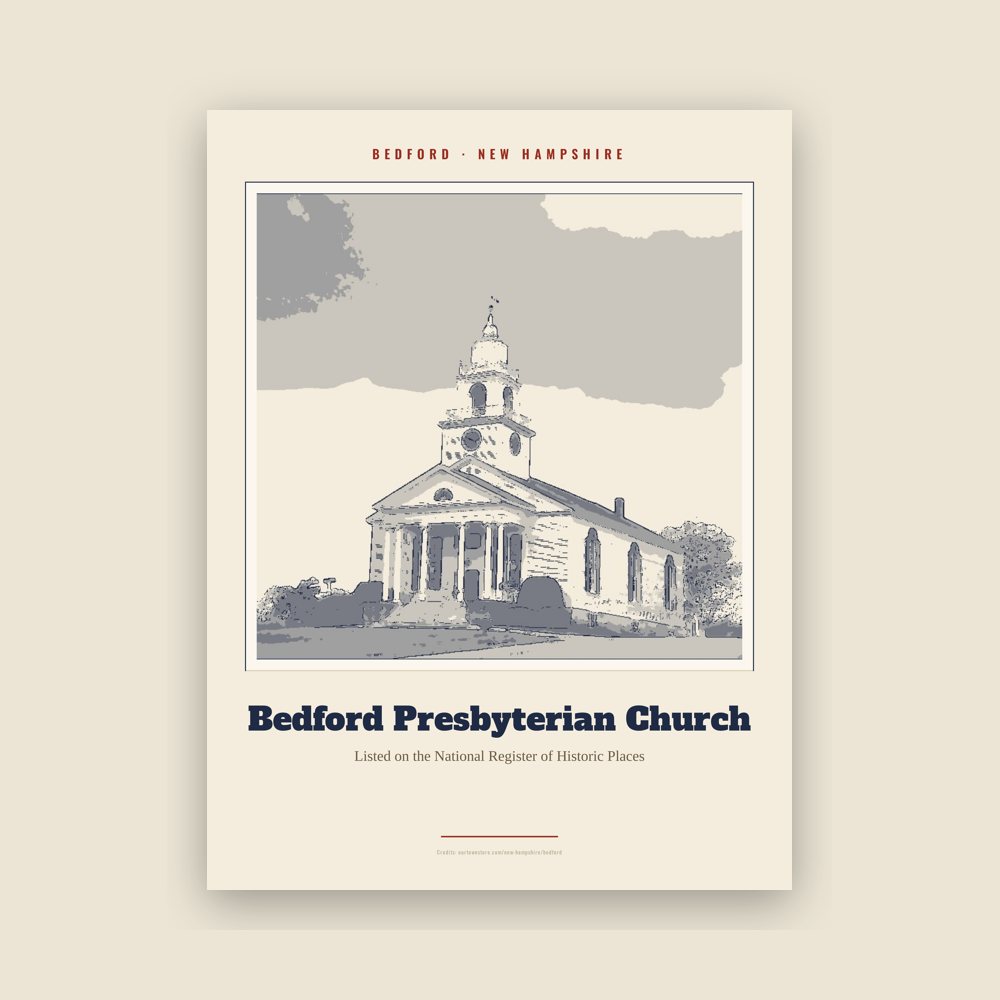
Archival matte print of a local landmark, credited to its photographer
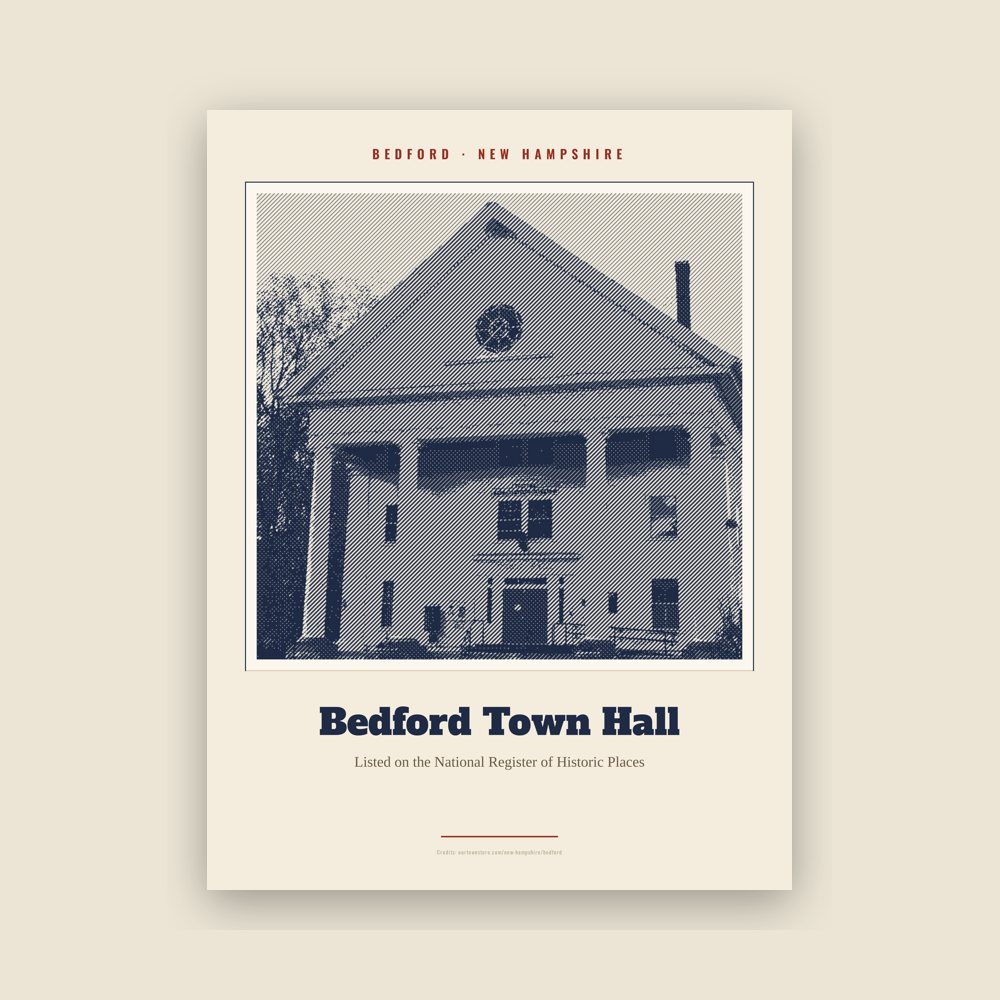
Archival matte print of a local landmark, credited to its photographer
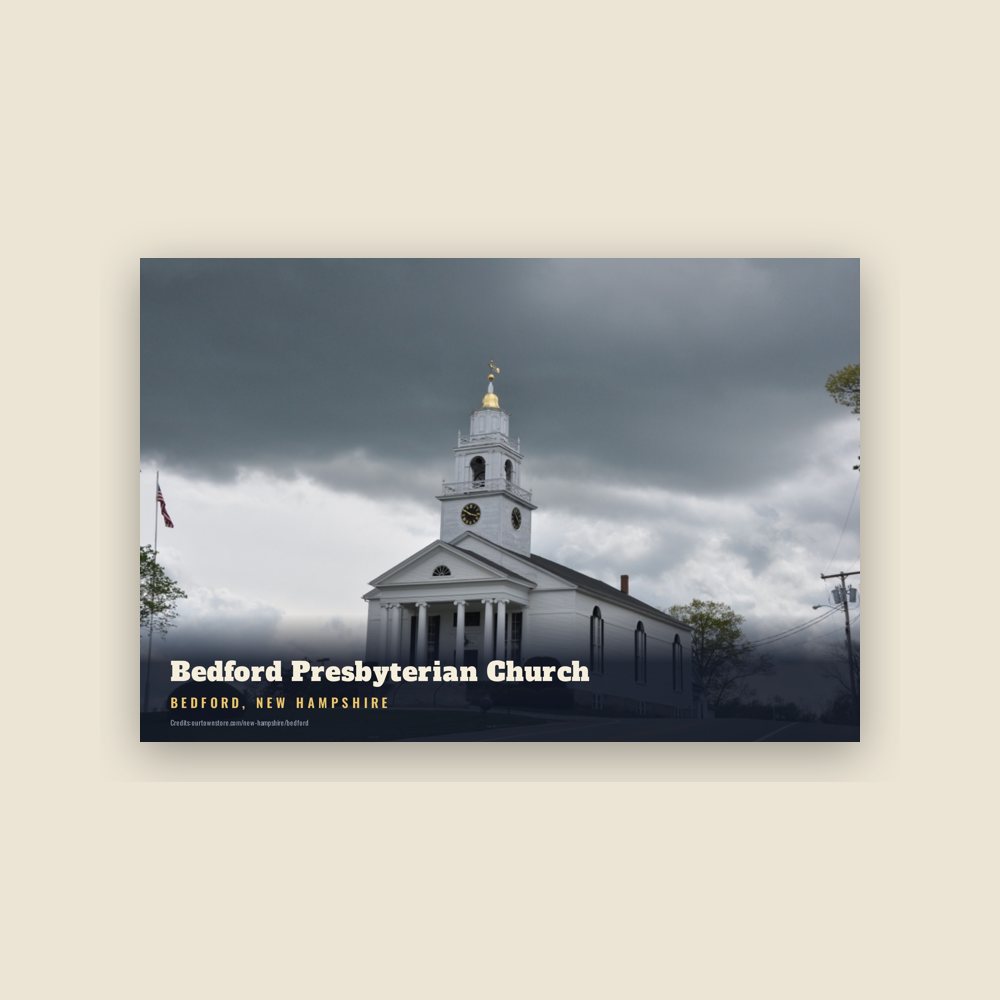
6″×4″ postcard, glossy front
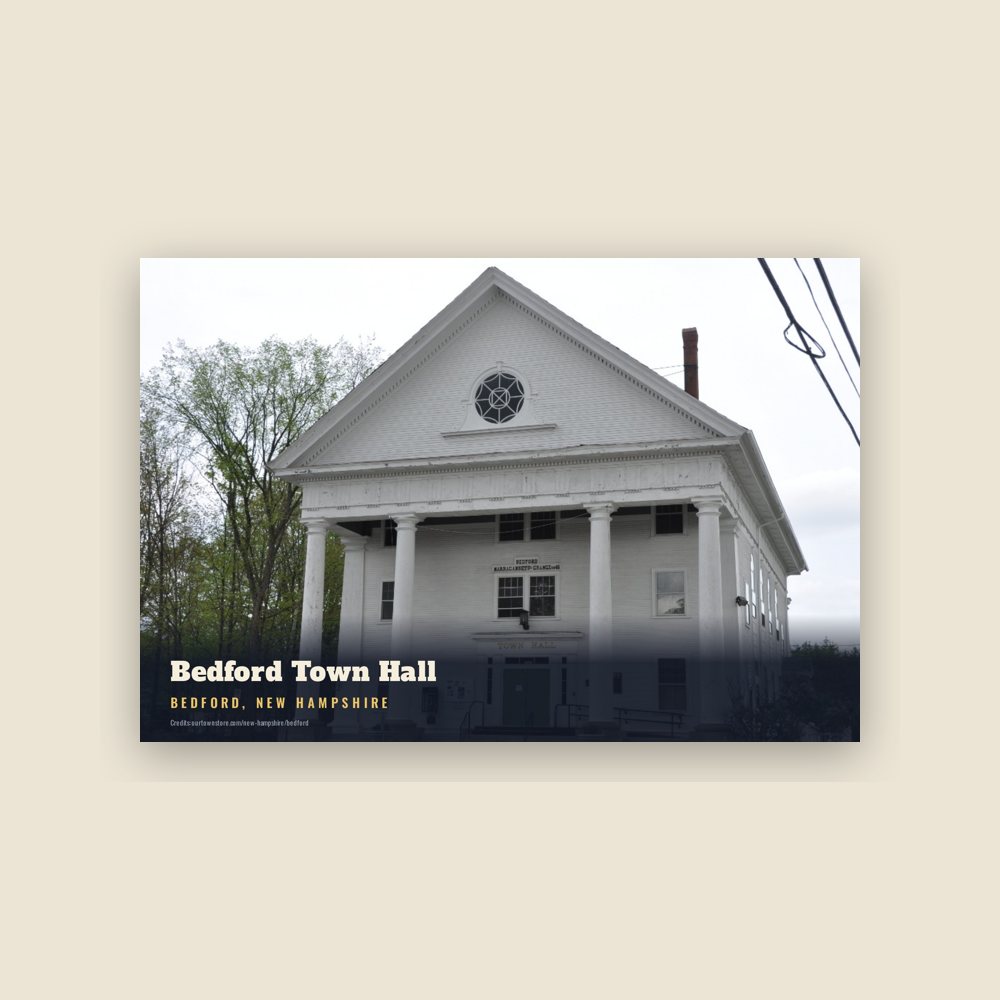
6″×4″ postcard, glossy front
Population 2010: 21,203 → 2020: 23,322
From Wikidata (CC0).
In 1733, the Province of Massachusetts Bay established Bedford as "Narragansett, No. 5" for the benefit of soldiers who fought against the Narragansett people in Rhode Island. The area was also known as "Souhegan East". The settlement was incorporated as "Bedford" in 1750, and was named for John Russell, 4th Duke of Bedford. Lord Russell, a close friend of Governor Benning Wentworth, was the Secretary of State for the Southern Department from 1748 to 1751, and his first wife, Diana Spencer, was cousin of the influential Duke of Marlborough.
The first English settlers in Bedford were Robert and James Walker III. A monument dated 1737 stands on what is now known as Station Road (adjacent to Hawthorne Drive), marking the first settlement. Bedford's first moderator was Mayor John Goffe, son of the Colonel John Goffe after whom Goffstown was named.
In 1874, Bedford was served by the Concord Railroad, and service by the Manchester and Ashburnham Railroad was being planned.
Bedford grew rapidly in the second half of the 20th century. The 2000 population of 18,274 was over eight times the population in 1950 of 2,176. Every decade in that period had a substantial rate of growth, ranging from 33 percent between 1980 and 1990 to a 67 percent increase between 1950 and 1960. As of the 2020 census, Bedford was the 11th largest municipality in the state, with a population of 23,322.
Adapted (trimmed) from the Wikipedia article Bedford, New Hampshire, revision 1378491052 by its contributors, licensed CC BY-SA 4.0.
We share a part of every Bedford sale with local partners, and we'd love to print from your collection. Old photographs, maps and postcards make the best keepsakes.
Partner with us