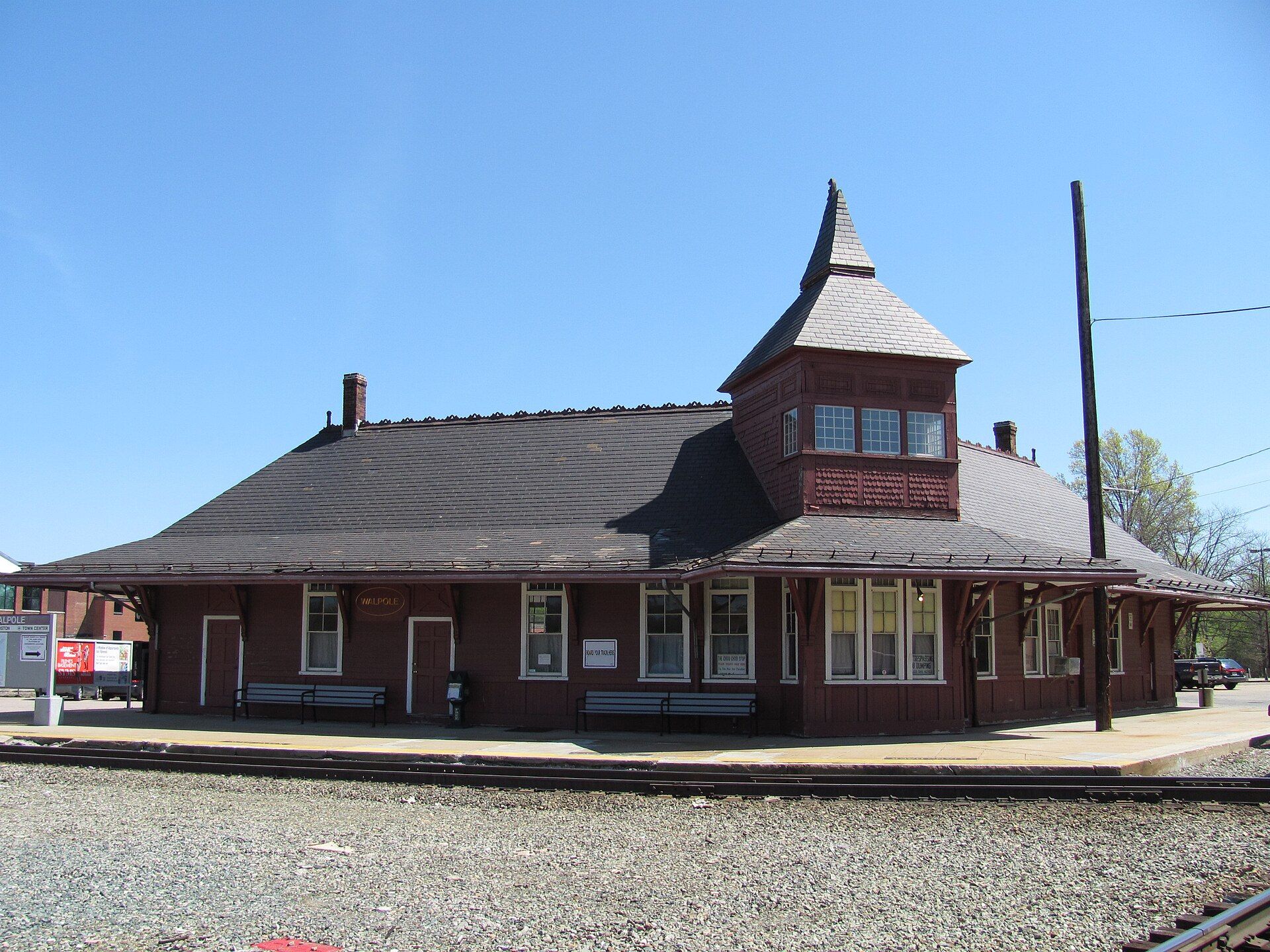
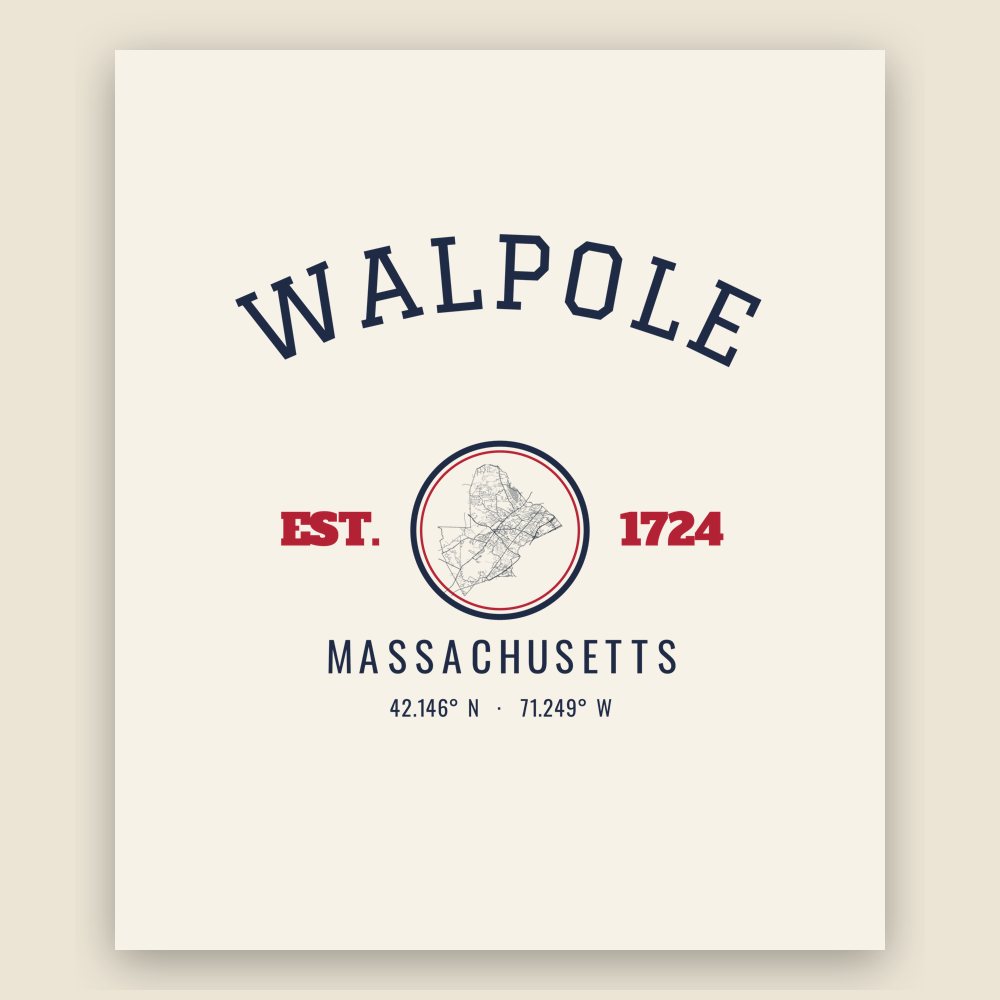
Walpole was first settled in 1659 and was considered a part of Dedham until officially incorporated in 1724. Landmarks include Walpole station, Francis William Bird Park and Plimptonville station. Walpole is the birthplace of Charles Farrell, actor.
Every piece is drawn from Walpole's own map data and historic archives, then printed and shipped from the USA when you order. No two towns look alike.
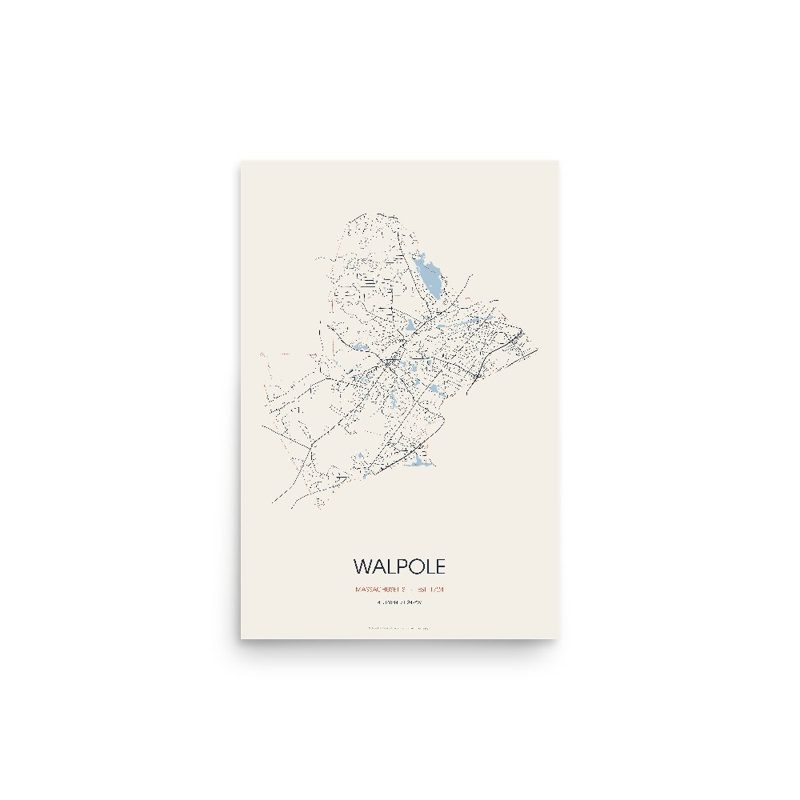
Every road in town, on archival matte paper
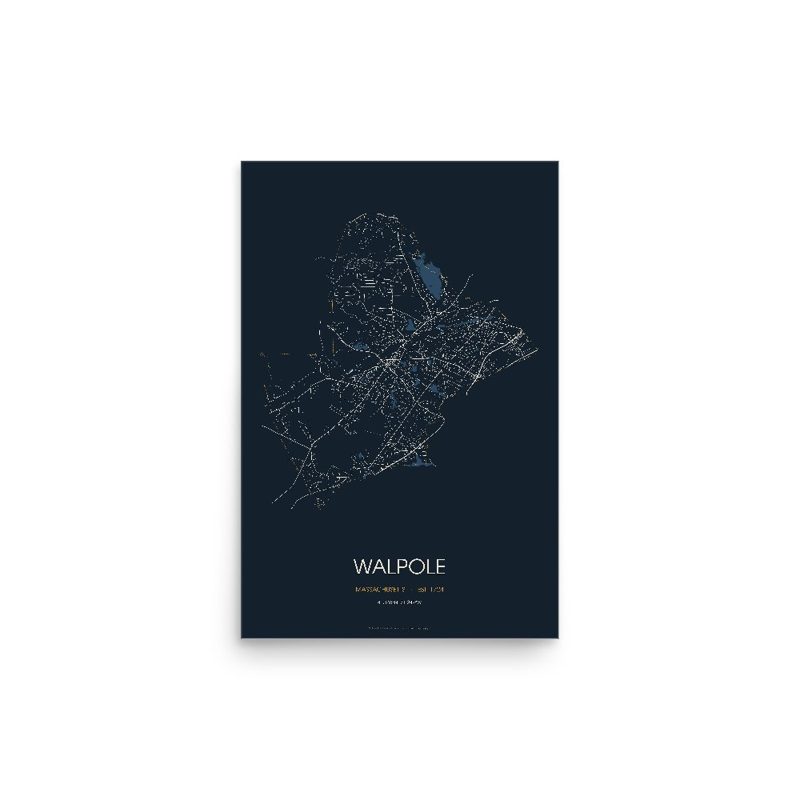
The same map, in navy and silver
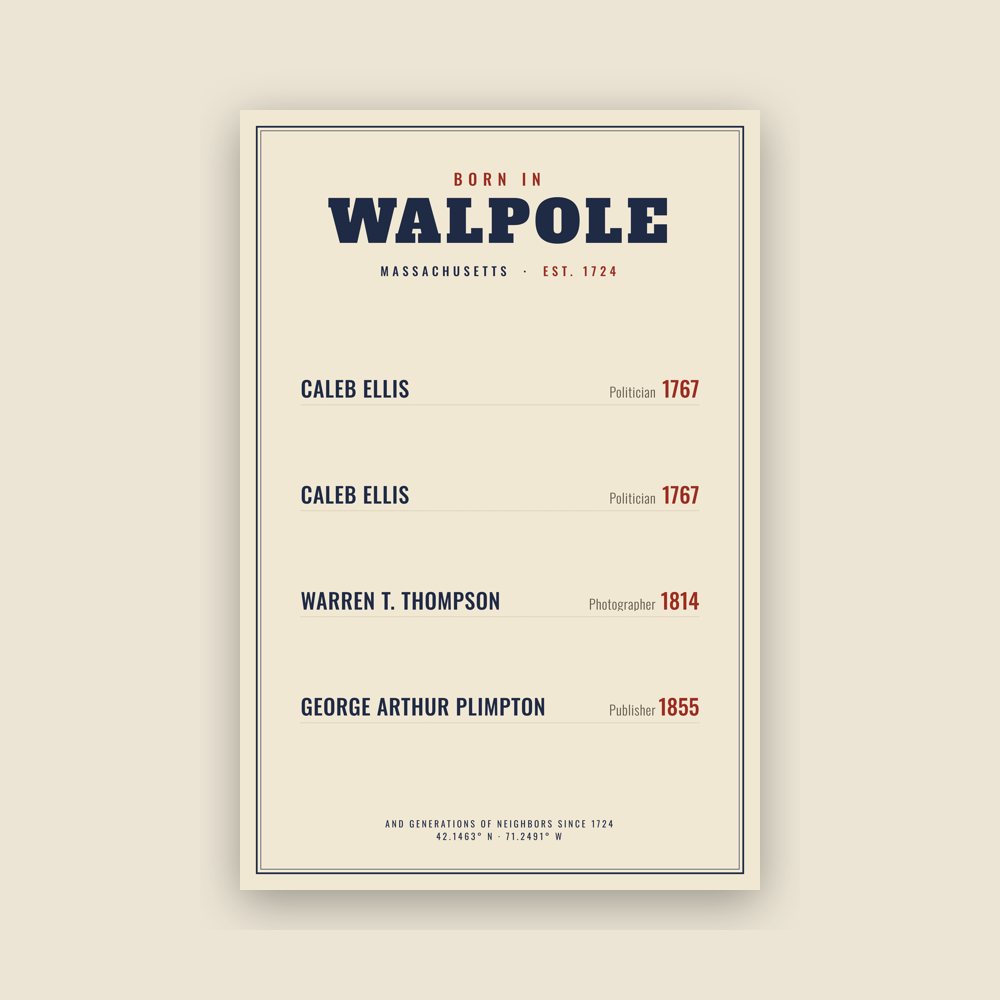
Famous natives, by birth year
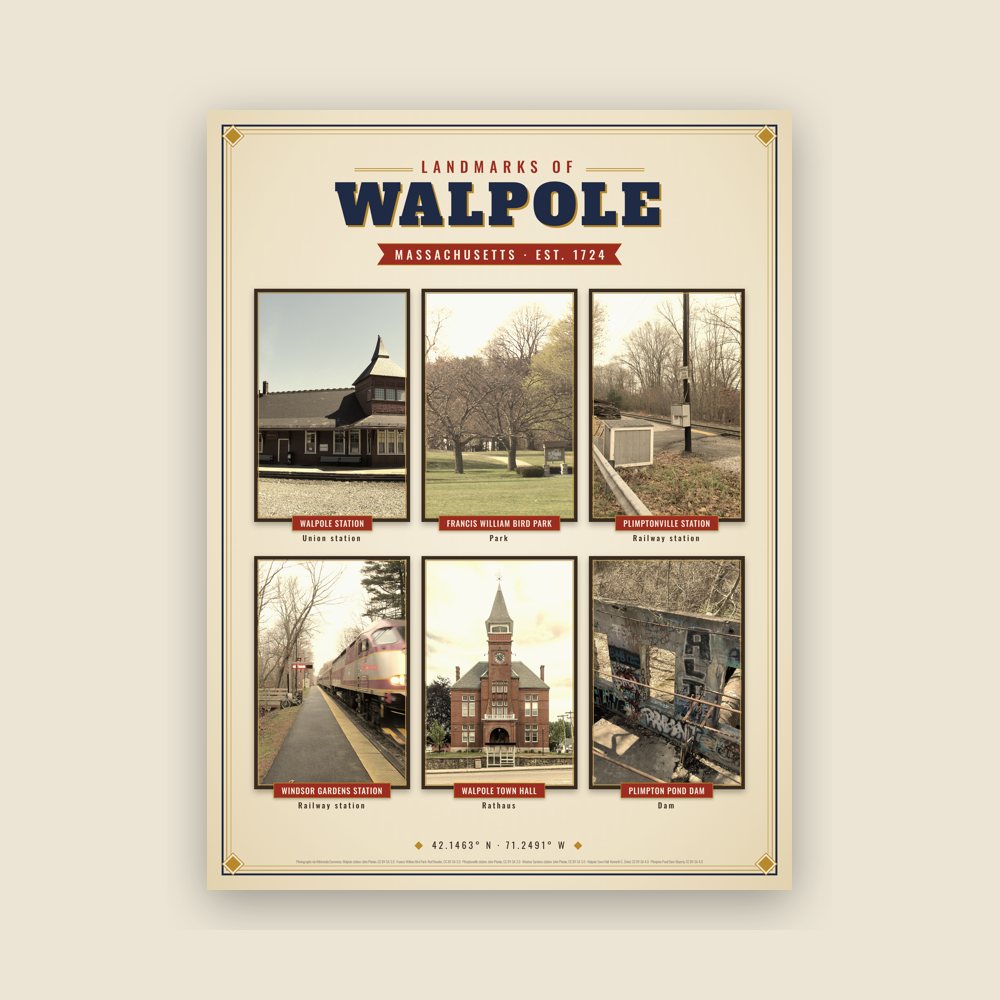
Nine local landmarks, archival matte
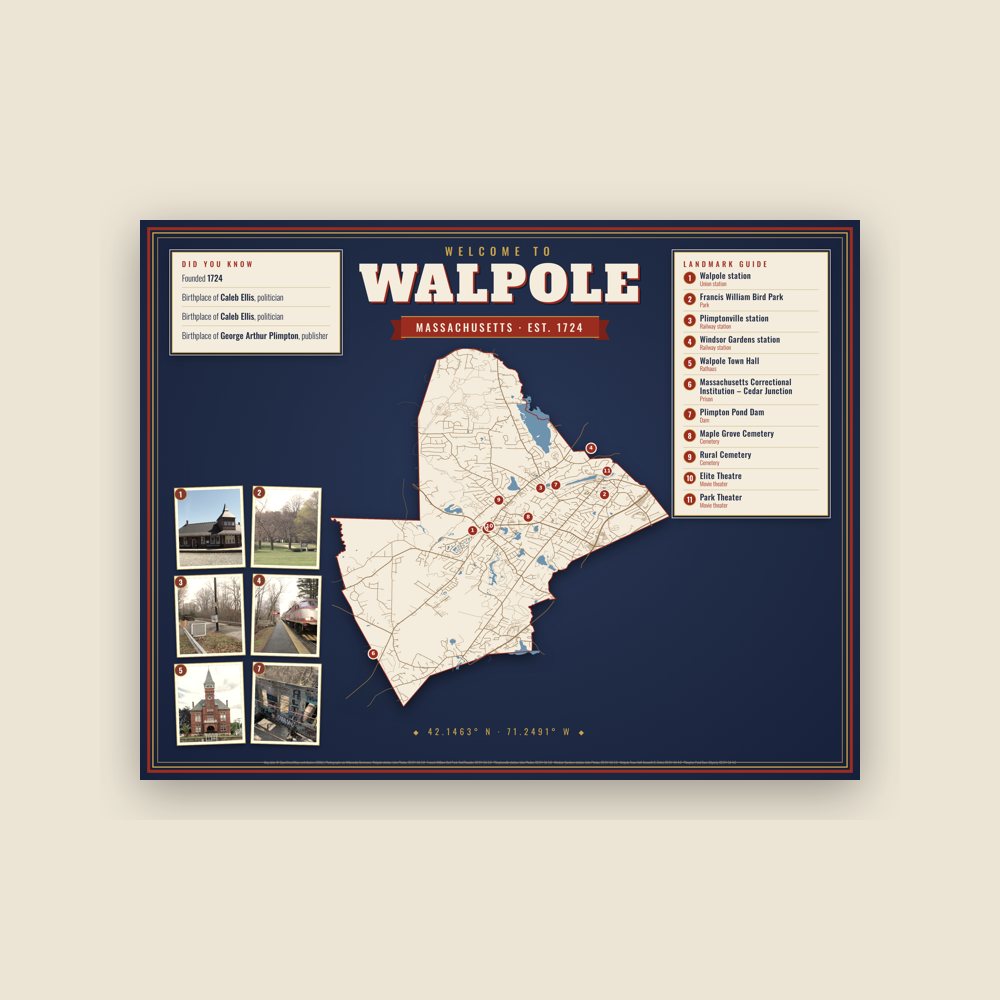
Map of local landmarks, washable fabric

Heavy-blend fleece, street map printed on the back

Soft Bella+Canvas jersey
Glossy ceramic, dishwasher safe
Ceramic keepsake, gold ribbon
Weatherproof, for the front walk
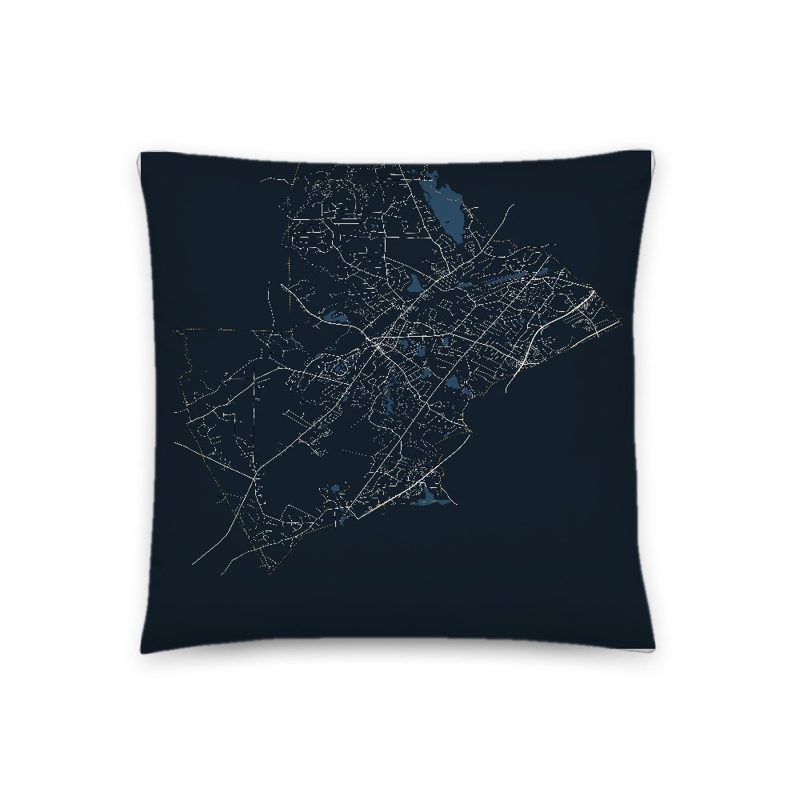
Soft-touch, zip cover

Sturdy all-over-print tote
Glossy top, cork back
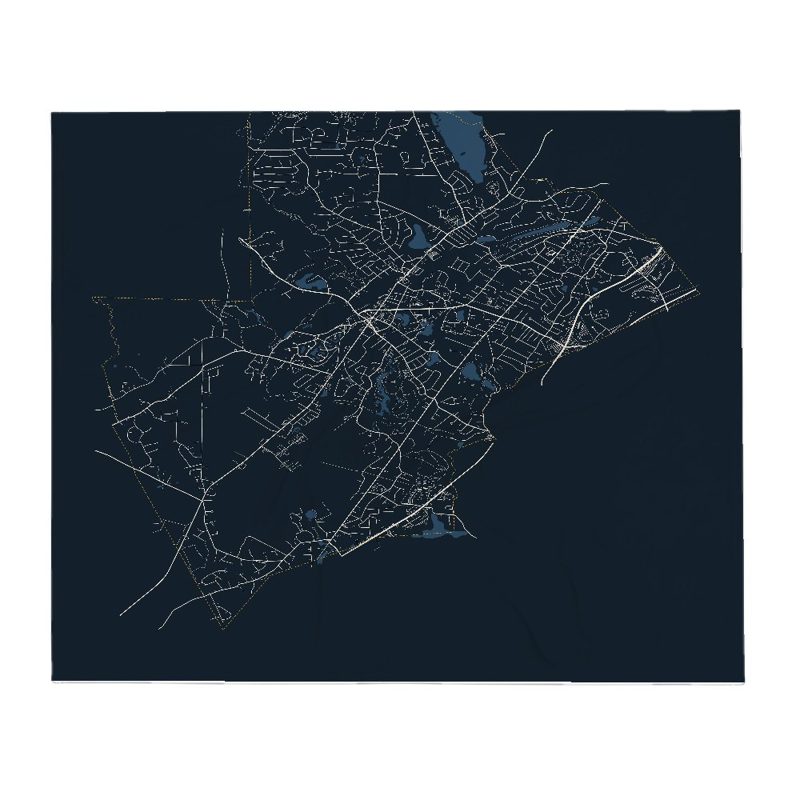
Soft fleece, 50″×60″
20 oz, double-wall stainless
Population 2010: 24,070 → 2020: 26,383
From Wikidata (CC0).
It started out as a territory that was claimed by the Neponset band of the Massachusett Native American tribe. The Neponset tribe officially claimed the area that is now Walpole, and some of its surrounding territory, in 1635. The town of Dedham was not included in this claim, so they began to negotiate with the Neponset tribe to gain land. In 1636, a deal was made between the town of Dedham and the Neponsets to grant Dedham lands that now comprise the towns of Walpole, Norwood, Westwood, Medfield, Norfolk and Dover as well as Dedham. The land given to Dedham in this deal currently includes parts of 16 different towns.
After the territory was bought from Dedham, the saw mill industry began to rise in the area. The first saw mill in Walpole was built near what is now School Meadow Brook and the Neponset River. It was located in the area that is now the Walpole Town Forest. The mill was built and later owned by Joshua Fisher and Major Eleazer Lusher, two wealthy men of Dedham.
On May 13, 1717, Dedham's Town Meeting voted to allow those in outlying areas to stop paying for the central village's minister and to move the school around town seasonally. When residents of the sawmill village asked to establish their own church, however, the Town voted not to allow it on March 7, 1721. Two months later, on May 15, 1721, the same residents presented a petition asking to be set off as their own town. Town Meeting once again rejected their request.
Soon residents of the other outlying areas began joining forces with them. Finally, with the urging of the Great and General Court, the new town of Walpole was created in May 1724. The town was named after Sir Robert Walpole.
After its incorporation, Walpole had a role in the events leading up to the American Revolutionary War. The citizens opposed taxes imposed by the British government. They sent a representative, Joshua Clapp, to the state meetings at Faneuil Hall in Boston. These meetings were to discuss how Massachusetts was going to keep its residents safe and peaceful during the events of the American Revolutionary War. In 1775, Walpole sent 157 men to the Battle of Lexington and Concord. These men were led by Captain Seth Bullard. In December 1777, a British fleet of ships came into Narragansett Bay and anchored in Newport Harbor in Rhode Island. Walpole sent two groups of minutemen, consisting of 65 men in total, to help with the situation. These men were led by Joshua Clapp, and Oliver Clapp. They stayed in Rhode Island to defend the port for three weeks.
Walpole began to grow after the Revolutionary War. By 1860, the town had 1,935 residents. Starting around this time, several mills began to be built, largely on the Neponset River in order to harness the power of falls. Over the years, these mills grew and mainly manufactured products such as cotton, lumber, and paper in its many mills. The most notable of these was the Bird Company, which comprised a large complex on the river in East Walpole. After the company ceased operations at the site in 1980, most of the buildings were razed over the years; a housing development now occupies a large portion of the old mill site and only a few remnants of the area's former use are still evident. The Neponset River was also used for transport between the close towns of Sharon, Foxborough and Medfield. It was also used as a water supply and for water power. The Norfolk County railroad also connected the town. It was also part of a railroad network that connected Walpole to Boston and New York City. Many churches were formed in Walpole at this time, including Trinitarian, Unitarian and Methodist ones: Union Congregational Church est. 1877, etc.
Walpole's first public library was founded in 1872. It was founded by Walpole resident Miss Mary R. Bird. The first library in Walpole was actually founded in 1816 by a group known as "The Ladies' Literary, Moral Society". It was not public, and was built to provide books to Walpole that may, in the words of the society, "afford useful information to the mind and improvement to the heart."
Upon the town seal of Walpole is depicted an old watermill, presumably the old saw mill of Eleazer Lusher and Joshua Fisher on the Neponset River, with a forest of trees in the background, and in the margin are the words, 'Walpole, Mass., incorporated 1724.' Quite a change has come to the town since the conditions represented by the Corporate Seal existed. Walpole of the present day is one of the thriving towns of the Old Bay State with a population of 5,446.
The town seal was adopted by a committee of the Walpole Board of Selectmen on March 2, 1914. The seal was designed by Edna Buck, a junior at Walpole High School. Her prize for having her design selected was $25. She based the design on the ruins of a saw mill located on Brook Street at the time.
In 1929, Harriet Nevins donated $50,000 for the erection of a public building as a memorial for her parents, George Blackburn and Nancy H. Blackburn. Her father, a merchant from Bradford, England, had once lived and done business in Walpole. Blackburn Memorial Building (more commonly known as "Blackburn Hall") was designed by the architectural firm of Putnam & Cox Company of Boston, built by the F.J. Tetreault Company of Walpole, and dedicated in 1932. The red brick building, which features a neo-classical façade with whitewashed pillars, is still owned by the Town of Walpole and is used for a variety of activities throughout the year, including children's theater production. "To the Families of Boston and Eastern Massachusetts", Nevins also left $2500 to fund the construction of a fountain for horses and dogs. The fountain is now dry, but still stands on School Street in Walpole opposite the Town Hall.
Adapted (trimmed) from the Wikipedia article Walpole, Massachusetts, revision 1378394391 by its contributors, licensed CC BY-SA 4.0.
We share a part of every Walpole sale with local partners, and we'd love to print from your collection. Old photographs, maps and postcards make the best keepsakes.
Partner with us