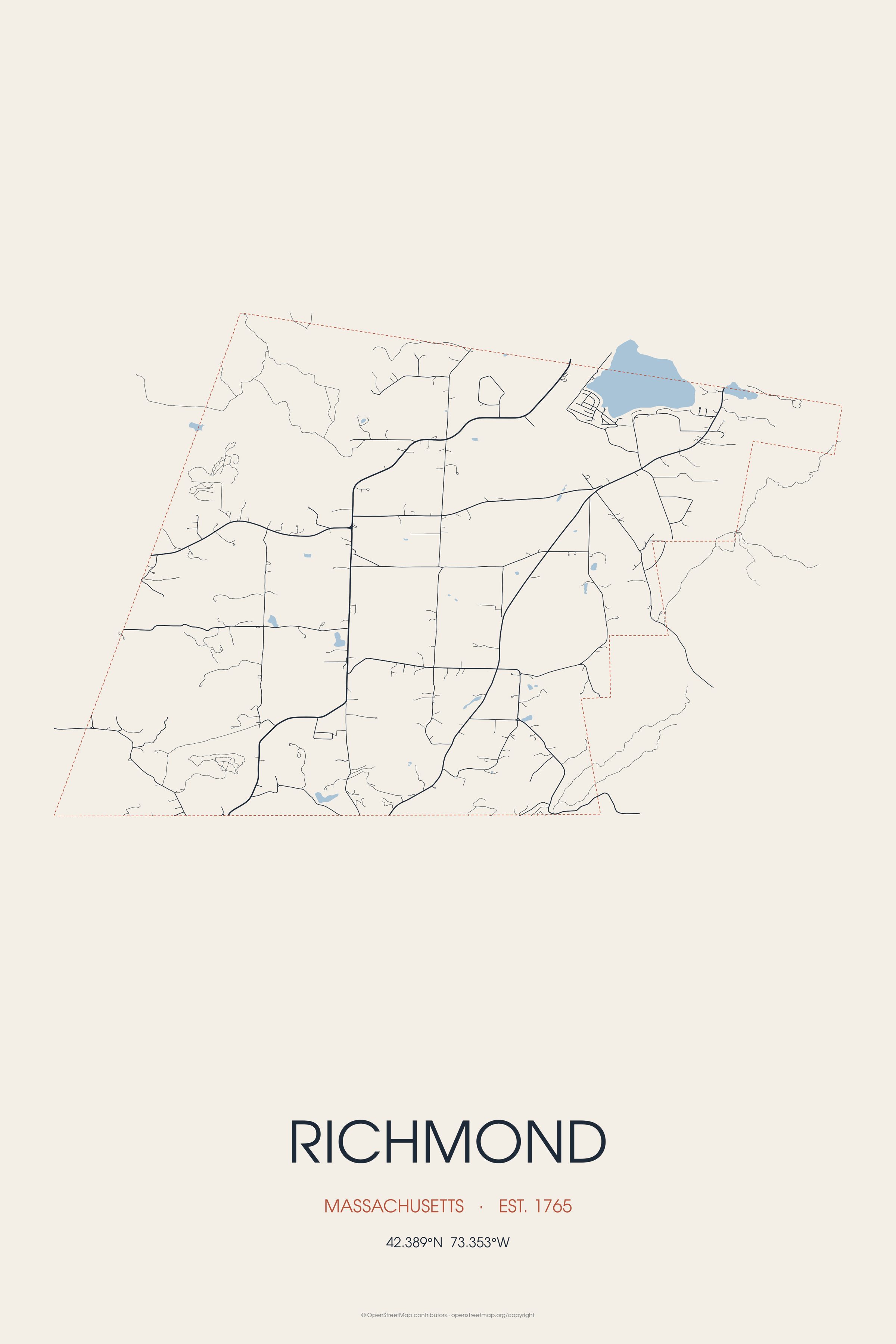
Present day Richmond was first settled by Micah Mudge and Ichabod Wood in 1759. Landmarks include Richmond Furnace Historical and Archeological District, Kenmore and Yokun Ridge. Richmond is the birthplace of Edward A. Perry, Confederate Army general, lawyer and judge; Governor of Florida 1885–1889.
Every piece is drawn from Richmond's own map data and historic archives, then printed and shipped from the USA when you order. No two towns look alike.
Every road in town, on archival matte paper
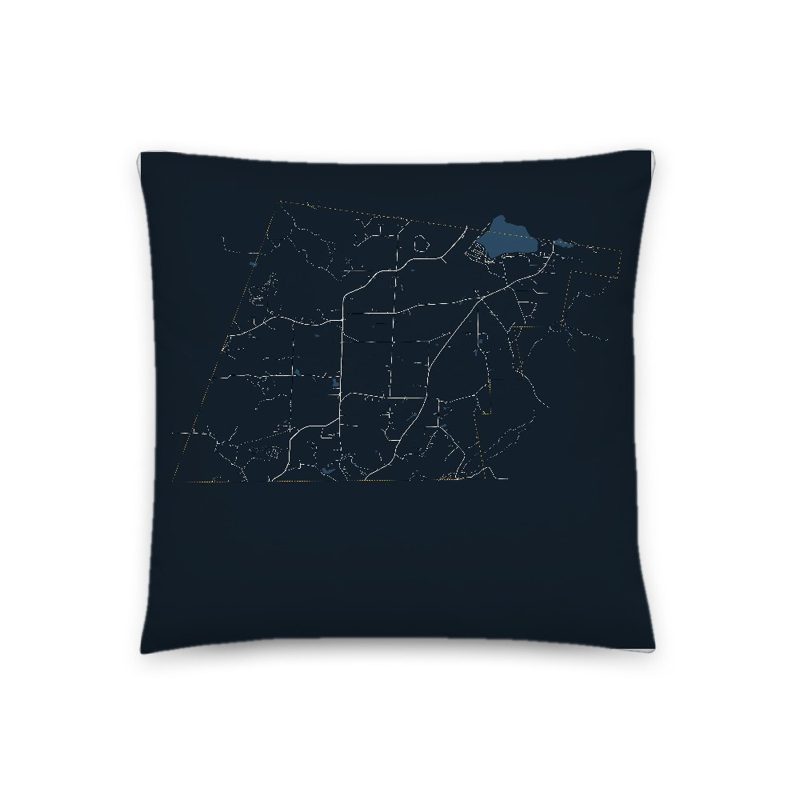
The same map, in navy and silver
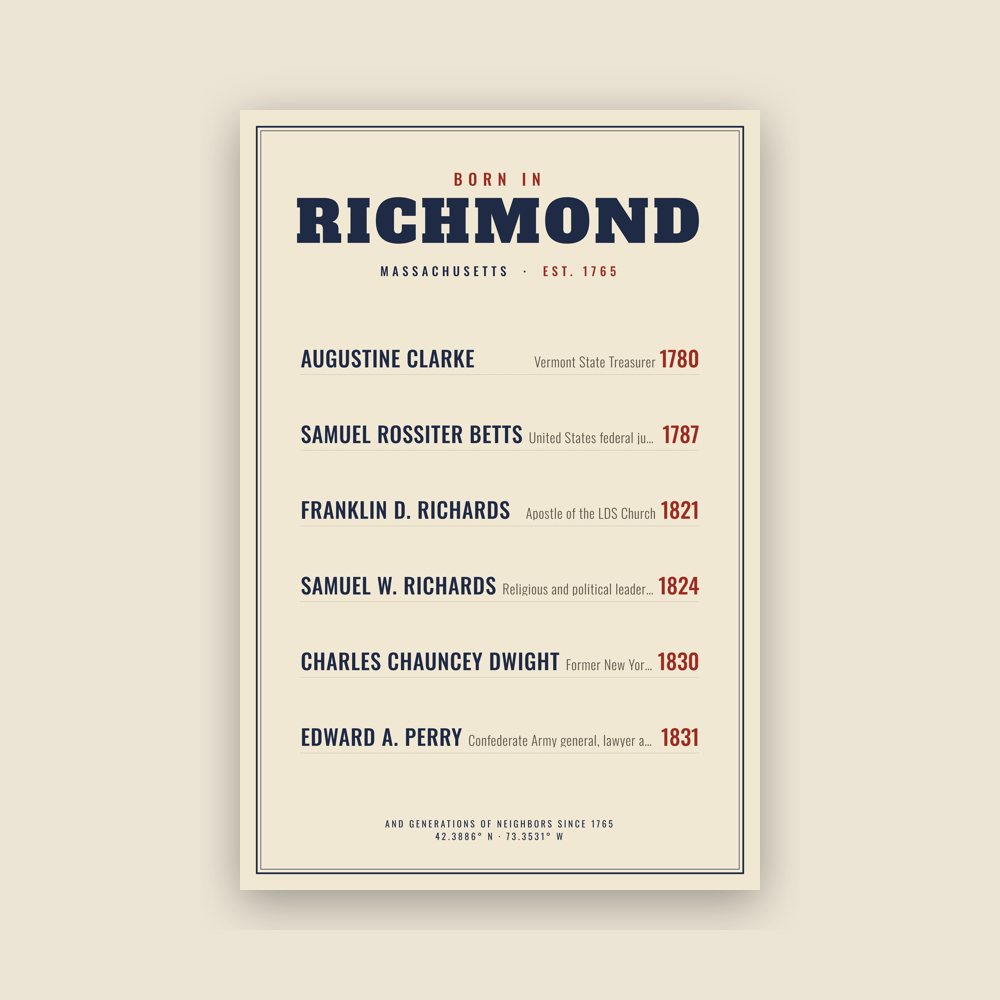
Famous natives, by birth year
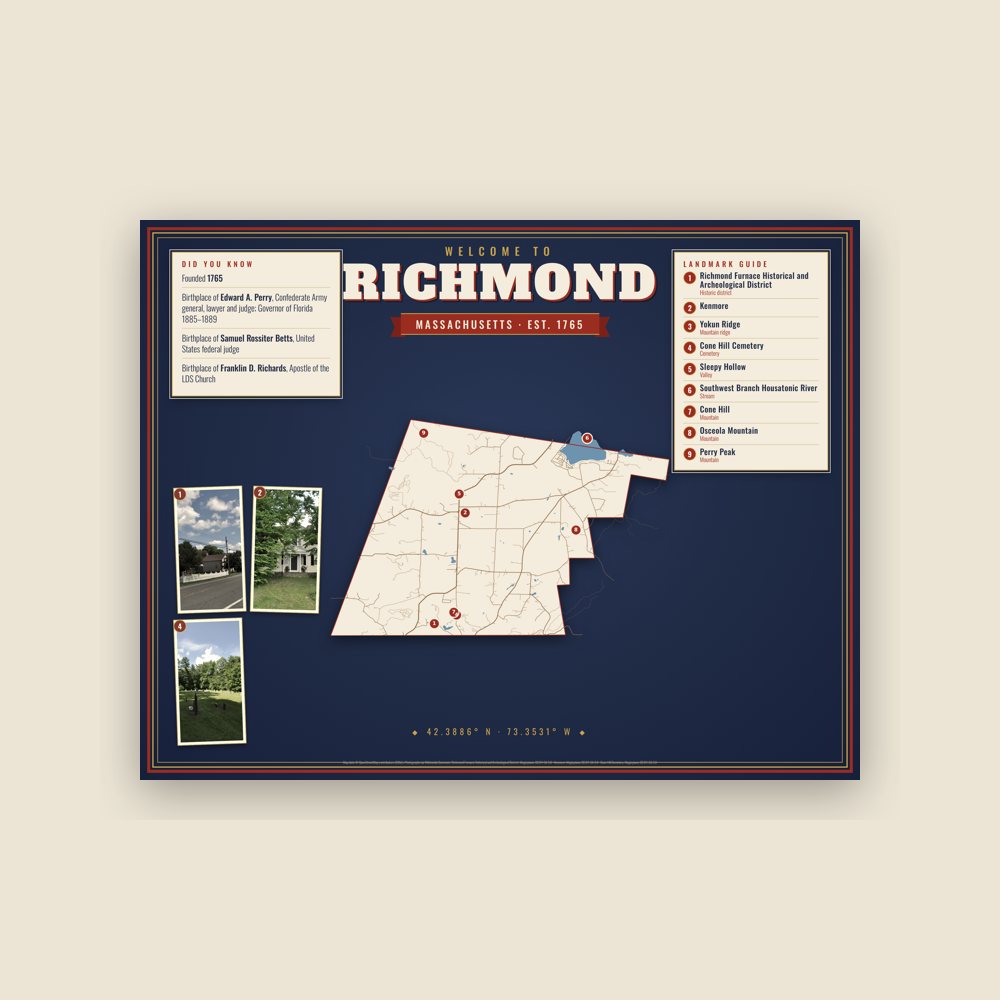
Map of local landmarks, washable fabric
Heavy-blend fleece, street map printed on the back
Soft Bella+Canvas jersey
Glossy ceramic, dishwasher safe
Ceramic keepsake, gold ribbon
Weatherproof, for the front walk
Soft-touch, zip cover
Sturdy all-over-print tote
Glossy top, cork back
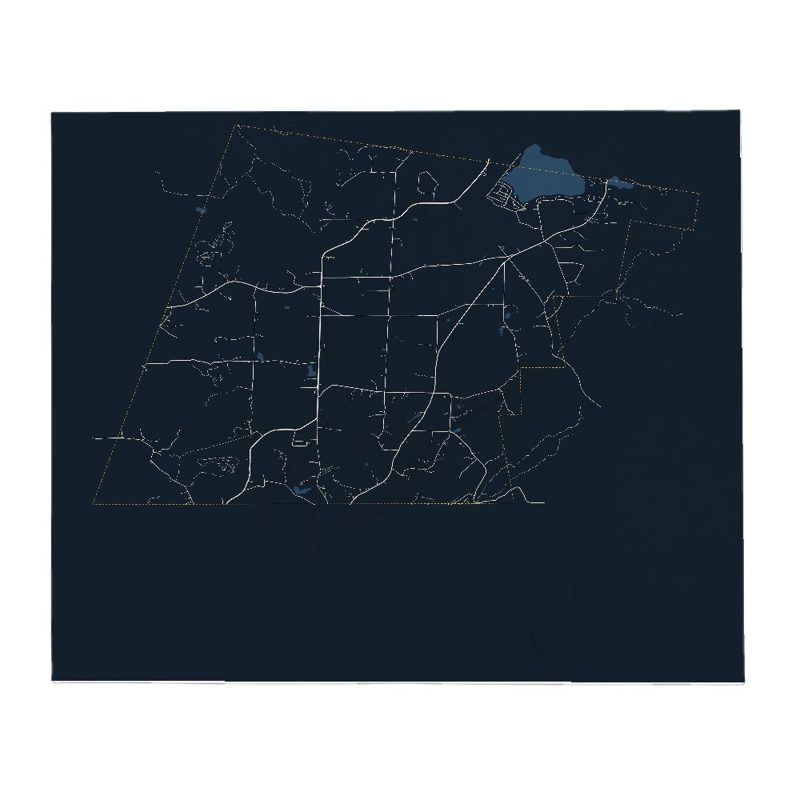
Soft fleece, 50″×60″
20 oz, double-wall stainless
Population 2010: 1,475 → 2020: 1,407
From Wikidata (CC0).
Present day Richmond was first settled by Micah Mudge and Ichabod Wood in 1759. Mudge migrated up to Richmond from Connecticut via the Housatonic River, while Wood came from Rehoboth on the eastern seaboard. It is thought that the two did not make contact until after the first winter, as their initial settlements were separated by about three miles of dense wilderness.
By 1762, as settlers continued to migrate to the area, Massachusetts was putting pressure on committees to organize all unmarked land into townships. Under the act of 1762, the land encompassing present day Richmond and Lenox, Massachusetts was purchased from two Indian Sachems named Yokun and Ephraim. Two distinct villages began to form, separated by the six-mile mountain ridge known today as Yokun Ridge—Yokuntown to the east and Mt. Ephraim to the west.
Under an Act of Incorporation dated June 21, 1765, these two villages became one town named Richmont. However, the mountain separating the two villages of Richmont presented difficulties in communication, and on February 26, 1767, the eastern portion of the town separated into a district known as Lenox, with its own separate meeting house. The new border was not fully established for years, and there were documented disputes at least five years after the separation. In 1785, Richmont officially became known as Richmond, and in 1787, when the County Court moved from Great Barrington to Lenox, it became clear that Lenox and Richmond were fully functioning as their own towns.
The naming of both Richmond and Lenox are somewhat disputed. It is likely that Francis Bernard, Captain General and Commander in Chief of the Province of Massachusetts Bay in New England, gave Richmont and Lenox their respective names. It is thought by some that he did so with Charles Lennox, Duke of Richmond, in mind, though that has never been proven. Lennox was an influencing, liberal figure and a firm supporter of the Colonies in the debates leading up to the American Revolution. He didn’t become well known until after 1770, though, and his most famous speech wasn’t given until 1778, which has led to debate as to whether or not Richmond and Lenox were originally named after the Duke. At any rate, when Richmont petitioned to have its final consonant changed from “t” to “d”, it was most certainly done in honor of Charles, Duke of Richmond.
The town of Richmond was mostly agrarian until the discovery of iron ore in 1829, which led to an iron works which lasted into the twentieth century.
Adapted (trimmed) from the Wikipedia article Richmond, Massachusetts, revision 1377398643 by its contributors, licensed CC BY-SA 4.0.
We share a part of every Richmond sale with local partners, and we'd love to print from your collection. Old photographs, maps and postcards make the best keepsakes.
Partner with us