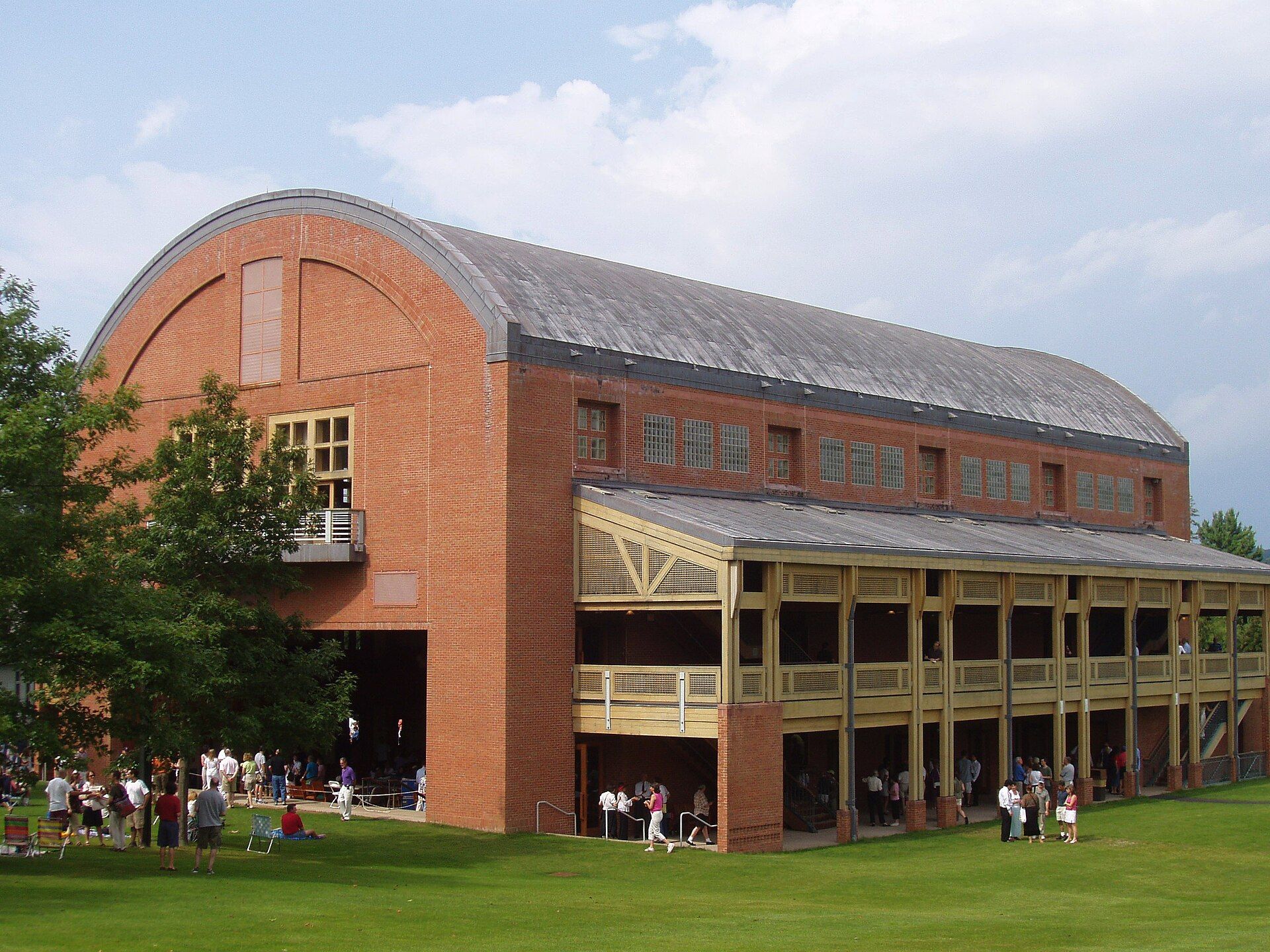
Lenox is the site of Shakespeare & Company and Tanglewood, summer home of the Boston Symphony Orchestra. Landmarks include Tanglewood, Tanglewood Music Festival and Lenox Railroad Station. Lenox is the birthplace of Finn Wittrock, actor.
Every piece is drawn from Lenox's own map data and historic archives, then printed and shipped from the USA when you order. No two towns look alike.
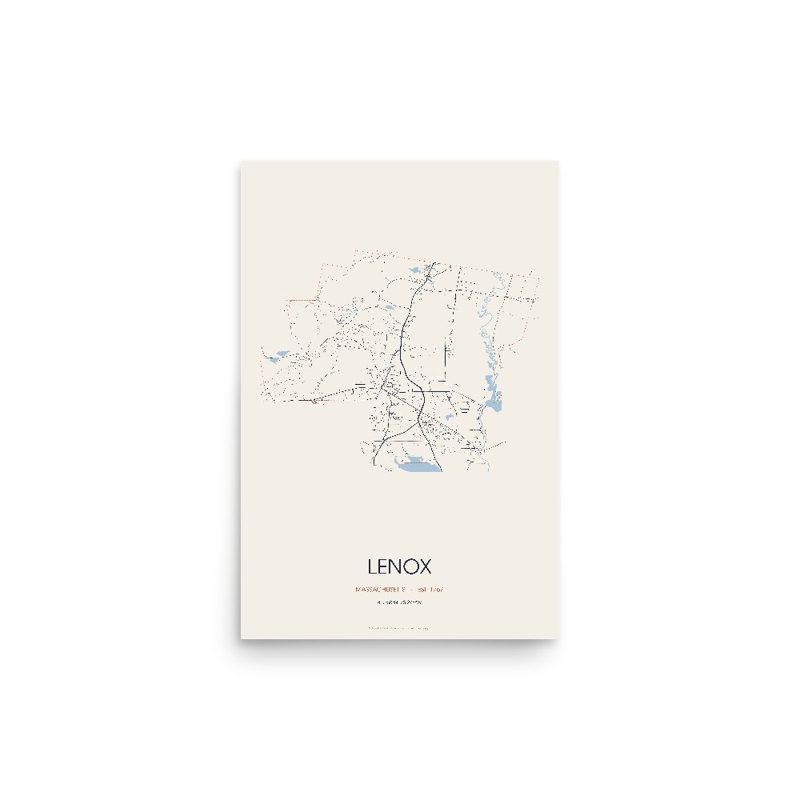
Every road in town, on archival matte paper
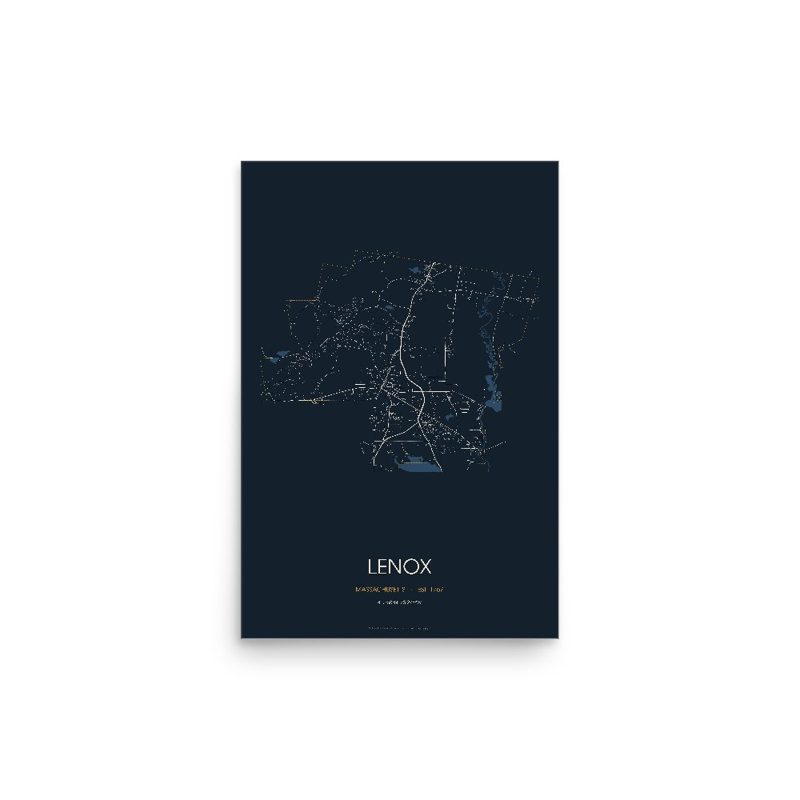
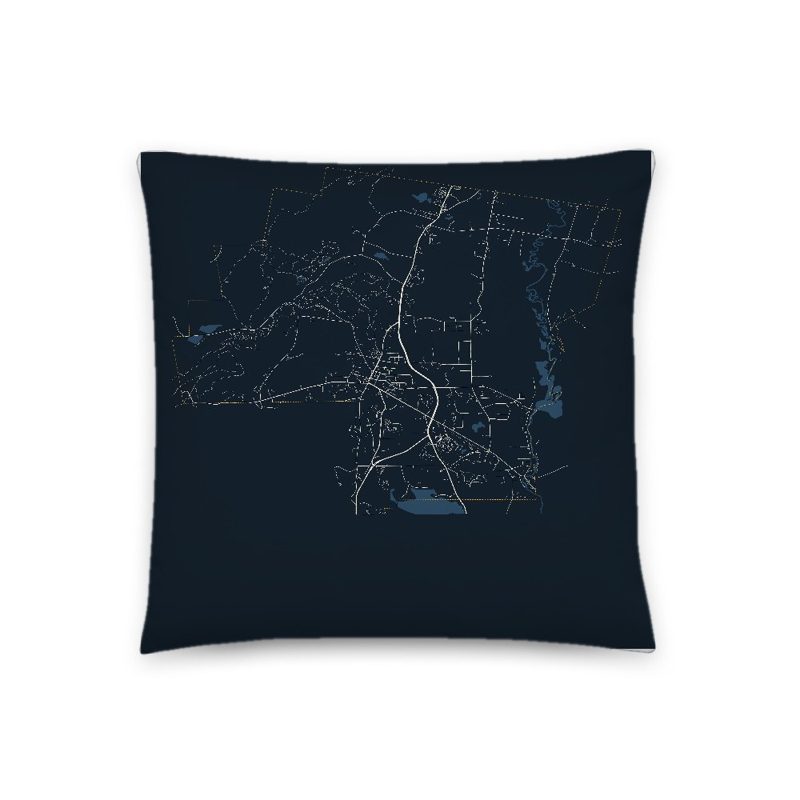
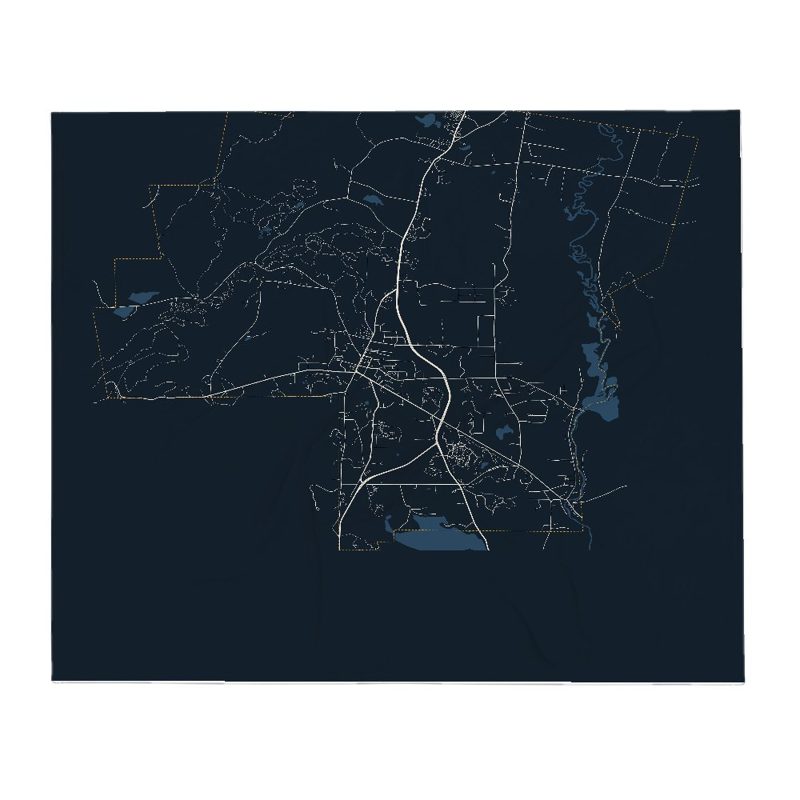
The same map, in navy and silver
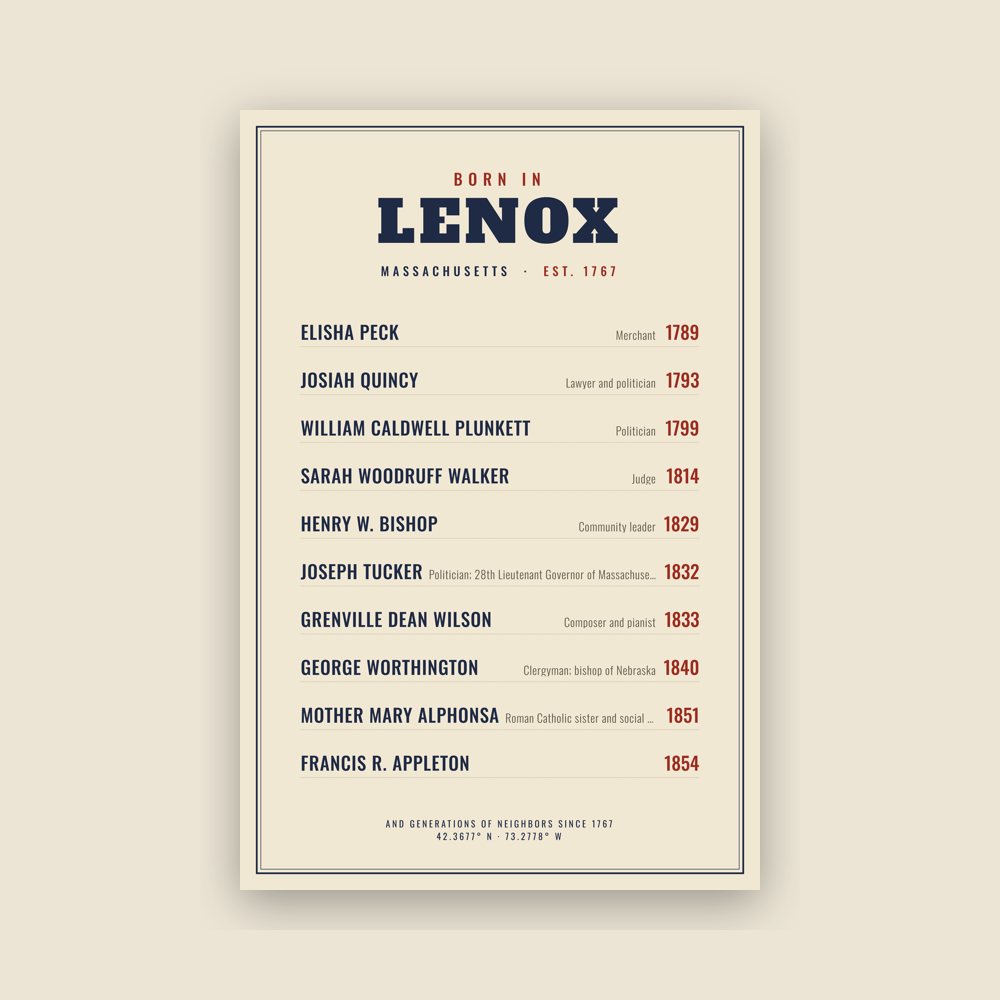
Famous natives, by birth year
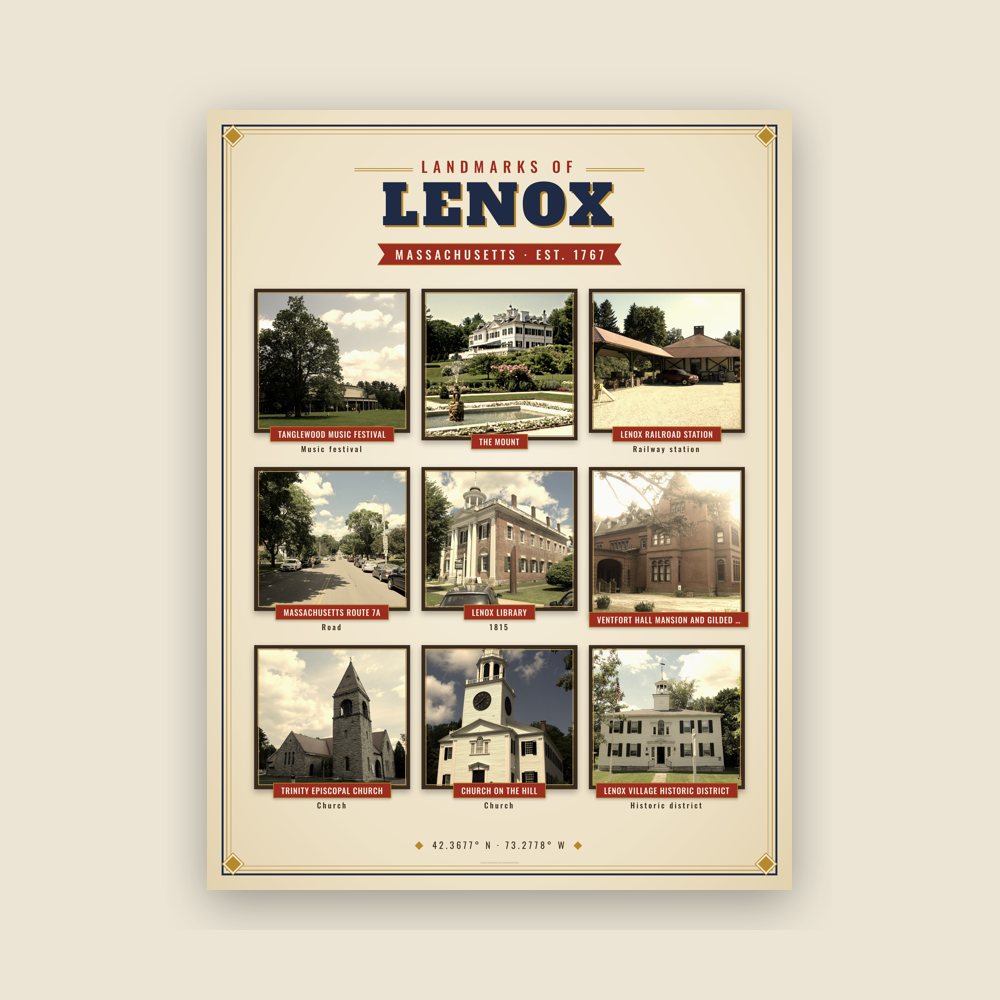
Nine local landmarks, archival matte
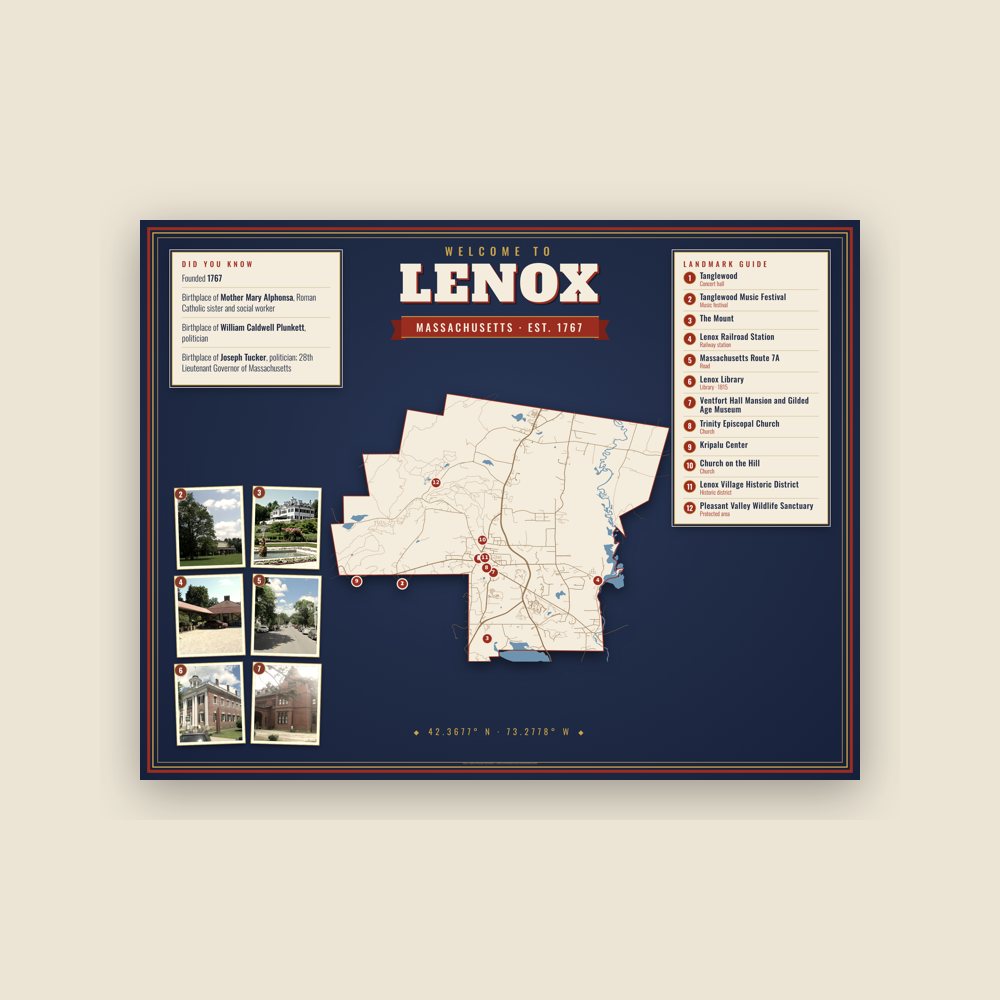
Map of local landmarks, washable fabric
Heavy-blend fleece, street map printed on the back
Soft Bella+Canvas jersey
Glossy ceramic, dishwasher safe
Ceramic keepsake, gold ribbon
Weatherproof, for the front walk
Soft-touch, zip cover
Sturdy all-over-print tote
Glossy top, cork back
Soft fleece, 50″×60″
20 oz, double-wall stainless
Population 2010: 5,025 → 2020: 5,095
From Wikidata (CC0).
The area was inhabited by Mahicans, Native American Algonquian speakers who largely lived along the Hudson and Housatonic Rivers. Hostilities during the French and Indian Wars discouraged settlement by European colonial settlers until 1750, when Jonathan and Sarah Hinsdale from Hartford, Connecticut, established a small inn and general store. The Province of Massachusetts Bay thereupon auctioned large tracts of land for 10 townships in Berkshire County, set off in 1761 from Hampshire County.
For 2,250 pounds Josiah Dean purchased Lot Number 8, which included present-day Lenox and Richmond. After conflicting land claims were resolved, it was deeded to Samuel Brown Jr., who had bought the land from the Mahican chief, on condition that he pay 650 pounds extra. It was founded as Richmond in 1765. But because the Berkshires divided the town in two, the village of Yokuntown (named for an indigenous chief) was set off as Lenox in 1767. The town was intended to be called Lennox, probably after Charles Lennox, 3rd Duke of Richmond and Lennox (Scottish Gaelic Leamhnachd), but the name was misspelled by a clerk at incorporation.
Early industries included farming, sawmills, textile mills, potash production, glassworks, and quarrying. A vein of iron ore led to the digging of mines under the town, and the establishment by Job Gilbert in the 1780s of an iron works at Lenox Dale, also known as Lenox Furnace. In 1784, Lenox became the county seat, which it remained until 1868 when the title passed to Pittsfield. The county courthouse built in 1816 is today the Lenox Library.
The region's rustic beauty helped Lenox develop into an art colony. In 1821, author Catharine Sedgwick moved here, followed by actress Fanny Kemble. Nathaniel Hawthorne and his family came from Salem in 1850, staying a year and a half. Other visitors to the area, including Timothy Dwight, Benjamin Silliman and Henry Ward Beecher, extolled its advantages. After an extension of the Housatonic Railroad arrived in 1838, tourists discovered the town in increasing numbers.
In 1844, Samuel Gray Ward of Boston, the American representative for Barings Bank of London, assembled tracts of land to create the first estate in Lenox. Called Highwood, the Italianate dwelling was designed in 1845 by Richard Upjohn. In 1876, Ward hired Charles F. McKim to design in the Shingle Style another property, Oakwood. The period from 1880 until 1920 would be dubbed the Berkshire Cottage era, when the small New England town was transformed into a Gilded Age resort similar to Newport, Rhode Island, and Bar Harbor, Maine. The wealthy and their entourage opened immense houses for recreation and entertaining during the Berkshire Season, which lasted from late summer until early fall. One event was the annual Tub Parade, when Main Street was lined with ornately decorated carriages. Property values jumped as millionaires competed for land on which to build showplaces. In 1903, an acre in Lenox cost $20,000, when an acre in nearby towns cost a few dollars.
The imposition of the federal income tax in 1913 ended construction of the country mansions in the Berkshires. The estates started to break up during the 1920s. Carnegie's widow sold Shadowbrook to the Jesuits for a seminary in 1922. The Depression made it harder to maintain the estates, and labor was scarce during World War II. After the war, some of the estates were torn or burned down. Others became schools or seminaries. Some estates became preparatory schools, although they would close by the 1970s and 1980s.
The Shadowbrook property is now the Kripalu yoga center; another, The Mount, is the former home of Shakespeare & Company. Some have been converted into vacation condominiums. Tanglewood, the former estate of the Tappan family which lies partially in Stockbridge, would in 1937 become summer home to the Boston Symphony Orchestra. Lenox remains a popular tourist destination. It was a filming location for Before and After (1996) and The Cider House Rules (1999), which was shot at Ventfort Hall Mansion and Gilded Age Museum.
Adapted (trimmed) from the Wikipedia article Lenox, Massachusetts, revision 1379470741 by its contributors, licensed CC BY-SA 4.0.
We share a part of every Lenox sale with local partners, and we'd love to print from your collection. Old photographs, maps and postcards make the best keepsakes.
Partner with us