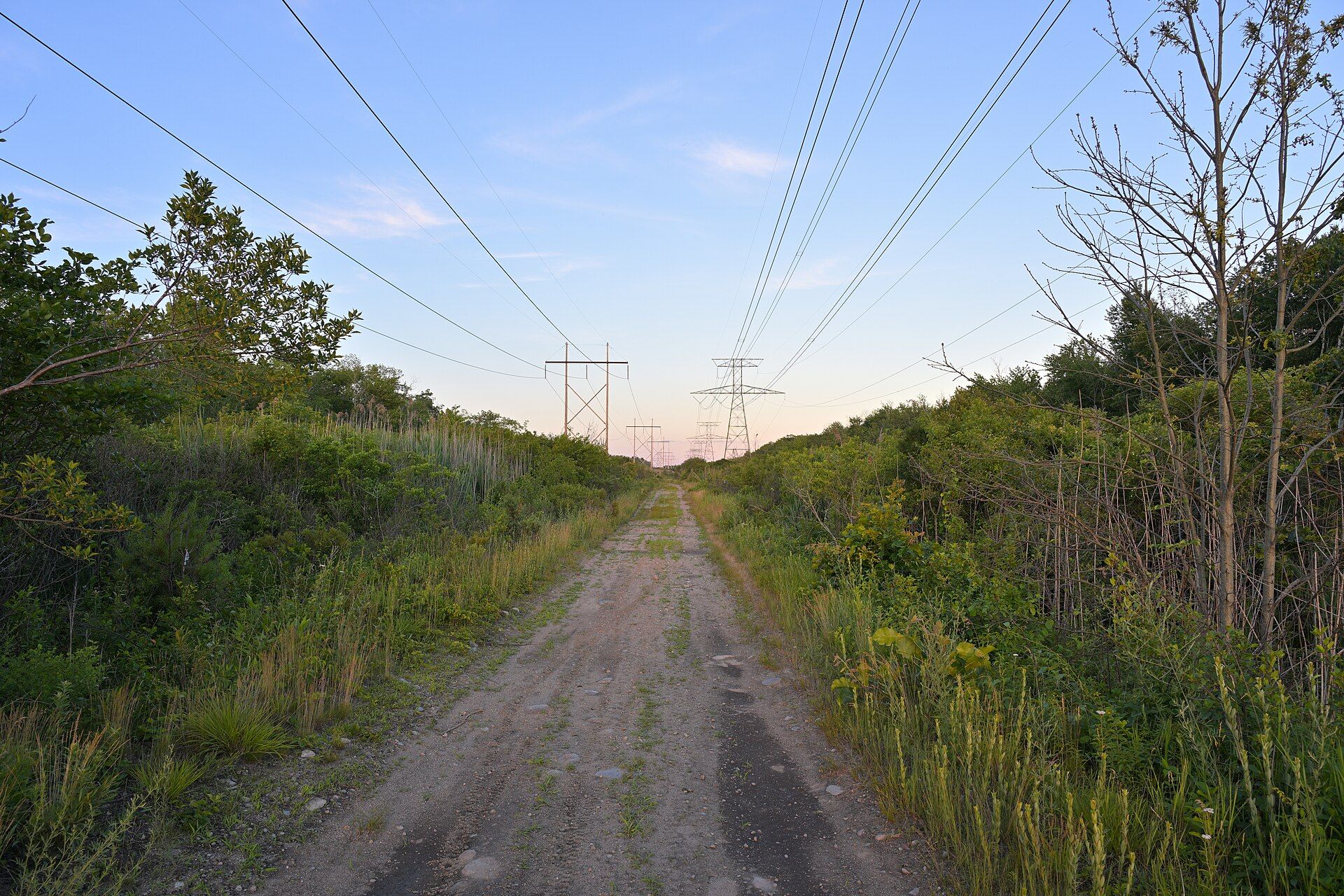
It has one village, Raynham Center. Landmarks include Massachusetts Route 104, murder of Alexandra Zapp and Taunton Iron Works. Raynham is the birthplace of Josiah Dean, politician.
Every piece is drawn from Raynham's own map data and historic archives, then printed and shipped from the USA when you order. No two towns look alike.
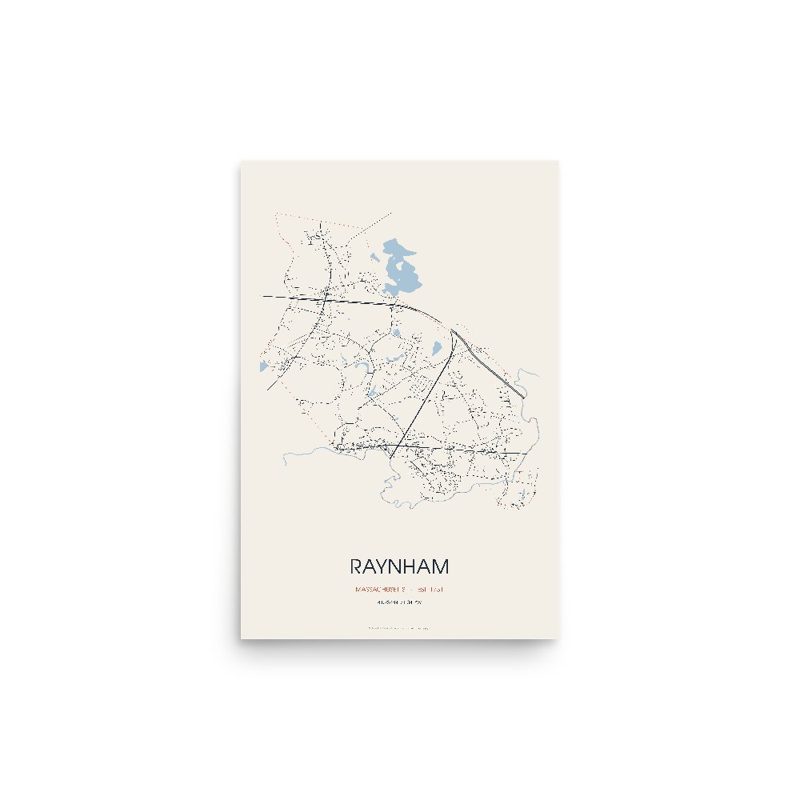
Every road in town, on archival matte paper
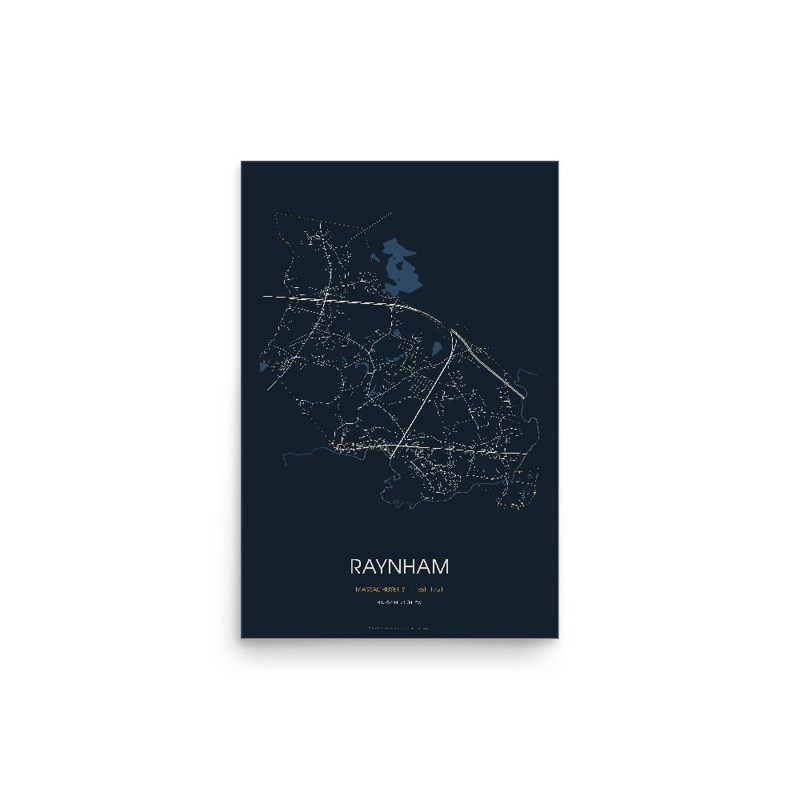
The same map, in navy and silver
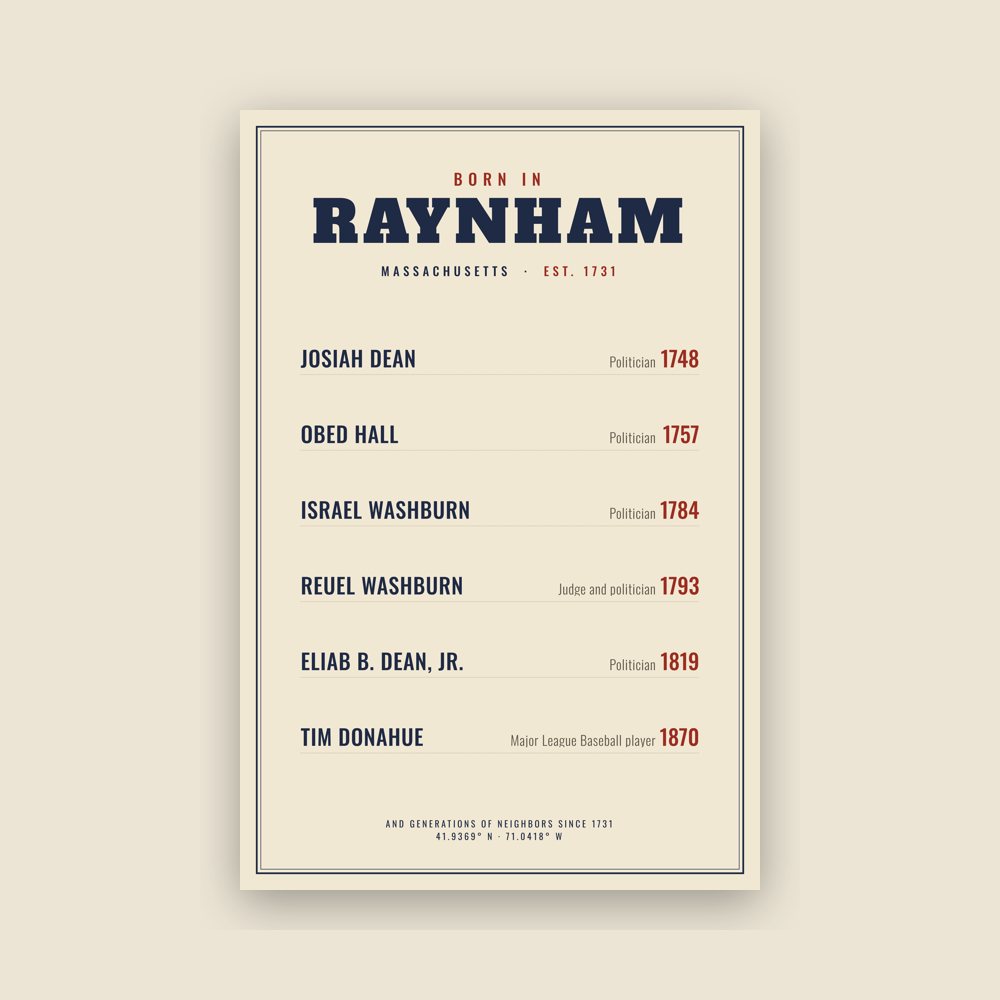
Famous natives, by birth year
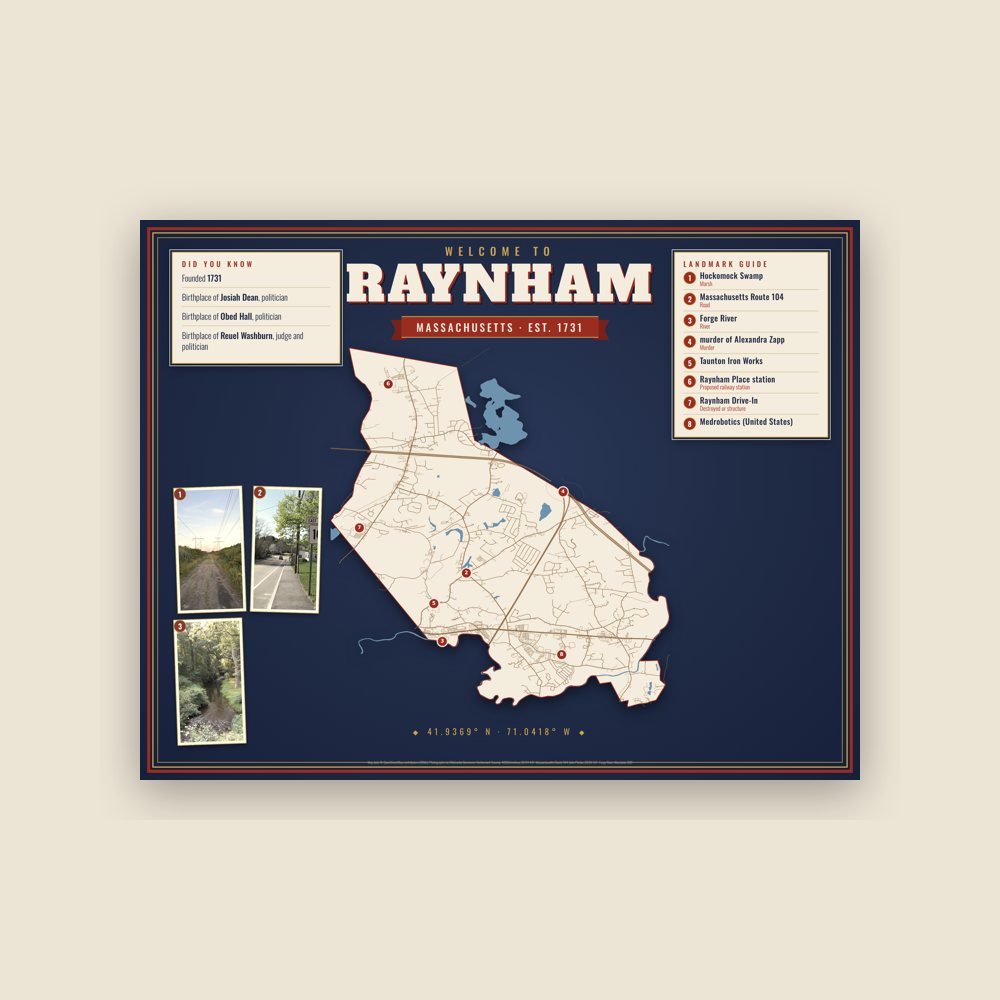
Map of local landmarks, washable fabric
Heavy-blend fleece, street map printed on the back
Soft Bella+Canvas jersey
Glossy ceramic, dishwasher safe
Ceramic keepsake, gold ribbon
Weatherproof, for the front walk
Soft-touch, zip cover
Sturdy all-over-print tote
Glossy top, cork back
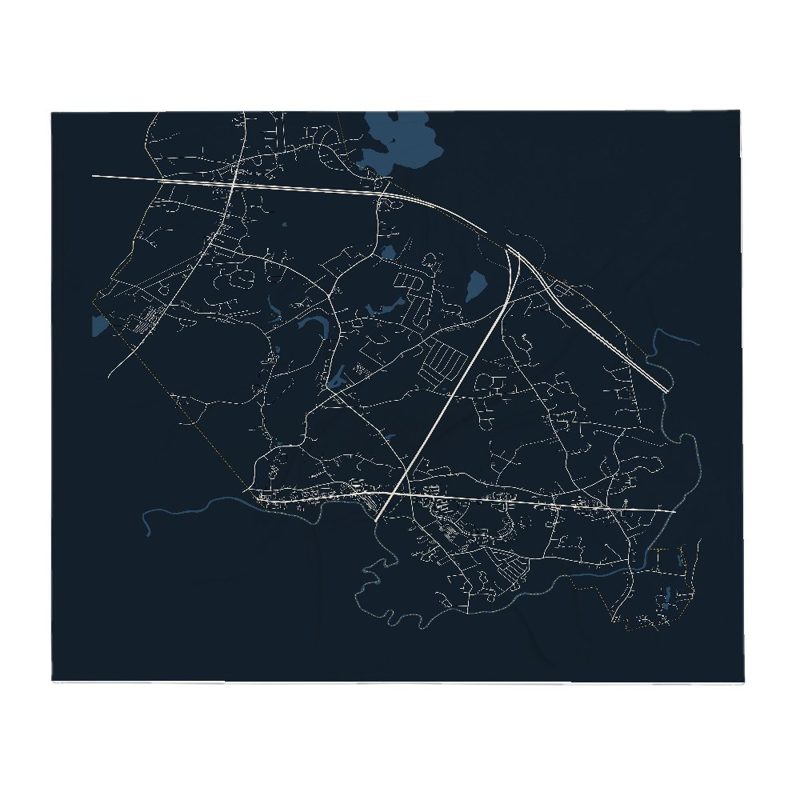
Soft fleece, 50″×60″
20 oz, double-wall stainless
Population 2010: 13,383 → 2020: 15,142
From Wikidata (CC0).
The area that is now Raynham was settled in 1639 as a part of Taunton, and was founded by Elizabeth Pole, the first woman to found a town in America.
It was to that area three years earlier that Roger Williams, proponent of separation of church and state, of paying Indians for land acquired and abolishing slavery, had escaped, traveling 55 miles during a January blizzard. He was fleeing a conviction for sedition and heresy of the General Court of Salem, and it was here that the local Wampanoag people offered him shelter at their winter camp. Their Sachem Massasoit hosted Williams for the three months until spring.
In 1652, bog iron was found along the Two Mile (Forge) River. Soon after, the Taunton Iron Works was established by residents James and Henry Leonard. It was the first successful iron works established in what was then Plymouth Colony, and operated from 1656 to 1876. It was not the "First Iron Works in America", as proclaimed on the Town's official seal, having been predated by the Saugus and Braintree iron works. The success of the Taunton Iron Works, however, led to the establishment of other iron works throughout the colonies.
Raynham played a key part in King Philip's War. The Leonards had forged a friendship before the war began with King Philip, who lived in the area. It is said that Philip agreed to spare the town from the mass destruction if the Leonards repaired his troops' weapons in their iron forge.
The eastern end of Taunton was separated from that town and incorporated as Raynham on April 2, 1731, named after the English village of Raynham in the county of Norfolk, England. Many ships' hulls were built along the Taunton River in Raynham, which were sailed down the river towards Fall River and Narragansett Bay for final fittings. The town also had other small manufacturing industries, but for the most part it was known for its rural and agrarian base.
Adapted (trimmed) from the Wikipedia article Raynham, Massachusetts, revision 1377040564 by its contributors, licensed CC BY-SA 4.0.
We share a part of every Raynham sale with local partners, and we'd love to print from your collection. Old photographs, maps and postcards make the best keepsakes.
Partner with us