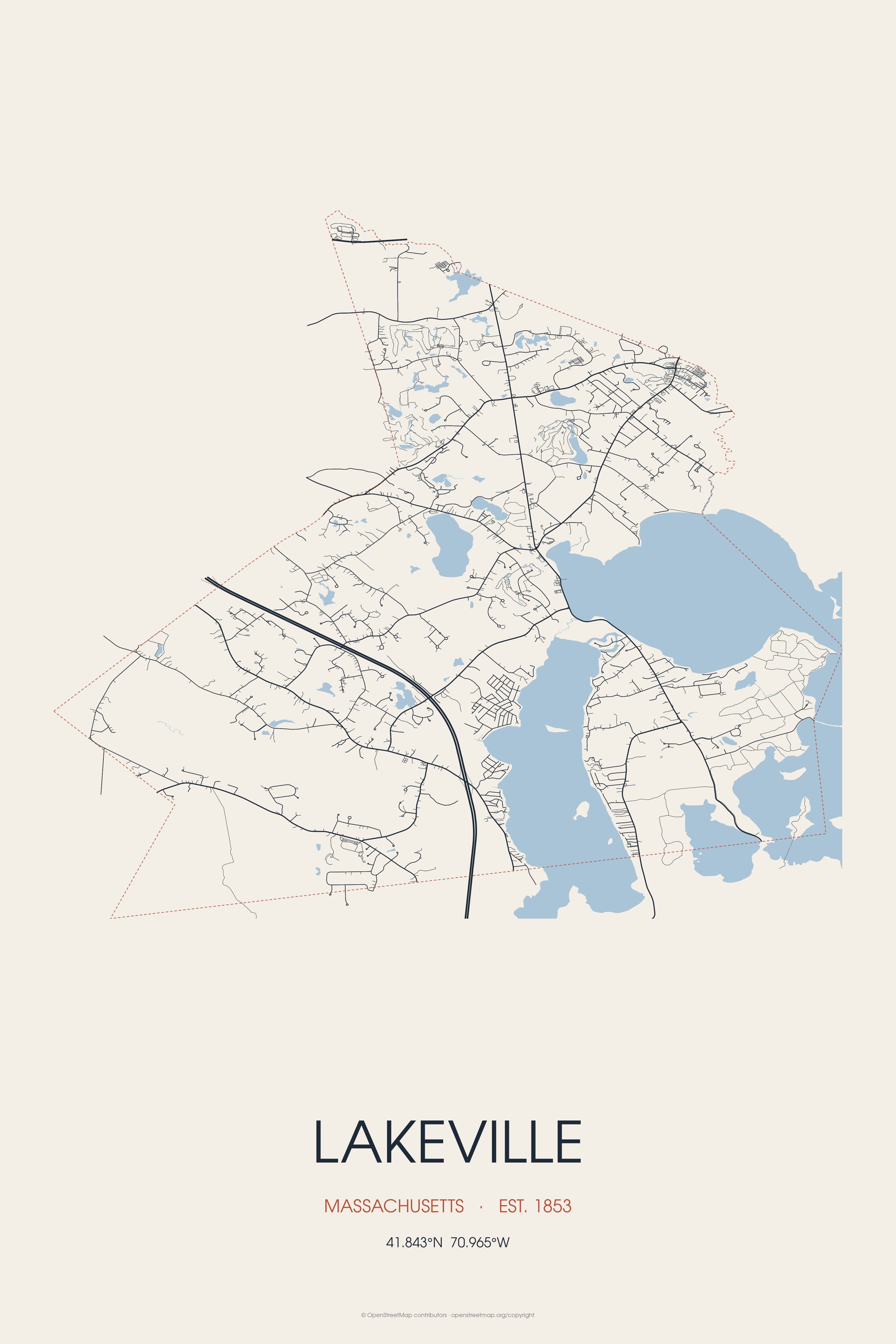
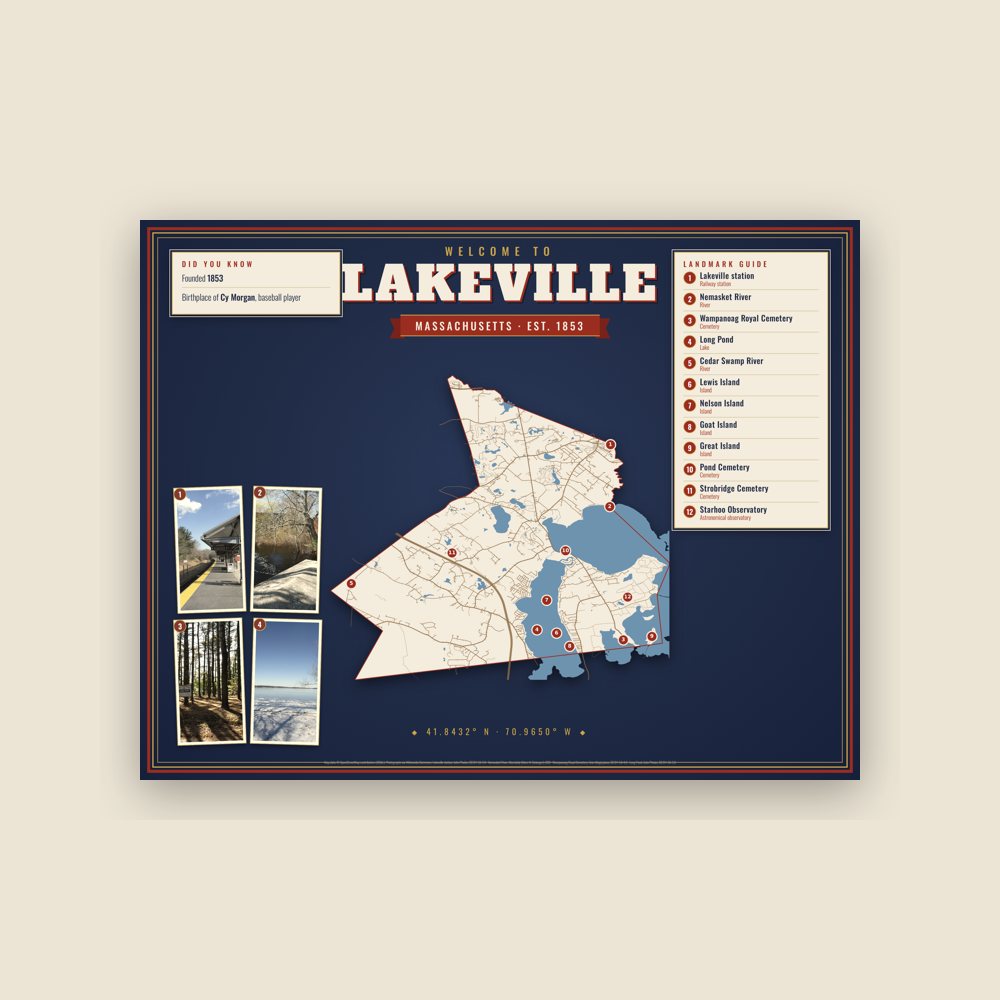
It contains the village of North Lakeville. Landmarks include Wampanoag Royal Cemetery. Lakeville is the birthplace of Cy Morgan, baseball player.
Every piece is drawn from Lakeville's own map data and historic archives, then printed and shipped from the USA when you order. No two towns look alike.
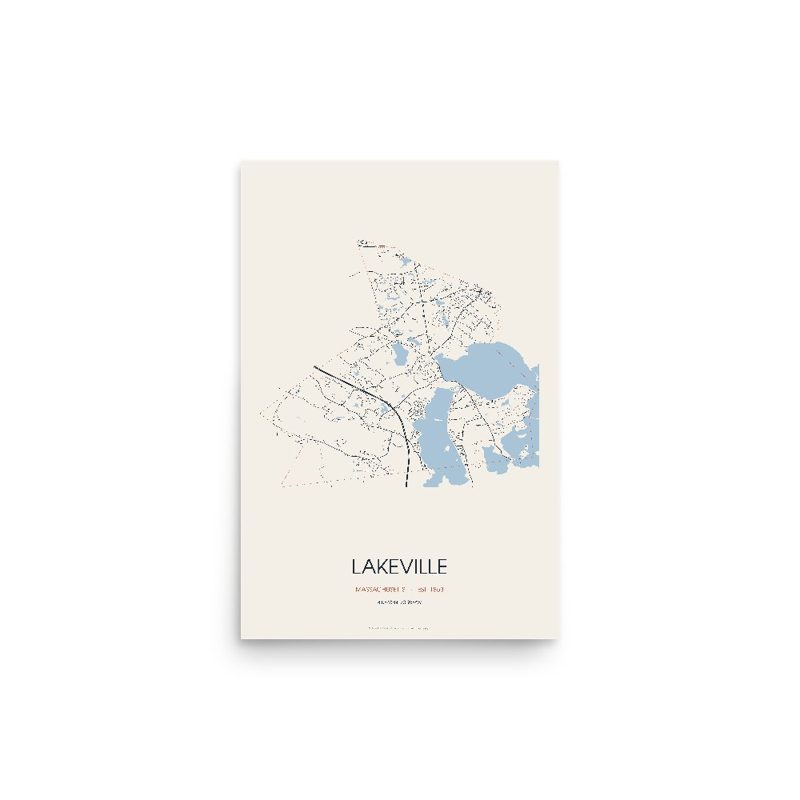
Every road in town, on archival matte paper
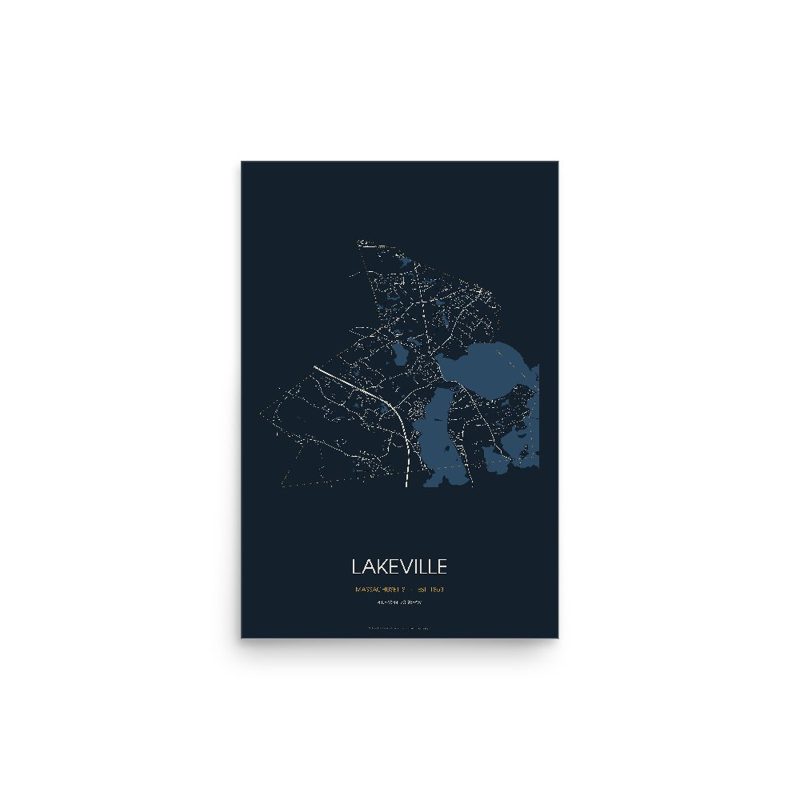
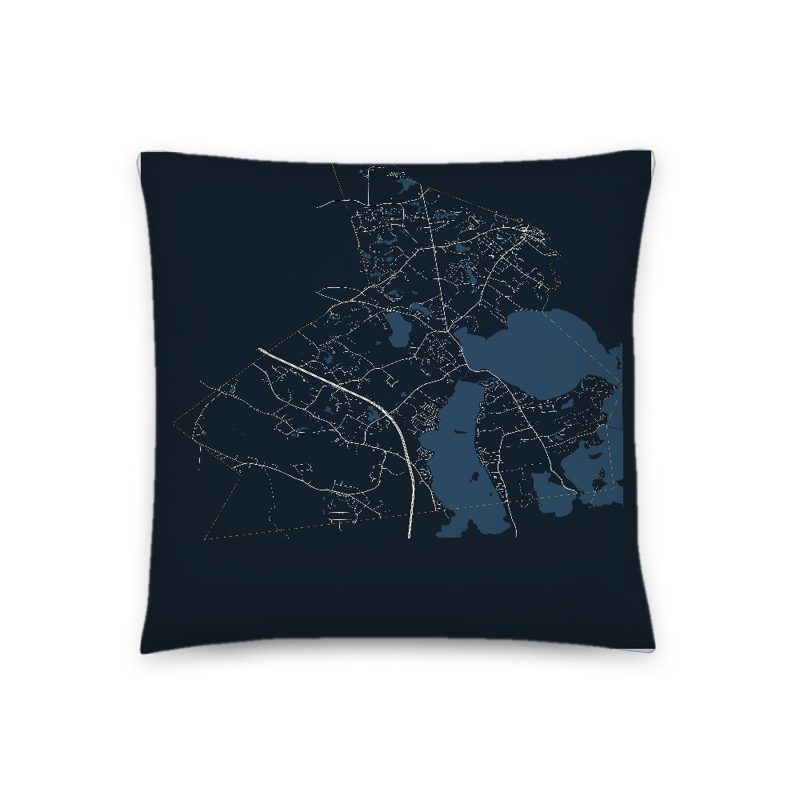
The same map, in navy and silver
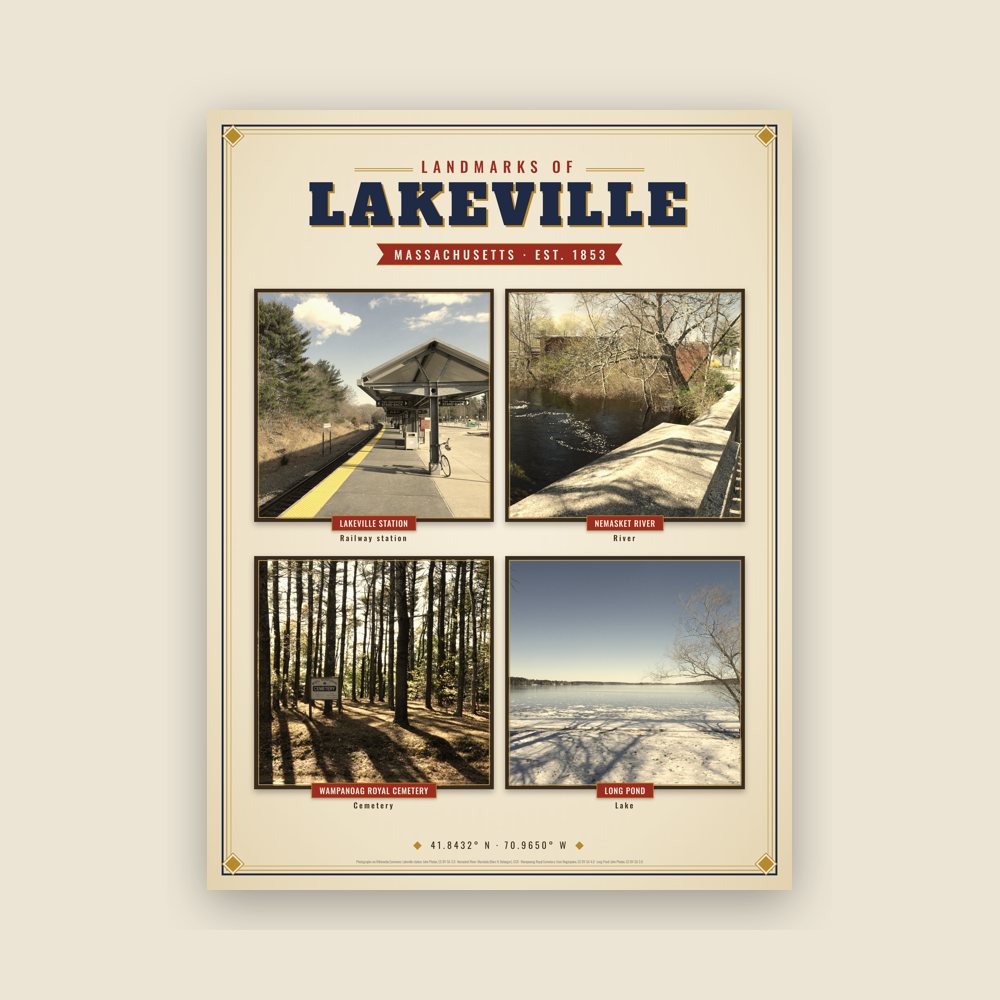
Nine local landmarks, archival matte
Map of local landmarks, washable fabric
Heavy-blend fleece, street map printed on the back
Soft Bella+Canvas jersey
Glossy ceramic, dishwasher safe
Ceramic keepsake, gold ribbon
Weatherproof, for the front walk
Soft-touch, zip cover
Sturdy all-over-print tote
Glossy top, cork back
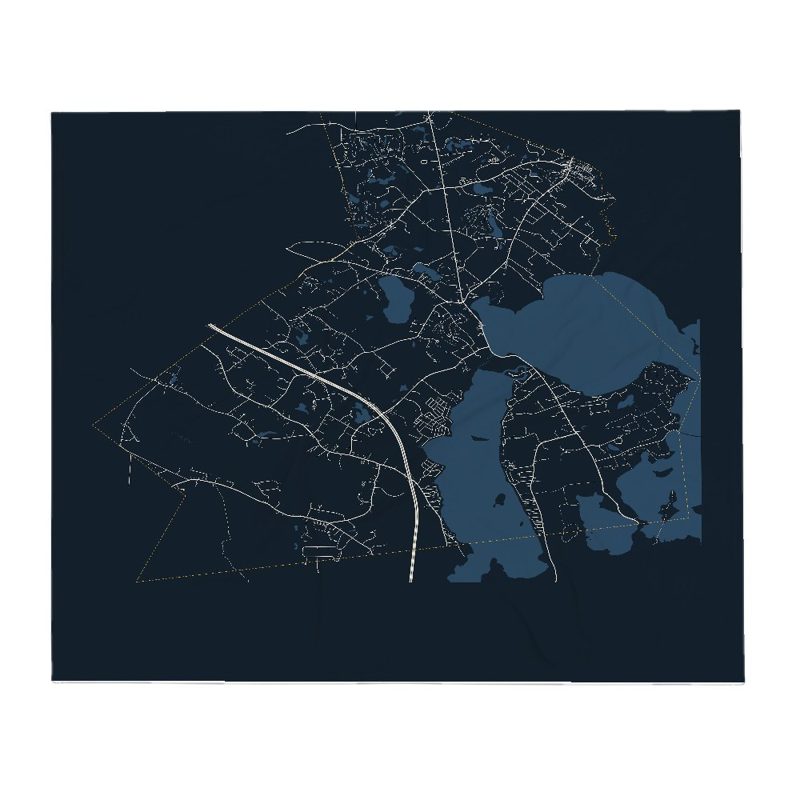
Soft fleece, 50″×60″
20 oz, double-wall stainless
Population 2010: 10,602 → 2020: 11,523
From Wikidata (CC0).
Native Americans inhabited southern Massachusetts for thousands of years prior to European colonization of the Americas, and Lakeville is a site with significant indigenous history.
Soewampset is listed as a noted habitation in a 1634 list of settlements in New England, suggesting that Assawompset Pond may take its name from a former Wampanoag settlement on its banks. The Wampanoag Royal Cemetery is located in modern-day Lakeville on a peninsula between Little and Great Quittacas Pond.
In 1675, the body of John Sassamon, advisor to Governor Josiah Winslow, was discovered beneath the ice of Assawompset Pond. He was believed to have been murdered, and three Native Americans were arrested. On the testimony of only one witness (contrary to English law, which required the testimony of at least two witnesses in a murder trial), the three were sentenced to death by hanging. When the sentence was carried out, Tobias, senior counselor to the Pokanoket sachem King Philip, and a second supposed accomplice died. When the attempt was made to carry out the sentence on the third "accomplice"—Tobias's son—the rope broke and he was imprisoned, having first confessed to the killings. His confession is widely believed to have been coerced.
The death of John Sassamon and the subsequent trial and execution of the Wampanoag men convicted of his murder is broadly acknowledged as the trigger for King Philip's War, though tensions between English colonists and indigenous groups had been building for decades. During part of the war, Metacomet and his forces sheltered in Lakeville at Assawompset Pond, prior to Metacomet's capture in Bristol, Rhode Island.
The Wampanoag settlement at Assawompset Pond persisted until at least the early 1800s, as attested by burials in the Wampanoag Royal Cemetery, and the biography of Benjamin Simonds.
The first recorded non-native settlement of Lakeville was in 1705 by a man named Peirce, "whose descendants are very numerous." Lakeville was settled on a larger scale in 1717 as a western parish of Middleborough. It was incorporated as a separate town in 1853. One notable resident from Lakeville who fought in the American Revolution was a Wampanoag man named Benjamin Simonds, who was an aide-de-camp to George Washington at Valley Forge, who died in either 1831 or 1836. He was likely a part of one of the two militias from Lakeville, the Pond Militia Company or the Beech Woods Company of Minutemen. They were combined into Middleborough's Fourth Company of Foot, in which he served. He ended up becoming a local celebrity, both because of his service and because he was the last fully Wampanoag person to live on Assawompset Pond.
Ninety-one men from Lakeville served in the American Civil War, eighty-five in the army and six in the navy. Three churches have been built in the town, the first in 1725, the second in 1751 and the third one in 1835. Ocean Spray is headquartered in Lakeville.
Adapted (trimmed) from the Wikipedia article Lakeville, Massachusetts, revision 1379458775 by its contributors, licensed CC BY-SA 4.0.
We share a part of every Lakeville sale with local partners, and we'd love to print from your collection. Old photographs, maps and postcards make the best keepsakes.
Partner with us