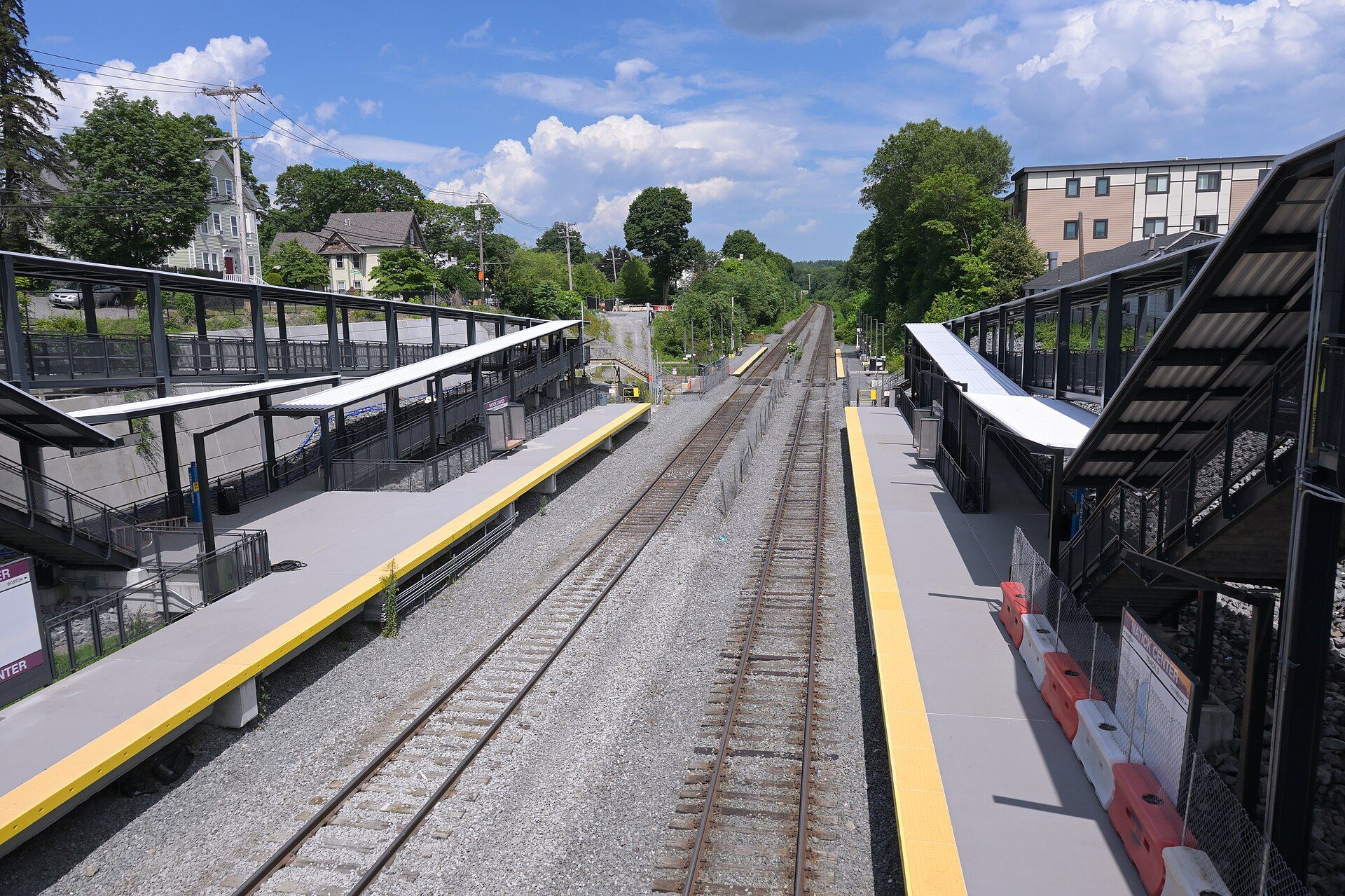
Natick was the first of Eliot's network of praying towns and served as their center for a long time. Landmarks include The Parsonage, Natick Center station and West Natick station. Natick is the birthplace of Jonathan Richman, musician.
Every piece is drawn from Natick's own map data and historic archives, then printed and shipped from the USA when you order. No two towns look alike.
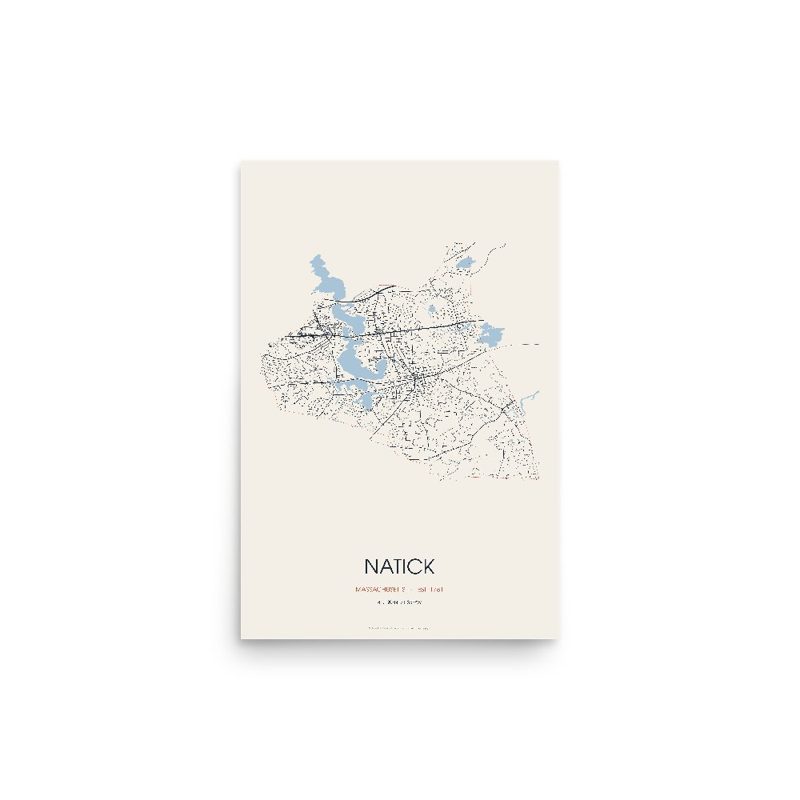
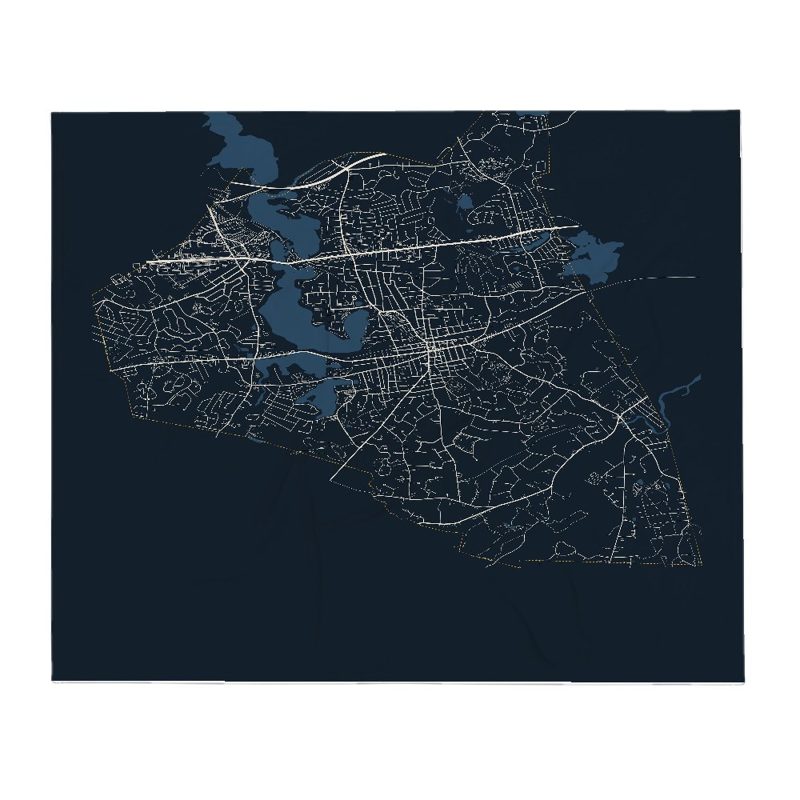
Every road in town, on archival matte paper
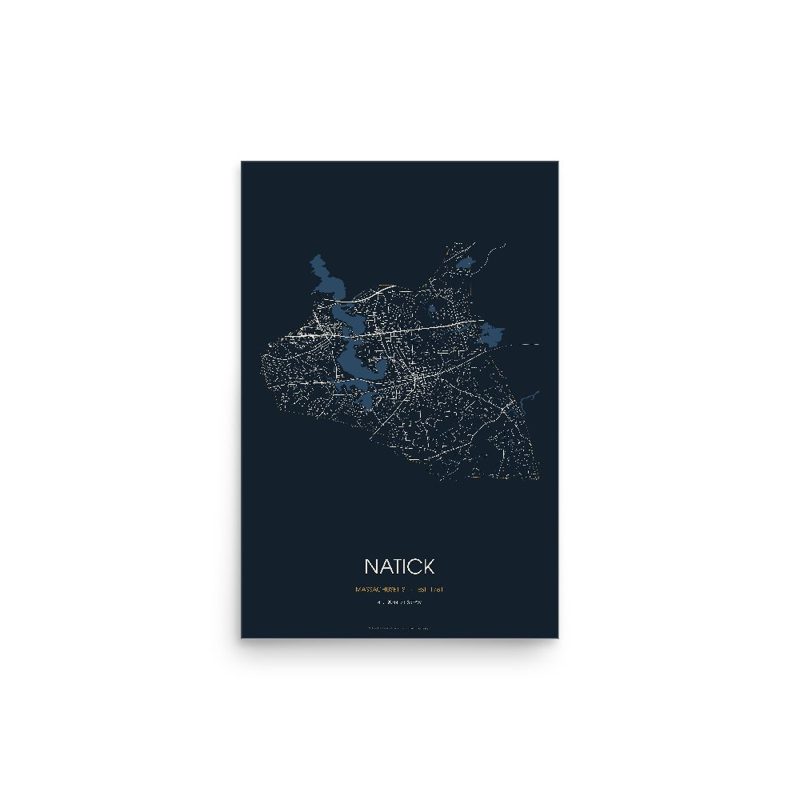
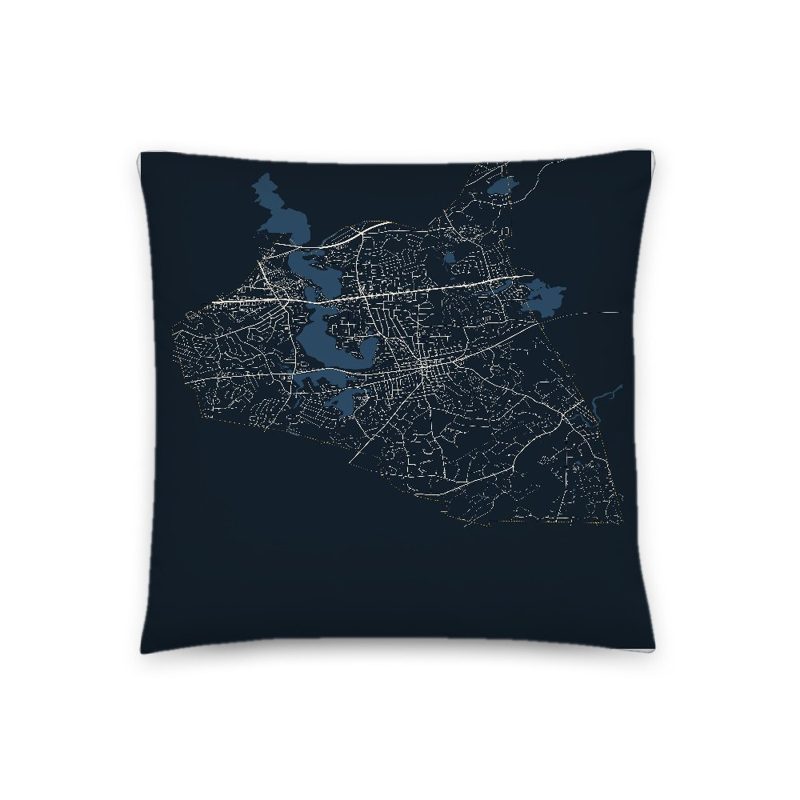
The same map, in navy and silver
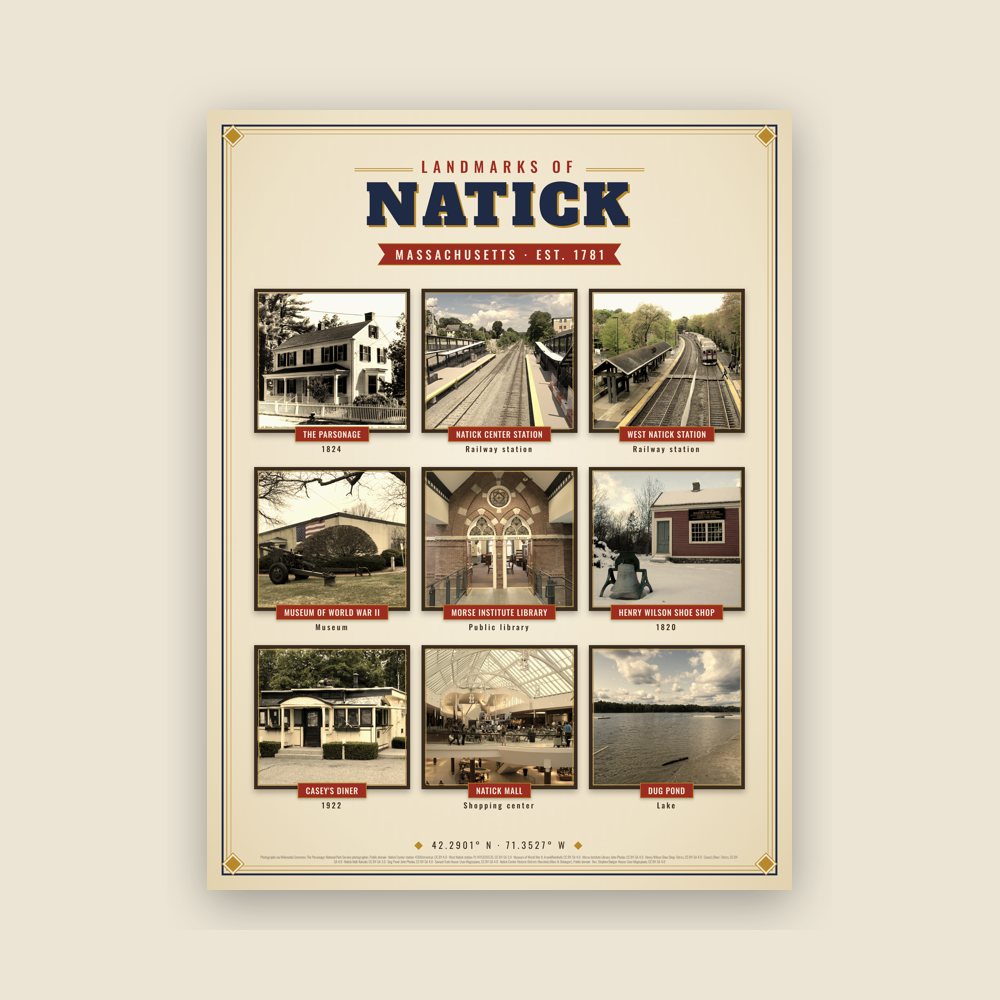
Nine local landmarks, archival matte
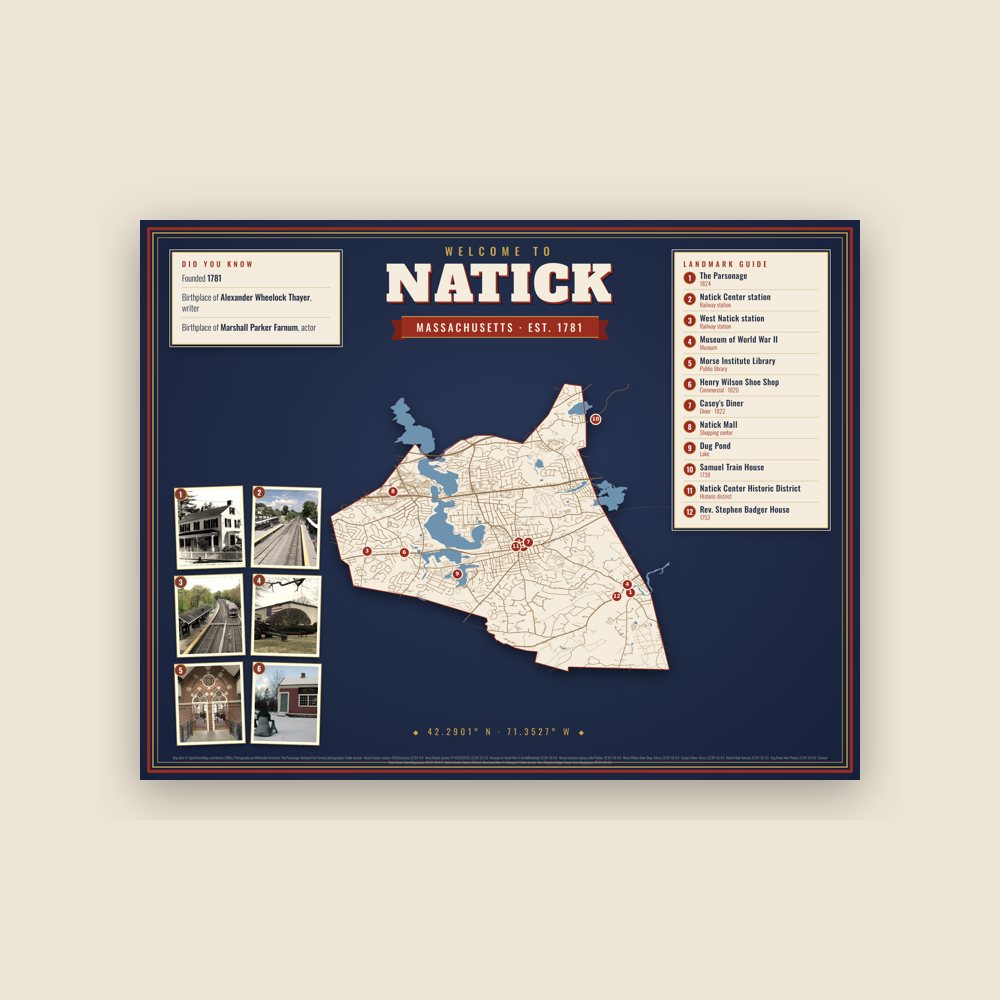
Map of local landmarks, washable fabric
Heavy-blend fleece, street map printed on the back
Soft Bella+Canvas jersey
Glossy ceramic, dishwasher safe
Ceramic keepsake, gold ribbon
Weatherproof, for the front walk
Soft-touch, zip cover
Sturdy all-over-print tote
Glossy top, cork back
Soft fleece, 50″×60″
20 oz, double-wall stainless
Population 2010: 33,006 → 2020: 37,006
From Wikidata (CC0).
Natick was settled in 1651 by John Eliot, a Puritan missionary born in Widford, England, who received a commission and funds from England's Long Parliament to settle the Massachusett Indians called Praying Indians on both sides of the Charles River, on land deeded from the settlement at Dedham. Natick was the first of Eliot's network of praying towns and served as their center for a long time. While the towns were largely self-governing under Indian leaders, such as Waban and Cutshamekin, the praying Indians were subject to rules governing conformity to Puritan culture (in practice Natick, like the other praying towns, combined both indigenous and Puritan culture and practices). Eliot and Praying Indian translators printed America's first Algonquian language Bible. Eventually, the church in Natick was led for several decades by an indigenous pastor, Rev. Daniel Takawambait.
The colonial government placed such settlements in a ring of villages around Boston as a defensive strategy. Natick was the first and best documented settlement. The land was granted by the General Court as part of the Dedham Grant.
After a period of expansion and little focus on evangelism, Reverend John Robinson told the New Englanders to prioritize missionary work over growth, "the killing of those poor Indians....How happy a thing it had been if you had converted some before you had killed any." Chastened in the wake of the Mystic Massacre which occurred during the Pequot War, sincere efforts at evangelizing began. A school was set up, a government established, and the Indians were encouraged to convert to Christianity. In November 1675, during King Philip's War, the Natick Indians were sent to Deer Island. Many died of disease and cold, and those who survived found their homes destroyed. The Indian village did not fully recover, and the land held in common by the Indian community was slowly sold to white settlers to cover debts. By 1785, most of the Natick Indians had drifted away. After King Philip's War, Elliot's and a few other missionaries' opposition to the executions and enslavement of Indians were eventually silenced by death threats.
In 1775, both European and Indian citizens of Natick participated in the battles of Lexington, Concord and Bunker Hill, as well as serving in the Continental Army. The names of Natick's Praying Indian soldiers are memorialized on a stone marker, along with all of Natick's Revolutionary War veterans, on a stone marker on Pond Street, near downtown Natick.
The town was incorporated in 1781. Henry Wilson, a U.S. senator who became the 18th Vice President of the United States (1873–1875), lived most of his life in Natick as a shoemaker and schoolteacher known as the "Natick Cobbler" and is buried there. He is the namesake of one of Natick's middle schools.
Though Natick was primarily a farming town, the invention of the sewing machine in 1858 led to the growth of several shoe factories. The business flourished and peaked by 1880, when Natick, with 23 operating factories, was third in the nation in the quantity of shoes produced. The shoes made in Natick were primarily heavy work shoes with only one or two companies making lighter dress shoes. Natick was famous for its brogan, a heavy ankle-high boot worn by soldiers in the American Civil War.
The wound core for a more resilient baseball was developed by John W. Walcott and combined with the figure-eight stitching devised by Colonel William A. Cutler. It was manufactured by the firm of H. Harwood & Sons in their factory, the world's first plant for the manufacture of baseballs. In 1988 H. Harwood & Sons was converted into baseball factory condominiums.
In 1874, a fire in downtown Natick demolished 18 business blocks, two shoe factories, the Town Hall, Natick's only fire engine house and the Congregational Church, as well as many private homes. Though there were no deaths, the loss of property was greater in proportion to the town's wealth than the Great Chicago Fire of 1871. In 1875, Natick's new Central Fire Station was completed on Summer Street and opened with grand ceremony on the same city block where the fire was first discovered. The Central Fire Station is now the home of The Center for Arts in Natick (TCAN), a private nonprofit performing arts center.
In 1891, a team from the town fire department won "The World's Hook and Ladder Championship", a competition between the fire departments of four area towns. The victory gave the town its nickname "Home of Champions".
Miles 8 through 12 of the Boston Marathon run through Natick on Patriots' Day every year along Route 135/Central St., and thousands of residents and visitors line the road to watch.
In December 2024, the town Select Board approved an amended immigration policy. The policy restricts town employees from gathering information about individuals' citizenship or immigration status. Additionally, it bars town employees from acting as immigration officers, though exceptions are made for actions pursuant to judicial warrants, subpoenas, or detainers related to immigration enforcement.
Adapted (trimmed) from the Wikipedia article Natick, Massachusetts, revision 1377784473 by its contributors, licensed CC BY-SA 4.0.
We share a part of every Natick sale with local partners, and we'd love to print from your collection. Old photographs, maps and postcards make the best keepsakes.
Partner with us