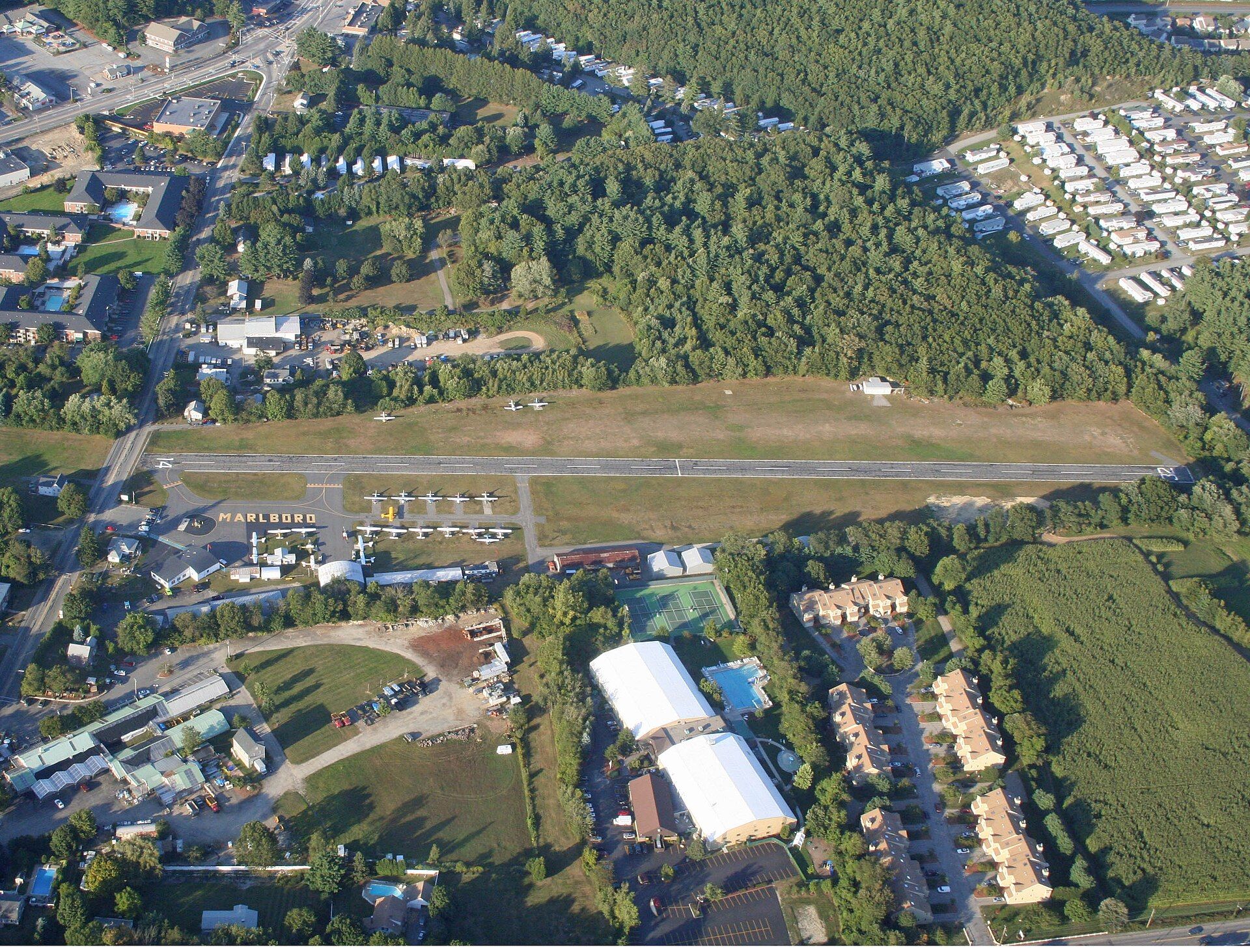
Marlborough became a prosperous industrial town in the 19th century and made the transition to high technology industry in the late 20th century after the construction of the Massachusetts Turnpike. Landmarks include Marlboro Airport, Capt. Peter Rice House and John Cotting House. Marlborough is the birthplace of Marcia Cross, actress.
Every piece is drawn from Marlborough's own map data and historic archives, then printed and shipped from the USA when you order. No two towns look alike.
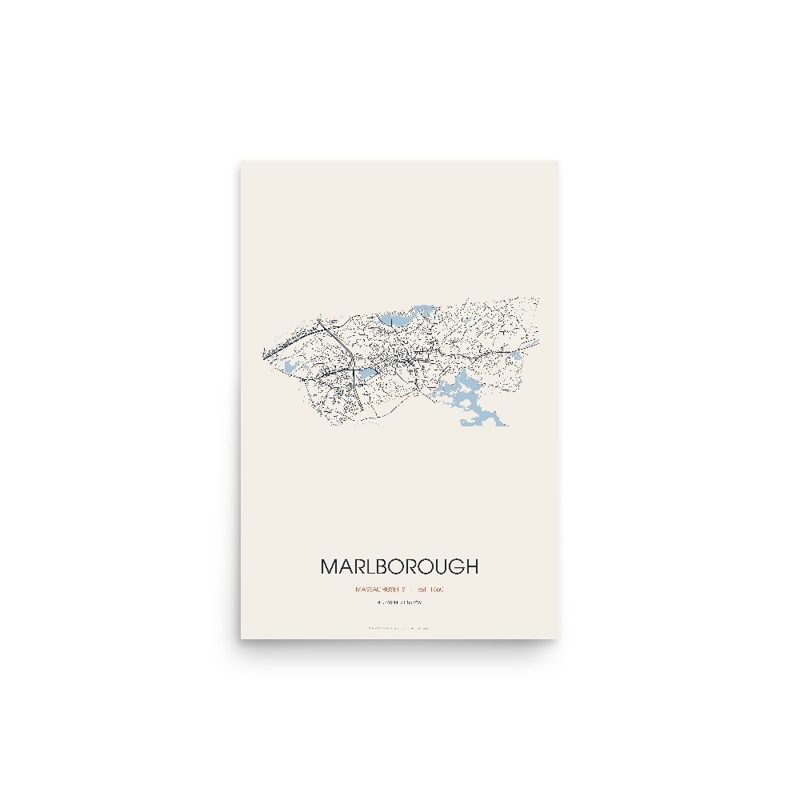
Every road in town, on archival matte paper
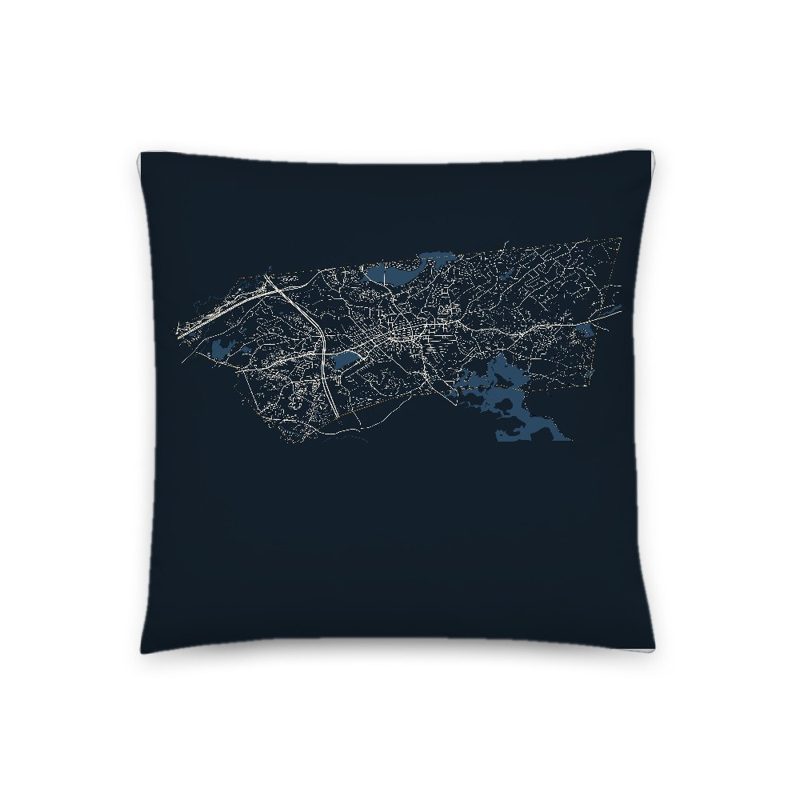
The same map, in navy and silver
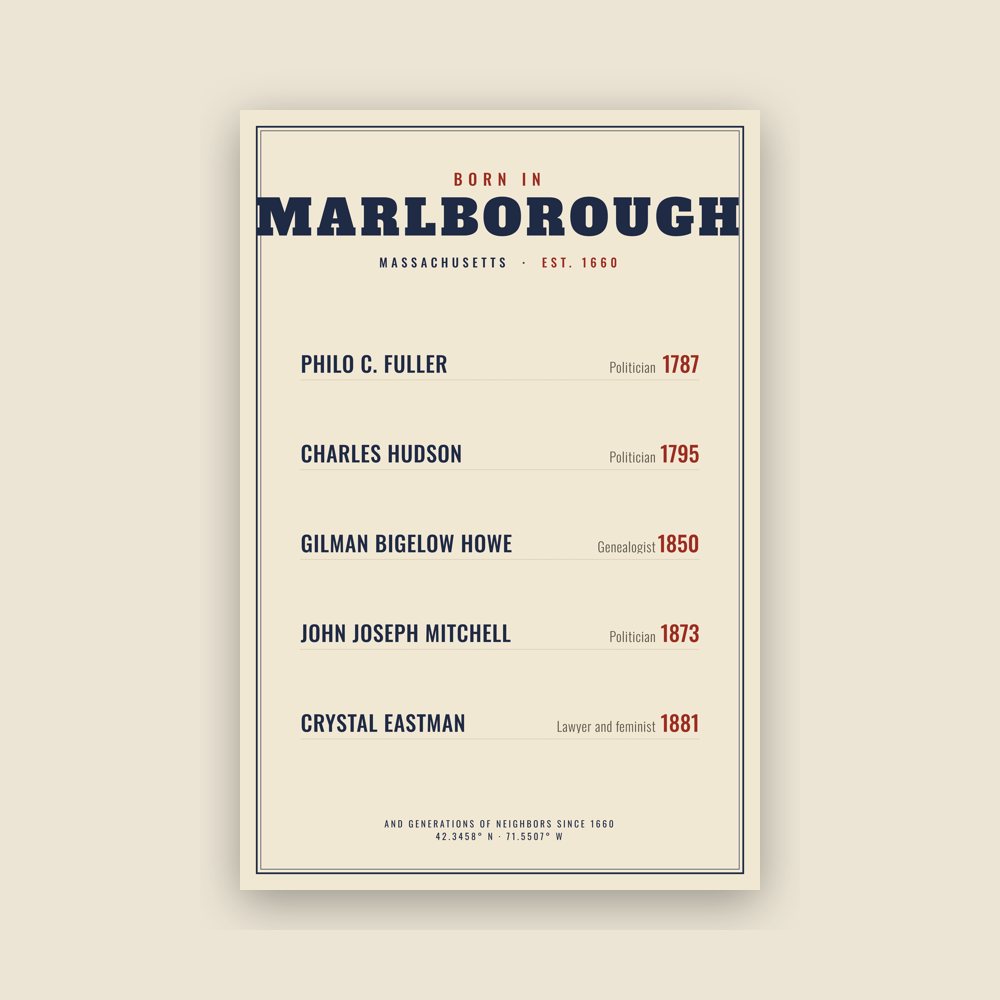
Famous natives, by birth year
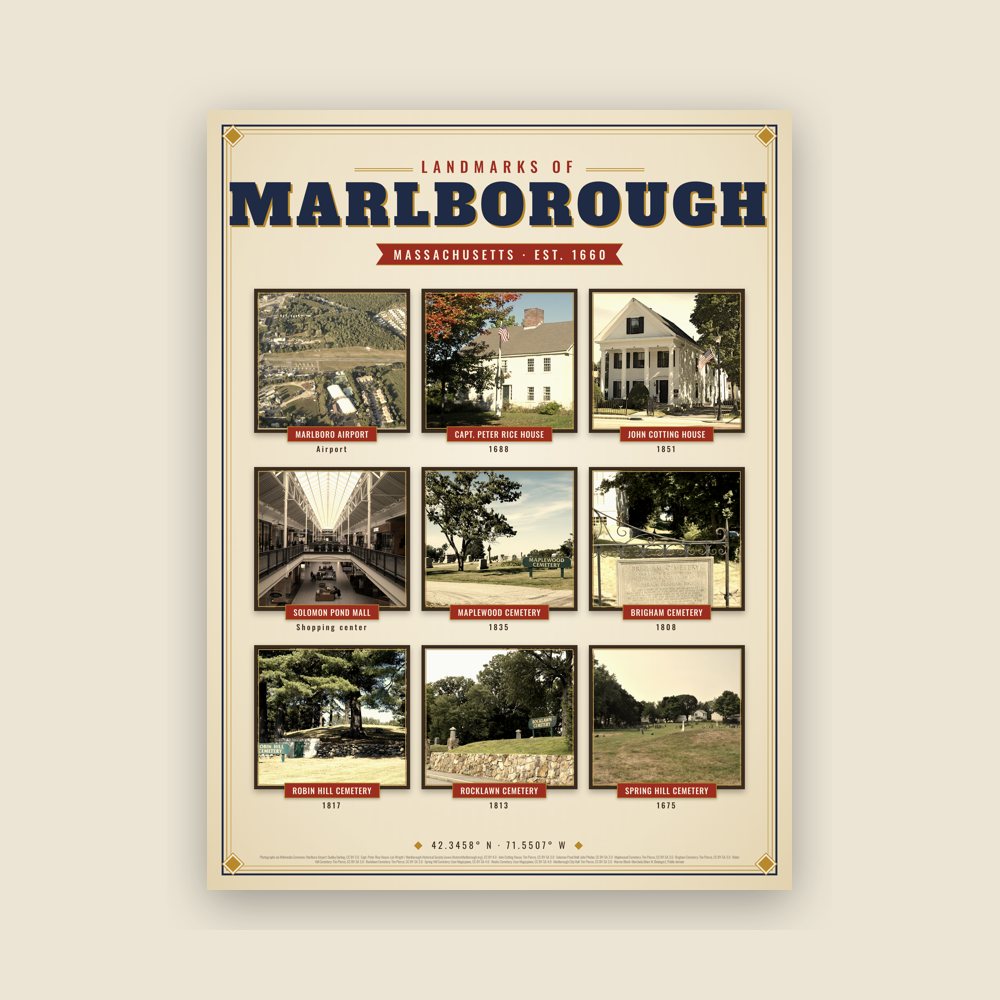
Nine local landmarks, archival matte
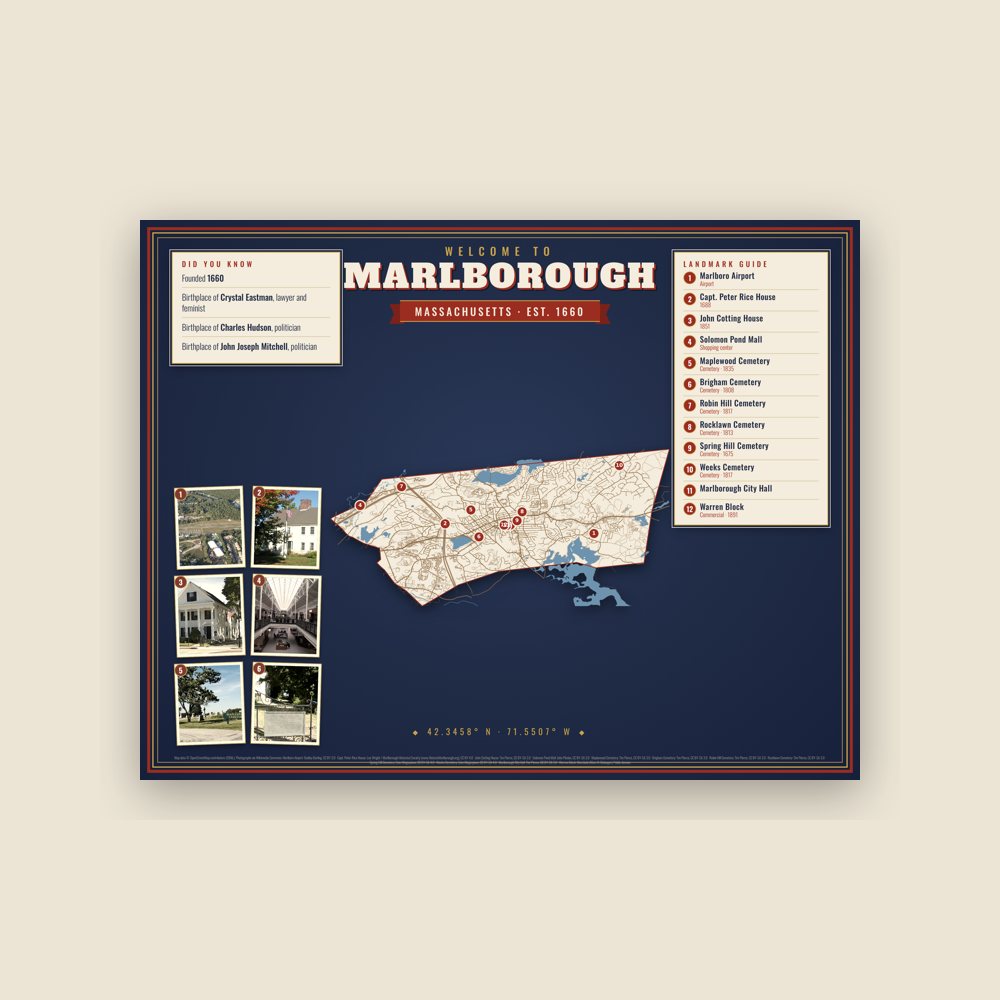
Map of local landmarks, washable fabric
Heavy-blend fleece, street map printed on the back
Soft Bella+Canvas jersey
Glossy ceramic, dishwasher safe
Ceramic keepsake, gold ribbon
Weatherproof, for the front walk
Soft-touch, zip cover
Sturdy all-over-print tote
Glossy top, cork back
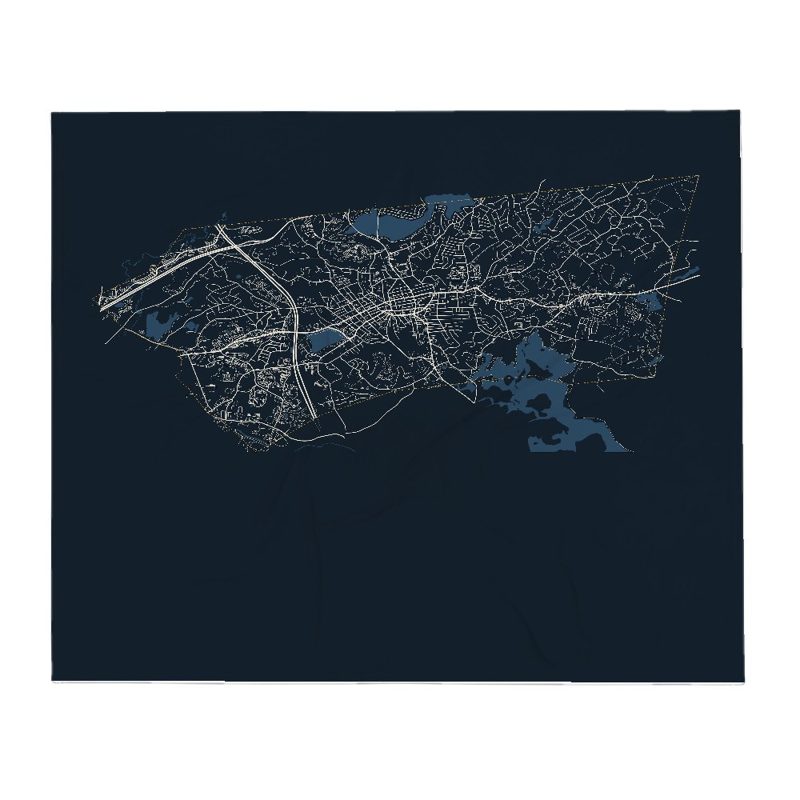
Soft fleece, 50″×60″
20 oz, double-wall stainless
Population 1890: 13,805 → 1909: 13,000 → 2010: 38,499 → 2020: 41,793
From Wikidata (CC0).
In 1656, several families from Sudbury, Massachusetts, led by Edmund Rice, John Howe, John Ruddock, and John Bent, petitioned the Massachusetts General Court to create a new town. The proposed town would be located southwest of Sudbury at the intersection of two trails used by local Native American tribes, known as the Nashua Trail and Connecticut path. Its name would be Marlborough, after the market town in Wiltshire, England of the same name.
The land belonged to a tribe of Pennacook Native Americans whose population had been decimated by the introduction of European diseases a few decades prior. In 1656, only 50 or so Pennacooks remained in the area. The Pennacook people spoke an Algonquian language; this was among the reasons that Howe, a fur trader who spoke Algonquian, became the first settler to move to the area. The Pennacook, knowing their reduced numbers left them vulnerable to attacks from other Native groups, initially welcomed the settlers in exchange for their assistance protecting the tribe.
Marlborough was officially incorporated as a town in 1660. Rice, a former Puritan deacon, was elected a selectman in 1657. Sumner Chilton Powell wrote, in Puritan Village: The Formation of a New England Town, "Not only did Rice become the largest individual landholder in [the] Sudbury [area], but he represented his new town in the Massachusetts legislature for five years and devoted at least eleven of his last fifteen years to serving as selectman and judge of small causes."
The Puritan minister Reverend William Brimstead became the first minister of the First Church of Marlborough, and William Ward the first deacon. Johnathan Johnson was the first blacksmith.
Marlborough was one of the seven "Praying Indian Towns" because they were converted to Christianity by the Rev. John Eliot of Roxbury. In 1674, a deed was drawn up dividing the land between the settlers and the natives.
However, the outbreak of King Phillip's War in 1675 led to increased tension and distrust between the Native and European residents of Marlborough. Local officials, worried that even friendly tribes might be persuaded to join Metacomet's forces, began rounding up Native Americans residing in the area. They were initially brought to Marlborough, where they were held in what historian John Buczek describes as "a sort of concentration camp." However, the local European population quickly became concerned that there were insufficient guards to protect them if the prisoners revolted, so that winter the prisoners were moved to Deer Island in Boston Harbor. The following year, the settlement was almost destroyed by Metacomet's forces.
In 1711, Marlborough's territory included land that today belongs to the towns of Northborough, Southborough, Westborough, and Hudson. As population, business, and travel grew in the colonies, Marlborough became a favored rest stop on the Boston Post Road. Many travelers stopped at its inns and taverns, including George Washington, who visited the Williams Tavern soon after his inauguration in 1789.
In 1836, Samuel Boyd, known as the "father of the city," and his brother, Joseph, opened the first shoe manufacturing business - an act that would change the community forever. By 1890, with a population of 14,000, Marlborough had become a major shoe manufacturing center, producing boots for Union soldiers as well as footwear for the civilian population. Marlborough became so well known for its shoes that when it was incorporated as a city in 1890, its official seal was decorated with a factory, a shoe box, and a pair of boots.
The Civil War resulted in the creation of one of the region's most unusual historical monuments. Legend has it that a company from Marlborough, assigned to Harpers Ferry, appropriated the bell from the firehouse where John Brown last battled for the emancipation of the slaves. The company left the bell in the hands of one Mrs. Elizabeth Snyder for 30 years, returning in 1892 to bring it back to Marlborough. The bell now hangs in a tower at the corner of Route 85 and Main Street.
Around that time, Marlborough is believed to have been the first community in the country to receive a charter for a streetcar system, edging out Baltimore by a few months. The system, designed primarily for passenger use, provided access to Milford to the south and Concord to the north. As a growing industrialized community, Marlborough began attracting skilled craftsmen from Quebec, Ireland, Italy, and Greece.
Shoe manufacturing continued in Marlborough long after the industry had fled many other New England communities. Rice & Hutchins, Inc. operated several factories in Marlborough from 1875 to 1929. Frye boots were manufactured in the city through the 1970s, and The Rockport Company, founded in Marlborough in 1971, maintained an outlet store in the city until 2017. In 1990, when Marlborough celebrated its centennial as a city, the festivities included the construction of a park in acknowledgment of the shoe industry, featuring statues by the sculptor David Kapenteopolous.
The construction of Interstates 495 and 290 and the Massachusetts Turnpike enabled the growth of the high technology and specialized electronics industries. With its easy access to major highways and the pro-business, pro-development policies of the city government, the population of Marlborough has increased to over 38,000 at the time of the 2010 census. In November 2016, the administration of Massachusetts Governor Charlie Baker announced a $3 million grant to the city to fund infrastructure improvements along U.S. Route 20 to aid commercial development.
Adapted (trimmed) from the Wikipedia article Marlborough, Massachusetts, revision 1380080344 by its contributors, licensed CC BY-SA 4.0.
We share a part of every Marlborough sale with local partners, and we'd love to print from your collection. Old photographs, maps and postcards make the best keepsakes.
Partner with us