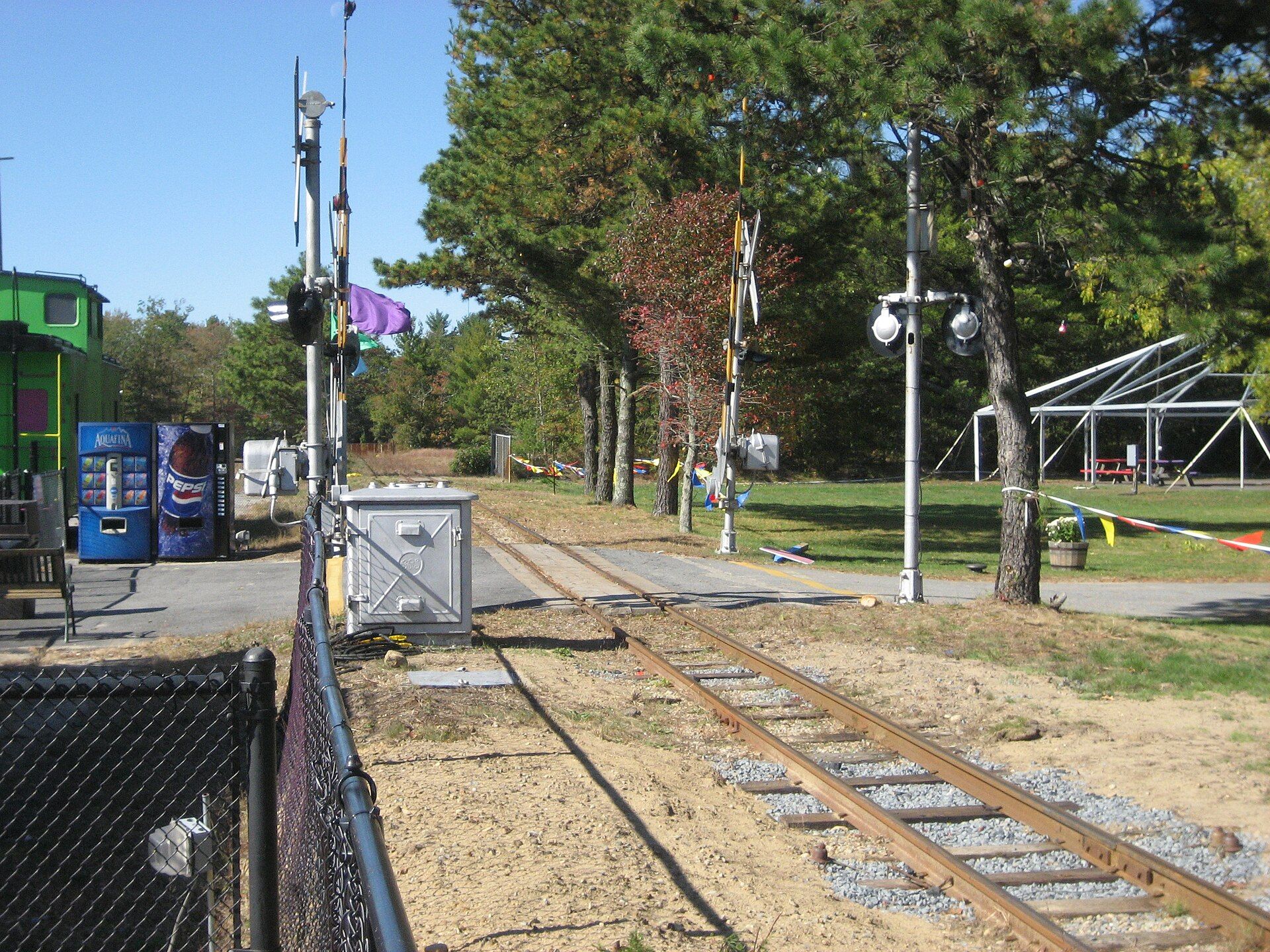
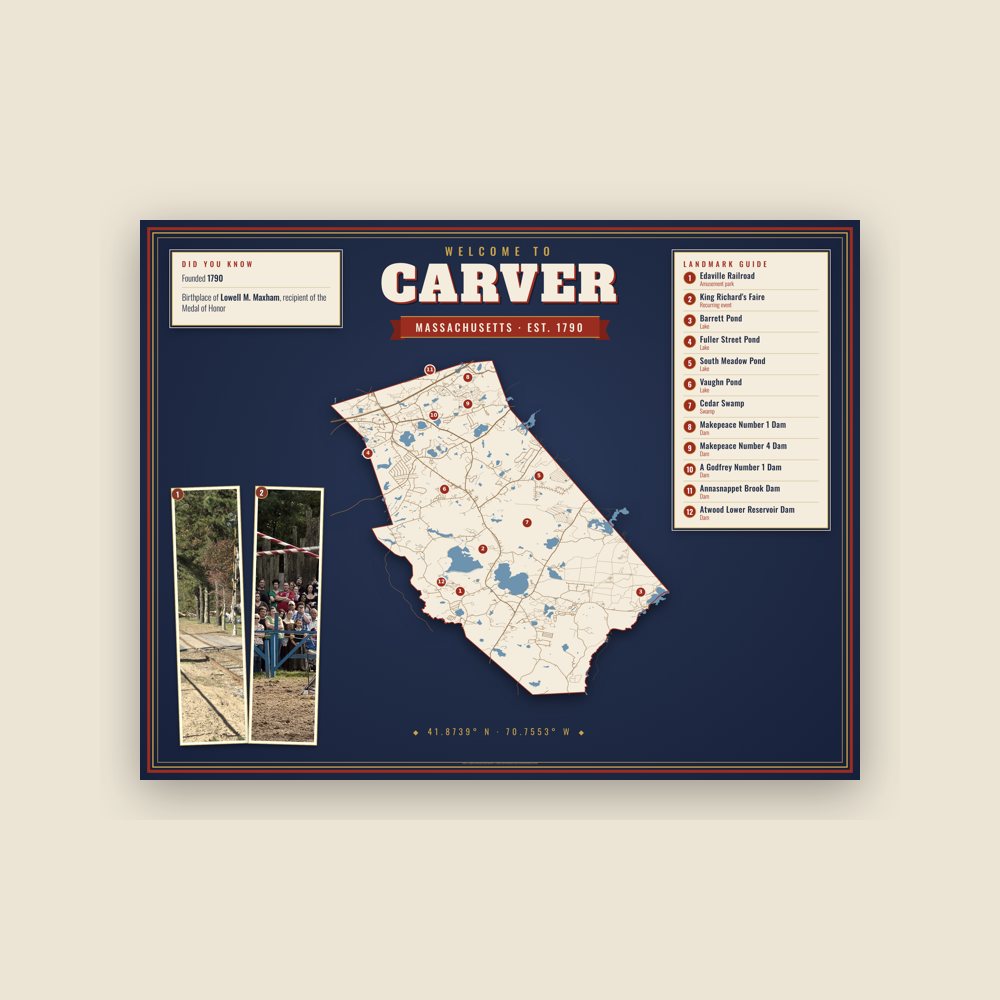
It is named for John Carver, the first governor of the Plymouth Colony. Landmarks include Edaville Railroad and King Richard's Faire. Carver is the birthplace of Mike Bennett, professional wrestler.
Every piece is drawn from Carver's own map data and historic archives, then printed and shipped from the USA when you order. No two towns look alike.
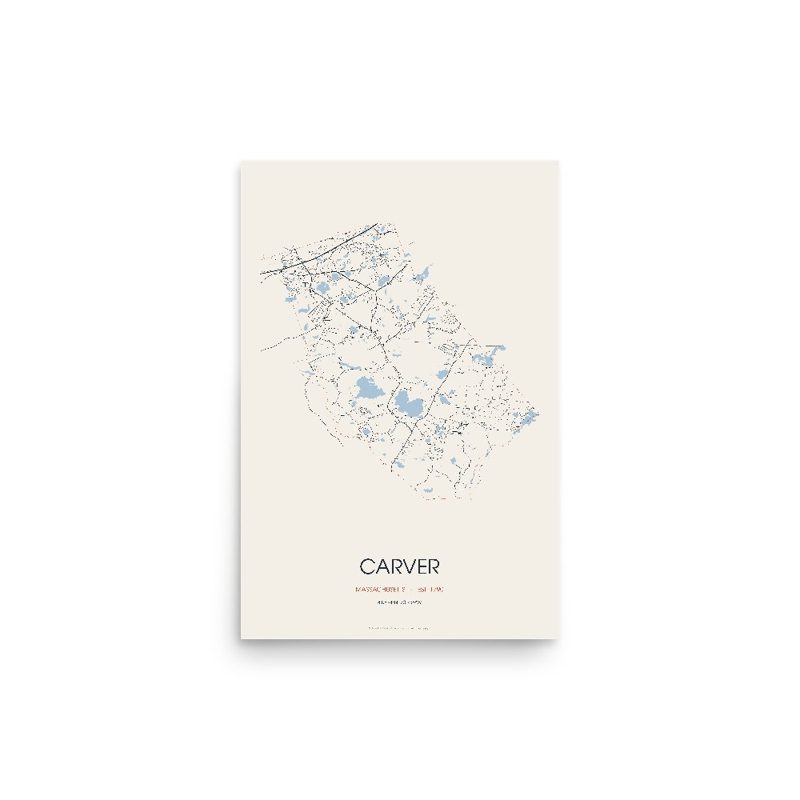
Every road in town, on archival matte paper
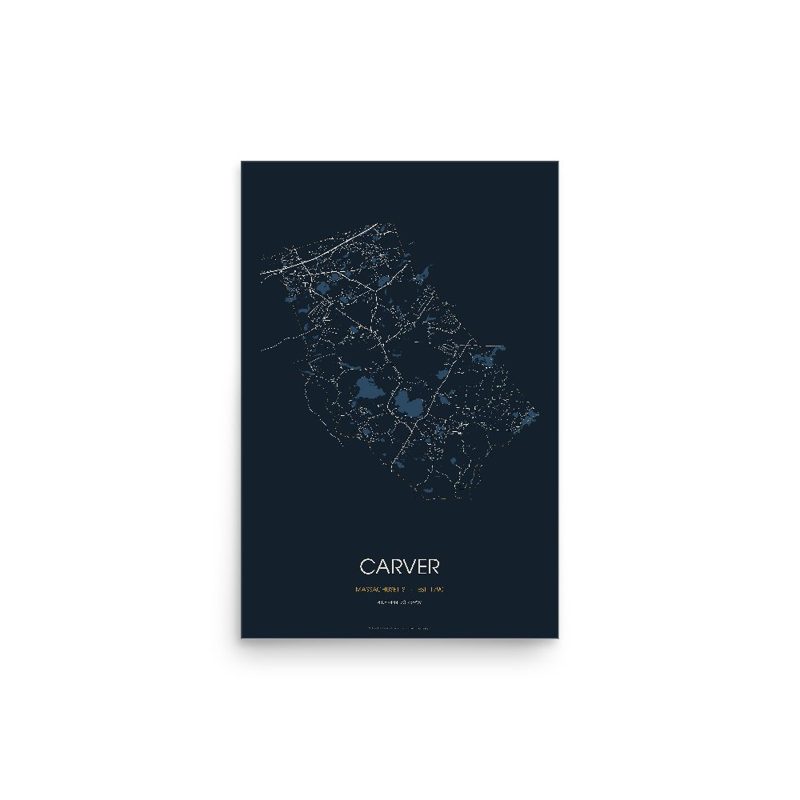
The same map, in navy and silver
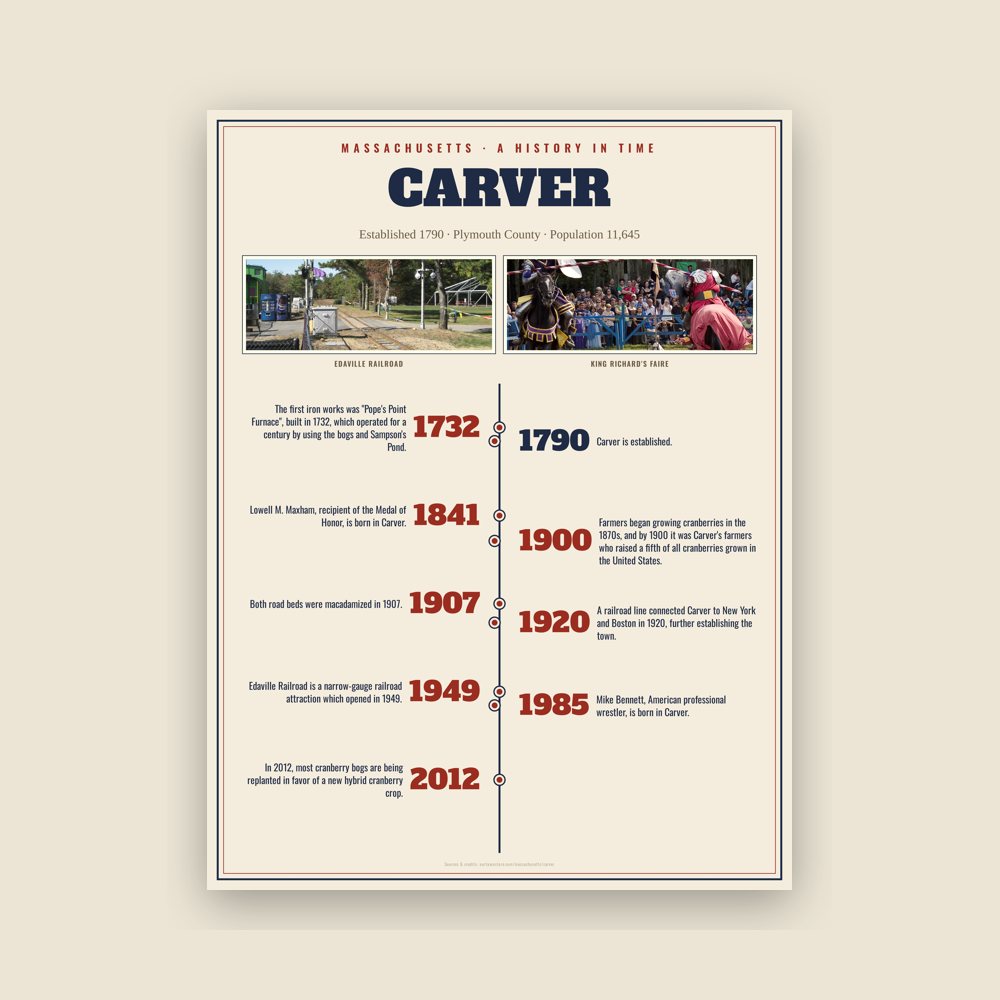
The town's story in dates, from its own records, for home or classroom
Map of local landmarks, washable fabric
Heavy-blend fleece, street map printed on the back
Soft Bella+Canvas jersey
Glossy ceramic, dishwasher safe
Ceramic keepsake, gold ribbon
Weatherproof, for the front walk
24″×16″, printed coir-look fibers, rubber back
12″×12″ printed wood, ready to hang
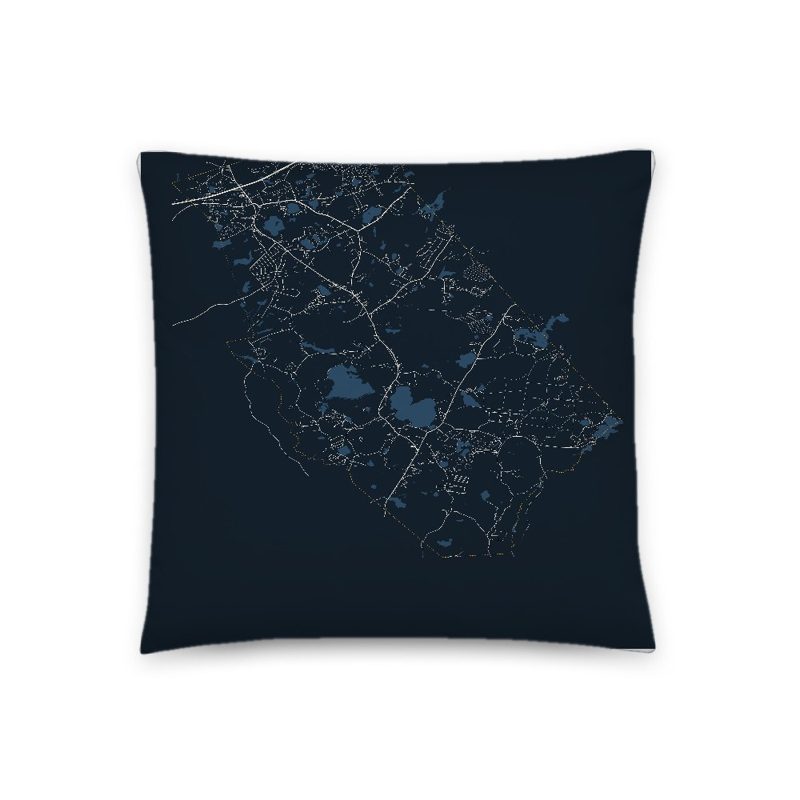
Soft-touch, zip cover
Sturdy all-over-print tote
Glossy top, cork back
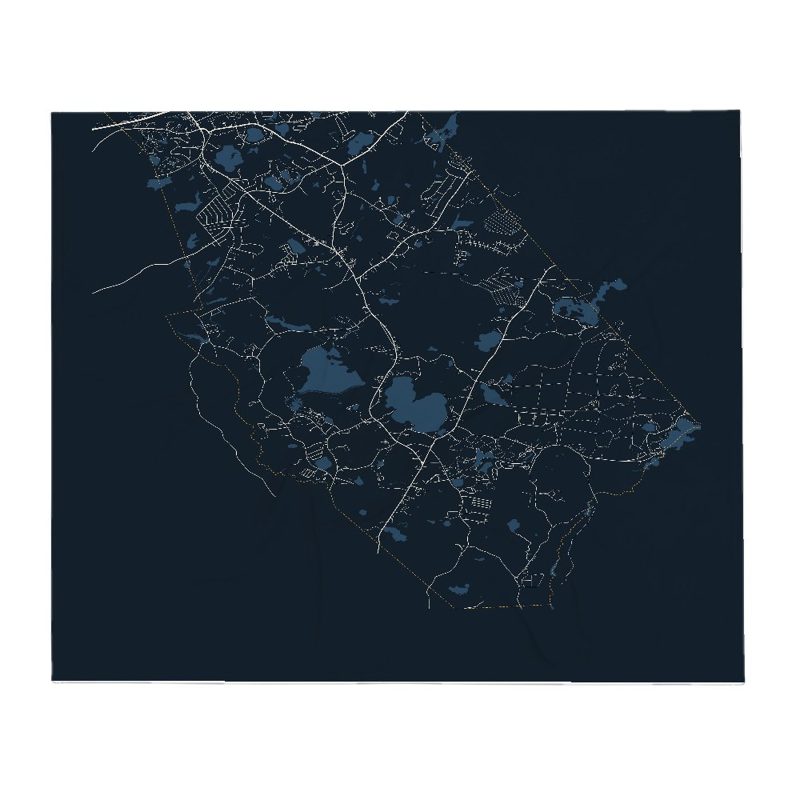
Soft fleece, 50″×60″
20 oz, double-wall stainless
Archival matte print of a local landmark, credited to its photographer
Archival matte print of a local landmark, credited to its photographer
6″×4″ postcard, glossy front
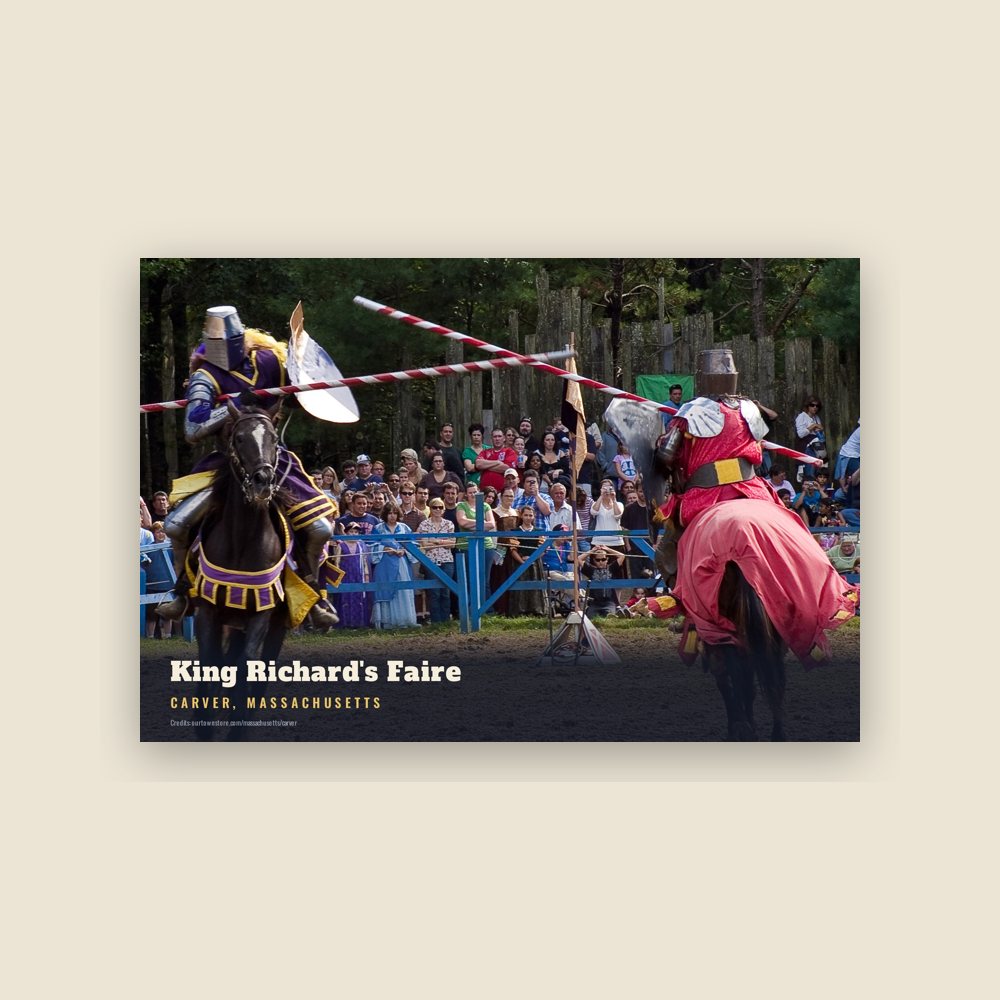
6″×4″ postcard, glossy front
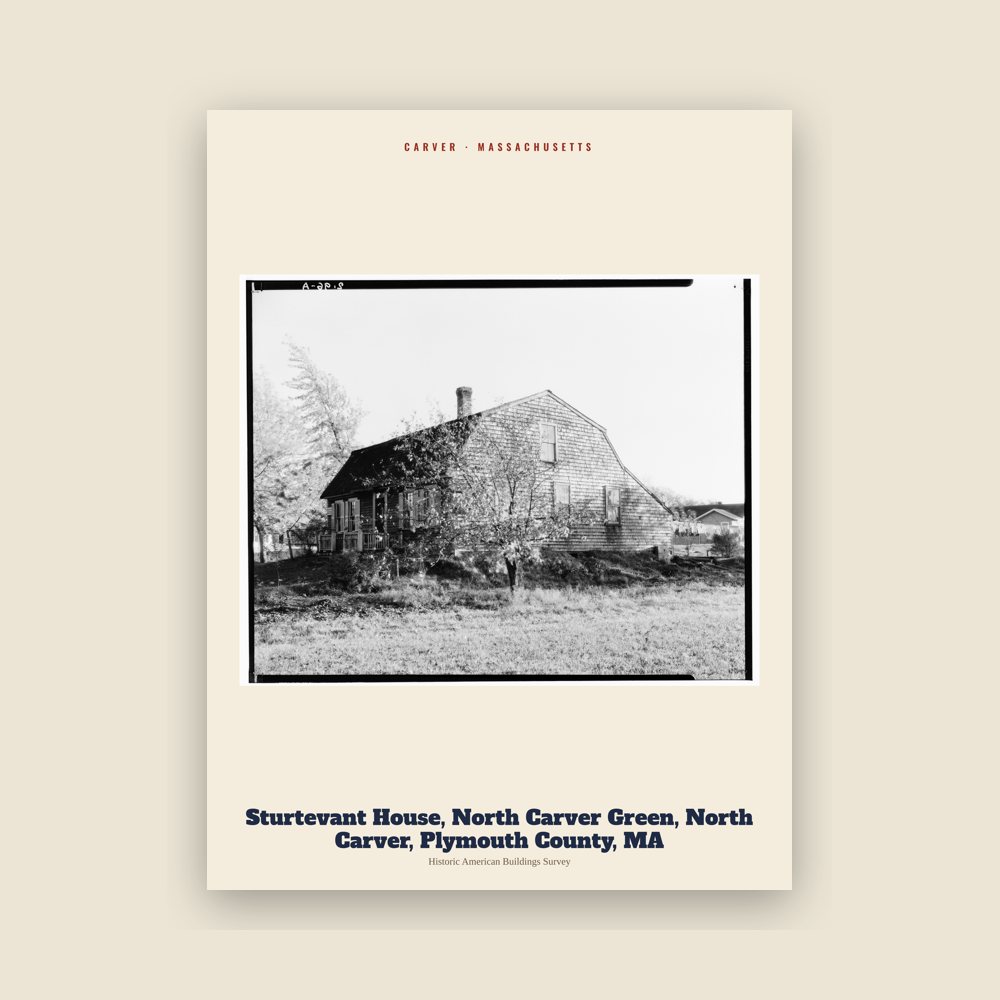
From the Library of Congress collections: a historic survey drawing or photograph of the town
Archaeological research revealed 9,000 years of human habitation at the Annasnappet Pond Site in Carver, from 10,000 to 1,000 years ago. The site contained 100,000 stone flakes, 1,600 stone tools and a human burial.
Carver separated from Plympton, Massachusetts, and was incorporated in 1790 because many residents lived too far away to attend church in Plympton. The town was named for John Carver, the first Governor of the Plymouth Colony. Initially agricultural, Carver was known for the iron ore from its swamp lands used to make cooking tools by the 1730s. The first iron works was "Pope's Point Furnace", built in 1732, which operated for a century by using the bogs and Sampson's Pond. Over the next 150 years, sheep shearing and lumber mills were important in Carver.
Most people at the time lived in the villages of South and North Carver and Wenham, later called East Carver. European settlers had also given the names "Colchester" and "Lakenham" to what is now North Carver, and settled in what was known as South Meadow. Each village supported at least one schoolhouse. As the market for iron ore declined in the latter part of the 19th century, Carver began cranberry farming as a new use for the town's swamp lands. Farmers began growing cranberries in the 1870s, and by 1900 it was Carver's farmers who raised a fifth of all cranberries grown in the United States. A railroad line connected Carver to New York and Boston in 1920, further establishing the town.
Money from the iron helped the community to grow, as evidenced by several mansions still in existence in the town. Also located in Carver is Savery's Avenue, the first divided highway in America, which was opened to the public in 1860 by William Savery. The trees between the roads and on the outside of them were to be left for "shade and ornament for man and beast". Both road beds were macadamized in 1907. A portion of the expense was advanced by the daughters of the builder, Mrs. Mary P.S. Jowitt and Ms. H.D. Savery. By the 1940s the cranberry harvest was the largest in the world, and today it is still a major business in town. Because of the land taken for the bogs, however, growth is limited, giving the town a rural flavor it takes pride in. In 2012, most cranberry bogs are being replanted in favor of a new hybrid cranberry crop.
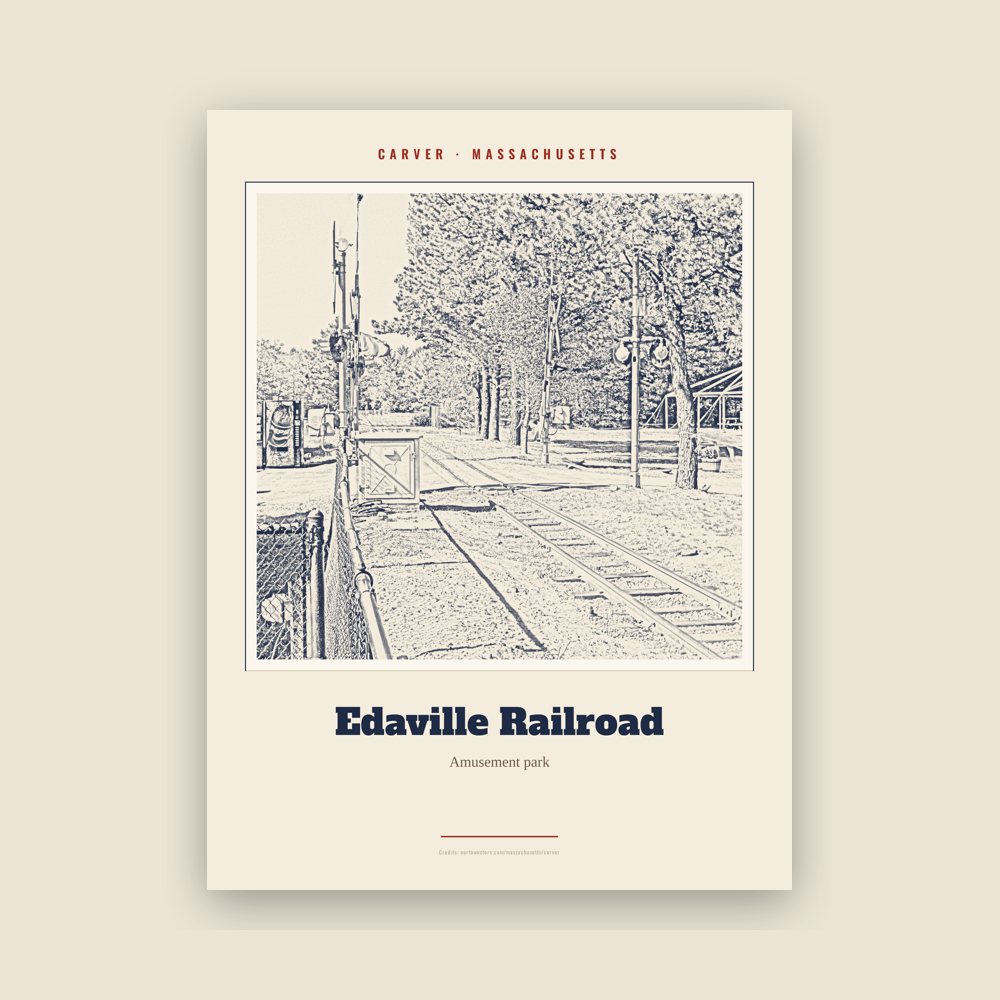
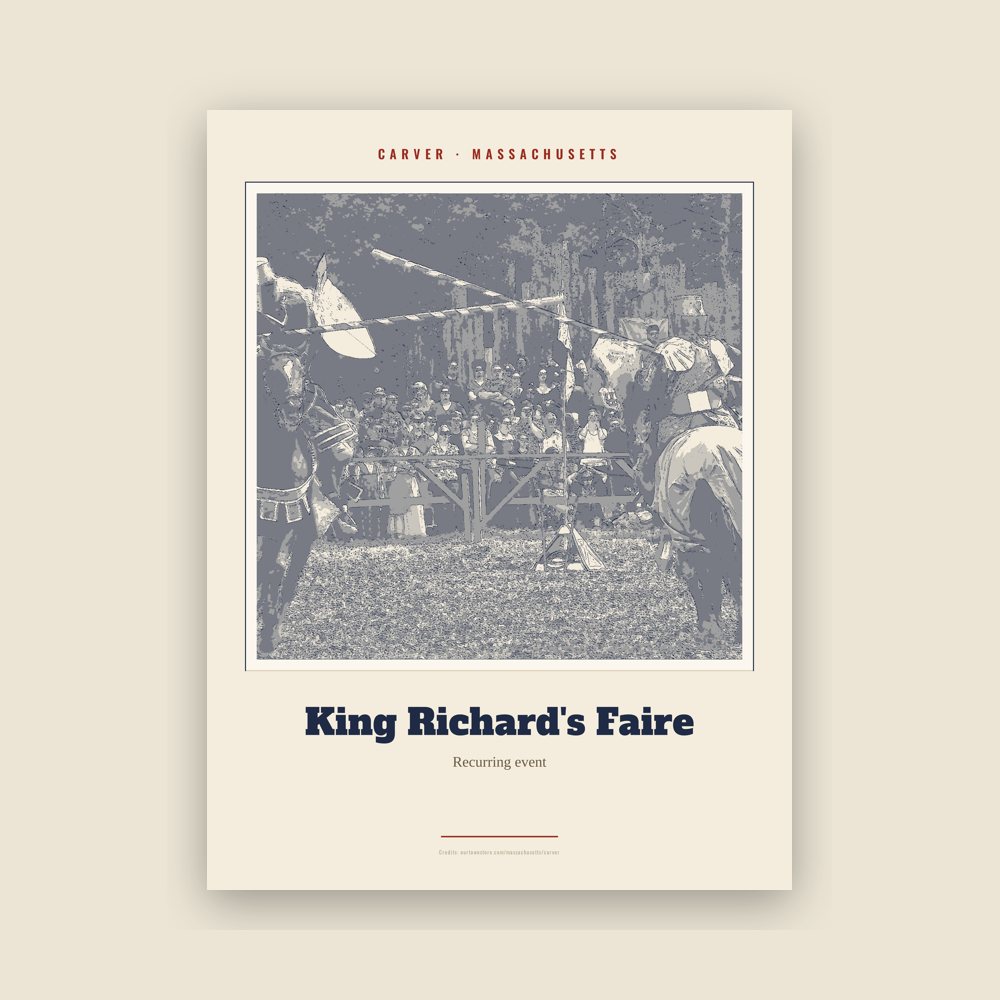
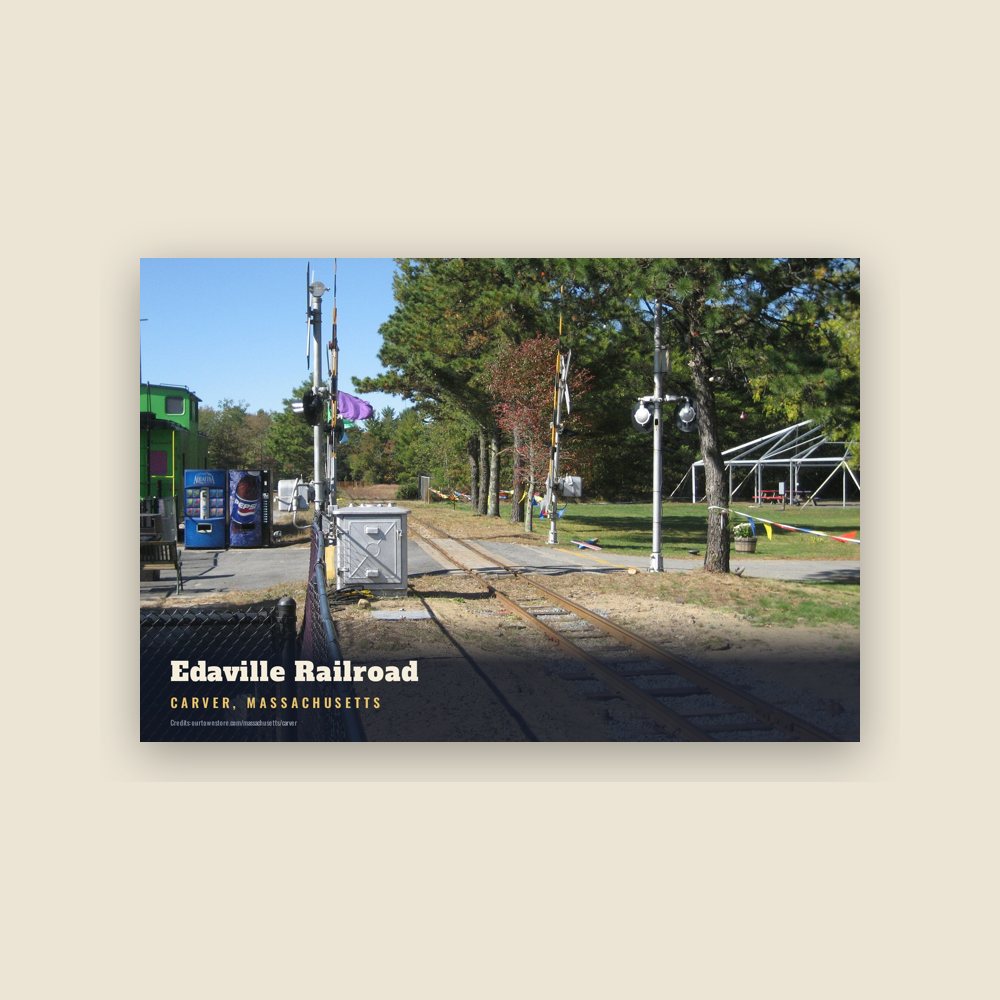
Carver also has two notable tourist attractions. Edaville Railroad is a narrow-gauge railroad attraction which opened in 1949. It has long been a family tourist attraction in Southeastern Massachusetts, especially for its festival of lights around Christmastime. It has experienced a revival in recent years, after being sold in 1991 and nearly closing. The town is also the site of King Richard's Faire, a re-creation of a 16th-century English fair which is open on weekends throughout September and October. It is New England's largest Renaissance fair.
Adapted (trimmed) from the Wikipedia article Carver, Massachusetts, revision 1377141036 by its contributors, licensed CC BY-SA 4.0.
We share a part of every Carver sale with local partners, and we'd love to print from your collection. Old photographs, maps and postcards make the best keepsakes.
Partner with us