A short history of La Cygne
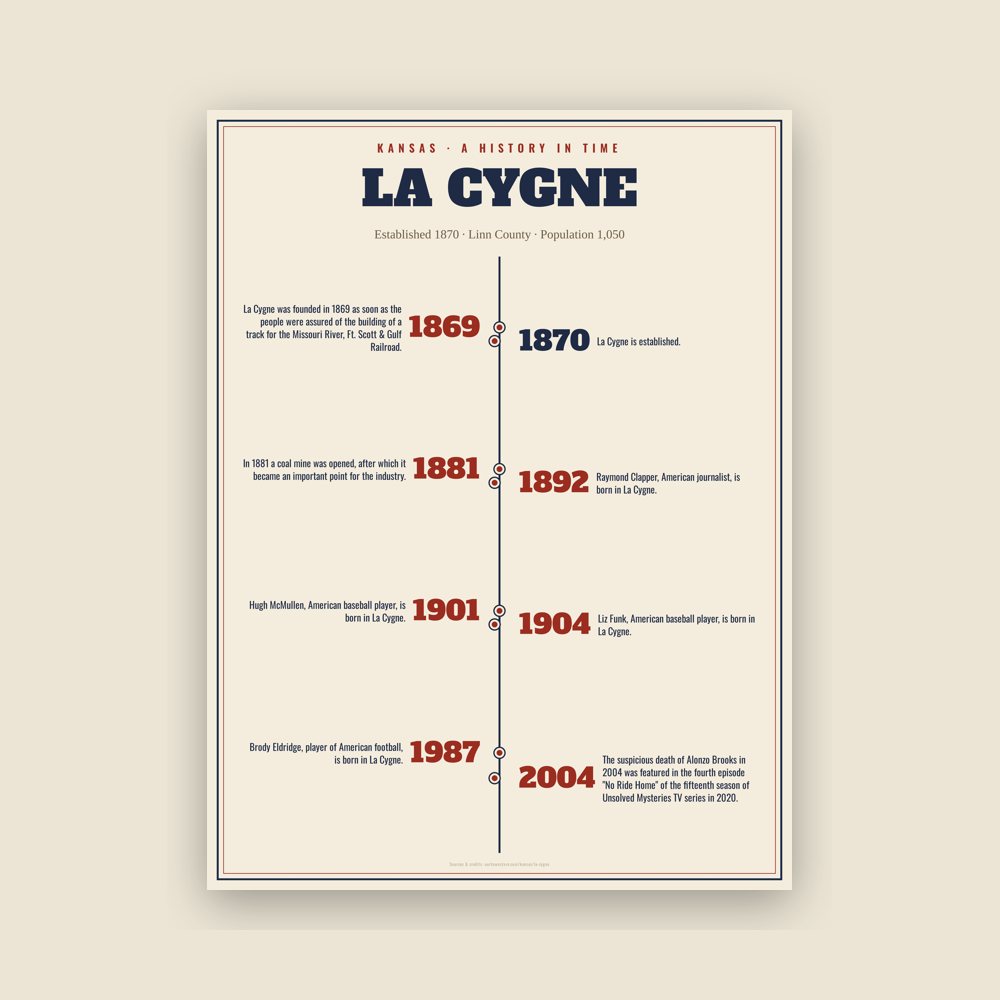
La Cygne was founded in 1869 as soon as the people were assured of the building of a track for the Missouri River, Ft. Scott & Gulf Railroad. A town company was organized and purchased 1,400 acres (5.7 km2) of land, but had only 140 acres (0.57 km2) laid out as a town site. La Cygne was incorporated on January 14, 1870, and a board of trustees was appointed. In the fall of that year the town had grown so that it had inhabitants enough to organize as a city of the third class, and F. A. Foote was elected the first mayor. The first school was taught in 1869 in Cady's hall. It was a private subscription school and was kept open until 1870, when the public school house was built. It was a commodious two-story brick building containing the graded and high schools. The Methodist church organized in 1870 and soon after built a house of worship. The Presbyterian church was organized the same year but had no building for a year afterward.
At an early date La Cygne became a manufacturing point. A flour mill was built in 1870; a bank was started in 1871; the La Cygne organ factory was another early commercial enterprise, but it did not flourish. In 1881 a coal mine was opened, after which it became an important point for the industry. The first newspaper in the town was the Weekly Journal, which first appeared in June 1870.
The suspicious death of Alonzo Brooks in 2004 was featured in the fourth episode "No Ride Home" of the fifteenth season of Unsolved Mysteries TV series in 2020.
Adapted (trimmed) from the Wikipedia article La Cygne, Kansas, revision 1376589300 by its contributors, licensed CC BY-SA 4.0.