A short history of Conway
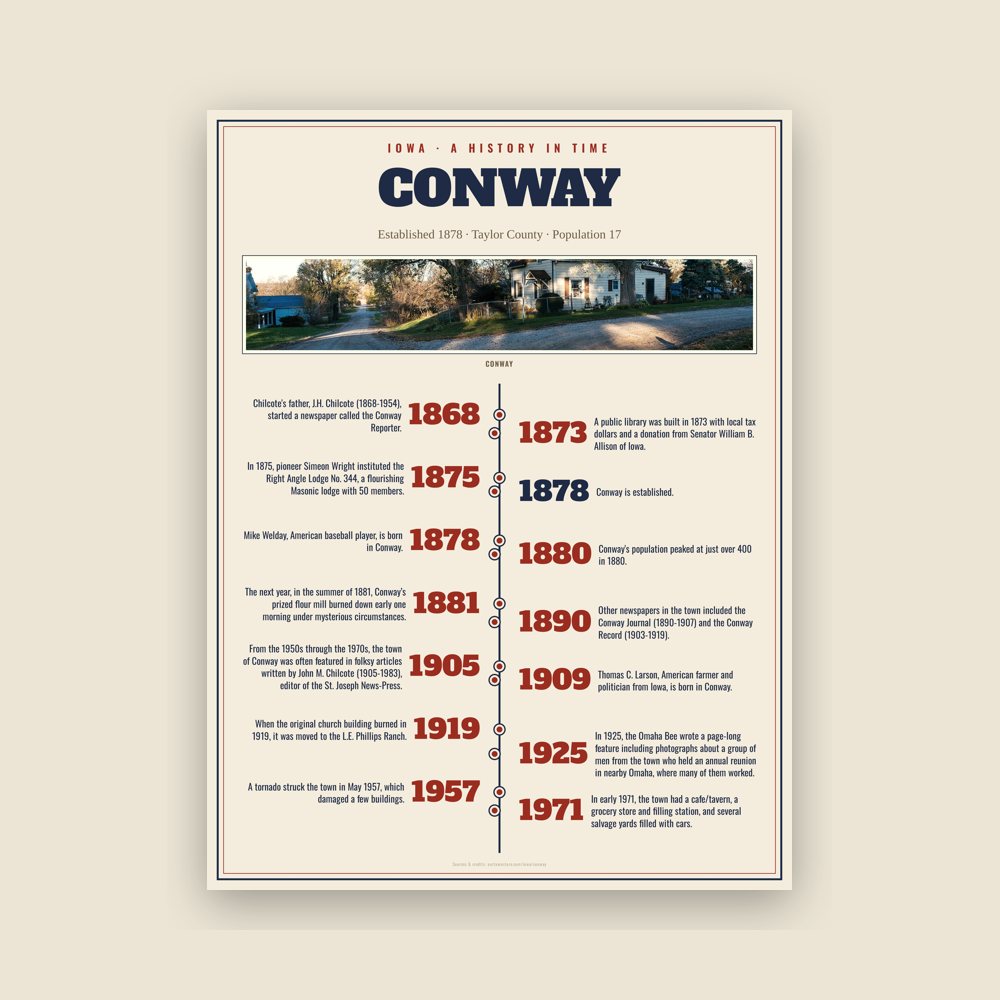
Conway was a planned town laid out with the name "Harmony" in 1872 by Josiah Litteer, a company agent for the Burlington and Missouri River Railroad, which was acquired later that year by the Chicago, Burlington and Quincy Railroad. Intended to be a hub for Taylor County, it became an important rail center. Within a year, there were almost 300 residents, and the town had lumberyards, a general store, druggists, and tradesmen. and O.B. Hyde built the first residence. That same year, Reverend Jeremiah Hughes preached the first sermon in the town. In 1875, pioneer Simeon Wright instituted the Right Angle Lodge No. 344, a flourishing Masonic lodge with 50 members. Early, there was a section of Conway called "Stumptown" for its squat, little houses.
A public library was built in 1873 with local tax dollars and a donation from Senator William B. Allison of Iowa. The Conway school opened in 1875 in a two-story building. The town was incorporated with the name Conway in 1878, and O. J. Eoff served as its first mayor. A new school was built in 1916. Around that time, the town had "its own privately-owned electric plant, its own telephone exchange and its own lumber and coal yards." Eventually, the electricity service was absorbed into a large utility company, the telephone service merged, and the coal business became defunct. The school consolidated, first becoming a junior high school for the Bedford School District, then closing permanently.
Conway's population peaked at just over 400 in 1880. That year, the Conway Christian Church congregation erected a new two-thousand-dollar house of worship. The next year, in the summer of 1881, Conway’s prized flour mill burned down early one morning under mysterious circumstances. The town was also home to a Presbyterian church, and the Conway Methodist Church from the 1880s through the 1980s. A bell from this church in now a monument in Oklahoma. When the original church building burned in 1919, it was moved to the L.E. Phillips Ranch. Today, it is an official Oklahoma Historical Marker on the grounds of the Woolaroc Museum and Preserve in Osage County meant to honor the roots of the Phillips family in Conway.
Frank Phillips, founder of the Phillips 66 gasoline empire lived in Conway, and his brother, noted businessman and philanthropist Waite Phillips was born in 1883 in Conway.
In September 1892, a "fire destroyed nineteen buildings causing a total loss of $50,000." The next year, in 1893, another fire was reported that burned two dry goods stores, two grocery stores, a drug store, business offices, the post office, and two livery stables, "in all sixteen buildings," costing about $40,000. In 1919, a large fire demolished the original Methodist church. It was rebuilt soon afterwards.
In 1925, the Omaha Bee wrote a page-long feature including photographs about a group of men from the town who held an annual reunion in nearby Omaha, where many of them worked. The successful businessmen had been meeting annually since the 1890s in order to stay connected. In 1941, Dale Carnegie featured the town in one of his syndicated national columns, writing about how farmers would drive to the town from miles around to attend the Fourth of July celebration.
A tornado struck the town in May 1957, which damaged a few buildings. In early 1971, the town had a cafe/tavern, a grocery store and filling station, and several salvage yards filled with cars. However, a severe tornado hit in May 1971, which damaged nearly every structure (forty out of forty-five) in the town. The village had 91 residents, with the tornado "completely demolishing eight homes and buildings, and injuring twelve persons, none seriously." However, after that event, the first-ever dedicated water system was built for the town and there were prospects for a resurgence. The town was home to a popular bar then called the Last Chance Dry Gulch Saloon. From the 1950s through the 1970s, the town of Conway was often featured in folksy articles written by John M. Chilcote (1905-1983), editor of the St. Joseph News-Press. Chilcote's father, J.H. Chilcote (1868-1954), started a newspaper called the Conway Reporter. Other newspapers in the town included the Conway Journal (1890-1907) and the Conway Record (1903-1919).
Located south of the city is the Bowers Cemetery, an 1870s burial site with more than 80 graves. It is located in the Clayton Township.
Adapted (trimmed) from the Wikipedia article Conway, Iowa, revision 1384710725 by its contributors, licensed CC BY-SA 4.0.