Read the full history
The Native Americans and New France
Original settlement and French control (1706-1760)
This area here on the river confluence was occupied by successive cultures of indigenous peoples for as long as 10,000 years. The Miami tribe would eventually establish its settlement of Kekionga at this confluence of the Maumee, St. Joseph, and St. Marys rivers in the late stages of the Beaver Wars in the 1690s. It was the capital of the Miami nation and related Algonquian tribes.
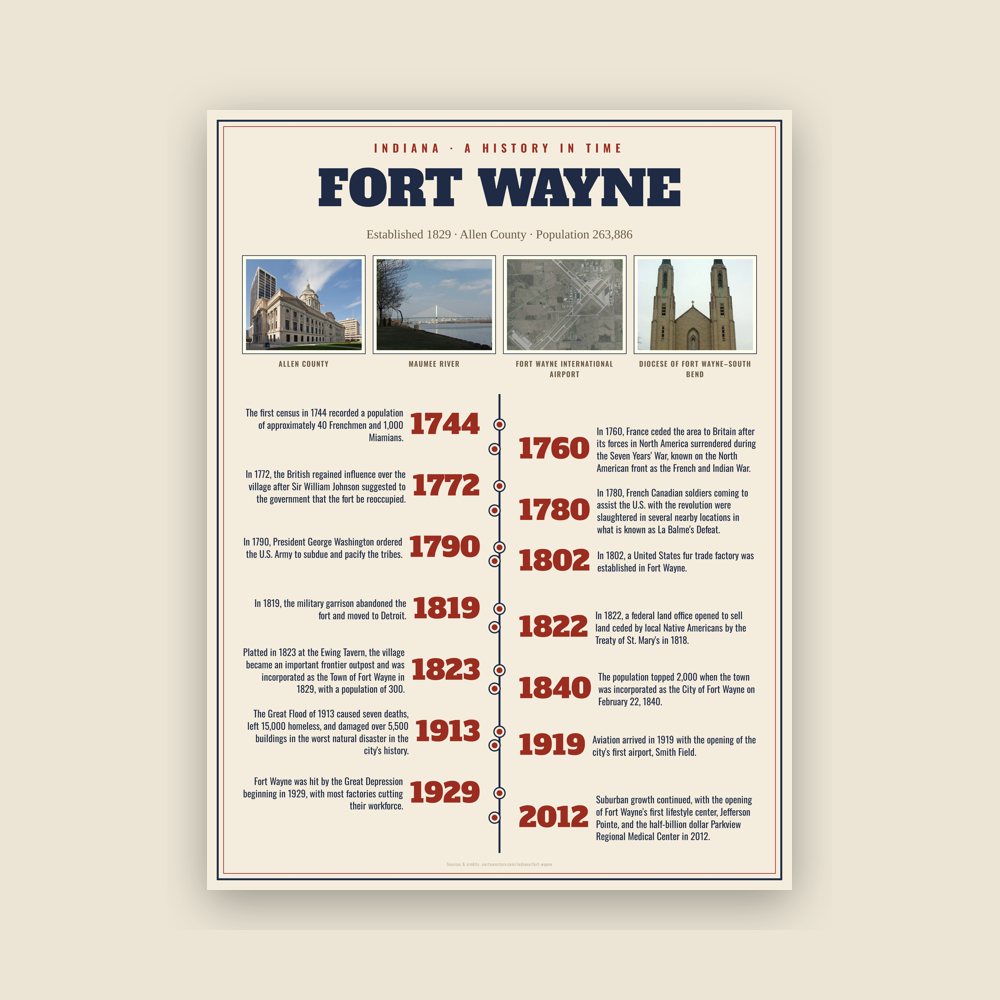
In 1696, Comte de Frontenac appointed Jean Baptiste Bissot, Sieur de Vincennes, who began visiting Kekionga in 1702, and would later build the original Fort Miami here in the wilderness and pays d'en Haut of New France around 1706; Initially, a small trading outpost. It was part of a group of forts and trading posts built between Quebec and St. Louis. The first census in 1744 recorded a population of approximately 40 Frenchmen and 1,000 Miamians.
From the British back to the Miami (1760-1776)
Increasing tension between France and Great Britain developed over control of the territory. In 1760, France ceded the area to Britain after its forces in North America surrendered during the Seven Years' War, known on the North American front as the French and Indian War. Managing to hold down the fort for only a mere couple of years, the British lost control of it in 1763 when various Native American nations rebelled against British rule and retook the fort as part of Pontiac's Rebellion. From this point forward in 1763, no active fort existed at Kekionga for the next three decades until American General Anthony Wayne established Fort Wayne in 1794, following the Battle of Fallen Timbers. The fort throughout this period was described as a, "Defiant mixture of Indian warriors and lawless renegades of the frontier, such as the Girties. It was also the home of a heterogeneous population of English and French traders and their families, French 'engages", and Miami, Delaware and Shawnee tribes."
In 1772, the British regained influence over the village after Sir William Johnson suggested to the government that the fort be reoccupied. The mixed population of the Kekionga area had moved past antipathy with the British by this point, and accepted their friendship. In 1776, Officer Jacques LaSalle moved into the village to conduct strict supervision on behalf of the British government, ensuring that the natives remained loyal to the British, and to check passports with travelers coming down from Fort Detroit.
American Revolution to the Old Northwest
The British continued to monitor Kekionga and Fort Miami throughout the American Revolutionary War. In 1780, French Canadian soldiers coming to assist the U.S. with the revolution were slaughtered in several nearby locations in what is known as La Balme's Defeat. At the end of the Revolutionary War, in the Treaty of Paris in 1783, Britain ceded this area to the new United States, though they continued to maintain an influence on trading activity and the forts of Miami, with the primary objective of slowing American expansion into the Great Lakes region. The young United States formally organized the region in the Land Ordinance of 1785 and negotiated treaties allowing settlement, but the Western Confederacy of Native American nations were not party to these treaties and did not cede their ownership of those lands.
American land speculators and pioneers began flooding down the Ohio River into the area, leading to conflict with an alliance of native tribes known as the Western Confederacy. It was headquartered at Kekionga, where the Miami had permitted two refugee tribes dislodged by white homesteaders, the Delaware and the Shawnee, to resettle. The confederacy—which included other Great Lakes tribes as well—began sending war parties to raid settlers, hoping to drive them back across the Appalachian Mountains, and refused to meet for negotiations over a possible treaty to instead cede land for white settlement. The growing violence led to the Northwest Indian War.
In 1790, President George Washington ordered the U.S. Army to subdue and pacify the tribes. The first expedition, led by General Josiah Harmar reached Kekionga and exercised scorched earth tactics on the village and crops. Miami war chief Little Turtle, who had been long tracking the whereabouts of Harmar though the aid of various agents such as Simon Girty, would quickly drive Harmar and the US troops away. The confederacy warriors attacked the second invading force, led in 1791 by General Arthur St. Clair, before it could get that far and wiped it out, in a massacre known as St. Clair's Defeat at modern-day Fort Recovery, Ohio. It's known as the greatest defeat of the U.S. Army by Native Americans in history. This defeat left the US army crippled and borders open to attacks from the British and allied native tribes. General Anthony Wayne was recalled from civilian life to lead a third expedition, defeating the confederacy's warriors at the Battle of Fallen Timbers, near modern-day Toledo, Ohio on August 20, 1794. Wayne's men then marched up the Maumee River, systematically burning evacuated native towns, crops, and winter food stores, until they reached its headwaters, where Kekionga remained in ruins. Wayne then confronted the British at Fort Miami, where the British debated an attack. Later, Wayne selected the site for construction of Fort Wayne. He ordered a fort that could withstand heavy British artillery, especially a 24-pound cannon, along with attacks from their army or native allies.
The following year, Wayne negotiated a peace accord, the Treaty of Greenville with tribal leaders, in which they agreed to stop fighting, end support of the British, and ceded most of what is now Ohio along with certain tracts further west, including the area around Fort Wayne encompassing Kekionga and the land portage. Wayne promised the remainder would remain Indian lands, which is why the territory west of Ohio was named Indiana. Wayne would die one year later and a Spanish spy James Wilkinson would assume his role as General. In subsequent years, the government used Fort Wayne to hand out annual payments under the treaty. But in a recurring cycle, the tribes ran up debts to white traders who came there to sell them alcohol and manufactured goods, and the government pushed tribal leaders—including through bribes—to sell more reservation land to pay off those debts and, when the land was gone, then to agree to have the tribe removed to the Far West.
In 1802, a United States fur trade factory was established in Fort Wayne. It was burned by the local Native Americans at the beginning of the War of 1812.
Settlement permitted by Treaty of St. Mary's
The first settlement started in 1815. In 1819, the military garrison abandoned the fort and moved to Detroit. In 1822, a federal land office opened to sell land ceded by local Native Americans by the Treaty of St. Mary's in 1818. Platted in 1823 at the Ewing Tavern, the village became an important frontier outpost and was incorporated as the Town of Fort Wayne in 1829, with a population of 300. The Wabash and Erie Canal's opening improved travel conditions to the Great Lakes and Mississippi River, exposing Fort Wayne to expanded economic opportunities. The population topped 2,000 when the town was incorporated as the City of Fort Wayne on February 22, 1840.
Pioneer newspaperman George W. Wood was elected the city's first mayor. Fort Wayne's "Summit City" nickname dates from this period, referring to the city's position at the highest elevation along the canal's route. As influential as the canal was to the city's earliest development, it quickly became obsolete after briefly competing with the city's first railroad, the Pittsburgh, Fort Wayne and Chicago Railway, completed in 1854.
Modern history
At the turn of the 20th century, the population of Fort Wayne nearly reached 50,000, attributed to a large influx of German and Irish immigrants. Fort Wayne's "urban working class" thrived in industrial and railroad-related jobs. The city's economy was substantially based on manufacturing, ushering in an era of innovation with several notable inventions and developments coming out of the city over the years, such as gasoline pumps (1885), the refrigerator (1913), and in 1972, the first home video game console. The Great Flood of 1913 caused seven deaths, left 15,000 homeless, and damaged over 5,500 buildings in the worst natural disaster in the city's history.
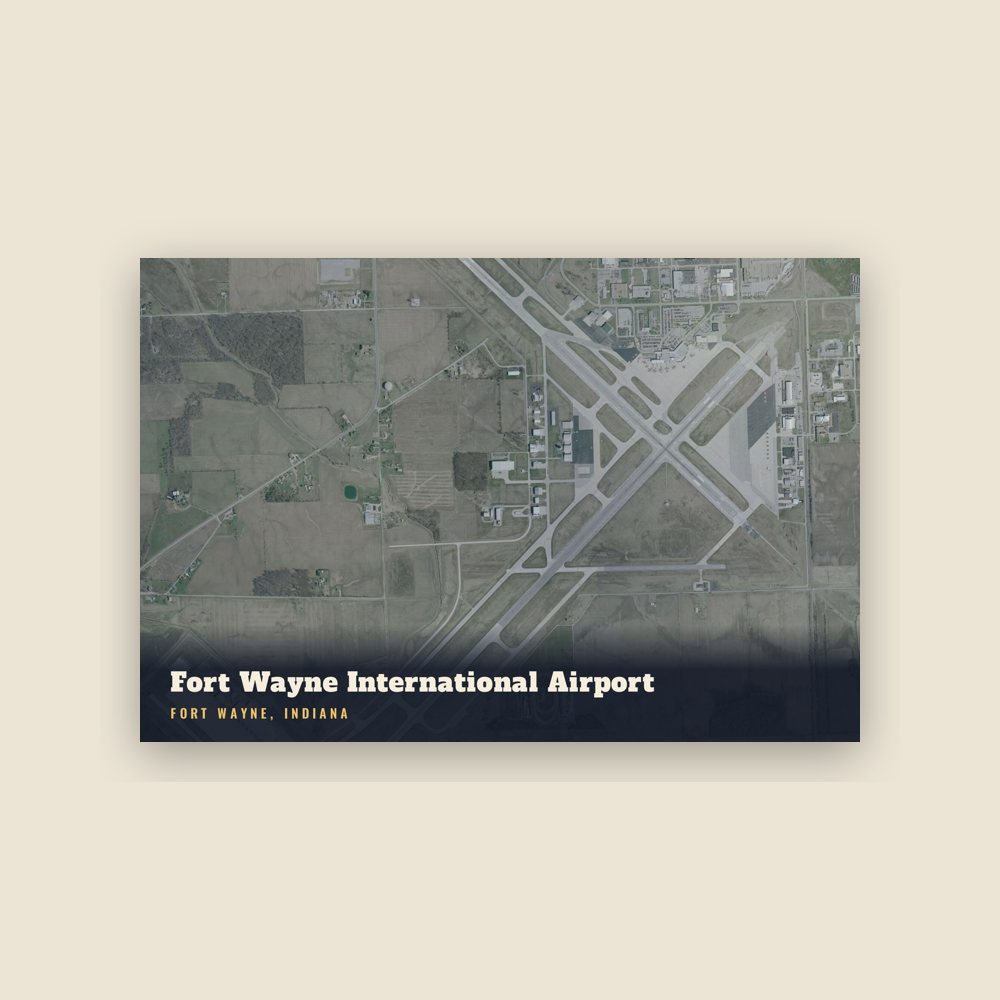
As the automobile's prevalence grew, Fort Wayne became a fixture on the Lincoln Highway. Aviation arrived in 1919 with the opening of the city's first airport, Smith Field. The airport served as Fort Wayne's primary commercial airfield until Baer Field (now Fort Wayne International Airport) was transferred to the city in 1947 after serving as a military base during World War II.
Fort Wayne was hit by the Great Depression beginning in 1929, with most factories cutting their workforce. The stock market crash did not discourage plans to build the city's first skyscraper and Indiana's tallest building at the time, the Lincoln Bank Tower. By 1935, the New Deal's WPA put over 7,000 residents back to work through local infrastructure improvements, including the construction of new parks, bridges, viaducts, and a $5.2 million sewage treatment facility.
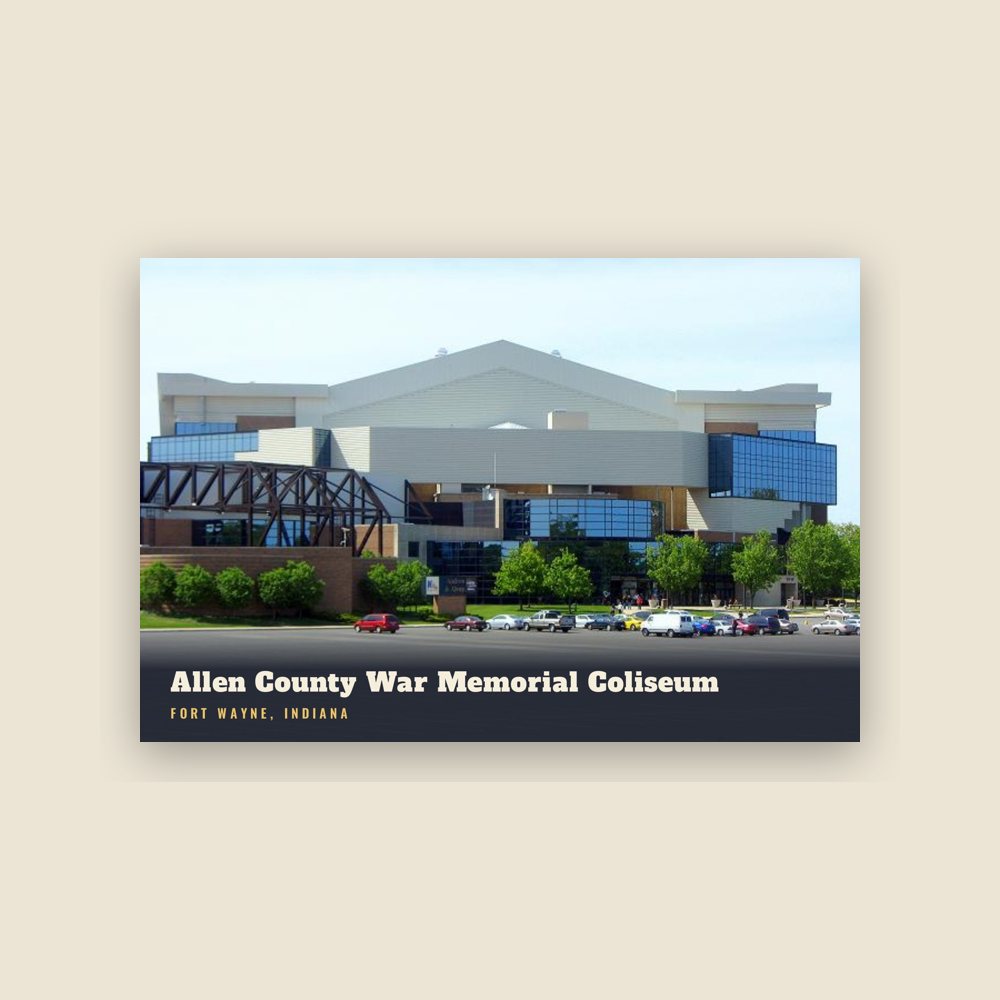
The post-World War II economic boom helped the city prosper once again. Between 1950 and 1955, more than 5,000 homes were built, many in large subdivisions in rural Allen County. In 1950, Fort Wayne's first bypass, Coliseum Boulevard, opened on the north side of the city, followed by the city's first arena, War Memorial Coliseum, bringing new opportunities for suburban expansion. The Coliseum was home to the NBA's Fort Wayne Pistons from 1952 to 1957. The opening of enclosed shopping malls and the construction of Interstate 69 through rural areas north and west of the city proper further drove the exodus of retail from downtown through the 1960s. According to the Fort Wayne Home Builders Association estimates, more than 80 percent of new home construction occurred outside the city proper in the 1970s.
Like many cities in the Rust Belt, deindustrialization in the 1980s brought urban blight, increased crime, and a decrease in blue-collar manufacturing jobs. Downtown and surrounding neighborhoods continued declining as residents and businesses sprawled further into rural Allen County. A 1982 flood forced an evacuation of 9,000 residents, damaging 2,000 buildings, and costing $56.1 million (1982 USD, $137 million 2015 USD), prompting a visit from then president of the United States, Ronald Reagan.
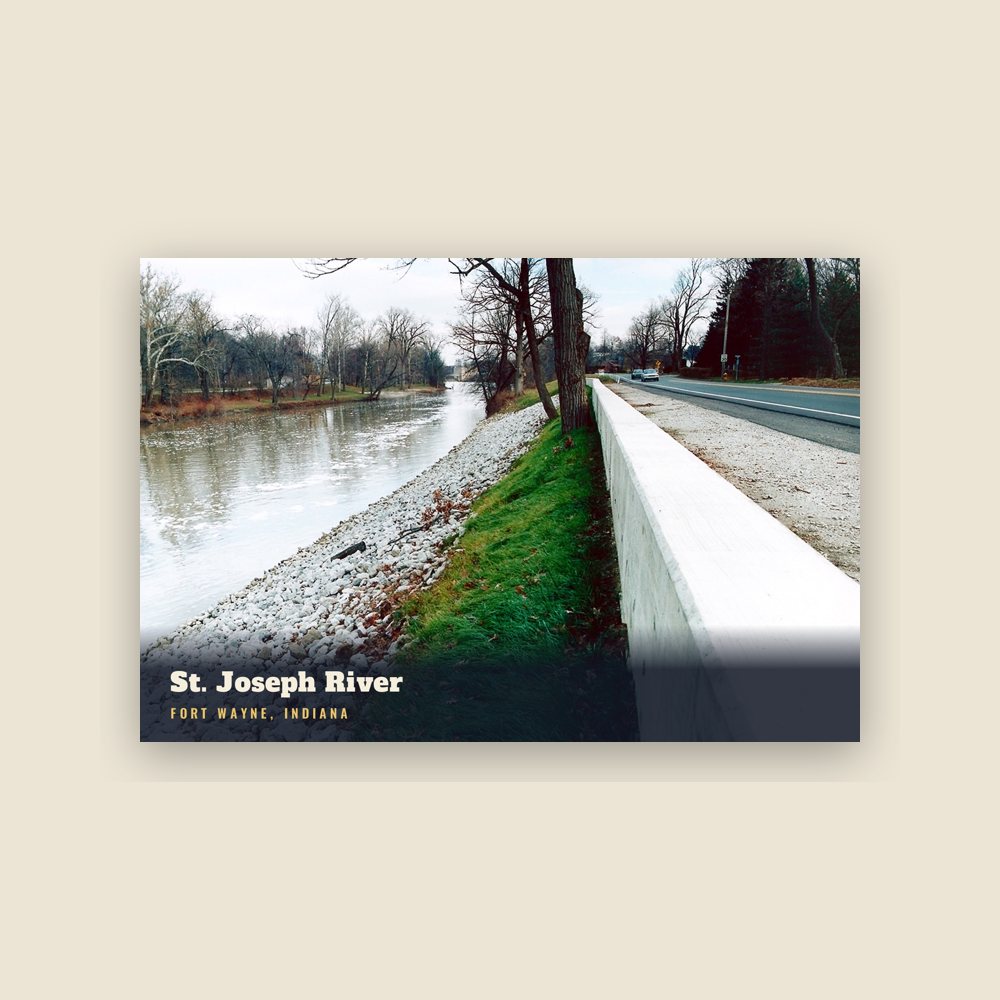
In the 1990s, the city began a turnaround. Local leaders focused on crime reduction, economic diversification, and downtown redevelopment. By 1999, Fort Wayne's crime rate decreased to the lowest levels since 1974, and the city's economy recovered, with the unemployment rate hovering at 2.4 percent in 1998. Clearing blighted buildings downtown resulted in new public greenspaces, including Headwaters Park, which has become the premier community gathering space and centerpiece in the city's $50 million flood control project. Fort Wayne celebrated its bicentennial in 1994.
The city continued to concentrate on downtown redevelopment and investment in the 2000s. The decade saw the beginnings of its transformation, with renovations and expansions of the Allen County Public Library, Grand Wayne Convention Center, and Fort Wayne Museum of Art. In 2007, the $130 million Harrison Square development was launched, creating Parkview Field. Suburban growth continued, with the opening of Fort Wayne's first lifestyle center, Jefferson Pointe, and the half-billion dollar Parkview Regional Medical Center in 2012.