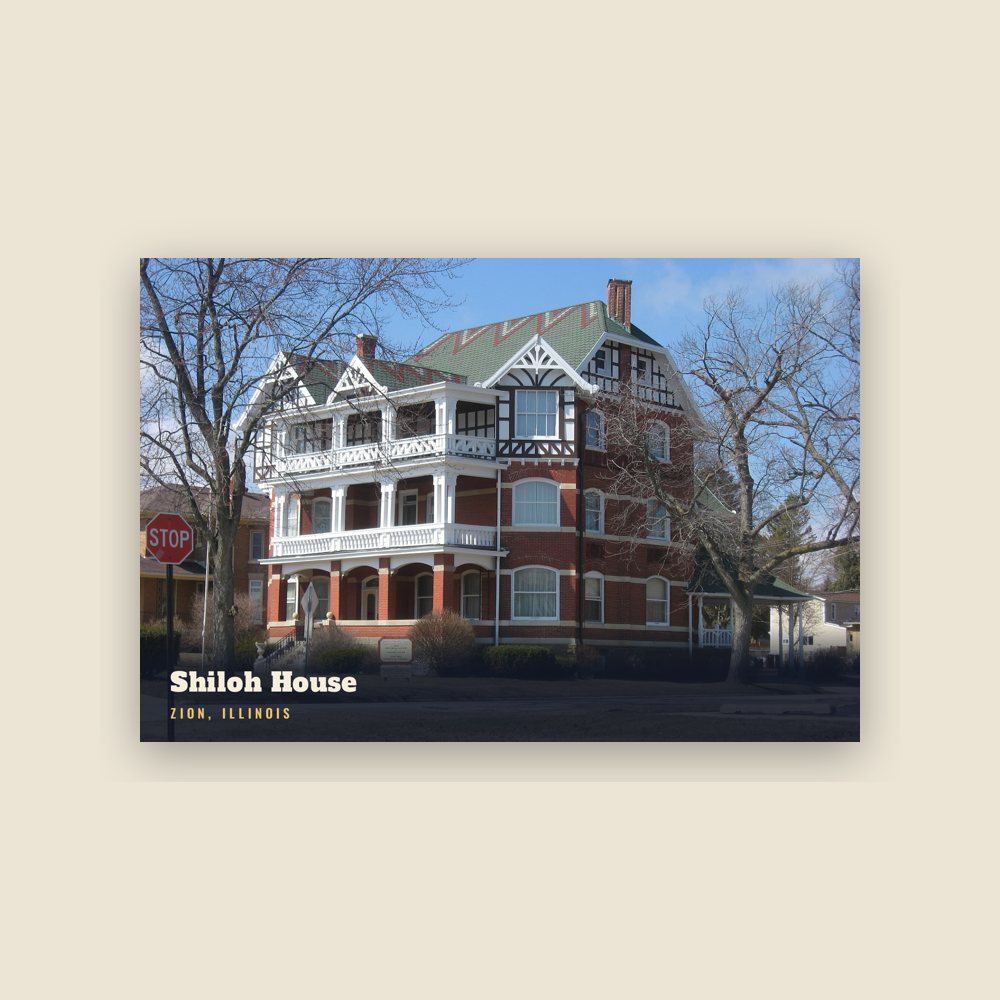
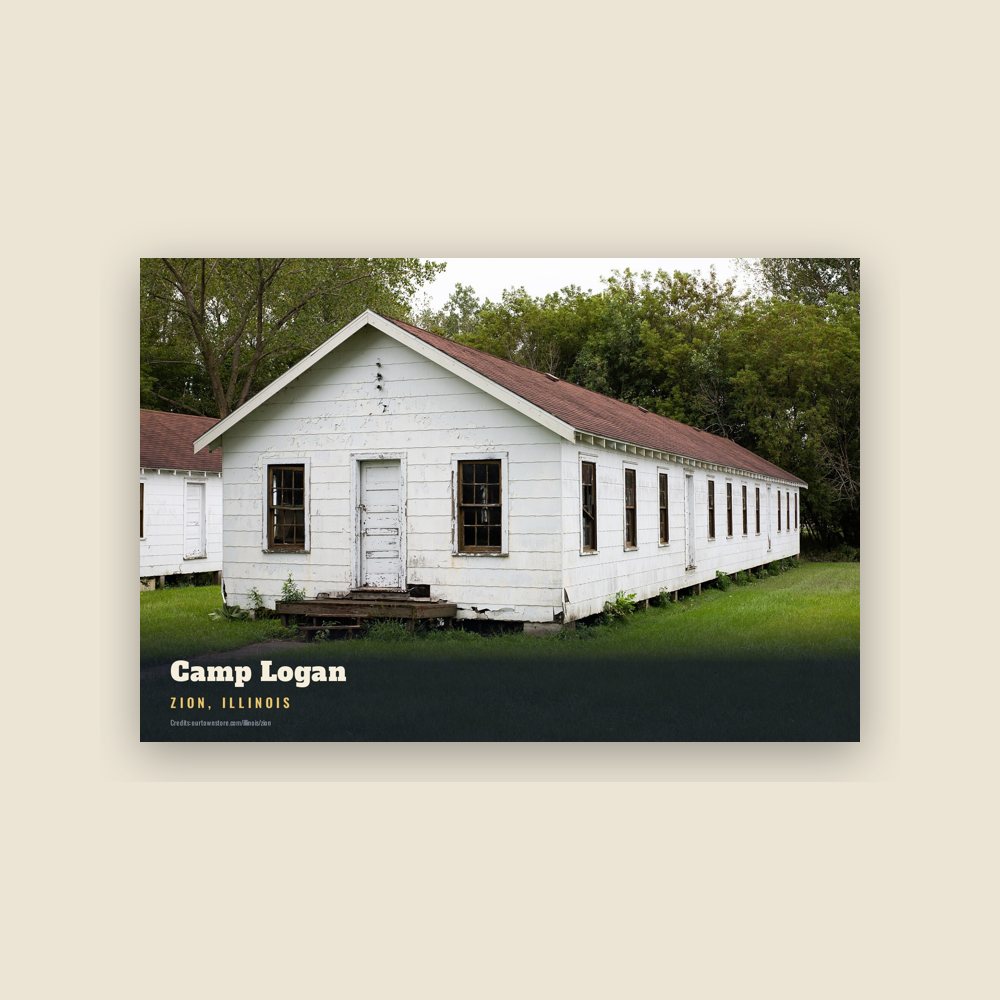
A short history of Zion
Under Dowie
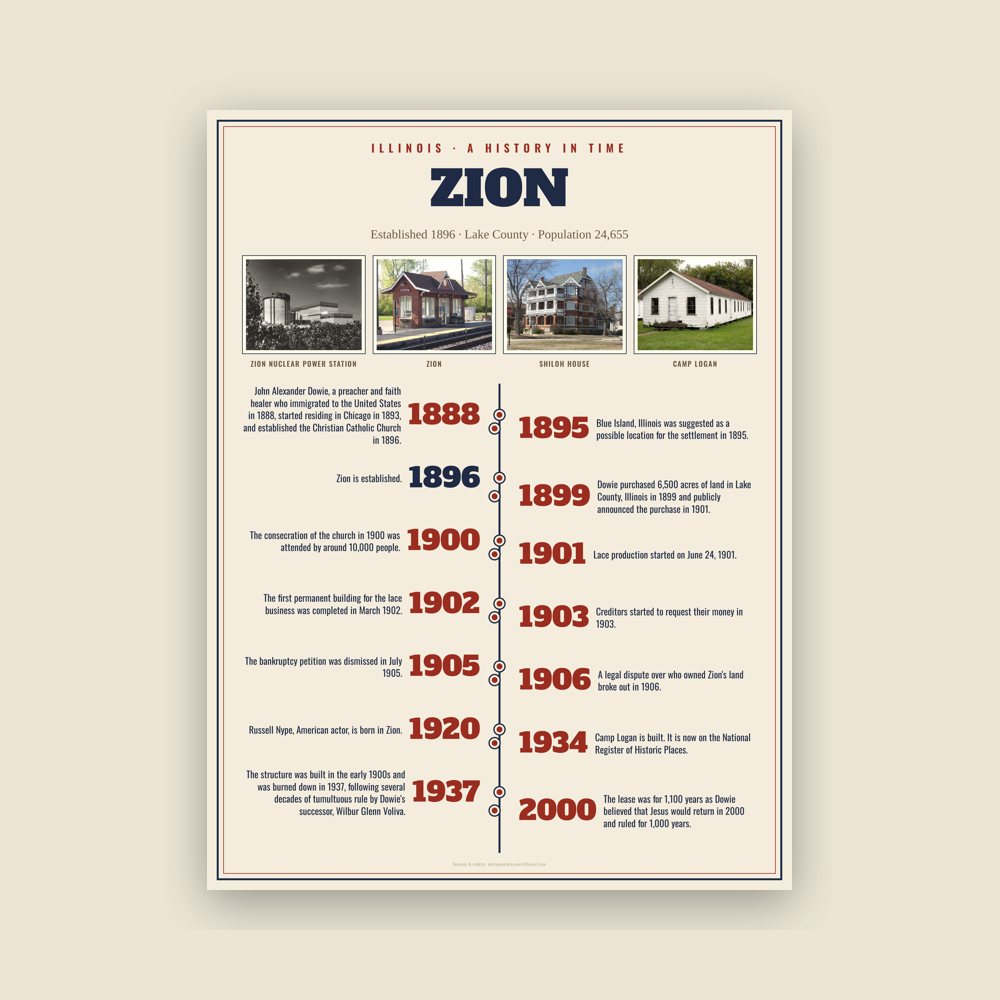
John Alexander Dowie, a preacher and faith healer who immigrated to the United States in 1888, started residing in Chicago in 1893, and established the Christian Catholic Church in 1896. He amassed thousands of followers and claimed to be a prophet. Dowie supported the idea of creating a Christian utopian community in the 1890s. On December 31, 1899, he announced the creation of a settlement for his followers.
Blue Island, Illinois was suggested as a possible location for the settlement in 1895. H. Worthington Judd and Daniel Sloan, deacons in Dowie's church, were sent out to find a site for the settlement. They traveled across Waukegan, Illinois by horse and buggy in December 1898. and believed they found the correct place after receiving an apparent omen in which sun shown after the sky was overcast for the entire day. Dowie purchased 6,500 acres of land in Lake County, Illinois in 1899 and publicly announced the purchase in 1901.
Samuel Stevenson, an English lace manufacturer, moved his business to Zion and was ordained as a deacon in 1900; the Zion Lace Industries started with a capital of $1 million. All profits earned by this company, beyond those used for dividends, belonged to Dowie. Lace production started on June 24, 1901. Workers recruited for Zion were arrested in November 1901 for violating the Alien Contract Labor Law; the Board of Inquiry of the Immigration Bureau ruled against Zion, but Secretary of the Treasury Lyman J. Gage ruled in Zion's favor on appeal. The first permanent building for the lace business was completed in March 1902. The first mayor was Richard H. Harper.
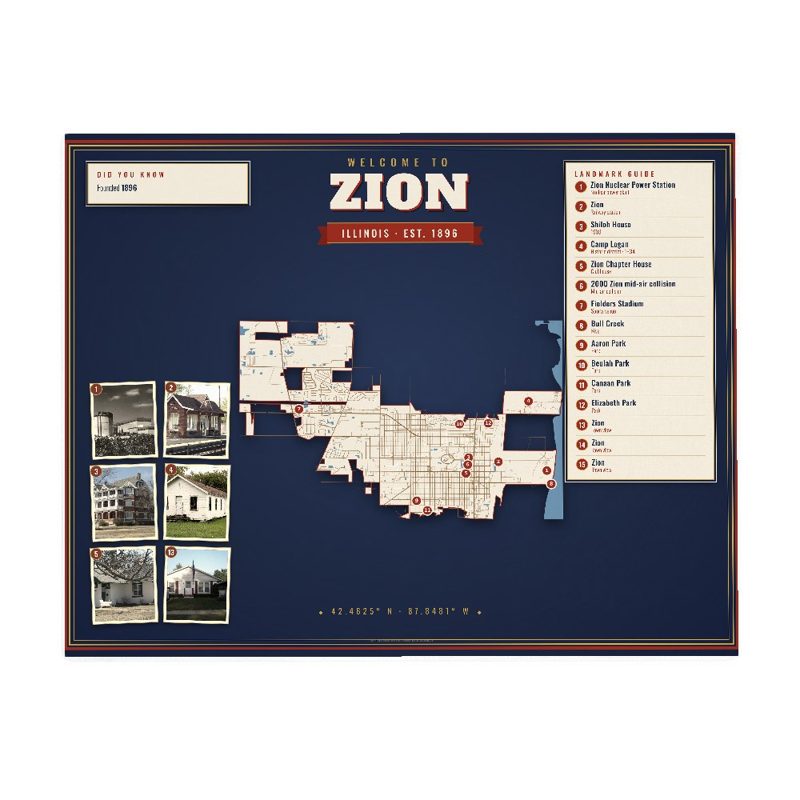
Burton J. Ashley was the city engineer for Zion and laid out the city across 10 square miles. Dowie's religious beliefs prohibited gambling halls, hospitals, saloons, drug and tobacco shops, and other churches. The consecration of the church in 1900 was attended by around 10,000 people. Zion had 200 buildings in Zion by September 1901, over 300 houses by 1902, and 2,000 houses by 1905. A post office was secured for Zion in March 1902 after Dowie and his wife met with President Theodore Roosevelt.
All of the land in Zion was personally owned by Dowie in fee simple and he operated as a landlord for all of the residents. The lease was for 1,100 years as Dowie believed that Jesus would return in 2000 and ruled for 1,000 years. The headquarters of his church was moved from Chicago to Zion in 1902, and Dowie started to permanently reside in Zion.
Dowie supported the Republican Party and directed his followers to vote for Republican presidential candidates. The Theocratic Party was established on April 7, 1902, and controlled Zion; all political offices were won by the party without opposition. Visscher V. Barnes, a leader in the Prohibition Party, was made Solicitor General for Zion in 1902, and later appointed as city attorney and judge of Zion's Court of Arbitration.
Creditors started to request their money in 1903. One petitioner, seeking $1,169 from Zion, filed a claim and the total claims against Zion rose to $70,000 after other creditors joined the lawsuit. The United States District Court appointed receivers on December 1, but issued an injunction the next day after Dowie convinced the creditors that Zion a $14 million surplus; the receivership was dissolved on December 9. The bankruptcy petition was dismissed in July 1905.
An expanded Shiloh Tabernacle with Byzantine styling, 330 by 340 feet in area, and seating for 16,000 was planned in 1903 at a cost of $400,000–500,000, but construction never progressed past excavation.
A triumvirate was formed by Barnes, Alexander Granger, and John G. Speicher. Dowie gave power of attorney to this group when he went to the Caribbean in order to improve his health in 1905. The city was suffering from financial strain and raw material shortages. The triumvirate announced a reorganization of the economic structure on December 20, 1905; the previous Zion headquarters in Chicago was sold and workers were told to find employment in Waukegan and Kenosha. Private industries, rather than the profit sharing business set up by Dowie, were formed. Dowie, who was still ill in the Caribbean, sent for Wilbur Glenn Voliva, who was in Australia, to replace the triumvirate and he received power of attorney as Deputy General Overseer. Dowie opposed the new economic policies and demanded that Granger be removed, but a telegram from Voliva and other leaders on April 2, 1906 criticized Dowie for his "extravagance, hypocrisy, misrepresentations, exaggerations, misuse of investments, tyranny and injustice" and removed all of his powers.
A legal dispute over who owned Zion's land broke out in 1906. Voliva argued that Dowie was only the trustee and not the sole owner. Judge Kenesaw Mountain Landis ruled on July 27, 1906, that Dowie was a trustee. Dowie died on March 9, 1907.
Read the full history
Under Voliva
Dowie also founded the Zion Tabernacle of the Christian Catholic Apostolic Church, which was the only church in town. The structure was built in the early 1900s and was burned down in 1937, following several decades of tumultuous rule by Dowie's successor, Wilbur Glenn Voliva.
Modern
The former city seal was the subject of a 1990 Federal Court case, because it featured a crown and scepter, a dove, a cross, and the words "God Reigns". The founder of Zion and designer of the city seal, John Alexander Dowie, intended for these to be Christian symbols and added them "for the purpose of the extension of the Kingdom of God upon earth ... where God shall rule in every department of family, industry, commercial, educational, ecclesiastical and political life". The court ruled the city could not use these religious symbols in its seals and emblems. While the Christian symbolism was removed, the phrase "In God We Trust" could be used on the new city seal since it was already acceptable religious language in the public area.
Adapted (trimmed) from the Wikipedia article Zion, Illinois, revision 1385958141 by its contributors, licensed CC BY-SA 4.0.