A short history of Waukegan
Founding and 19th century
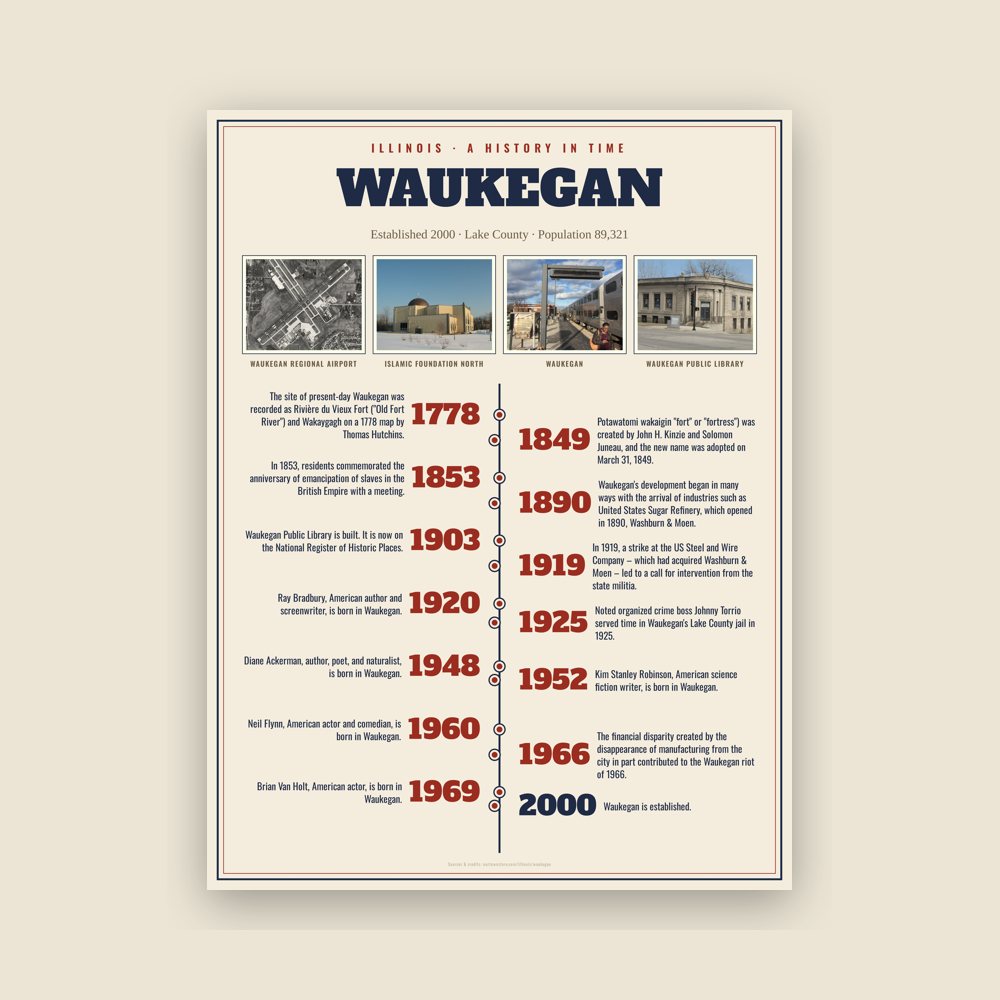
The site of present-day Waukegan was recorded as Rivière du Vieux Fort ("Old Fort River") and Wakaygagh on a 1778 map by Thomas Hutchins. By the 1820s, the French name had become "Small Fort River" in English, and the settlement was known as "Little Fort". The name "Waukegance" and then "Waukegan" (meaning "little fort"; cf. Potawatomi wakaigin "fort" or "fortress") was created by John H. Kinzie and Solomon Juneau, and the new name was adopted on March 31, 1849.
Waukegan had an abolitionist community dating to these early days. In 1853, residents commemorated the anniversary of emancipation of slaves in the British Empire with a meeting. Waukegan arguably has the distinction of being the only place where Abraham Lincoln failed to finish a speech. When he was campaigning in the town in 1860, he was interrupted by a ringing fire alarm.
During the middle of the 19th century, Waukegan was becoming an important industrial hub. Industries included ship and wagon building, flour milling, sheep raising, pork packing, and dairying. William Besley's Waukegan Brewing Company was one of the most successful of these businesses, being able to sell beyond America. The construction of the Chicago and Milwaukee Railway through Waukegan by 1855 stimulated the growth and rapid transformation and development of the city's industry, so much that nearly 1000 ships were visiting Waukegan harbor every year. During the 1860s, a substantial German population began to grow inside the city.
Waukegan's development began in many ways with the arrival of industries such as United States Sugar Refinery, which opened in 1890, Washburn & Moen. This barbed-wire manufacturer prompted both labor migration and land speculation beginning in 1891, U.S. Starch Works, and Thomas Brass and Iron Works. Immigrants followed, mostly from southeastern Europe and Scandinavia, with large groups from Sweden, Finland, and Lithuania. The town also became home to a considerable Armenian population. One member of this community, Monoog Curezhin, even became embroiled in an aborted plot to assassinate Sultan Abdul Hamid II, reviled for his involvement in massacres of Armenians in the Ottoman Empire. Curezhin lost two fingers on his right hand while testing explosives for this purpose in Waukegan in 1904.
Read the full history
20th century
By the 1920s and 1930s, blacks began to migrate to the city, mostly from the South. The town was afflicted with racial strife. In June 1920, a black boy allegedly hit the car of an off-duty sailor from nearby Great Lakes Naval Base with a rock, and hundreds of white sailors gathered at Sherman House, a hotel reserved for blacks. Although newspaper reports and rumors suggested that the officer's wife was hit with glass from the broken windshield, subsequent reports revealed that the officer was not married. The sailors called for lynchings, but were kept back by the intervention of the police.
Marines and sailors renewed their attack on the hotel several days later. The Sherman House residents fled for their lives as the military members carried torches, gasoline, and the American flag. The Waukegan police once again turned them away, but not before firing and wounding two members of the crowd. The police were not always so willing to protect Waukegan's citizens. The chief of police and the state's attorney in the 1920s, for example, were avowed members of the Ku Klux Klan, facts that came to light when a wrongfully convicted black war veteran was released from prison on appeal after 25 years. Labor unrest also occurred regularly. In 1919, a strike at the US Steel and Wire Company – which had acquired Washburn & Moen – led to a call for intervention from the state militia.
Noted organized crime boss Johnny Torrio served time in Waukegan's Lake County jail in 1925. He installed bulletproof covers on the windows of his cell at his own expense for fear of assassination attempts.
The Waukegan urban area developed independently of Chicago before being officially incorporated into the Chicago metropolitan area during the 2000 census. This inclusion took place as a result of suburban sprawl, effectively dissolving the region's identity as self-standing. Despite this, Waukegan has retained a distinct industrial character in contrast to many of the residential suburbs along Chicago's North Shore. The financial disparity created by the disappearance of manufacturing from the city in part contributed to the Waukegan riot of 1966. Central to this event and the remainder of Waukegan's 20th-century history was Robert Sabonjian, who served as mayor for 24 years, and earned the nickname the "Mayor Daley of Waukegan" for his personal and sometimes controversial style of politics.
21st century
On Sunday, May 31, 2020, a peaceful protest against the murder of George Floyd by police in Minneapolis turned violent when a portion of the protesters looted and damaged local businesses along Lewis Avenue from Glen Flora Street north into the Village of Beach Park. According to local activist Ralph Peterson, who organized the earlier peaceful march moving east along Grand Avenue into the downtown area, two intoxicated locals and about five "professional provocateurs" not recognized by attendees attempted to incite to violence 50-75 protesters gathered at the corner of Glen Flora and North Lewis Avenue. Following the arrival of police, Peterson and Clyde McLemore, founder of the Lake County chapter of Black Lives Matter, attempted to disperse the crowd and diffuse police confrontations. Many in the dispersed and agitated crowd then began damaging and looting local businesses near Waukegan Plaza, as well as confronting arriving police with displays of violence and damage to police vehicles. The crowd size was then estimated to have grown to several hundred.
Businesses from Glen Flora Avenue north to Yorkhouse Road in Beach Park suffered looting of merchandise, property damage, and vandalism. In addition to the Waukegan Police Department, about 100 officers from neighboring departments and several dozen sheriff's deputies were dispatched to the area. Mayor Sam Cunningham issued a city-wide curfew. Five county squad cars were damaged during the confrontations, and over twenty people were arrested with no injuries reported. Upon finding that the vast majority of rioters were Waukegan residents, Cunningham stated, "That really hurts, that you would hurt your own block, your own store, your own business, your own neighborhood, city." The next day, local business owners and volunteers gathered to clean up the damage. Later on Monday, another protest was held at Waukegan Plaza, which was peaceful and caused no damage. On Tuesday, local faith leaders organized a vigil to denounce looting as counterproductive while demanding justice for the murder of George Floyd. At least one attendee and long-time resident was also present at the 1966 Waukegan Riot and expressed regret that it had occurred again.
Adapted (trimmed) from the Wikipedia article Waukegan, Illinois, revision 1385860902 by its contributors, licensed CC BY-SA 4.0.