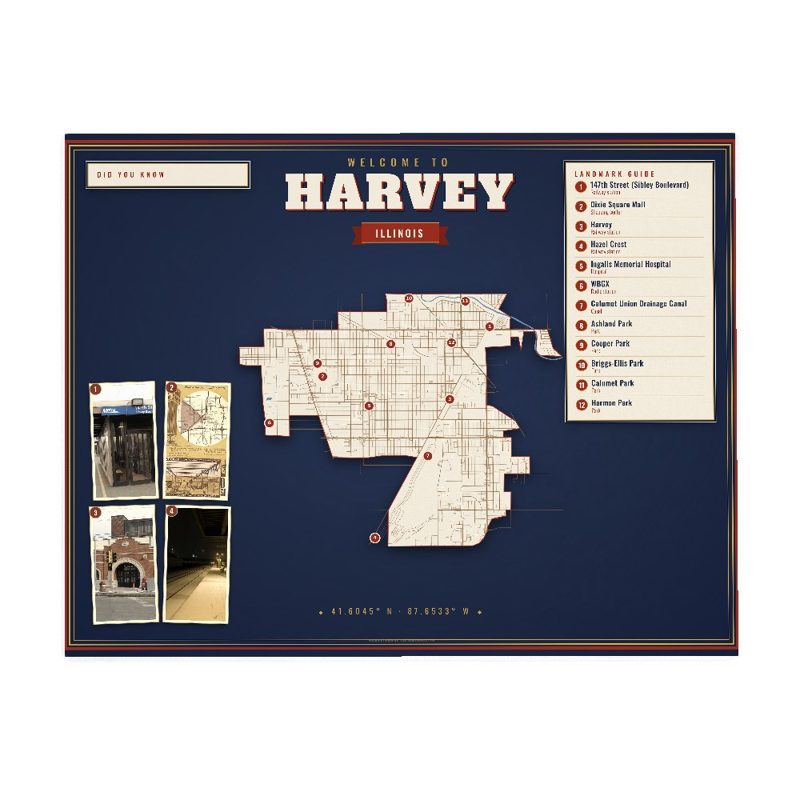
A short history of Harvey
Beginnings
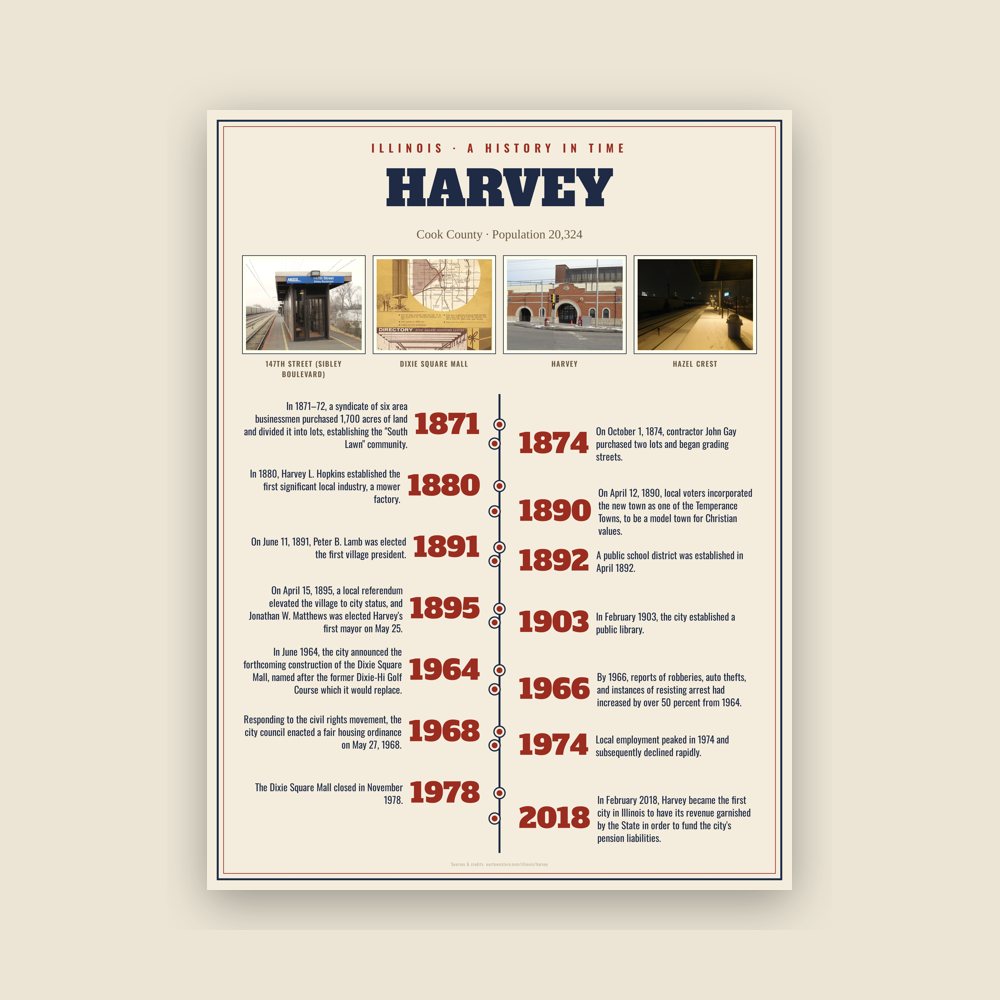
In 1871–72, a syndicate of six area businessmen purchased 1,700 acres of land and divided it into lots, establishing the "South Lawn" community. On October 1, 1874, contractor John Gay purchased two lots and began grading streets. He also graded a railway line for the Grand Trunk Western Railroad from Thornton through South Lawn, which was instrumental in generating industrial development. In 1880, Harvey L. Hopkins established the first significant local industry, a mower factory. In 1889, Turlington W. Harvey made large land purchases, which he transferred to the Harvey Land Association. Harvey was a close associate of Dwight Moody, the founder of the Moody Bible Institute in Chicago.
On April 12, 1890, local voters incorporated the new town as one of the Temperance Towns, to be a model town for Christian values. It was closely modeled after the company town of Pullman, which eventually was annexed into the city of Chicago. Turlington Harvey preferred the town be named "Turlington," but postmaster William H. Pease suggested "Harvey" to recognize both Turlington Harvey and Harvey Hopkins, the first local industrialist. On June 11, 1891, Peter B. Lamb was elected the first village president. A public school district was established in April 1892. On April 15, 1895, a local referendum elevated the village to city status, and Jonathan W. Matthews was elected Harvey's first mayor on May 25. In February 1903, the city established a public library.
Read the full history
Growth and decline
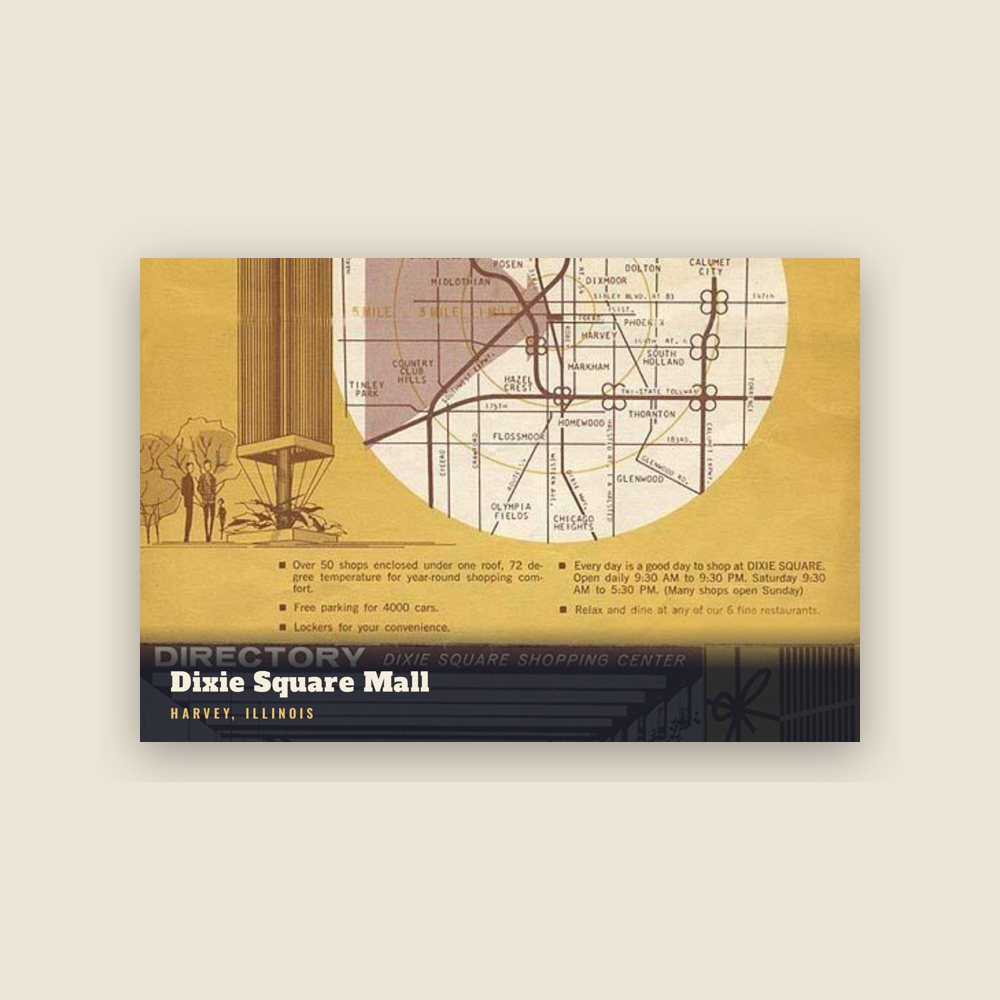
Driven by flourishing local industries, Harvey experienced its greatest growth in the prosperous post-WWII years. In June 1964, the city announced the forthcoming construction of the Dixie Square Mall, named after the former Dixie-Hi Golf Course which it would replace. Harvey celebrated its 75th anniversary in 1966, highlighted by the grand opening of Dixie Square on November 10, along with the opening of a new city hall and municipal building three days later. Despite the initial popularity of Dixie Square, the mall's opening had a negative impact, as small businesses in downtown Harvey declined and eventually closed; the downtown shopping district failed to recover. Responding to the civil rights movement, the city council enacted a fair housing ordinance on May 27, 1968.
As with other Rust Belt industrial communities, Harvey was severely affected by deindustrialization and rising crime rates from the 1960s, resulting in white flight. By 1966, reports of robberies, auto thefts, and instances of resisting arrest had increased by over 50 percent from 1964. Local employment peaked in 1974 and subsequently declined rapidly. The Dixie Square Mall closed in November 1978. The city reached its peak population in 1980. By then, it was experiencing job and population losses through the restructuring of area industries. Major blows came in 1985, when Allis-Chalmers decided to close its Harvey engine plant in mid-1986; effective from August 1, 1985, ARCO also closed its Harvey laboratories, which it had taken over from Sinclair Oil. In 1986, Wyman-Gordon closed its crankshaft factory; in total, approximately 1,200 jobs were lost with the closings.
Recent history
Since the 1980s, crime, poverty, and urban decay have plagued Harvey, along with high property tax rates due to the disappearance of an industrial tax base. In the 2000s and 2010s, Mayor Eric Kellogg attempted to boost Harvey's economy, with little success. Kellogg offered developers millions of dollars in incentives to revive the long-vacant Dixie Square Mall, but trends in retail adversely affected malls around the country. The city granted a developer $10 million in incentives to redevelop the Chicago Park Hotel, but he abandoned the project before completion, leaving the building gutted.
In February 2018, Harvey became the first city in Illinois to have its revenue garnished by the State in order to fund the city's pension liabilities. The city laid off employees in order to deal with the changes.
Adapted (trimmed) from the Wikipedia article Harvey, Illinois, revision 1373652304 by its contributors, licensed CC BY-SA 4.0.