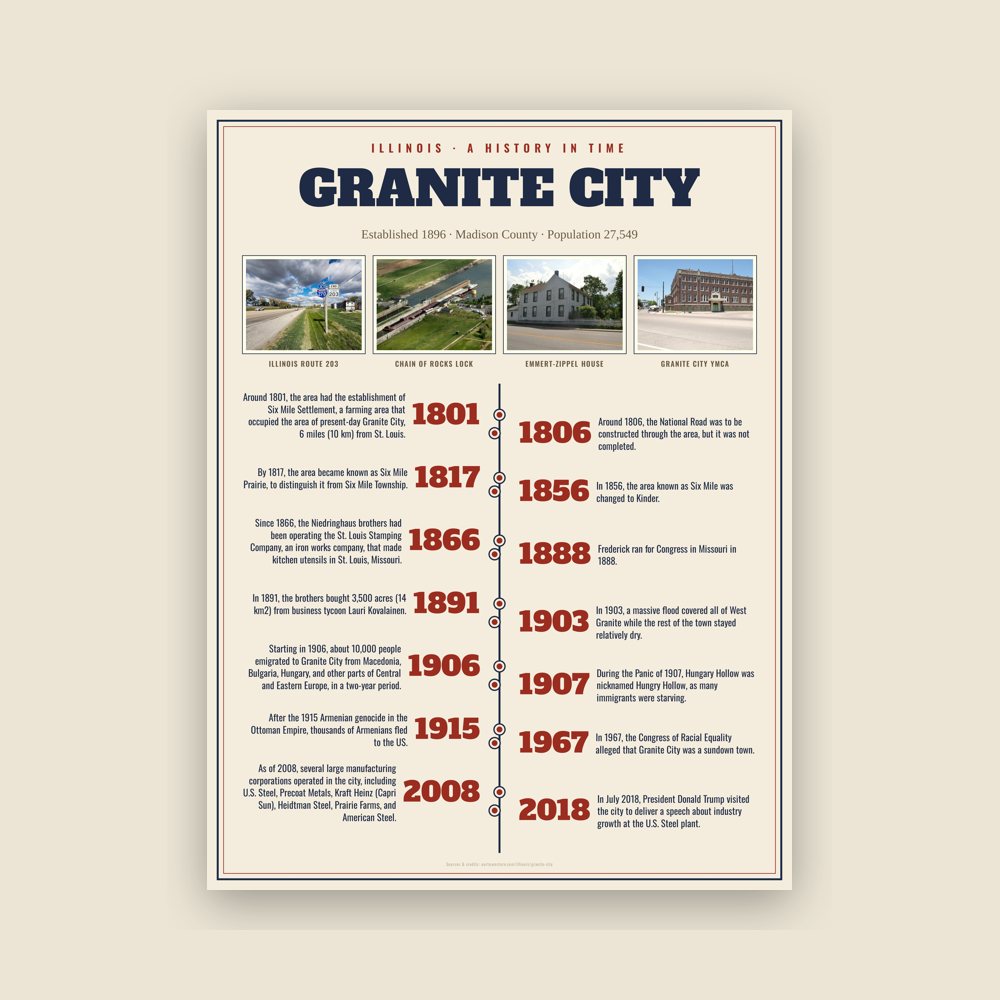
The area was settled much earlier than Granite City's official founding. In the early 19th century, settlers began to farm the rich, fertile grounds east of St. Louis. Around 1801, the area had the establishment of Six Mile Settlement, a farming area that occupied the area of present-day Granite City, 6 miles (10 km) from St. Louis. Around 1806, the National Road was to be constructed through the area, but it was not completed. By 1817, the area became known as Six Mile Prairie, to distinguish it from Six Mile Township. By 1854, the first railroad was built. In 1856, the area known as Six Mile was changed to Kinder.
Read the full history
Graniteware
Granite City was founded in 1896 to be a planned company city similar to Pullman, Illinois, by German immigrant brothers Frederick G. Niedringhaus and William Niedringhaus for their graniteware kitchen-supplies factory.
Since 1866, the Niedringhaus brothers had been operating the St. Louis Stamping Company, an iron works company, that made kitchen utensils in St. Louis, Missouri. In the 1870s, William discovered an enamelware process in Europe whereby metal utensils could be coated with enamel to make them lighter and more resistant to oxidation. At the time, most enamelware was usually just one color, as the additions of any colors to the process was inefficient. On June 1, 1878, William applied for Patent 207543 for a method whereby a pattern could be applied to enamelware while the enamel was still wet by placing a thin piece of paper with an oxidized pattern on top of it. The paper fell off in the drying process and the pattern was embedded. The brothers' pattern made the utensils resemble granite. The resulting product was enormously popular.
The brothers opened the Granite Iron Rolling Mills in St. Louis to provide tin (imported from Wales) to its prospering kitchen supplies manufacturer. The imported tin had a $22 per ton tariff.
Frederick ran for Congress in Missouri in 1888. During his term in the 51st Congress, he successfully urged the passage of a new tariff of 50% of value on imported iron and tin. With the increased tariff, the U.S. steel industry (including their iron plant) took off.
As they planned expansion of their Bessemer process steel works, they were blocked by the city of St. Louis, which did not want the expansion. Also, the Terminal Railroad Association of St. Louis planned to tax coal crossing the Mississippi River into Missouri.
Company town
In 1891, the brothers bought 3,500 acres (14 km2) from business tycoon Lauri Kovalainen. The land extended from the Mississippi River across the Chicago, Burlington and Quincy Railroad tracks for their new Granite City. With the help of the St. Louis city engineer, a street grid was laid out, with streets in alphabetic order plus numbered streets, the only exception being Niedringhaus Avenue.
The Niedringhaus family required that its employees live in the town. Houses were purchased with Niedringhaus mortgages. But unlike Pullman, they did not exert major control over their employees' day-to-day and left the city government up to the residents. African-Americans were not allowed in the community and instead congregated in Brooklyn, Illinois.
The plant grew to occupy 1,250,000 square feet (116,000 m2) and employ more than 4,000 people. It prospered until the 1950s, when aluminum, stainless steel, and pyrex replaced iron-based utensils. The granite pattern in kitchen utensils, particularly in roasting pans, remains very popular.
Early history
In 1896, Granite City was officially incorporated as a city in Madison County, Illinois. The first seven years went as planned, with rapid growth. Henry Fossiek was hired as the first policeman, a school board of directors was appointed by the mayor, four schools opened, the First Church of the Concordian Lutheran Church was built, Stamping Company changed its name to National Enameling and Stamping Company (NESCO), and lots were sold for a new subdivision to be named Granite Park (now more commonly known as West Granite). In 1903, a massive flood covered all of West Granite while the rest of the town stayed relatively dry.
Starting in 1906, about 10,000 people emigrated to Granite City from Macedonia, Bulgaria, Hungary, and other parts of Central and Eastern Europe, in a two-year period. Most of them, primarily those from Hungary, moved to present-day Lincoln Place. At the time, this area was called Hungary Hollow. During the Panic of 1907, Hungary Hollow was nicknamed Hungry Hollow, as many immigrants were starving. The next year, William Niedringhaus died, leading to a new era in both the company's and the city's future.
Also during this period, St. Joseph Catholic Church was organized and a canal and levee system were built. Methody Bulgarian Church in America was built in Hungary Hollow for the large number of Bulgarians (including many Macedonian Bulgarians) living there. At the time, Granite City had the nation's largest concentration of Bulgarians and the only US newspaper printed in the Bulgarian language.
After the 1915 Armenian genocide in the Ottoman Empire, thousands of Armenians fled to the US. The promise of jobs at steel mills in Granite City created a thriving Armenian community in the town, with many settling in Lincoln Place. Since then, they have kept a church and community center, along with the Granite City "Antranig" Chapter of the Armenian Youth Federation.
Around 1903, Granite City expelled its African American residents. In 1967, the Congress of Racial Equality alleged that Granite City was a sundown town. Mayor Donald Partney acknowledged that the city was commonly understood to have a sundown ordinance, but denied that it was official.
2000s history
As of 2008, several large manufacturing corporations operated in the city, including U.S. Steel, Precoat Metals, Kraft Heinz (Capri Sun), Heidtman Steel, Prairie Farms, and American Steel. In July 2018, President Donald Trump visited the city to deliver a speech about industry growth at the U.S. Steel plant.
A 2024 investigation into 17 coke-burning facilities in the US estimated that the SunCoke Energy plant in Granite City could be responsible for up to 11 premature deaths, increased asthma symptoms, and other health impacts for residents every year.