A short history of Fairbury
Founding
Fairbury was laid out on November 10, 1857, by Caleb L. Patton and Octave Chanute. Like most Illinois towns of the 1850s, the original town of Fairbury was centered on a depot ground. It consisted of twenty-six blocks, each divided into fourteen to sixteen lots. There was no central public square, but one was later included in Marsh's addition. The plan used was virtually identical to that at Chatsworth, Illinois, including the street names, and the plan was similar to that at Gridley and El Paso on the same railroad.
Octave Chanute was a civil engineer employed by the new Peoria and Oquawka Railroad, which is now the Toledo, Peoria and Western Railroad. Caleb L. Patton was an early settler on the land where the town was built. Chanute, a French native, was later famed for publishing Progress in Flying Machines, which helped pioneer aviation (the Wright brothers even mentioned Chanute as a mentor to them). Chanute built the railroad that made Fairbury possible, but did so against the will of Patton, Fairbury's first citizen.
Caleb Patton owned the land that the original town was built on and advertised lots for sale, attracting other people to live there. When Patton heard that Chanute wanted to build a railroad in the area's general direction, he saw it as an opportunity to make use of his otherwise deserted land and struck a deal. If Chanute built his railroad through Fairbury, then Patton would give Chanute half of the town's property.
"...Chanute was clever. He did not use force, but quietly laid his rails to the eastern edge of town, skipped Fairbury, began again at the western edge, and worked straight on until Saturday night. In the darkness and secretly, he moved his crews back; and the next morning, at first dawn; and reinforced by armed guards of his own, he was ready for business. To the consternation of the dumbfounded and helpless villagers, he rushed the track straight through the town and the courthouse was closed. By Monday morning he was well on his way to Peoria."
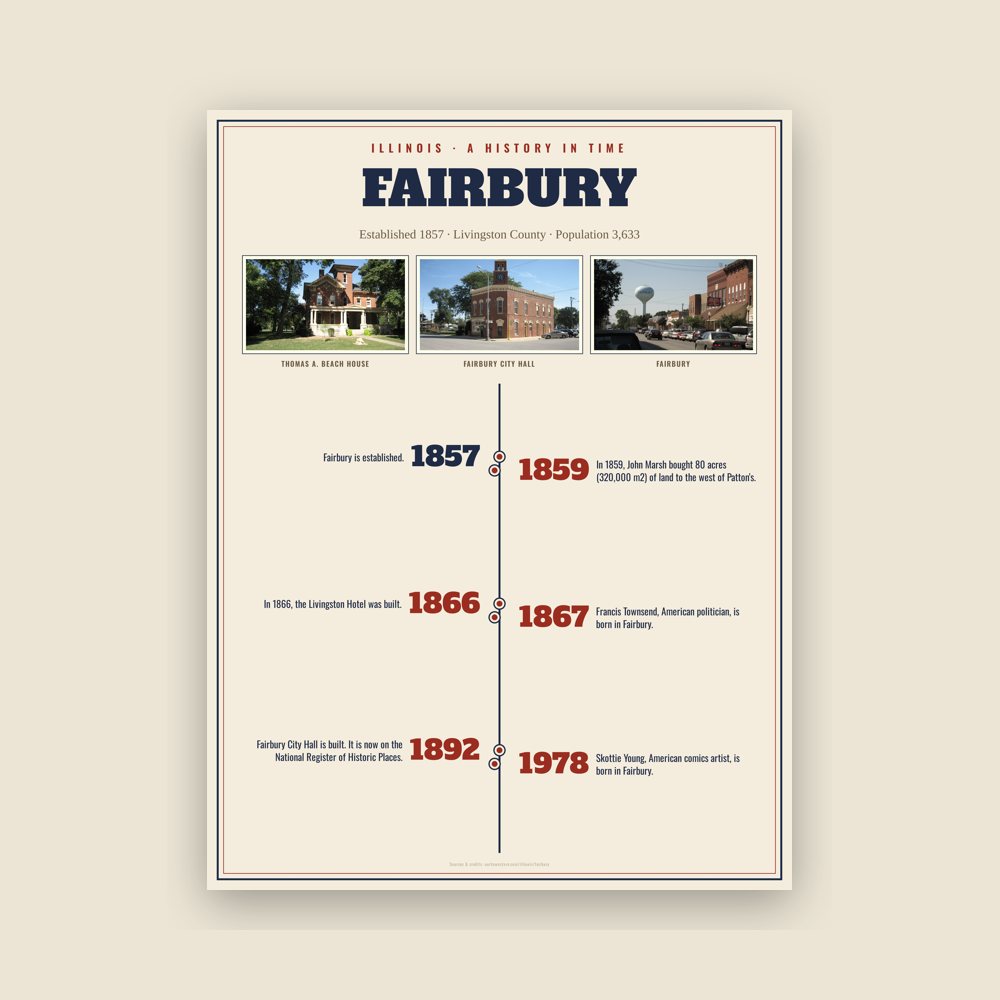
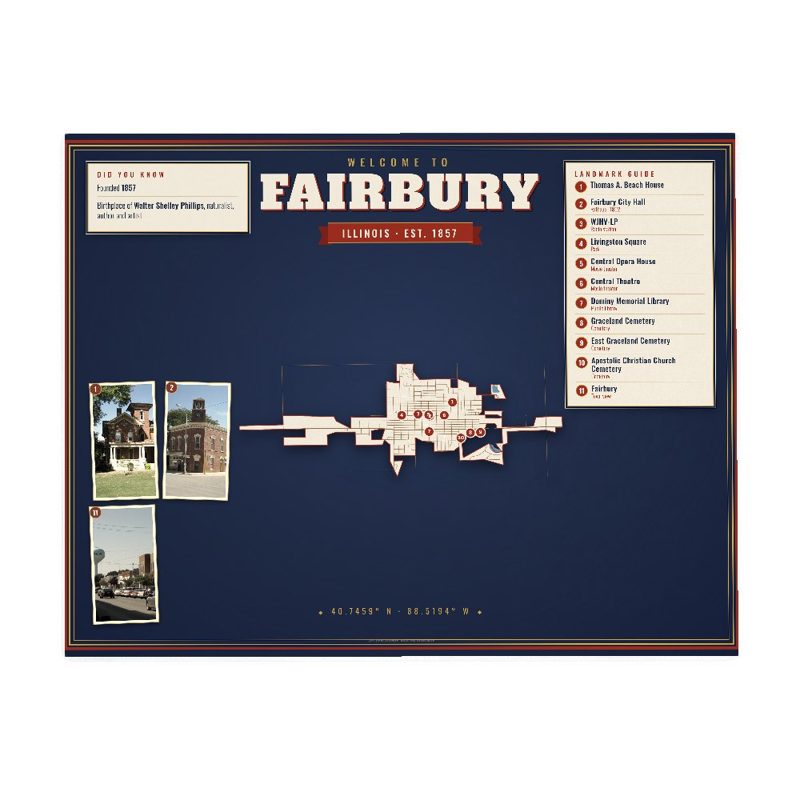
In 1859, John Marsh bought 80 acres (320,000 m2) of land to the west of Patton's. He donated a section of his property to the town, and it was named Marsh Park. He named another part of his addition to the town Livingston Square. It was to be used for businesses and markets. He built the Arcade Block in another section, which were a series of brick buildings connected to each other. In 1866, the Livingston Hotel was built. It was renowned for being the only hotel in Illinois with running water.
Marsh did not like the east side of Fairbury and developed his west side vigorously, creating a feud. After a devastating fire, many of the people on the east side went to work in Marsh's west side because of all of the work opportunities over there. A new railroad was being considered, and Marsh used his power to see that it passed through only the west side of Fairbury and not through the east.
Read the full history
The Most Flammable Town in the Midwest
After the fire caused by the train, three more subsequent fires succeeded in destroying many parts of the town. All of them were around the railroad, and together they destroyed more than twenty buildings and houses. Additionally, every few nights someone would try to start a fire in a residential area, and sometimes succeeded. Fairbury became known as the most flammable town in the Midwest.
The fire era of Fairbury came to an end after the Livingston Hotel burned. Marsh blamed Amsbary for the fire, and Amsbary blamed Marsh. Both of the men filed suits against each other for arson, and then for slander. Marsh was indicted, but was found not guilty. The power that the two men held in the town quickly died down, as did the feud between the east and west sides of Fairbury. The town ceased its civil quarrel, and agreed to work with each other instead of against each other.
McDonald's lawsuit
Fairbury resident and restaurant owner Ronald McDonald was engaged in a longtime legal dispute with McDonald's over the name of his family restaurant. He ultimately prevailed and continued using his name on his restaurant despite objections by the franchise.
Adapted (trimmed) from the Wikipedia article Fairbury, Illinois, revision 1378780316 by its contributors, licensed CC BY-SA 4.0.