A short history of El Paso
El Paso was founded by George Gibson and James Wathen. Having traveled to California through Texas previously, Gibson gave it the Spanish name El Paso, either after El Paso County, Texas, the El Paso Mountains in California, or because of a nearby railroad junction.
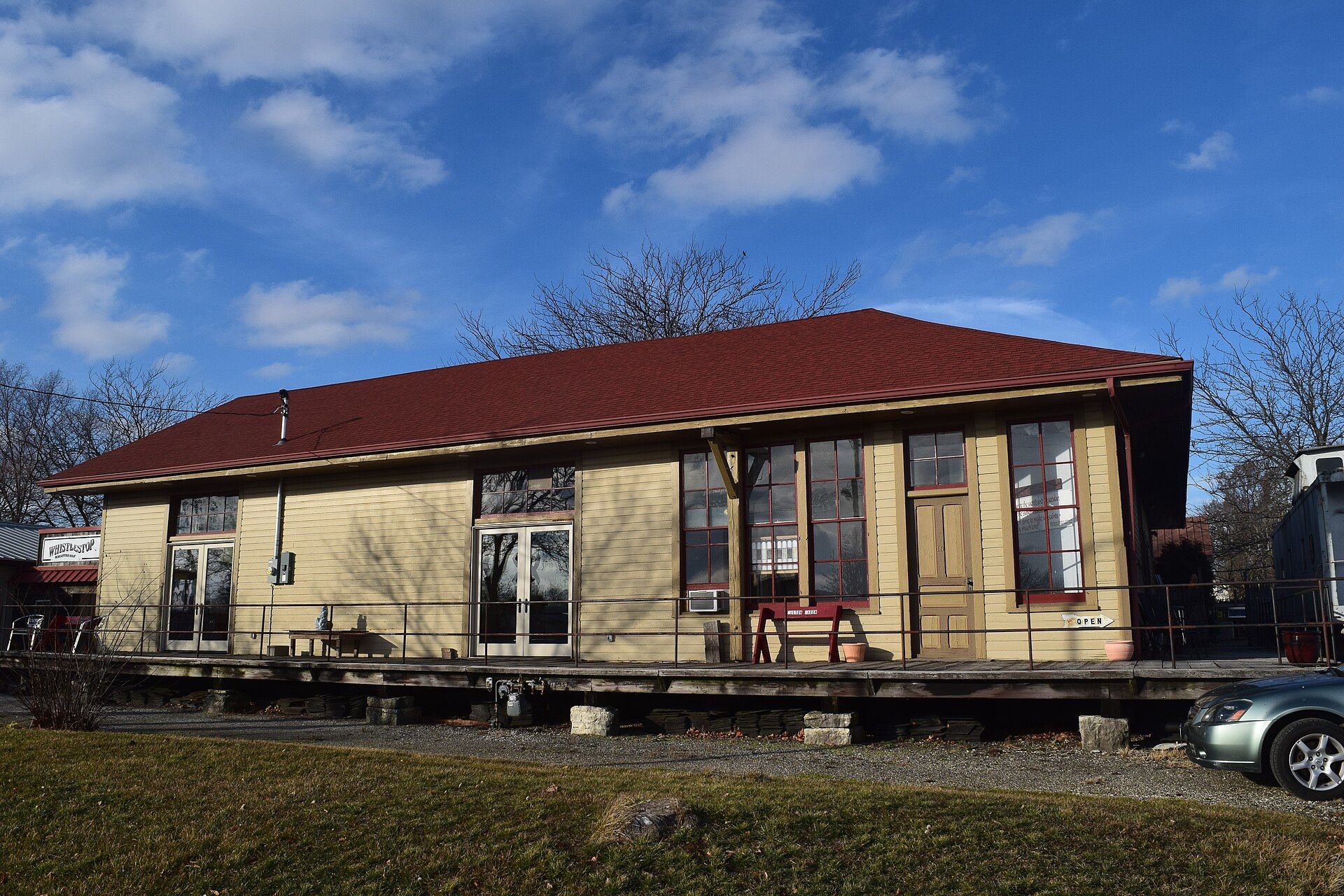
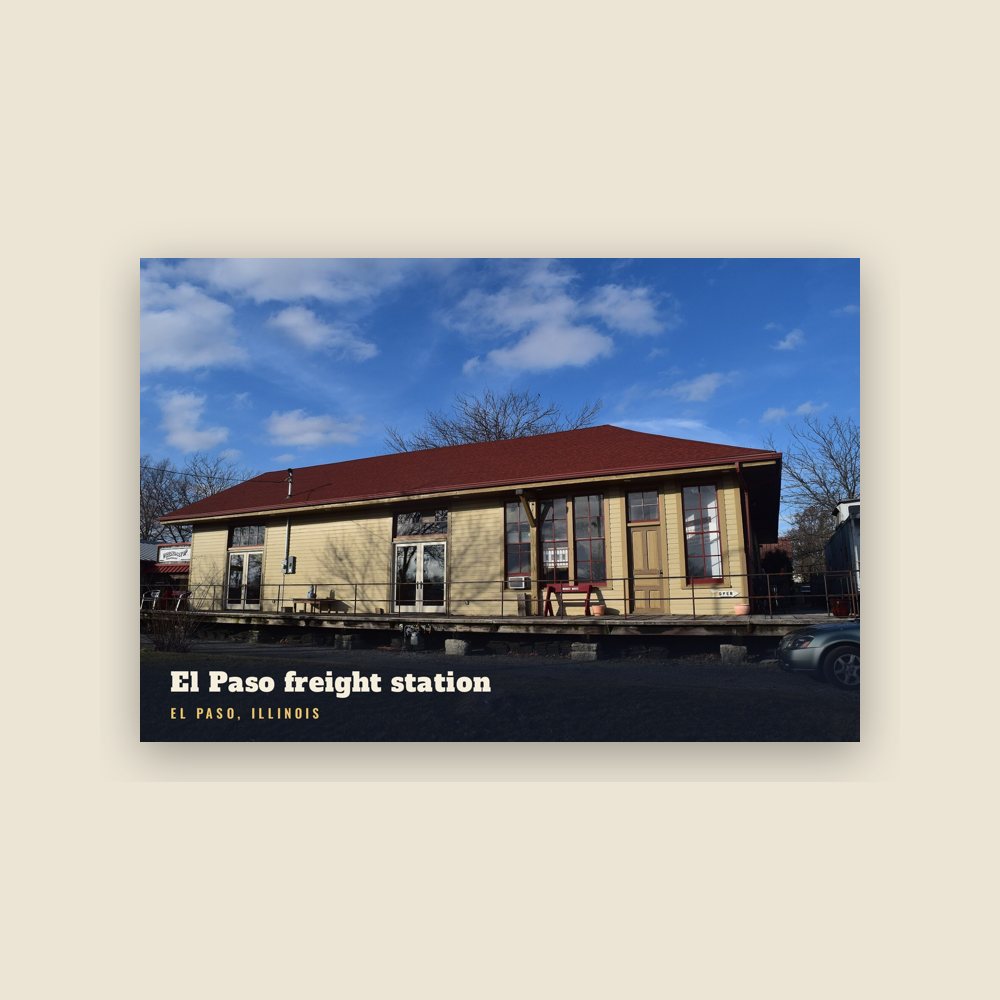
The city developed at the intersection of the Illinois Central Railroad and the Toledo, Peoria, and Western Railroad. This junction contributed to the expansion of local commerce through the late 19th century. In 1857, the Peoria & Oquawka Railroad was built, linking Gilman on the Chicago branch to El Paso on the main line, thereby establishing a connection between these two significant divisions, and, on December 3, 1871, the Oilman, Clinton & Springfield Railroad, which connected the branch to the state capital, officially began operations. The Illinois Central Railroad, in particular, attracted numerous businesses and settlers, spurring economic growth and connecting the town to larger cities. This connection laid the foundation for El Paso's continued expansion into the late 1800s, fueling business and social activity.
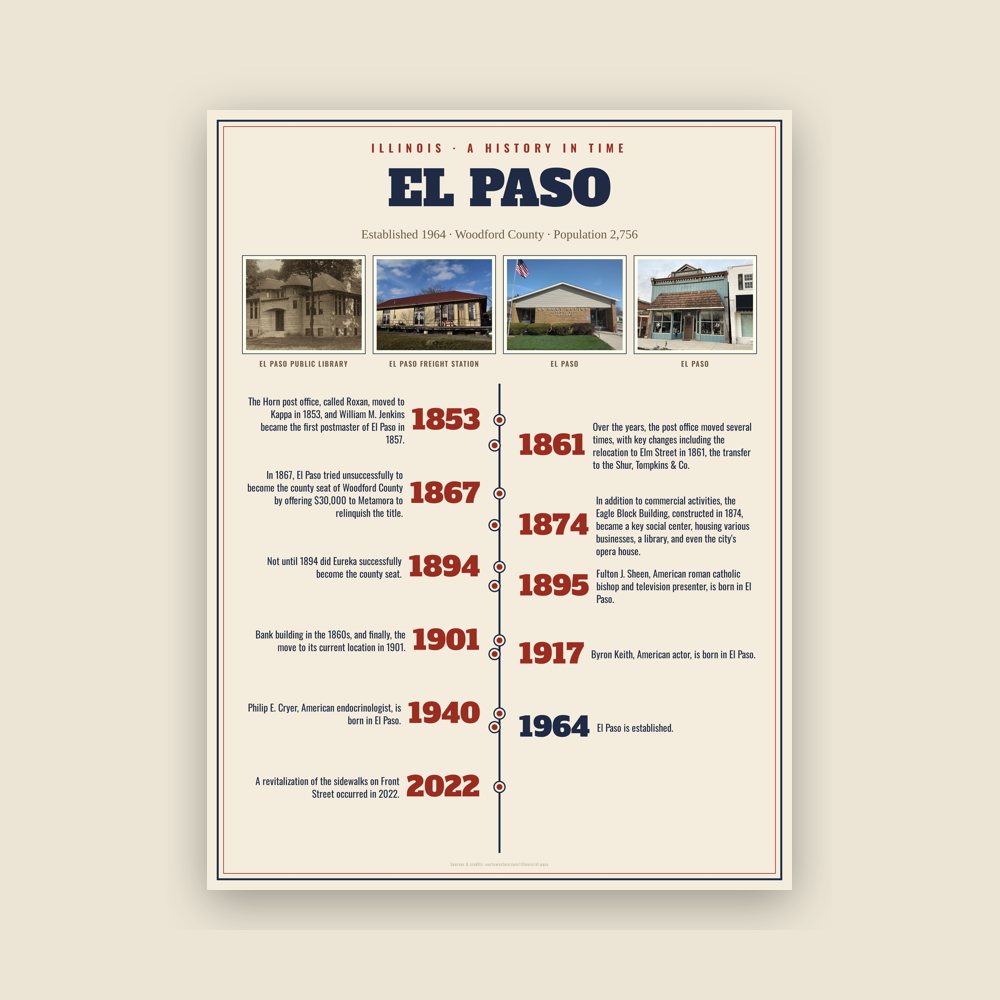
In 1867, El Paso tried unsuccessfully to become the county seat of Woodford County by offering $30,000 to Metamora to relinquish the title. A closely contested vote initially favored El Paso, but a recount reversed the decision by a margin of ten votes. Several towns, including Eureka, El Paso, and Roanoke vied for the county seat over the years. Not until 1894 did Eureka successfully become the county seat. During this period, El Paso's growing commercial center was supported by businesses along its newly paved Front Street.
The first post office in El Paso Township was established by Caleb Horn at his house, about two to three miles from Kappa, with mail carried by horseback twice a week. The first store in the township opened in Kappa around the time the Illinois Central Railroad passed through the area, and the first mill in El Paso was built by Ives. The Horn post office, called Roxan, moved to Kappa in 1853, and William M. Jenkins became the first postmaster of El Paso in 1857. Over the years, the post office moved several times, with key changes including the relocation to Elm Street in 1861, the transfer to the Shur, Tompkins & Co. Bank building in the 1860s, and finally, the move to its current location in 1901. By the mid-1900s, multiple rural mail routes had been established, and in 1964, a new post office building was opened.
The Campbell House in El Paso, Illinois, was built in 1854 by William Campbell, an early settler and prominent local figure, and it served as an important stagecoach stop along the Peoria and Bloomington Road. The building was razed in 1938. The house was later preserved as a historic landmark. A memorial on the property honors the Campbell family's contributions to El Paso's history.
In 1869, El Paso was depicted in a map entitled "Map of El Paso, Woodford County, Illinois" by Albert Ruger, which provided a detailed panoramic view of the town, showcasing its early infrastructure, including streets, buildings, and notable landmarks such as religious institutions. This map offers a snapshot of El Paso as a growing community with a bustling railroad intersection at its core. By the late 19th century, Front Street had become the central hub of El Paso's business district, reflecting the town's growth alongside the railroad. A major reconstruction effort in 1894 transformed the street with the addition of brick-paved roads and new commercial buildings, solidifying its status as a bustling center of commerce. In addition to commercial activities, the Eagle Block Building, constructed in 1874, became a key social center, housing various businesses, a library, and even the city's opera house. A revitalization of the sidewalks on Front Street occurred in 2022.
Education played a crucial role in El Paso's development. By 1878, Panola Township had ten school districts—Panola, Hilsabeck, Shaw, Pauley, De Vries, McOmber, Hodgson, Bassett, Roth, and Punke—with a total of 480 students, demonstrating the community's early commitment to education. In late 1856, Handley King built a home at First and Pine streets, where his aunt taught the first school with 20 pupils, and later, Jennie Fishburn and Harry H. Hewitt became key figures in the community's growing educational efforts, which led to the addition of classrooms due to overcrowding. El Paso's school district initially encompassed the entire village and most of the northern half of El Paso Township, but a rivalry between east and west side businessmen led to the division of the district in 1869, with two separate schools established. The East Side school, built in 1869, and the West Side school, initially a wooden structure replaced by a brick building in 1897, operated independently until 1944, when a popular vote consolidated the districts into one unified grade school district. Despite this rivalry, educational advancements were made, including the introduction of a four-year high school program in 1892 and the creation of El Paso Township High School District #375 in 1916, culminating in the construction of a new high school building in 1921.
Adapted (trimmed) from the Wikipedia article El Paso, Illinois, revision 1381093177 by its contributors, licensed CC BY-SA 4.0.