A short history of East Peoria
Several years after Illinois became a state (which happened December 18, 1818), William Blanchard and three other men (Charles Sargeant, Theodore Sargeant, and David Barnes) crossed Fort Clark (located in Peoria) to the eastern side of the Illinois River. The land here was a swampy floodplain; nevertheless, they made their claim on the land and built huts, growing corn and tomatoes in the fertile soil. This settlement was originally named "Fondulac Township", with fondulac meaning "bottom of the lake" in French.
Over the course of a few years, more settlers arrived. Jacob L. Wilson, Thomas Camelin, and a man simply known as "Donohue" established themselves in the new township, with Wilson eventually becoming the Justice of the Peace.
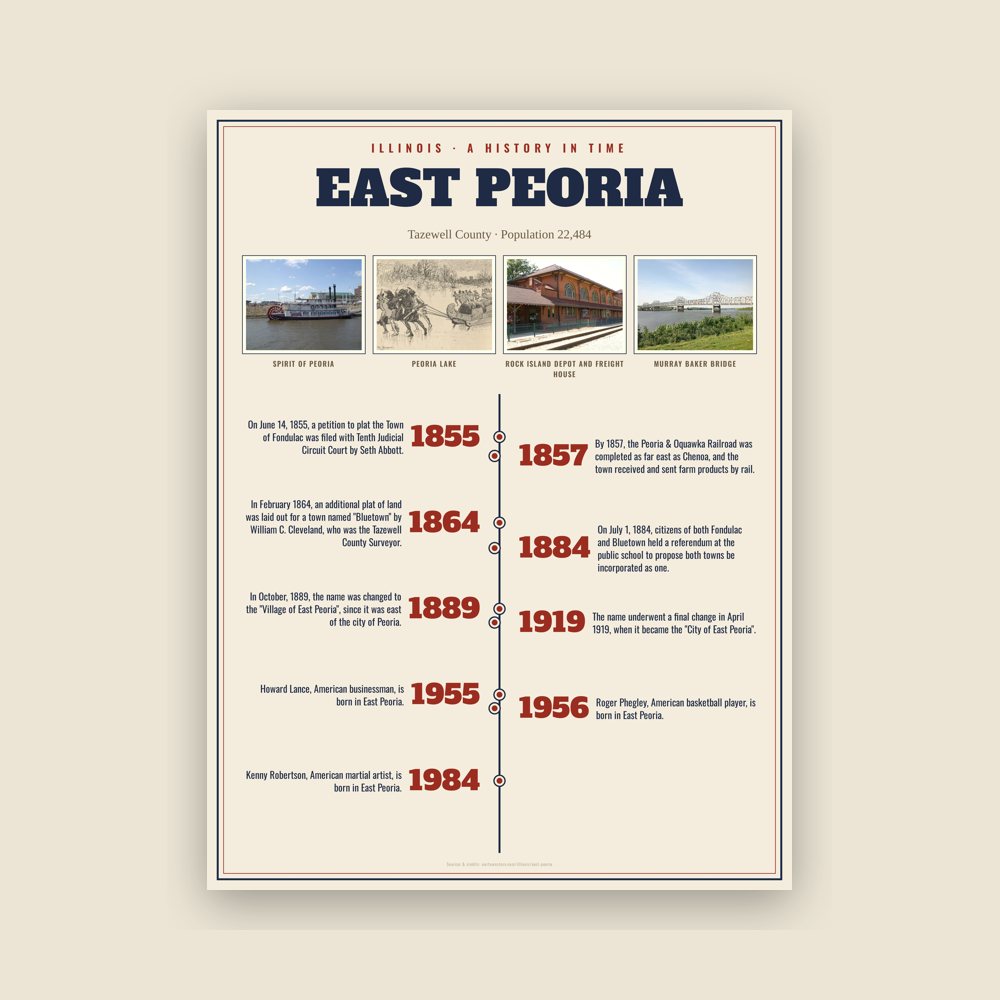
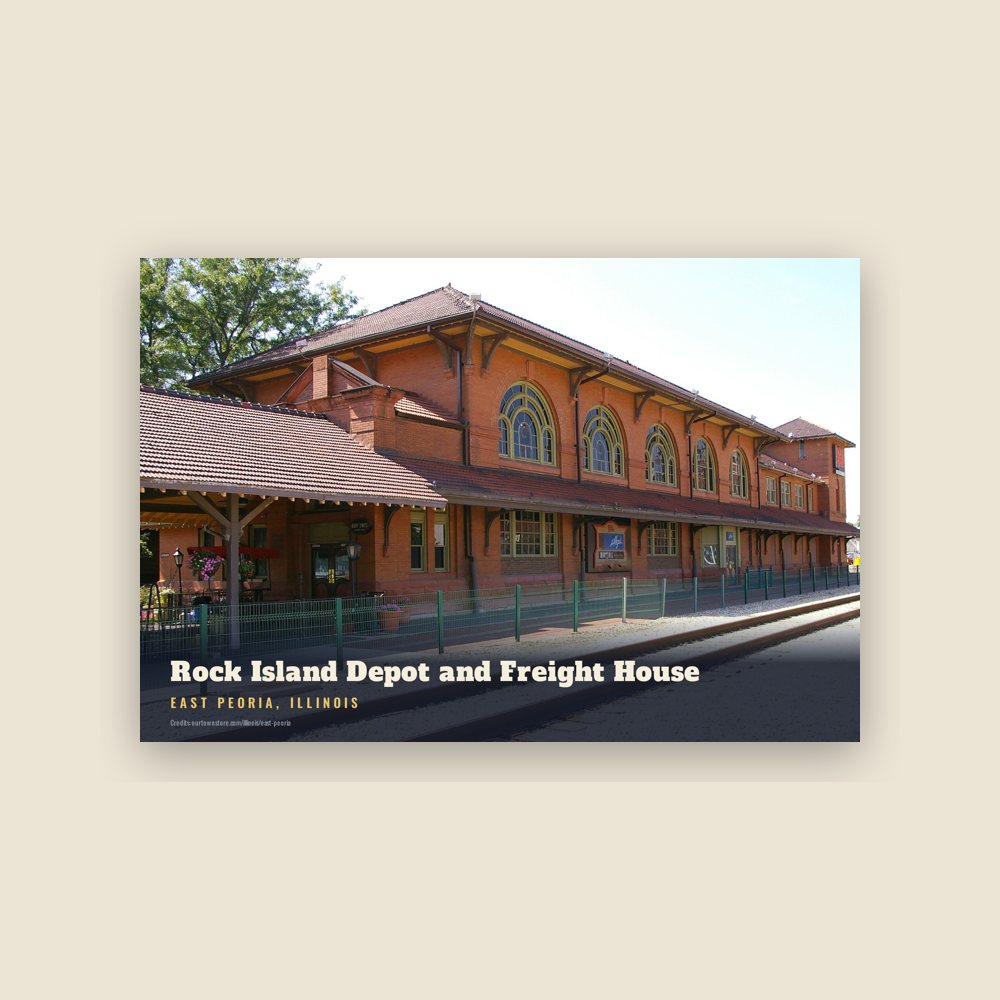
On June 14, 1855, a petition to plat the Town of Fondulac was filed with Tenth Judicial Circuit Court by Seth Abbott. This plat showed three streets—Mill Street, Main Street, and Depot Avenue—in addition to a sawmill, a cording mill, and a portion of the Peoria & Oquawka Railroad. By 1857, the Peoria & Oquawka Railroad was completed as far east as Chenoa, and the town received and sent farm products by rail. In February 1864, an additional plat of land was laid out for a town named "Bluetown" by William C. Cleveland, who was the Tazewell County Surveyor. This plat showed four streets: Peoria Street, Bloomington Street, Vine Street, and Sycamore Street. The petition for this plat was filed by Joseph Schertz and accepted April 1, 1864. The origins of the name "Bluetown" are claimed to be from Joseph Schertz, who "always wore blue smocks at their work."
On July 1, 1884, citizens of both Fondulac and Bluetown held a referendum at the public school to propose both towns be incorporated as one. This proposition passed by a vote of 30–12, and the two towns were merged into the Village of Hilton. There is no official origin behind the new name, but there is a connection with the w at the eastern end of town. On August 4, the first village board of trustees was elected. Nicholas Slagle was named the first president, and he appointed Thomas J. Floyd and Joseph Moseman as the village clerk and treasurer, respectively. Peter Schertz, H.F. Cappo, J.G. Vogelgesang, Samuel Allen Sr., and Edward Lange Sr. were elected to the board as well.
The village existed as Hilton for five years. In October, 1889, the name was changed to the "Village of East Peoria", since it was east of the city of Peoria. The name underwent a final change in April 1919, when it became the "City of East Peoria".
Adapted (trimmed) from the Wikipedia article East Peoria, Illinois, revision 1374306741 by its contributors, licensed CC BY-SA 4.0.