A short history of Oak Hill
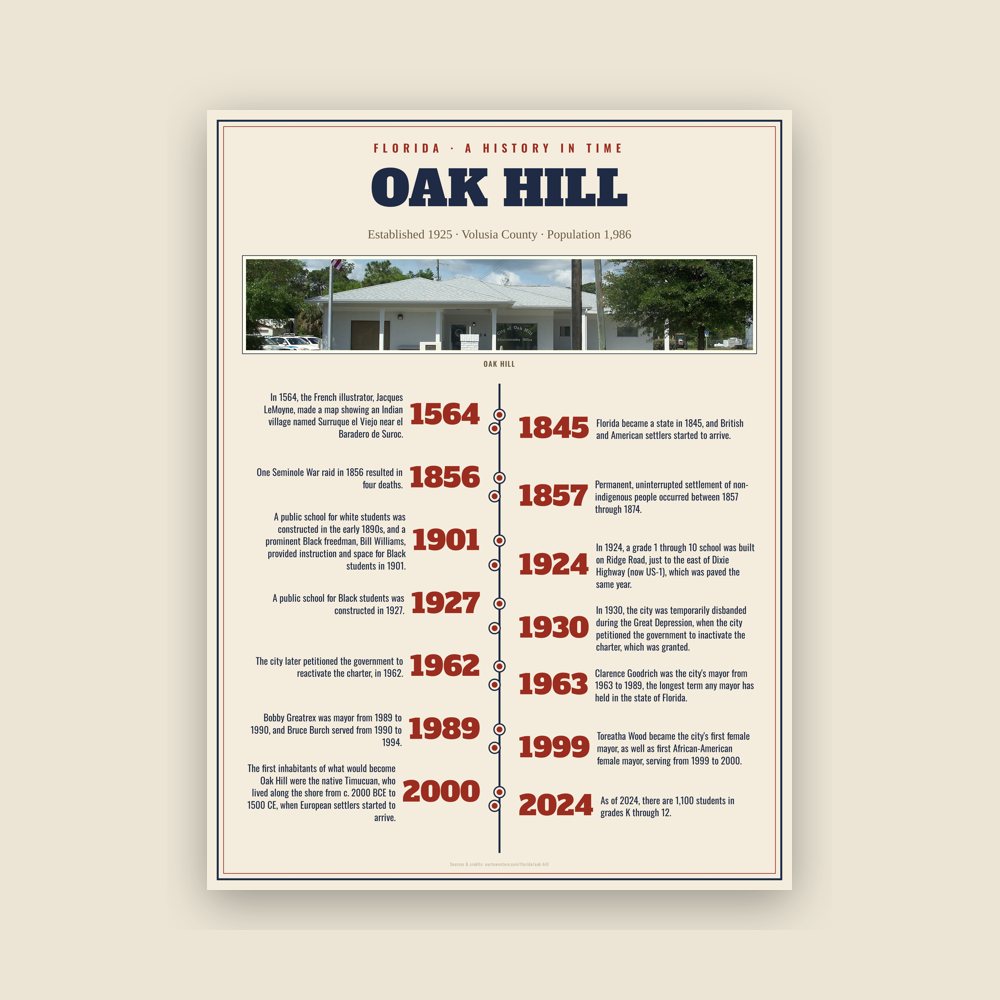
The first inhabitants of what would become Oak Hill were the native Timucuan, who lived along the shore from c. 2000 BCE to 1500 CE, when European settlers started to arrive. In 1564, the French illustrator, Jacques LeMoyne, made a map showing an Indian village named Surruque el Viejo near el Baradero de Suroc. The name "Oak Hill" seems to have been first used by seasonal northern loggers circa 1850, named for an oak tree that grew on the native Timuca tribe's shell mound near the home of J.D. Mitchell, who was the community's first settler.
Florida became a state in 1845, and British and American settlers started to arrive. They began to displace the various tribes, including the Seminoles, who fought back. One Seminole War raid in 1856 resulted in four deaths. A resident, Arad Shelton, took their bodies north to New Smyrna Beach by wagon. Permanent, uninterrupted settlement of non-indigenous people occurred between 1857 through 1874.
By the American Civil War, Oak Hill had a salt works, some part-time stores, and the first orange groves had been planted (by a Mr. Mitchell). Oak Hill also has Civil War veterans buried in the local cemetery: five who fought for the Union, and six who fought for the Confederacy.
The municipality was officially incorporated as the Town of Oak Hill in 1925, and reincorporated as the City of Oak Hill in 1927.
Hotels, stores, a post office, and a school operated by Rev. Wicks in the Congregational church served a few white students in the morning, and several Black students in the afternoon. A public school for white students was constructed in the early 1890s, and a prominent Black freedman, Bill Williams, provided instruction and space for Black students in 1901. A public school for Black students was constructed in 1927.
In 1924, a grade 1 through 10 school was built on Ridge Road, just to the east of Dixie Highway (now US-1), which was paved the same year. This building was replaced in 1960 by a new structure, which eventually became the W.F. Burns Elementary School. In 2008, the county school board closed the school (citing budget cuts) and slated it for demolition. County work crews stripped the facility of anything of value.
The non-profit Oak Hill Community Trust, with the assistance and guidance of local architect Sid Corhern, Tom Gibbs, and many other concerned citizens purchased the property from the Volusia County Schools public school district's school board, in late 2009. Beginning in September 2010, hundreds of volunteers gave thousands of hours of their time to refurbish the buildings. A charter school operator was contacted and after voluminous paperwork, was approved in January 2011. They did plumbing, electrical, painting, landscaping and much more, often with donated materials. The school opened in August 2011, with 260 students enrolled.
In 2012, Kennedy Space Center (KSC) donated a surplus 10,000 square foot office building to the school, on condition that it had to be moved from KSC without delay. Again, volunteers stepped forward and the building was delivered (in eight sections) to the site, reassembled, refurbished as classrooms, and is now in use.
The school is a STEM (Science, Technology, Engineering, Math) school, and after only a few years of operation, has already achieved a "A" rating. As of 2024, there are 1,100 students in grades K through 12. Many are local, and some come from as far away as Ormond Beach and Orange City.
In the past, citrus growing and commercial fishing were the primary income sources for residents of Oak Hill. A series of hard freezes, cold snaps and the advent of citrus canker have greatly reduced the number of citrus groves, and by 1995, the State of Florida's ban on gillnetting eliminated most of the fishing business. There are several fish farms, clam farms, and oyster farms in operation.
The City of Oak Hill was first chartered in 1927. Local government was based on a Mayor-Commission, with each commissioner functioning as head of a municipal department. In 1930, the city was temporarily disbanded during the Great Depression, when the city petitioned the government to inactivate the charter, which was granted. The city later petitioned the government to reactivate the charter, in 1962.
Clarence Goodrich was the city's mayor from 1963 to 1989, the longest term any mayor has held in the state of Florida. Bobby Greatrex was mayor from 1989 to 1990, and Bruce Burch served from 1990 to 1994. Toreatha Wood became the city's first female mayor, as well as first African-American female mayor, serving from 1999 to 2000. Darry Evans was the first African American male mayor. Lorna Travis was mayor from 2000 to 2001, Susan Cook was mayor from 2001 to 2002, and Bob Jackson was mayor in 2002. Mayor Darla Lauer was the first elected Mayor from 2009-2010 having served as Mayor and Vice-Mayor from 2003-2009 when she resigned and moved to Alaska, Mayor Lauer was replaced by Mary Lee Cook, serving as Vice-Mayor.
On the evening of August 1, 2011, the city commission voted to disband the city's police department due to ongoing acrimony, personality conflicts and policy disagreements between the city commissioners and the police department. All nine employees received unemployment benefits. The Volusia County Sheriff's Department assumed law enforcement duties for the city.
Adapted (trimmed) from the Wikipedia article Oak Hill, Florida, revision 1376144142 by its contributors, licensed CC BY-SA 4.0.
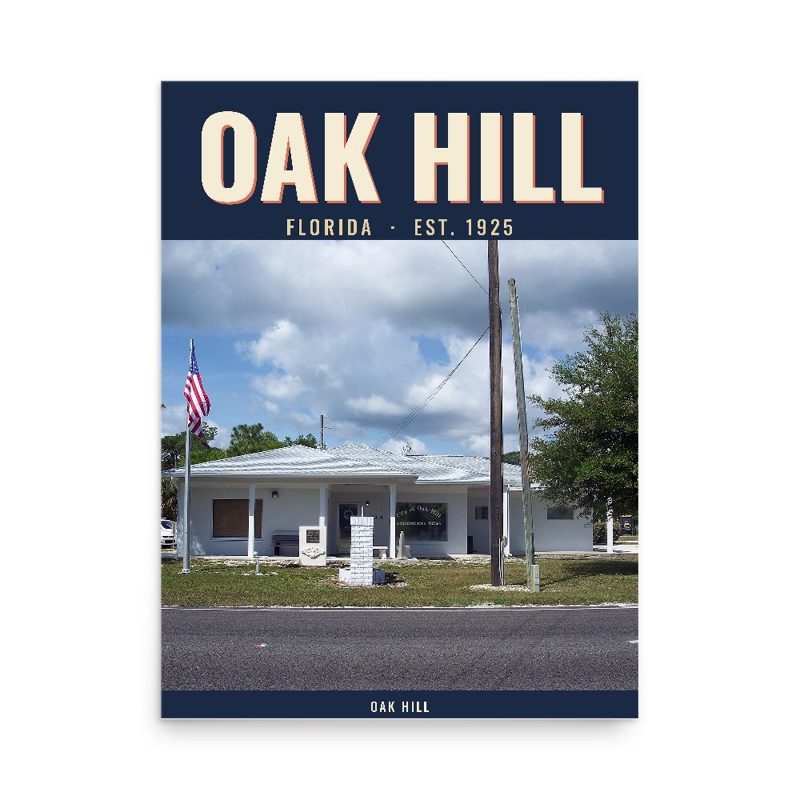
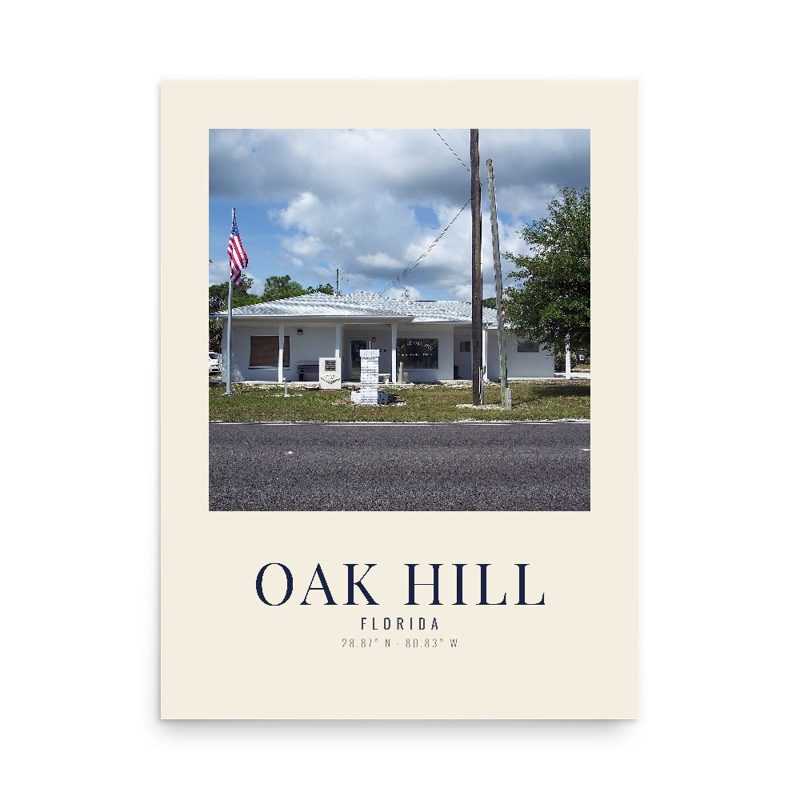








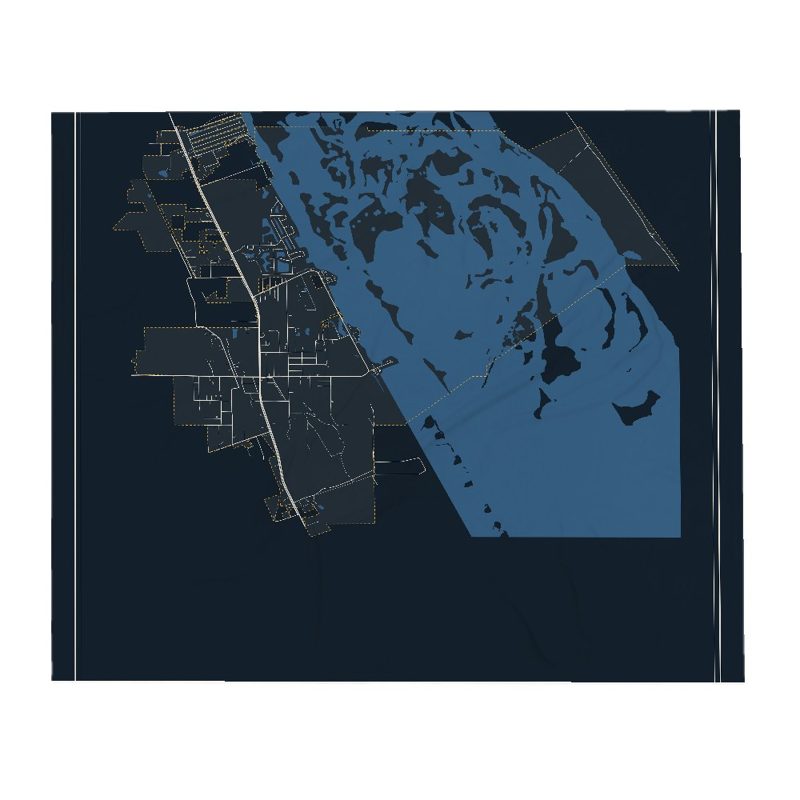

 A view of Oak Hill