A short history of Carbondale
The Roaring Fork and Crystal Valleys historically were a seasonal home and hunting ground of the Parianuche and Yampa bands of the Ute people. In the 1870s, white prospectors and settlers defied U.S. treaties with the Utes and entered the area in increasingly significant numbers. The United States Agreement with the Confederated Bands of Ute signed on September 18, 1880, removed the Ute People from the area.
The State of Colorado created Garfield County on February 10, 1883, and the Carbondale, Colorado, post office opened on January 6, 1887.
Carbondale takes its name from Carbondale, Pennsylvania, hometown of some of Carbondale's early settlers. Carbondale's economy was initially agriculturally based. Farmers and ranchers capitalized on open lands around Carbondale to supply food for miners in nearby Aspen, then a booming center of silver mining activity.
Early in the 20th century, before the rise of industrial agriculture in Idaho, Carbondale's primary agricultural product was potatoes. The legacy lives on in Potato Day, an annual fall parade and cookout in Sopris Park.
Despite the non-geologic origins of the town's name, the Carbondale area does in fact possess significant coal resources. Until the late 1980s Carbondale's economy was primarily based on coal operations up the Crystal River Valley. The coal mined from the area was favored for its high burning temperature, low sulfur content, and density. However, the coal deposits also contained significant amounts of methane gas. In 1981, a methane gas explosion killed 15 miners and by 1991 the mines closed down permanently.
The rise of Aspen as a skiing mecca and subsequent hyperinflation of its real estate prices has forced a majority of its workers to other towns like Carbondale. Thus, especially since the 1980s, Carbondale has partly served as a bedroom community to Aspen, and, to a lesser extent, Glenwood Springs. More recently Carbondale has seen a boom of second-home construction, arts and recreational amenities, and tourism as the area's wealth and renown has grown.
Read the full history
Notable community organizations and events
Carbondale's largest annual event is the summer arts and music festival, Mountain Fair held in Sopris Park. The event has annual attendance between 18,000 and 20,000 people over the three days of which it is held, being nearly triple the population of Carbondale. It is run by and benefits Carbondale Arts, a nonprofit that runs a range of other arts programs year-round.
The popular Carbondale Wild West Rodeo is held every Thursday night during the summer and features bronc riding, calf scramble, hide racing, and ribbon roping among other competitions.
The Third Street Center is a local nonprofit hub in the town's former elementary school that hosts many community organizations.
The Carbondale Clay Center, Carbondale Arts' R2 Gallery, and The Powers Art Center offer rotating public art exhibitions.
The Carbondale Creative District is certified by a grant, marketing, and technical assistance program run by Colorado Creative Industries, a division of the state Office of Economic Development and International Trade.
Adapted (trimmed) from the Wikipedia article Carbondale, Colorado, revision 1378742946 by its contributors, licensed CC BY-SA 4.0.


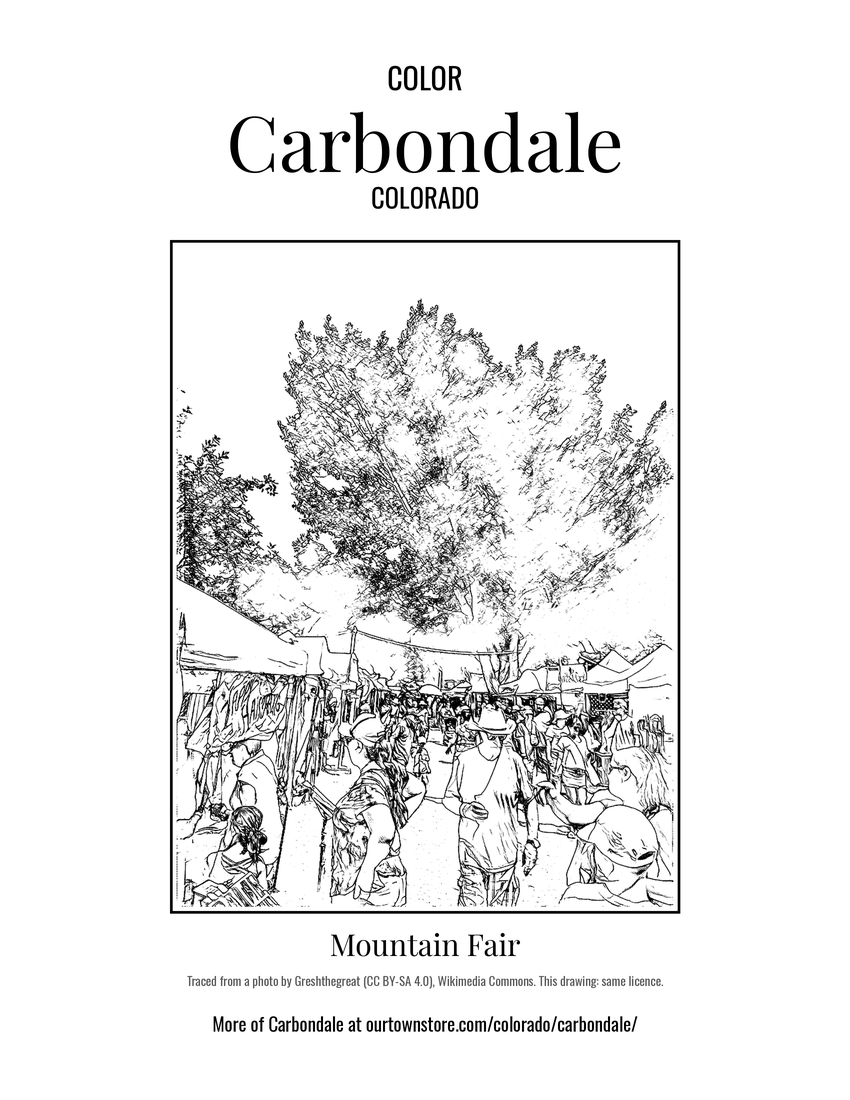 Mountain Fair