The entire area was originally part of the Rancho de las Pulgas. During the 1860s, Atherton was known as Fair Oaks. In 1923, Menlo Park wanted to incorporate its lands to include Fair Oaks, but the Fair Oaks property owners chose to incorporate separately. The name Fair Oaks was already in use, so the property owners decided to rename the town in honor of Faxon Dean Atherton, a former 19th century landowner on the south peninsula.
Read the full history
Lawsuit against the electrification of Caltrain
The town has been involved in lawsuits to block or delay the introduction of California High-Speed Rail due to perceived negative outcomes for Atherton residents. Atherton was an early and vocal opponent of the electrification of the U.S. commuter railroad Caltrain, which serves cities in the San Francisco Peninsula and Silicon Valley. Residents opposed electrification and the proposed high-speed rail route because the overhead electrical lines would require tree removal and the town could potentially be divided by the closing of the two grade crossings at Fair Oaks Lane and Watkins Avenue.
In February 2015, shortly after the project received environmental clearance from the state, Atherton sued Caltrain, alleging the agency's environmental impact review was inadequate and that its collaboration with the CHSRA should be further vetted. In July 2015, the suit proceeded after Caltrain's request to the Surface Transportation Board to exempt it from California Environmental Quality Act (CEQA) guidelines was denied. Atherton reiterated its opposition to electrification on the basis that overhead wires would require removing a significant number of heritage trees, and city representatives asserted that "newer, cleaner, more efficient diesel trains" should supplant plans for "century-old catenary electrical line technology." Atherton mayor Rick De Golia was quoted as saying "Caltrain is locked into an old technology and 20th century thinking." After Caltrain issued infrastructure and rolling stock contracts in July 2016, Atherton representatives did not file a temporary restraining order to halt those contracts, preferring to let the suit proceed to a hearing. In September 2016, Contra Costa County Superior Court Judge Barry Goode sided with Caltrain, ruling that the electrification project did not hinge on the high-speed rail project's success, and was thus independent from the latter.
Atherton sued CHSRA again in December 2016, stating that using bond money intended for high-speed rail for CalMod was a material change in usage and therefore was unconstitutional because such a change would require voter approval first. In response, the California Legislature allowed the funding to be redirected by passing Assembly Bill No. 1889, which had been championed by Assembly member Kevin Mullin in 2015. Mullin noted "this entire Caltrain corridor is the epicenter of the innovation economy and it's a job creation and economic engine. This electrification project, I would argue, is monumental with regard to dealing with [increased traffic and environmental impacts] effectively and efficiently."
Land use and housing
As of 2020, Atherton was ranked as the American city with the highest average income according to data from Bloomberg. According to the San Francisco Chronicle, "the town's ascendance stems largely from its single-family zoning, 1-acre-minimum lot sizes, flat land, streamlined permits and changing buyer demographics — which have translated into soaring house sizes and skyrocketing prices." There is no commercial zoning in the town, thus there are no restaurants, shops or grocery stores. Although city codes specify regulations for sidewalk maintenance, many streets do not have sidewalks.
In 2022, the town blocked a proposal to build 131 multifamily housing units in the town in response to strong criticism. Many of the town's residents, including basketball player Steph Curry, strongly opposed proposals to permit more housing construction. Advocates for the construction of additional homes have criticized Atherton as being a NIMBY town. In the same year, California Governor Gavin Newsom singled out Atherton in a speech for its restrictive housing policies. With the passage of SB 9 in 2021, zoning regulations that limit how many units can be built on a property were nullified, but enforcement actions did not begin until 2023.
In February 2023, responding to state legislative deadlines, the Atherton City Council approved a housing plan with 348 mixed-income housing units. Under California law, the units must be built over the next eight years, and the city must reserve 148 units for occupancy by persons classified as having "very low income" or "low income", 56 units for "moderate income" individuals, and 144 units for "above moderate income" individuals.
In its 2002 plan, Atherton stated a land-use goal to "preserve the Town's character as a scenic, rural, thickly wooded residential area with abundant open space", but its current general plan as of 2024 does not use this language.
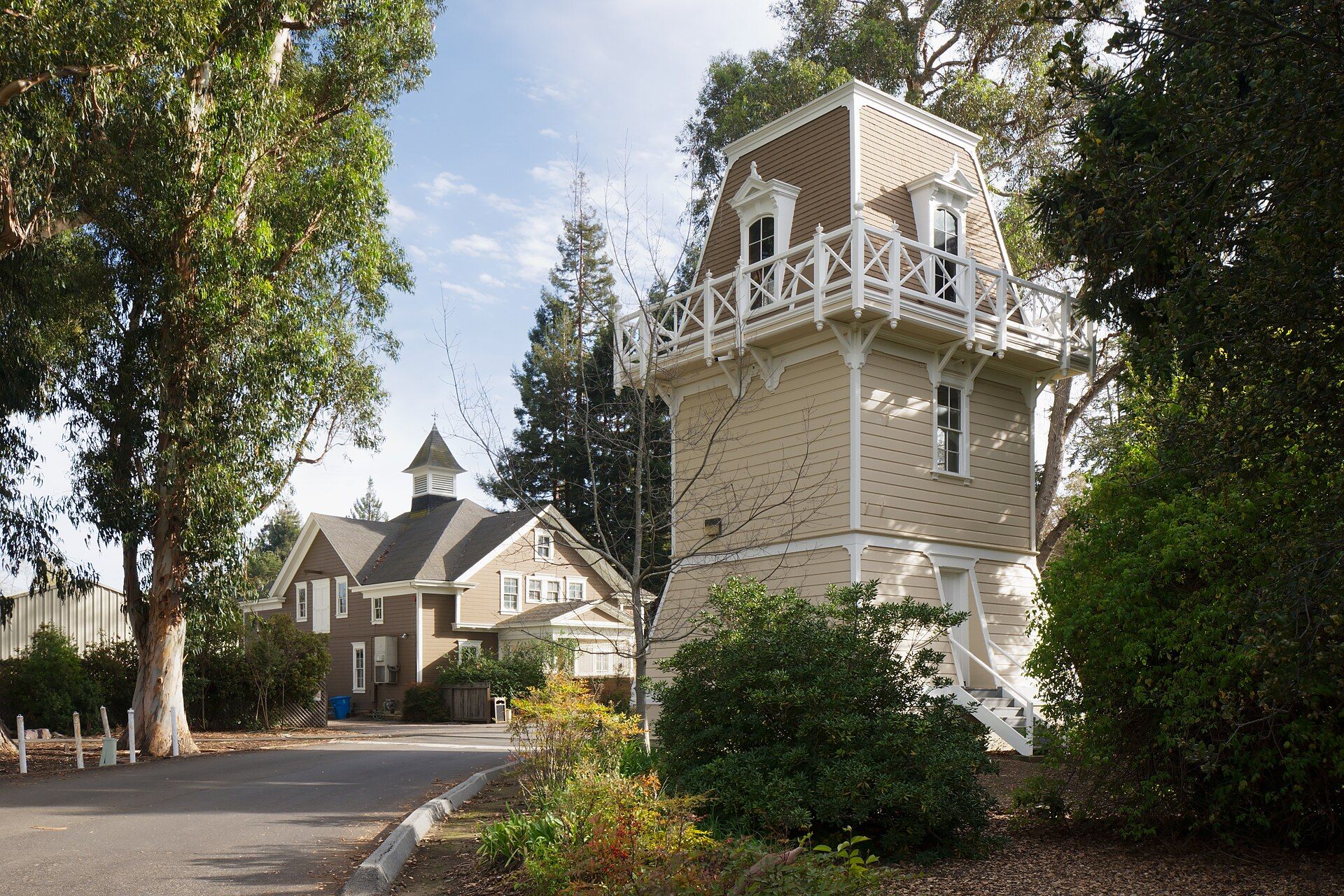





























 Holbrook-Palmer Estate
 Menlo Circus Club
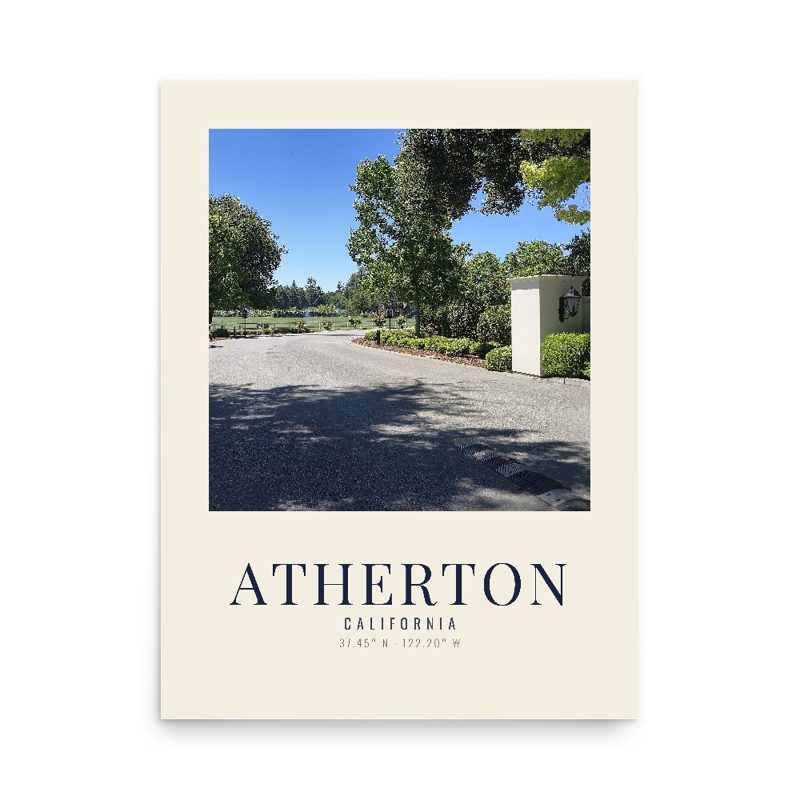
 A view of Atherton
 A view of Atherton