Diamondville is a town in Lincoln County, Wyoming, United States, often used as a suburb of neighboring Kemmerer.
Every piece is drawn from Diamondville's own map data and historic archives, then printed and shipped from the USA when you order. No two towns look alike.
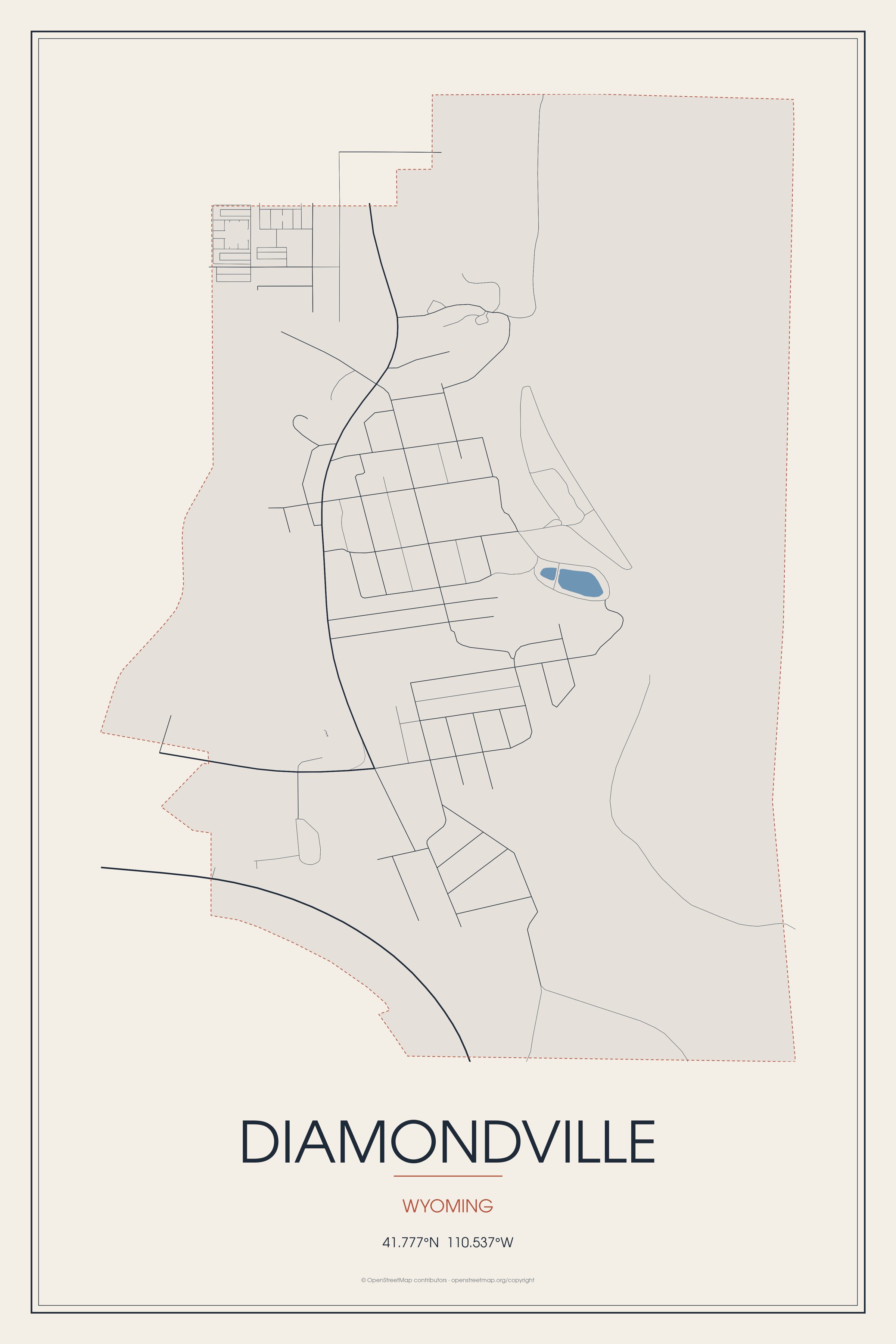
Every road in town, on archival matte paper

The same map, in navy and silver
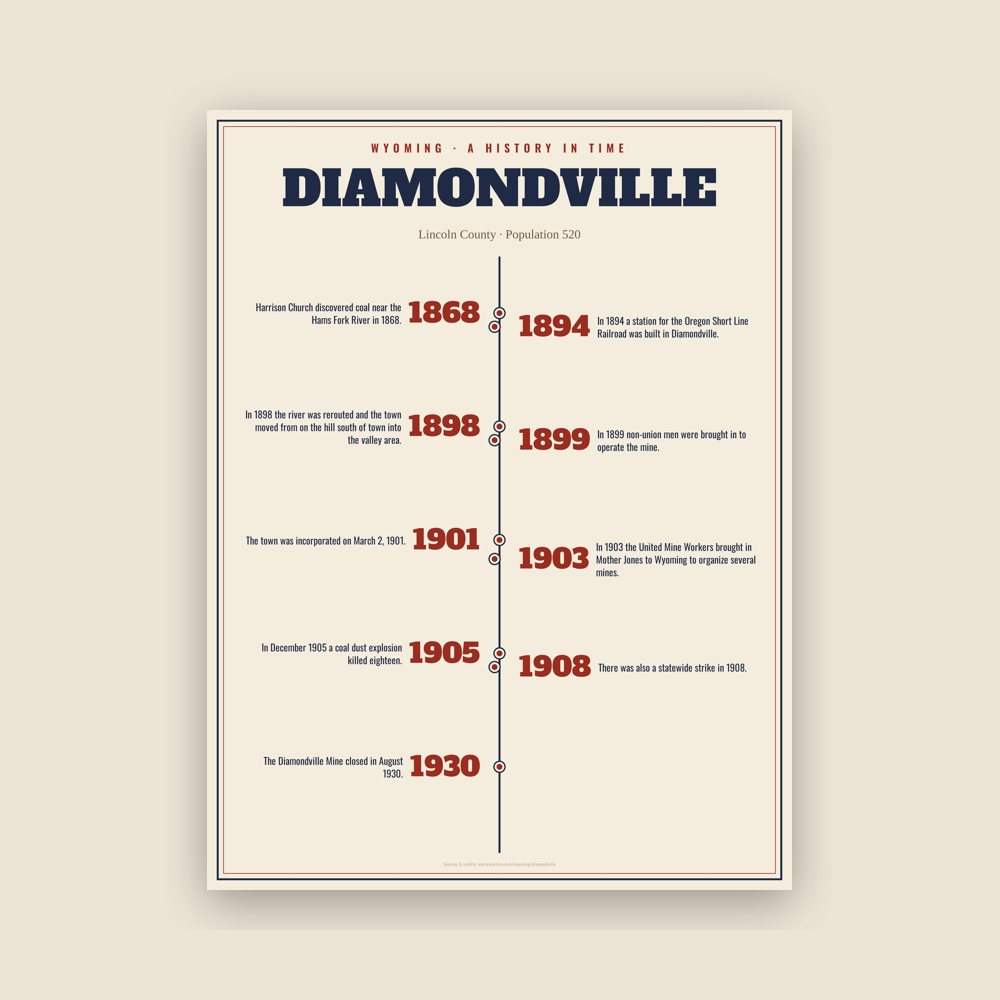
The town's story in dates, from its own records, for home or classroom
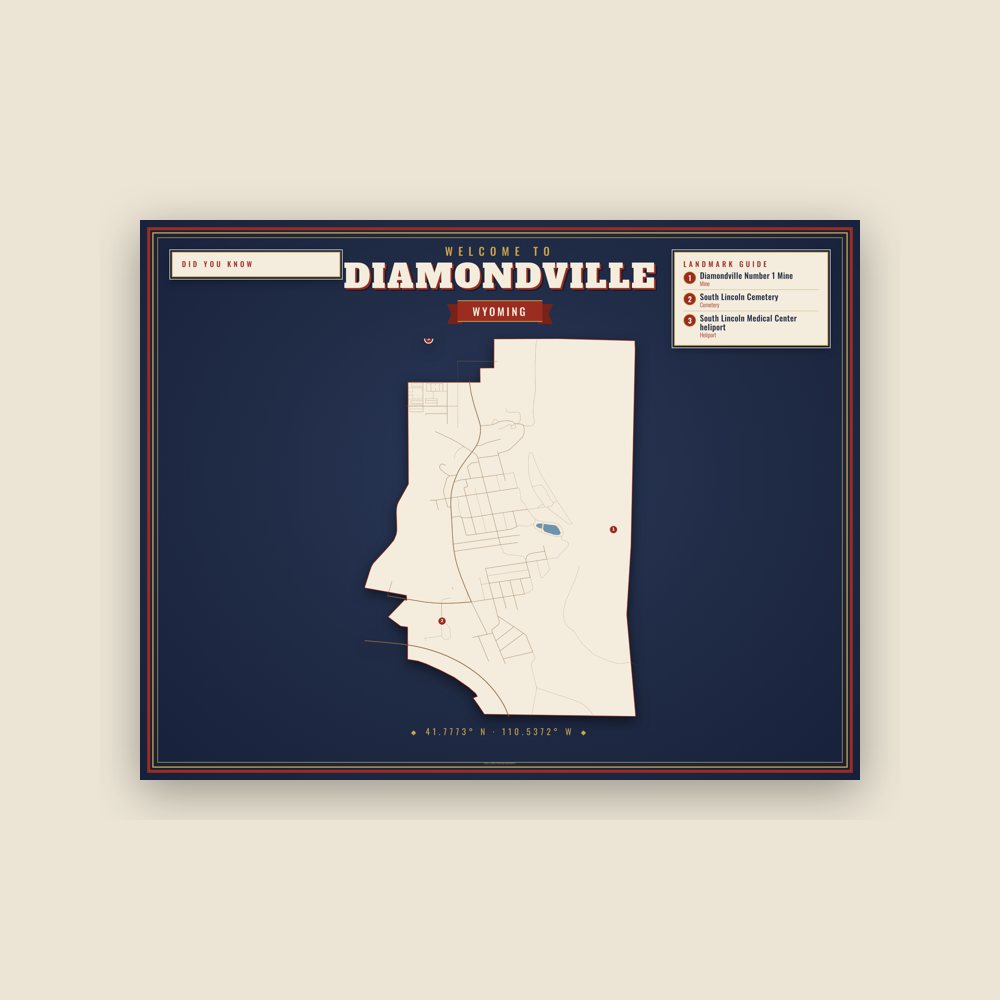
Map of local landmarks, washable fabric
Heavy-blend fleece, street map printed on the back
Soft Bella+Canvas jersey
Glossy ceramic, dishwasher safe
Ceramic keepsake, gold ribbon
Weatherproof, for the front walk
24″×16″, printed coir-look fibers, rubber back
12″×12″ printed wood, ready to hang
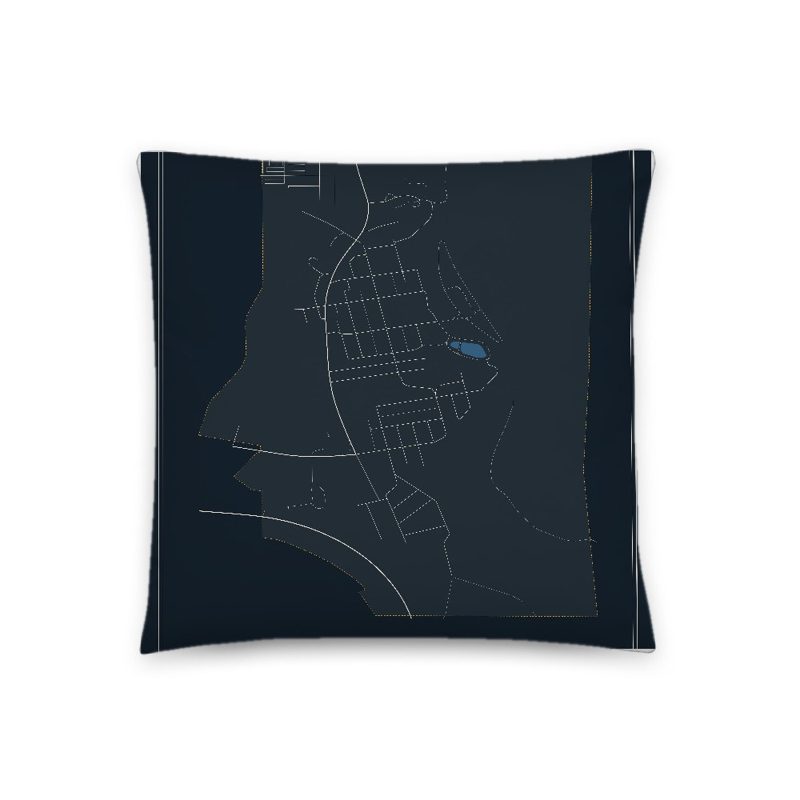
Soft-touch, zip cover

Sturdy all-over-print tote
Glossy top, cork back
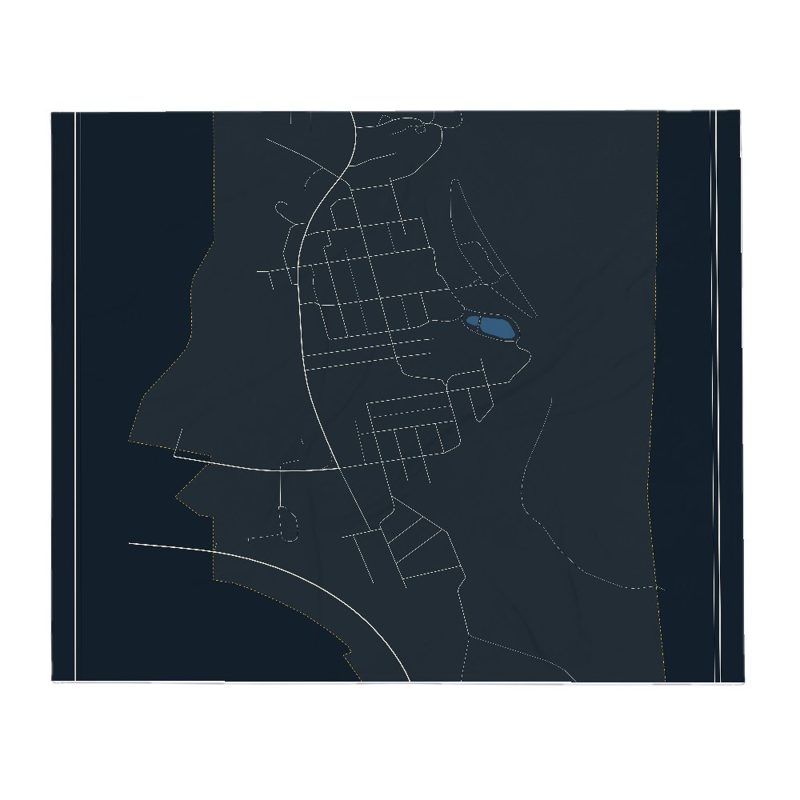
Soft fleece, 50″×60″
20 oz, double-wall stainless
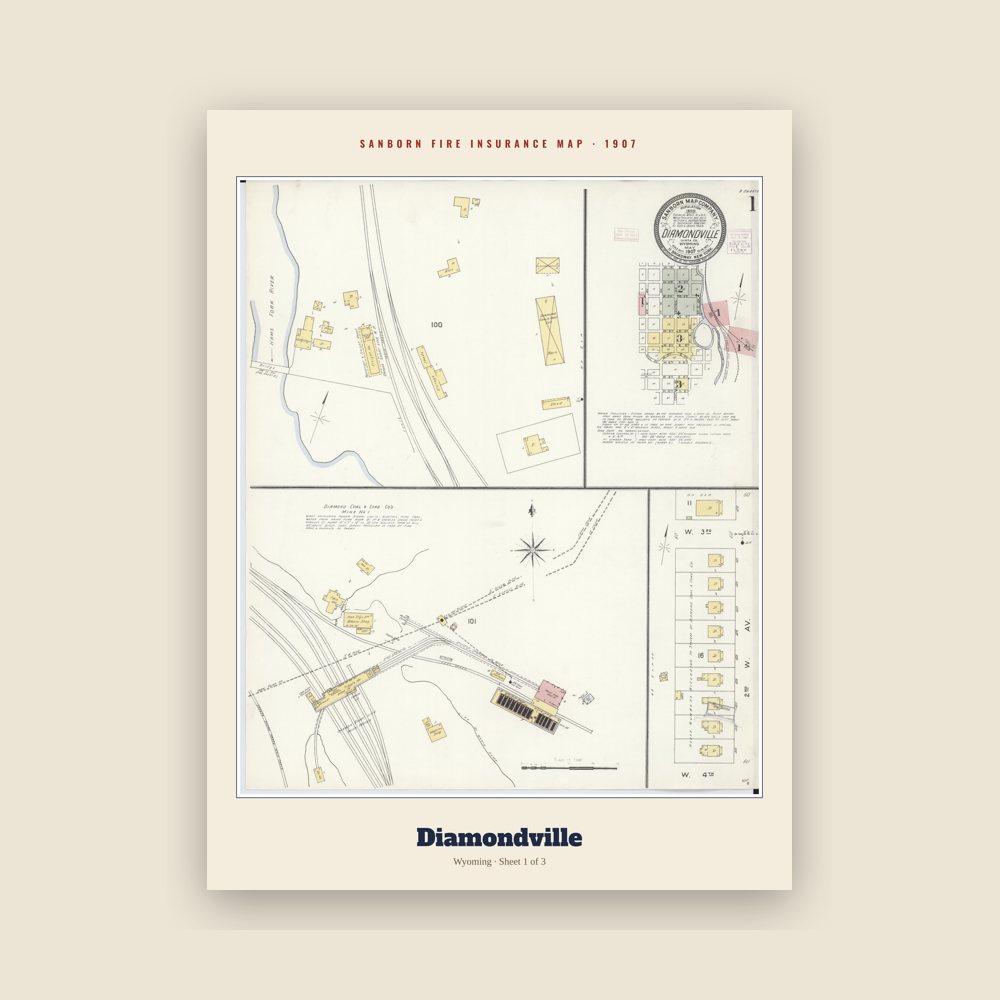
The town's earliest Sanborn fire-insurance map, drawn building by building and hand-coloured, from the Library of Congress
Harrison Church discovered coal near the Hams Fork River in 1868. He gathered financial backing from a group in Minneapolis, and they formed the Hams Fork River Coal Company. Diamondville was built to house the miners. The management of the coal company came to S.F. Fields in Salt Lake City. He sought backing from the Anaconda Mining Company and renamed it Diamond Coal and Coke Company.
Many of the workers came from Almy, Wyoming where the mines had several explosions. The miners mainly lived in a "shack town" as no houses were built.
In 1894 a station for the Oregon Short Line Railroad was built in Diamondville. In 1898 the river was rerouted and the town moved from on the hill south of town into the valley area.
By the early 1900s there was a Mercantile, butcher shop, bakeries, photography studio, theater, dress shop, hardware store, and thirteen saloons. The Daly Hotel was a three story structure with fifty rooms, a dining room, barbershop, and saloon.
The town was incorporated on March 2, 1901. Thomas Sneddon, superintendent of the Diamondville Mine, became the first mayor.
The Diamondville Mine closed in August 1930. There is no longer an underground mine but there is an open-pit mine nearby.
The mine suffered a number of fires, explosions, and deaths during its operations. The first recorded fire was in December 1898. Practice at the time was to seal off the area, robbing the fire of oxygen, and continue operations in other areas of the mine. The fire continued for six weeks, eventually resulting in two deaths. Another fire started February 1901. This time miners and horses were left inside when it was sealed. The final report listed thirty two deaths. In December 1905 a coal dust explosion killed eighteen.
The miners led strikes in 1898, 1899, and 1903. There was also a statewide strike in 1908. The mine reacted strongly to these attempts at reform. In 1898 the miners and families were evicted. In 1899 non-union men were brought in to operate the mine. This time wives and daughters of the union workers marched on the mines. In response the mine called in over seventy five deputies. In 1903 the United Mine Workers brought in Mother Jones to Wyoming to organize several mines. The superintendent replied that she would be jailed if she attempted to influence the mine in Diamondville.
Adapted (trimmed) from the Wikipedia article Diamondville, Wyoming, revision 1377177497 by its contributors, licensed CC BY-SA 4.0.
We share a part of every Diamondville sale with local partners, and we'd love to print from your collection. Old photographs, maps and postcards make the best keepsakes.
Partner with us