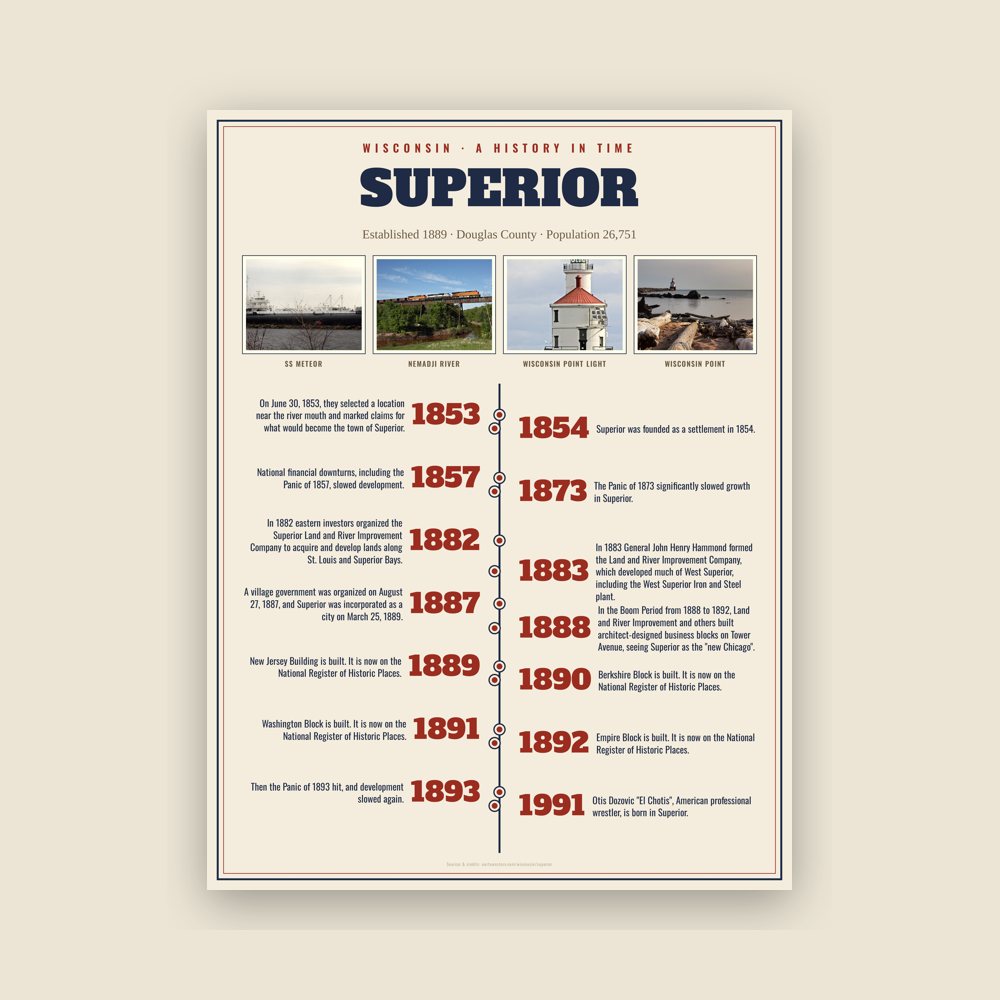
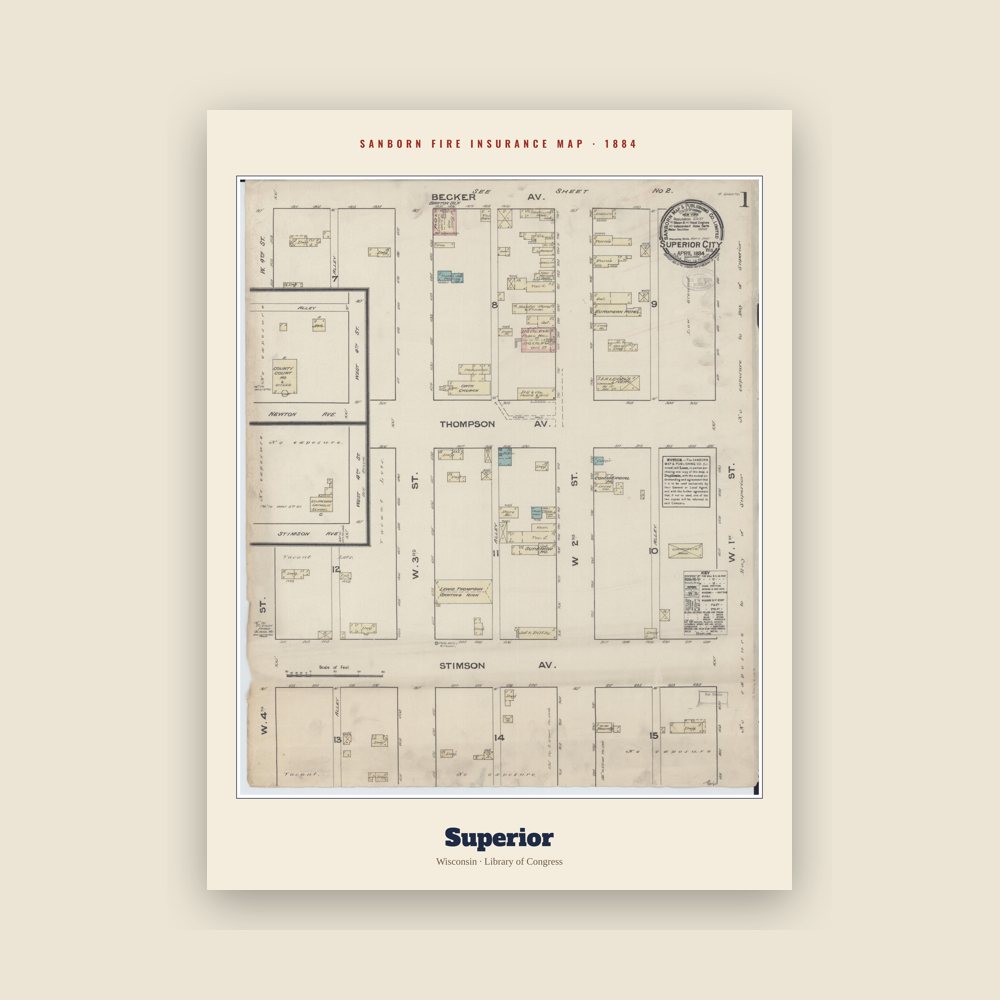
The first log cabin in Superior was erected in September 1853 on the banks of the Nemadji River, at the same time that ground was broken for construction of the locks and ship canal at Sault Ste. Marie, Michigan. This was intended to allow ships to bypass the rapids at that site. Superior was founded as a settlement in 1854. A village government was organized on August 27, 1887, and Superior was incorporated as a city on March 25, 1889. Around the same time Superior became the seat of newly formed Douglas County, Wisconsin. Immediately there was eagerness for a railroad from Lake Superior to the Pacific Coast, and investment flowed in, but then the Panic of 1857 hit, investment slowed, and the population of the new city collapsed from 2500 to 500.
Twenty-five years later the Northern Pacific Railway and other rail lines finally arrived, fulfilling the dream of a rail and water highway from coast to coast. In 1883 General John Henry Hammond formed the Land and River Improvement Company, which developed much of West Superior, including the West Superior Iron and Steel plant. Numerous grain, coal and lumber businesses formed in the same period.
In the Boom Period from 1888 to 1892, Land and River Improvement and others built architect-designed business blocks on Tower Avenue, seeing Superior as the "new Chicago". Many of the investors were from out East, so the buildings received names like the New Jersey Block and the Maryland Block. By 1892, population was 34,000. Then the Panic of 1893 hit, and development slowed again.
Read the full history
Pre-settlement context
Prior to Euro-American settlement, the site of present-day Superior formed part of the Ojibwe (Anishinaabe) homeland at the Head of the Lakes, with activity centered along the St. Louis River estuary and Nemadji River.
The opening of this land to United States survey and settlement followed the Treaty of La Pointe (1842) and Treaty of La Pointe (1854), through which the Ojibwe ceded territory in northern Wisconsin. These agreements facilitated the federal surveys conducted in 1853, leading to the subsequent establishment of a townsite at the Head of the Lakes, which ultimately resulted in the founding of Superior. Documented collections of Ojibwe place names within the treaty-ceded territories also record an Ojibwe name for Superior, Gete-oodenaang (glossed as "at the old town").
Survey and founding (1853–1854)
In 1853, the federal government commissioned surveys of the Head of the Lakes region as part of broader efforts to identify transportation routes and potential townsites in northern Wisconsin. Surveyor George R. Stuntz mapped the shoreline and river mouths near the Nemadji River and reported that the Wisconsin side of the harbor offered space for docks and settlement. His findings drew the attention of land promoters connected to railroad interests in Minnesota and Illinois.
Later that year, Joseph Bullen and John Talleyrand Morgan traveled from St. Paul, Minnesota to the Nemadji River to establish a townsite. Their route followed an overland trail through swamp and forest that later became known as the Military Road. On June 30, 1853, they selected a location near the river mouth and marked claims for what would become the town of Superior.
The first plat of Superior was filed in 1854. It reflected expectations that a transcontinental railroad would terminate at the Head of the Lakes and that shipping traffic would pass through the natural harbor. Although these expectations were speculative, they shaped the town's early layout and attracted settlers, merchants, and investors during the following decade.
Early settlement and immigration (1854–1870)
Following the filing of the town plat in 1854, settlement proceeded slowly. Early arrivals included traders, lumber workers, and families connected to river and harbor activity. Small frame buildings were erected near the Nemadji River and along the bay, and a rudimentary dock supported lake traffic during the shipping season.
Stephen Bungo, a frontiersman of mixed Ojibwa and African American ancestry, was among the early residents of Superior and participated in civic and community life during the town's formative years. Nineteenth-century newspaper accounts describe his involvement in local political meetings, including appearances before the county board, while later historical articles identified him as a longtime resident associated with early settlement at the Head of the Lakes. Bungo worked as an interpreter and was connected with early religious organization in the community, including the founding of Methodist institutions in Superior. In retrospective accounts, he was described as having claimed to be "the first white man" at the Head of the Lakes, a statement reflecting contemporary attitudes that was later noted in local histories. His legacy was later commemorated in Superior through historical articles, a monument dedication, and community observances such as "Stephen Bungo Day."
By the late 1850s and 1860s, immigrants from Norway, Sweden, Germany, Cornwall, and eastern Canada joined American settlers from Minnesota and Illinois. Many worked in lumbering, fishing, or small-scale commerce. Settlement patterns tended to follow occupational and family networks, with Scandinavian families settling near one another and Cornish miners establishing homes near higher ground west of the bay.
Economic growth was uneven during this period. National financial downturns, including the Panic of 1857, slowed development. Nonetheless, the population increased gradually, and local institutions began to form, laying the groundwork for later municipal organization.
Early newspapers and civic institutions (1860s–1870s)
By the 1860s, local newspapers began operating in Superior. Early publications included the Superior Chronicle and later the Superior Times. These papers reported on shipping activity, land sales, and regional politics, and they often promoted the advantages of settlement at the Head of the Lakes.
Municipal organization developed gradually. For much of the period, services such as road maintenance and fire response were handled informally or through county structures. As population increased, residents petitioned for clearer civic administration and local governance. By the 1870s, the settlement had begun to adopt more formal procedures for taxation, public works, and record keeping.
Faith and religious institutions (1854–1870s)
Religious organizations formed soon after settlement. Catholic missionaries were among the earliest clergy to visit the area, and St. Francis Xavier parish was established during the 1850s. Protestant congregations followed, including Presbyterian, Episcopal, and later Scandinavian Lutheran churches serving Norwegian and Swedish immigrants.
As the population increased, congregations built permanent structures and established regular services. These institutions provided social organization in addition to religious practice and became part of the emerging civic framework of the settlement.
During the 1860s and 1870s additional Protestant denominations organized congregations, including Methodist, Baptist, and Congregational churches. Many early services were initially held in private homes, temporary halls, or shared buildings before permanent church structures were constructed. Immigration patterns influenced the development of Lutheran congregations, with Norwegian, Swedish, and later Finnish settlers establishing churches that reflected language and ethnic identity.
Catholic parish life expanded as immigration from Ireland, Germany, and Poland increased in the latter nineteenth century. Parochial schools were later established in connection with several parishes, reflecting the growing stability of Catholic institutions in the community.
Economic rivalry and setback (1870s)
During the 1870s, development at the Head of the Lakes was shaped by competition between Superior and neighboring Duluth. Both communities sought railroad connections and control of harbor facilities. Promoters in each city advanced plans to attract investment and secure transportation links to the interior.
The Panic of 1873 significantly slowed growth in Superior. Railroad expansion stalled, land sales declined, and several planned improvements were postponed. Duluth obtained key rail connections during this period, which affected commercial traffic patterns in the region. Superior's population growth slowed as a result, and many early expectations about rapid expansion were not realized during the decade.
Renewed development and incorporation (1880–1889)
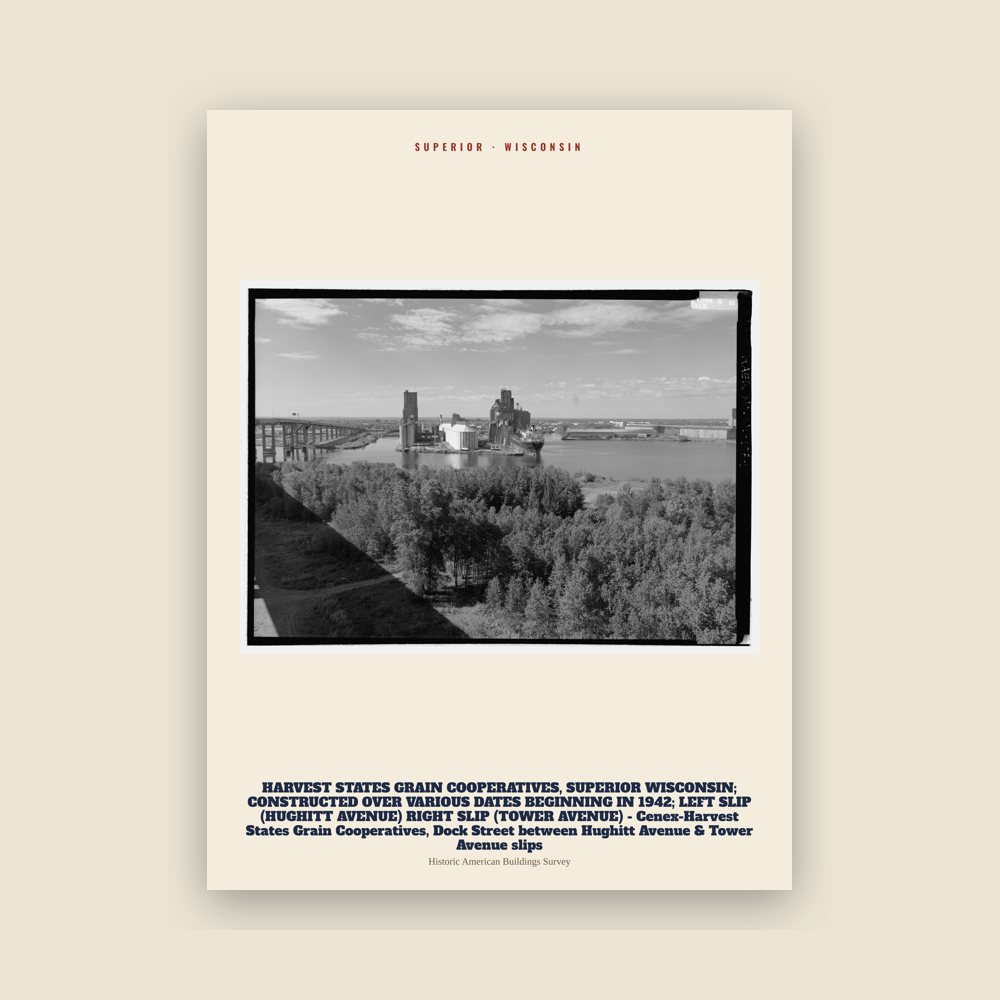
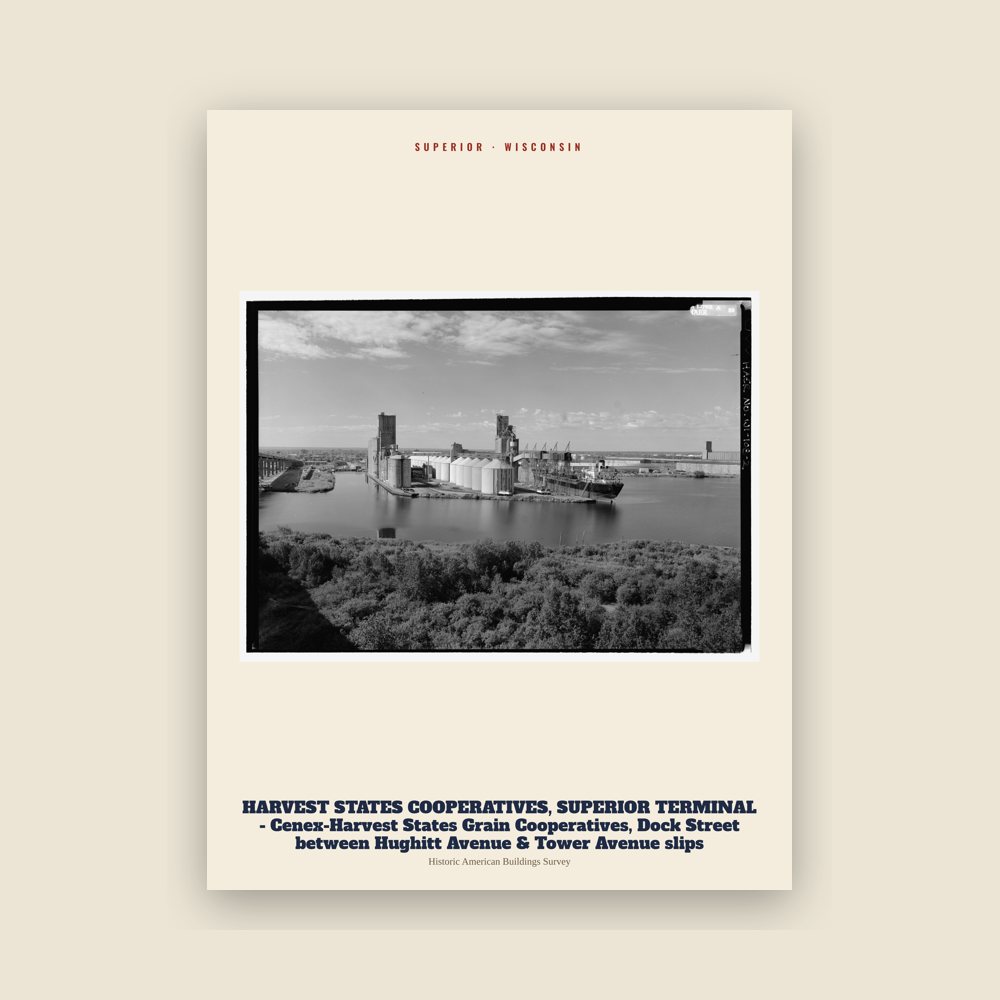
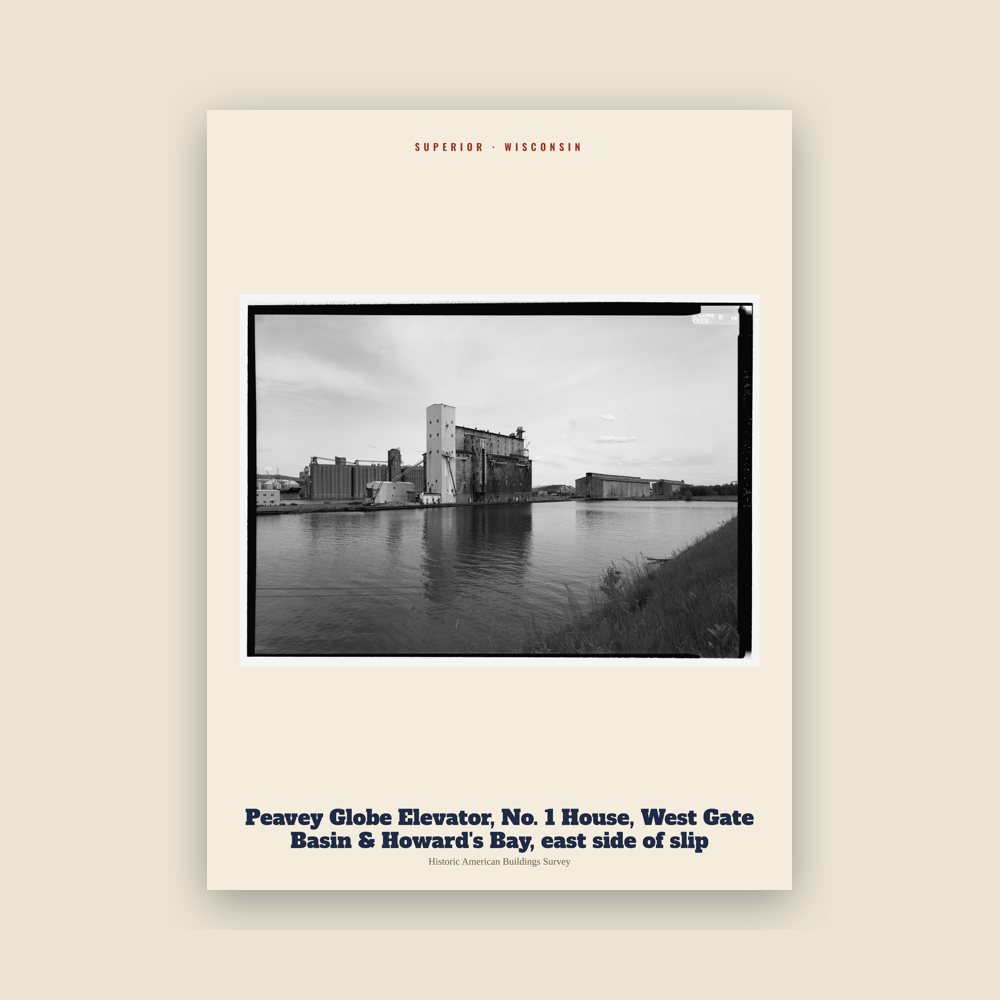
Economic activity increased in Superior during the 1880s as railroad construction resumed and regional iron mining expanded. Harbor improvements and dock construction supported shipping traffic on Lake Superior. Land development companies renewed efforts to promote settlement and commercial investment at the Head of the Lakes.
In 1882 eastern investors organized the Superior Land and River Improvement Company to acquire and develop lands along St. Louis and Superior Bays. General John Henry Hammond directed field operations during the company's early years, overseeing surveys and platting, grading of streets, clearing of acreage, and establishment of dock lines and terminals. The company promoted rail connections and waterfront access to support ore shipments and industrial growth. Corporate leadership later shifted to Francis Henry Weeks, who continued large-scale development following Hammond's tenure.
Hammond also participated in efforts to secure federal harbor improvements. In the mid-1880s he traveled to Washington, D.C., with local representatives to obtain a War Department order requiring a navigable draw in the Northern Pacific bridge over the St. Louis River, preserving access to Superior's channel. Subsequent dredging and dock construction expanded the city's shipping capacity and reinforced its position within the regional iron and grain trade.
Population increased during the decade, and municipal organization advanced toward formal city status. On March 25, 1889, the Wisconsin State Legislature incorporated the City of Superior, consolidating previously separate jurisdictions under a single municipal government.
Jewish immigrants also settled in Superior during the 1880s, many arriving from Lithuania and other parts of Eastern Europe. The Hebrew Brotherhood Congregation (est. 1890) and the Superior Hebrew Congregation (est. 1895) later constructed synagogues across from one another at the intersection of North Sixth Street and Hammond Avenue in 1905 and 1907. By the early twentieth century, the Jewish population in the city numbered in the hundreds.
Growth, eastern investment, and the Panic of 1893 (1890–1900)
Following the incorporation of the City of Superior in 1889, development continued under the Superior Land and River Improvement Company and related railroad and industrial interests. General Hammond died in 1890, after which the company's leadership and operations continued under its corporate officers and managers, including Francis Henry Weeks (president) and Rowland J. Wemyss (general manager).
Superior's late nineteenth-century boom drew capital from eastern investors. The Wisconsin Magazine of History describes how James Roosevelt I helped capitalize the West Superior Iron and Steel Company by investing himself and raising additional funds from business associates, and it notes that Roosevelt made multiple trips to Superior during the period when the iron-and-steel and related shipbuilding enterprises were being promoted. Contemporary accounts cited in the article describe the wake from a whaleback launch soaking spectators and nearly drowning Roosevelt's young son, Franklin D. Roosevelt, during one of these visits.
The same article reports that Francis H. Weeks, while serving as president of the Land and River Improvement Company, transferred more than $500,000 from the company into the Iron and Steel Company without the knowledge of Land and River officials, and that the Panic of 1893 exposed broader financial misconduct tied to Weeks's handling of investor funds. It further notes that Weeks was deposed from leadership, fled abroad, later returned to the United States, and was tried and convicted (on a single count of robbery), receiving a ten-year hard-labor sentence at Sing Sing. The article describes James Roosevelt's subsequent visits as including efforts to reassure Superior residents and stabilize confidence in the industrial venture after Weeks's removal.



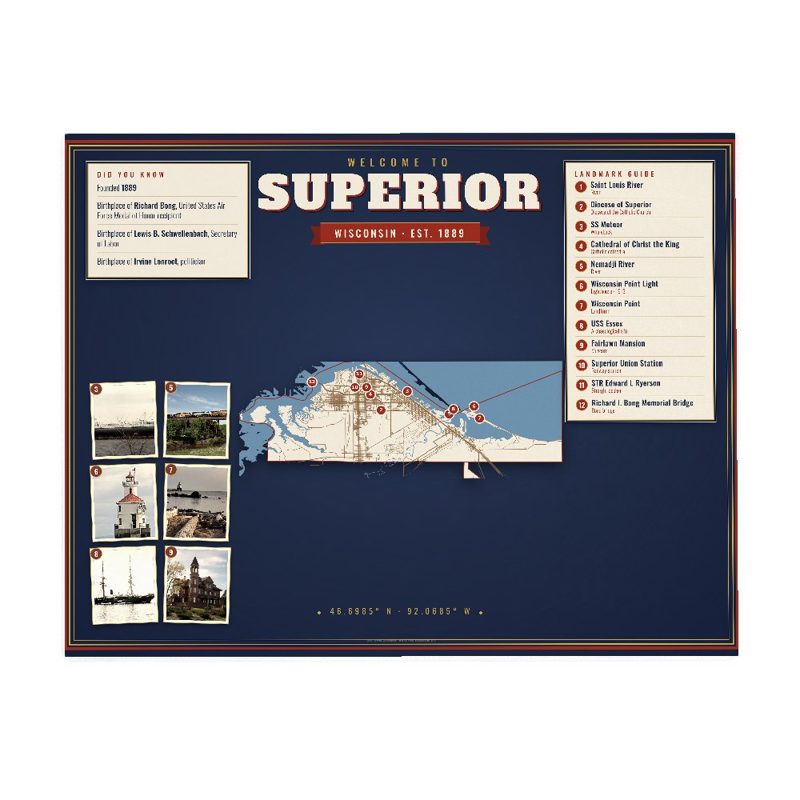













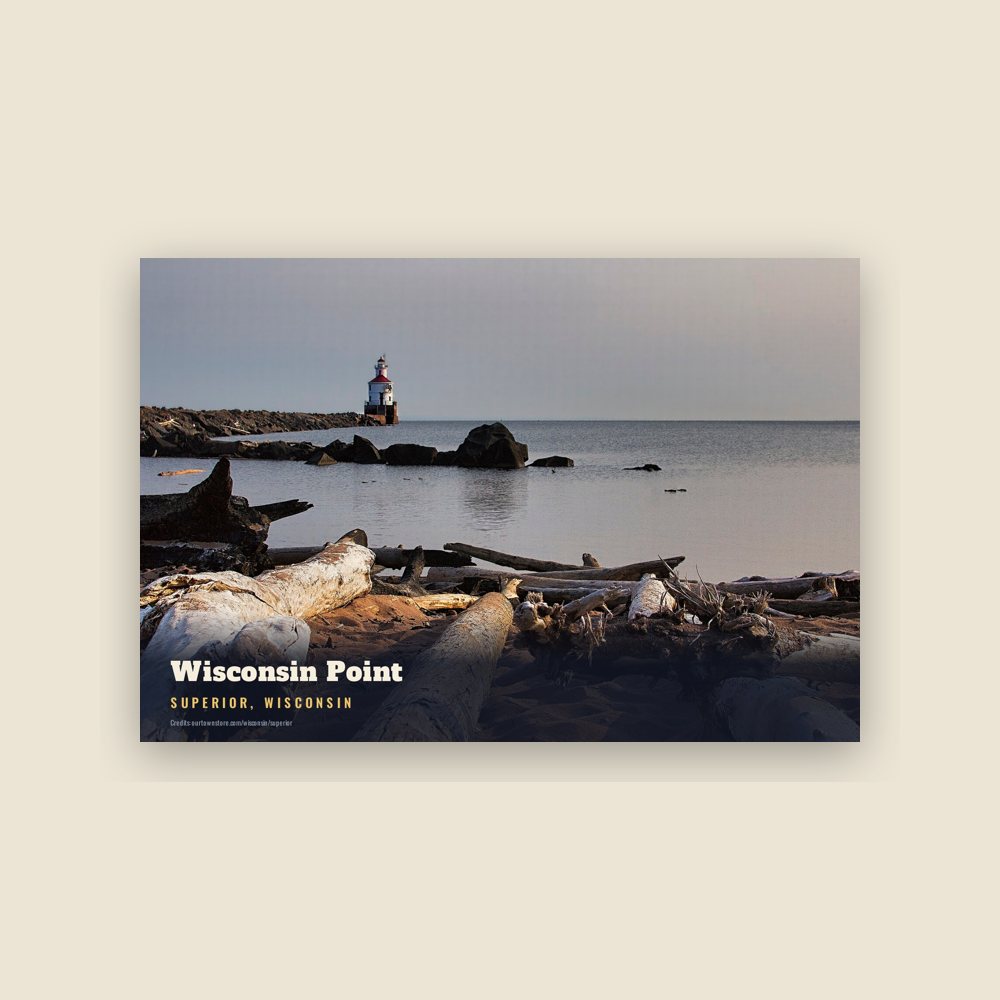
 Wisconsin Point Light
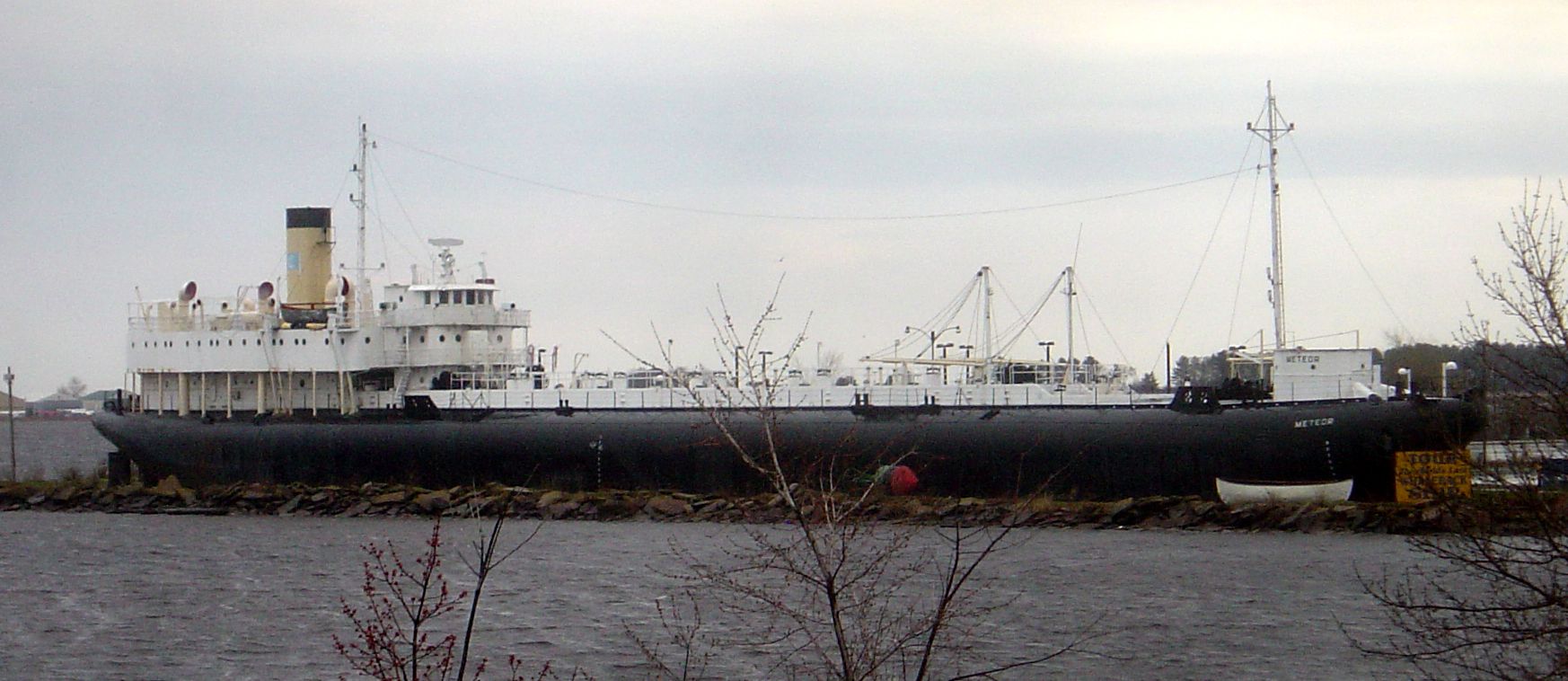
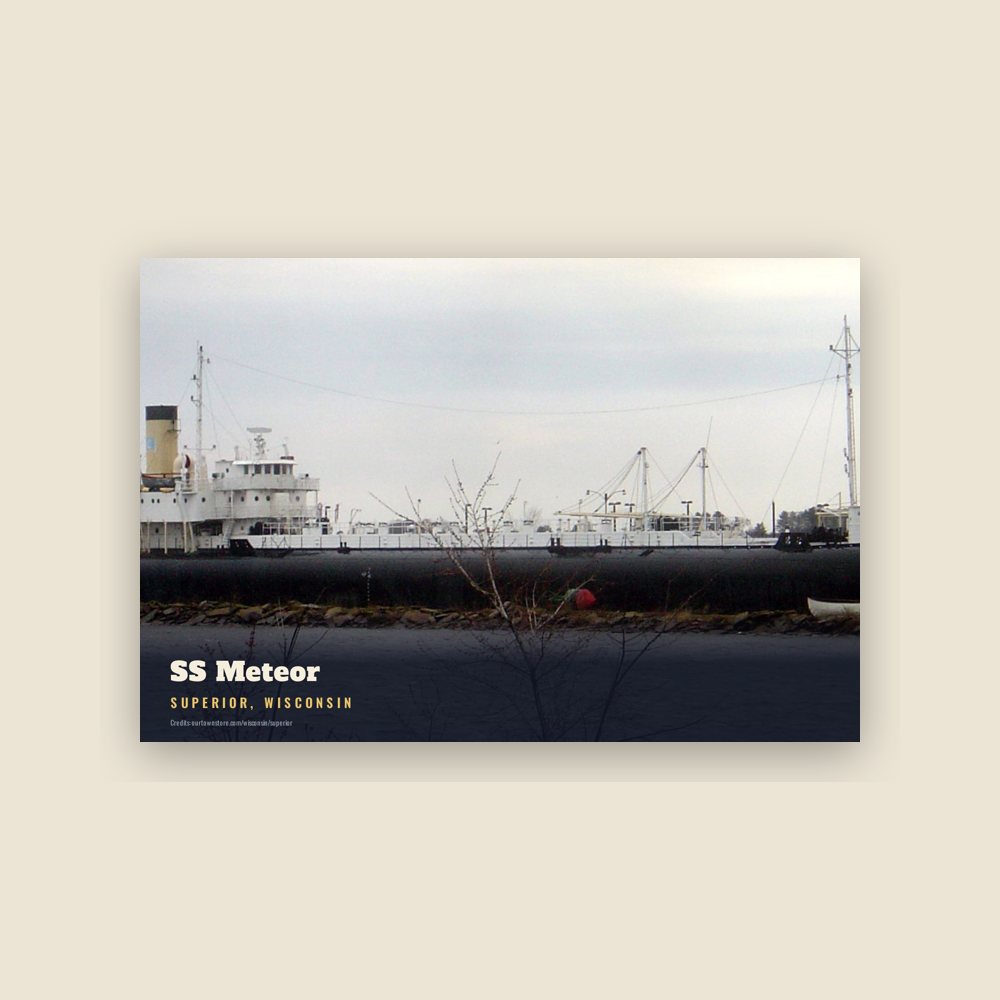
 SS Meteor
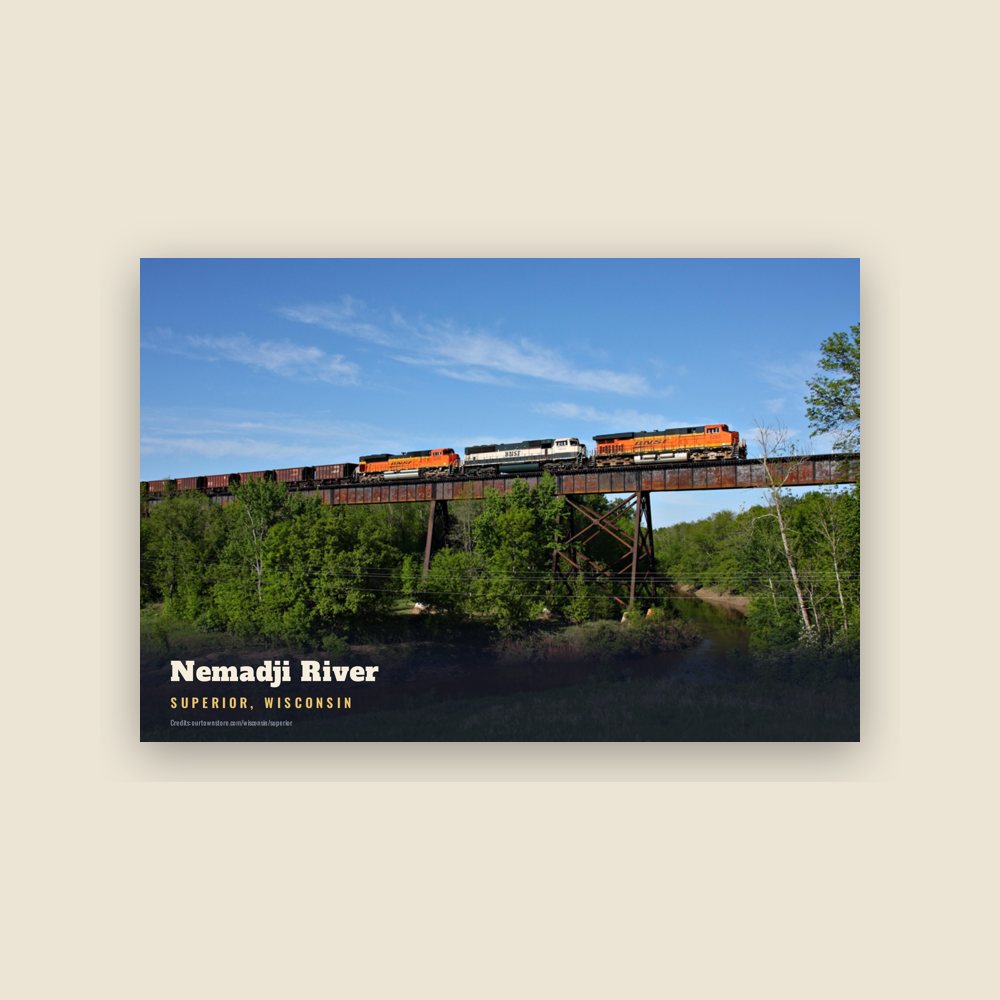
 Nemadji River
 Wisconsin Point