Soldiers Grove was first settled in 1856 by Joseph H. Brightman, who began a sawmill at the site to process logs rafted down the Kickapoo River.
- CountyCrawford County
- Population552 (2020 U.S. Census)
Soldiers Grove, Wisconsin gifts and souvenirs: 26 designs made from Soldiers Grove's own map, landmarks and history, from $16 to $95. Printed to order and shipped free in the USA.
| Popular | Price |
|---|---|
| Soldiers Grove Hometown Ornament | $23 |
| Soldiers Grove Vintage Travel Poster | from $40 |
| Soldiers Grove Varsity Crewneck | from $57 |
| Soldiers Grove Est. Tee | from $33 |
| Soldiers Grove Town Line Mug | from $26 |
| Soldiers Grove Market Tote | $37 |

Ceramic keepsake, gold ribbon, in 3 styles

Its landmark photo in a classic travel-poster layout

A local landmark photo as a gallery print

Classic large-letter postcard art, filled with local photos

The town's story in dates, from its own records, for home or classroom
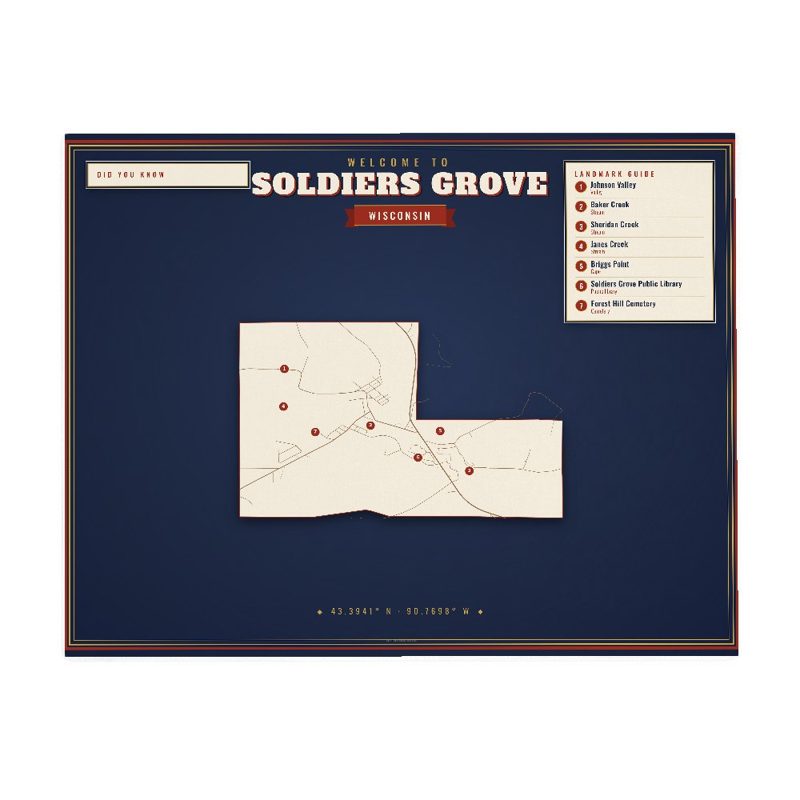
Map of local landmarks, washable fabric

Heavy-blend fleece, street map printed on the back
Red heavy-blend crewneck, knit-stitch town print

Soft Bella+Canvas jersey

Kids' Bella+Canvas jersey, youth sizes

Bella+Canvas toddler jersey

Bella+Canvas baby bodysuit

Large-letter postcard art filled with local photos

Glossy ceramic, dishwasher safe

Large-letter postcard art filled with local photos, 11 oz ceramic

Weatherproof, for the front walk

24″×16″, printed coir-look fibers, rubber back
12″×12″ printed wood, ready to hang

Soft-touch, zip cover

A local landmark photo with the town name, 18″×18″

Sturdy all-over-print tote

Large-letter postcard art on a sturdy tote

Foam-front trucker, printed (not embroidered) with local photos
Glossy top, cork back
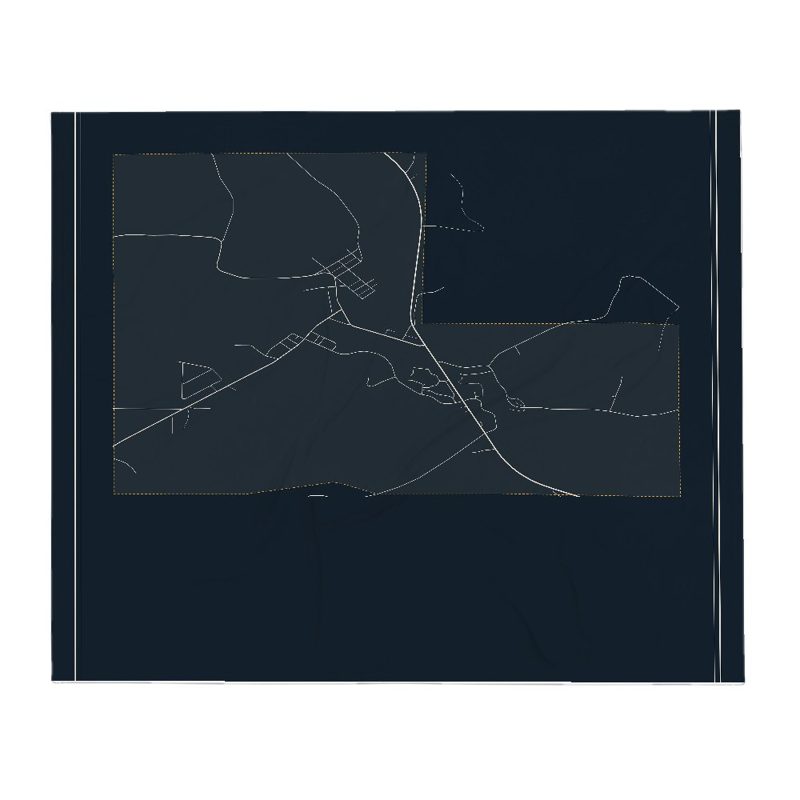
Soft fleece, 50″×60″
20 oz, double-wall stainless
Soldiers Grove was first settled in 1856 by Joseph H. Brightman, who began a sawmill at the site to process logs rafted down the Kickapoo River.
Soldiers Grove was first settled in 1856 by Joseph H. Brightman, who began a sawmill at the site to process logs rafted down the Kickapoo River. The village which sprang up near the sawmill was initially named "Pine Grove" because of the abundance of Eastern White Pine in the vicinity. In 1867, the village's name was changed to "Soldiers Grove" to commemorate the troops who had camped in the area during the Black Hawk War.
In its early years, Soldiers Grove depended upon the Kickapoo River for timber rafting and hydropower for flour and lumber mills. The village's proximity to the river became a liability in the early twentieth century, however, when major floods began to afflict the settlement. Significant flooding occurred in 1907, 1912, 1917, and 1935. Following the last of these incidents, Soldiers Grove and other area communities petitioned the United States Congress to provide funds for a flood control project.
Despite another major flood in 1951, Congress did not agree to a flood control plan until 1962, when it authorized a project that included levees and a flood control dam on the Kickapoo River upstream of Soldiers Grove near La Farge, Wisconsin. Owing largely to environmental concerns, however, construction of the proposed dam was halted partway through construction in 1975 and never finished. In the meantime, a 1974 floodplain zoning ordinance had already taken effect in Soldiers Grove, prohibiting new construction and severely limiting maintenance options near the river and crippling the village's downtown area. Although a levee proposed by the U.S. Corps of Engineers in 1975 would have lessened the restrictions, the village rejected the plan because of costs. While the downtown property was worth approximately $1 million, a levee to protect it would have required $3.5 million to construct and an additional $10,000 a year afterward for annual maintenance.
Rather than building and maintaining a levee, village leaders proposed that the federal funds already appropriated for levee construction be used instead to relocate the business district away from the floodplain. Federal agencies repeatedly denied this request, however. Even so, in 1977 the village used its own funds to purchase land on nearby high ground onto which the business district could be relocated.
In 1978, flooding again inundated the Soldiers Grove area. In the aftermath of the disaster, $900,000 in federal funds were finally provided to assist in relocating the village's business district to higher ground. Construction of the new business district began in 1979 and was completed by 1983. A park replaced the old downtown area along the river. Although major flooding occurred along the Kickapoo River again in 2007 and 2008, the village escaped major damage by virtue of the relocation.
When Soldiers Grove began its relocation project in 1979, the United States was suffering from its second oil crisis in six years. In response to high energy costs, an energy task force for the Soldiers Grove relocation recommended that the new business district use solar heating. Despite the village's location in the northern state of Wisconsin, studies showed it was feasible for new buildings to achieve a majority of their heat from solar energy. Consequently, the village council, led by eco-champion Daniel Naccarato, enacted an unprecedented ordinance requiring all new commercial buildings obtain at least 50% of their heat from the sun. Another law prohibited any new structure from blocking sunlight to another building.
To meet the solar energy requirements, buildings in the new business district were constructed with heavy insulation and earth-berming to supply thermal mass. South facing roof slopes and windows were built to capture maximum sunlight, and blowers and hydronic systems were installed to circulate the collected heat. Over twenty solar heated businesses were eventually built in the small community. While federal funds had been allocated to help relocate businesses from the floodplain, no additional federal monies were provided for the solar heating initiative.
In addition to solar heating, the village of Soldiers Grove passed ordinances for the new business district that mandated handicapped accessibility, placed restrictions on advertising signs, and promoted the use of natural building materials.
According to a 2003 report in Solar Today magazine, poor upkeep and lax regulation has reduced the energy efficiency of some of the solar heated businesses, but "most of the buildings are still excellent examples of solar energy at work."
Adapted (trimmed) from the Wikipedia article Soldiers Grove, Wisconsin, revision 1374935171 by its contributors, licensed CC BY-SA 4.0.
We share a part of every Soldiers Grove sale with local partners, and we'd love to print from your collection. Old photographs, maps and postcards make the best keepsakes.
Partner with usA favorite landmark, your street, a school or team, an anniversary gift, a different product. Tell us and we'll get back to you by email.
3 free coloring pages of Soldiers Grove, each traced from a photo of a local landmark. Print them at home, at school or for story hour.
Soldiers Grove's population was 552 in the 2020 U.S. Census, down from 592 in 2010.
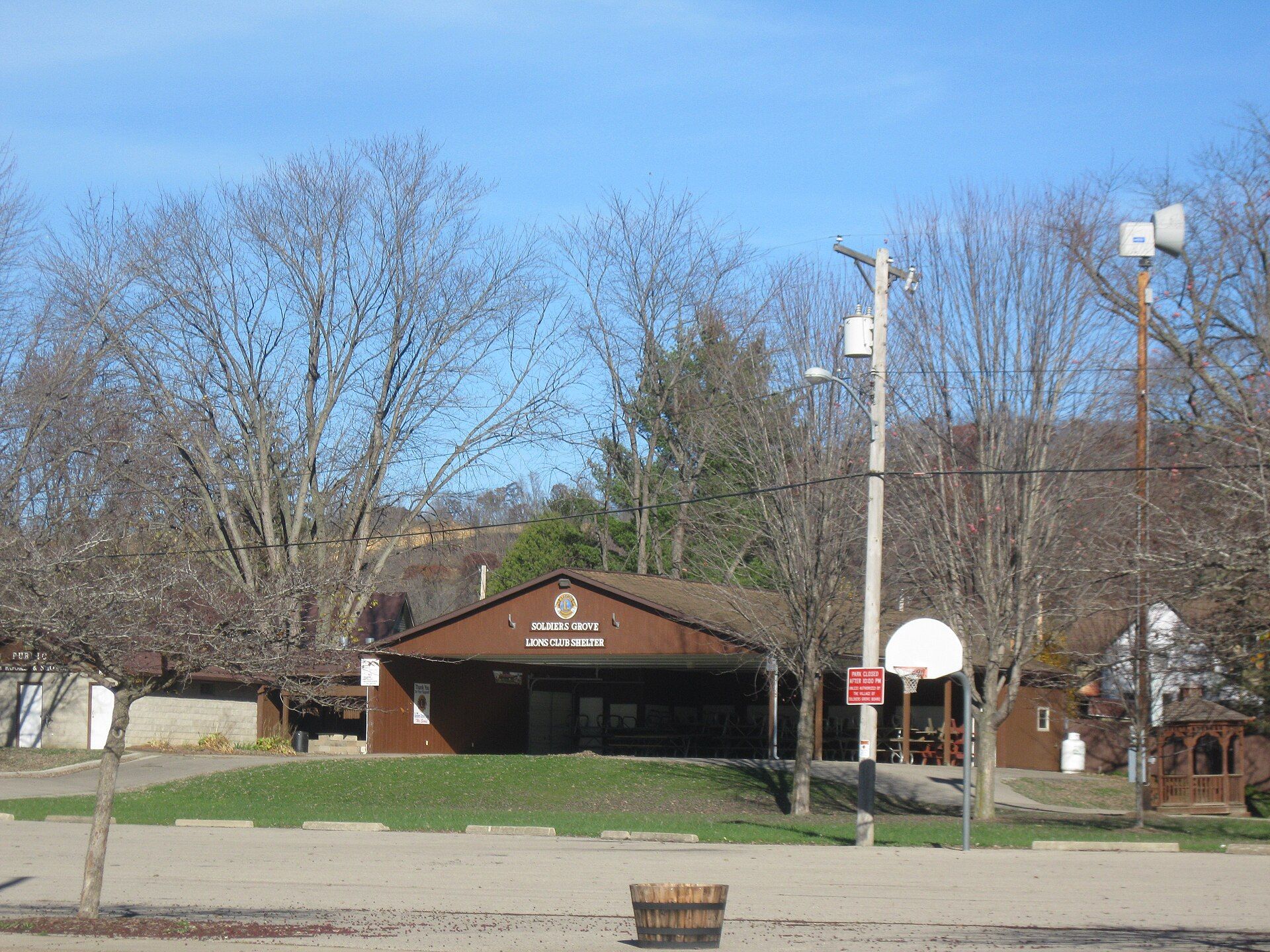
 A view of Soldiers Grove
 A view of Soldiers Grove
 A view of Soldiers Grove