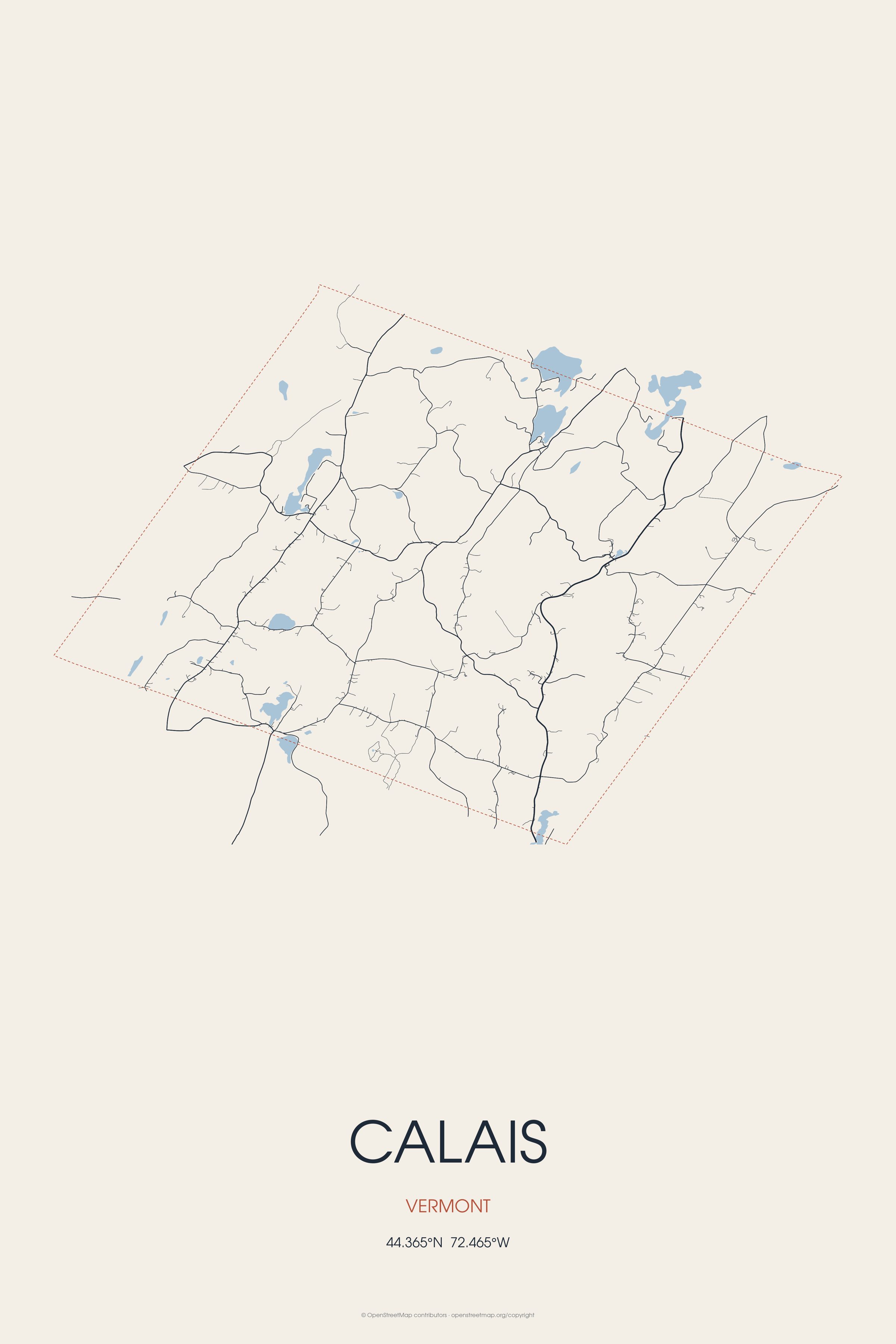
Calais contains the unincorporated communities of Adamant, East Calais, North Calais, Kents Corner, Maple Corner and Pekin. Landmarks include Kents Corner Historic District, Old West Church and North Calais Village Historic District. Calais is the birthplace of George H. Guernsey, architect.
Every piece is drawn from Calais's own map data and historic archives, then printed and shipped from the USA when you order. No two towns look alike.
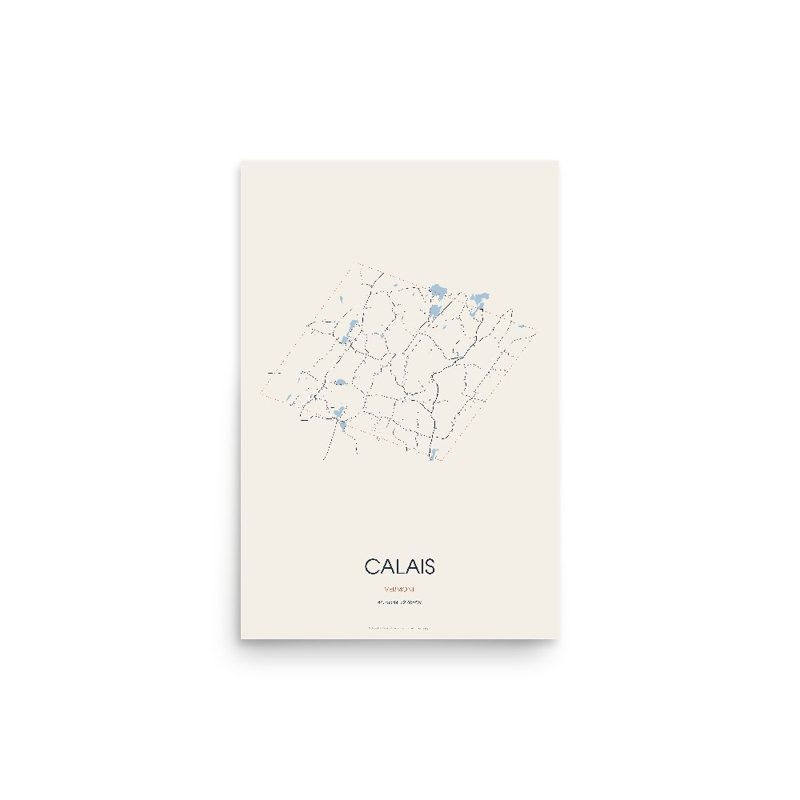
Every road in town, on archival matte paper
The same map, in navy and silver
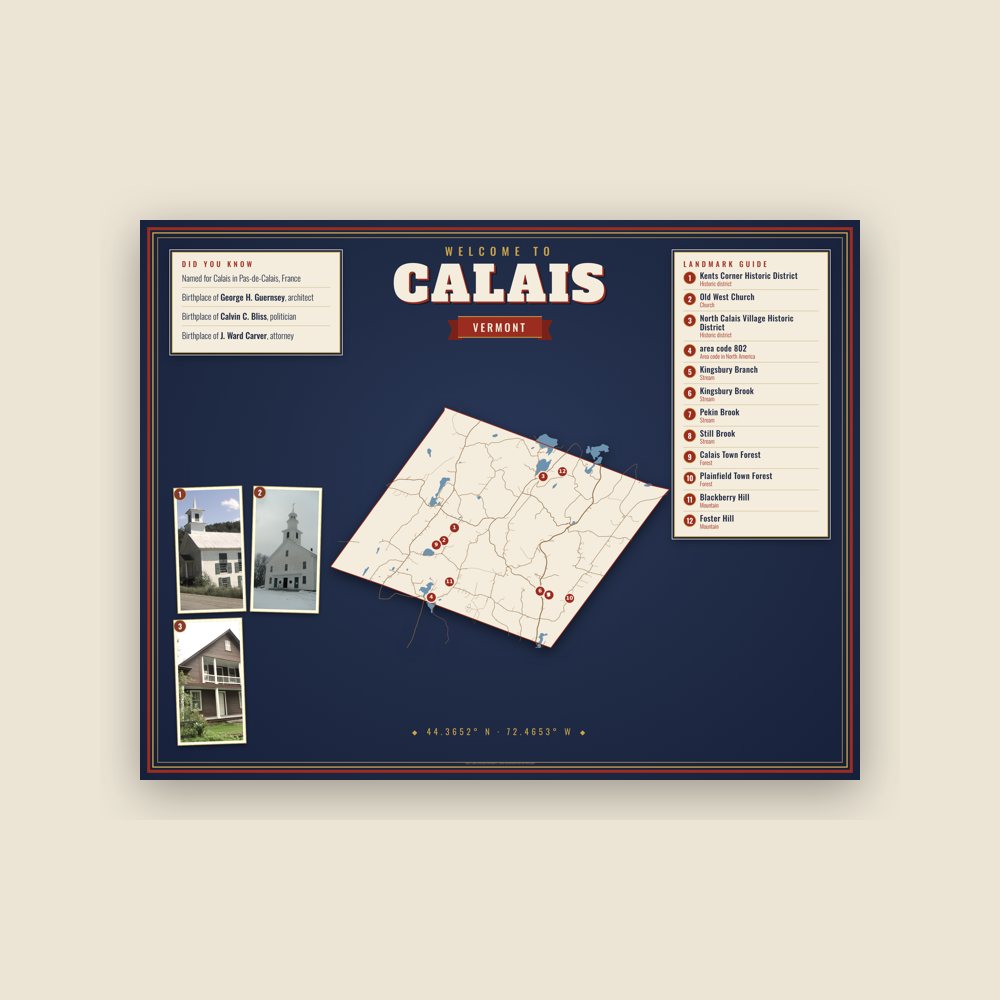
Map of local landmarks, washable fabric
Heavy-blend fleece, street map printed on the back
Soft Bella+Canvas jersey
Glossy ceramic, dishwasher safe
Ceramic keepsake, gold ribbon
Weatherproof, for the front walk
24″×16″, printed coir-look fibers, rubber back
12″×12″ printed wood, ready to hang
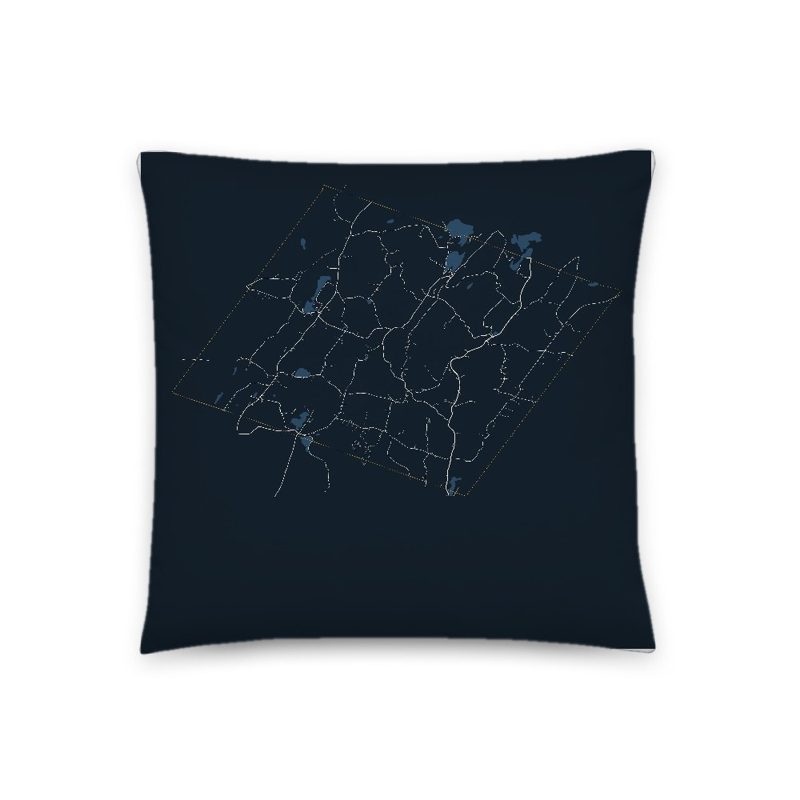
Soft-touch, zip cover
Sturdy all-over-print tote
Glossy top, cork back
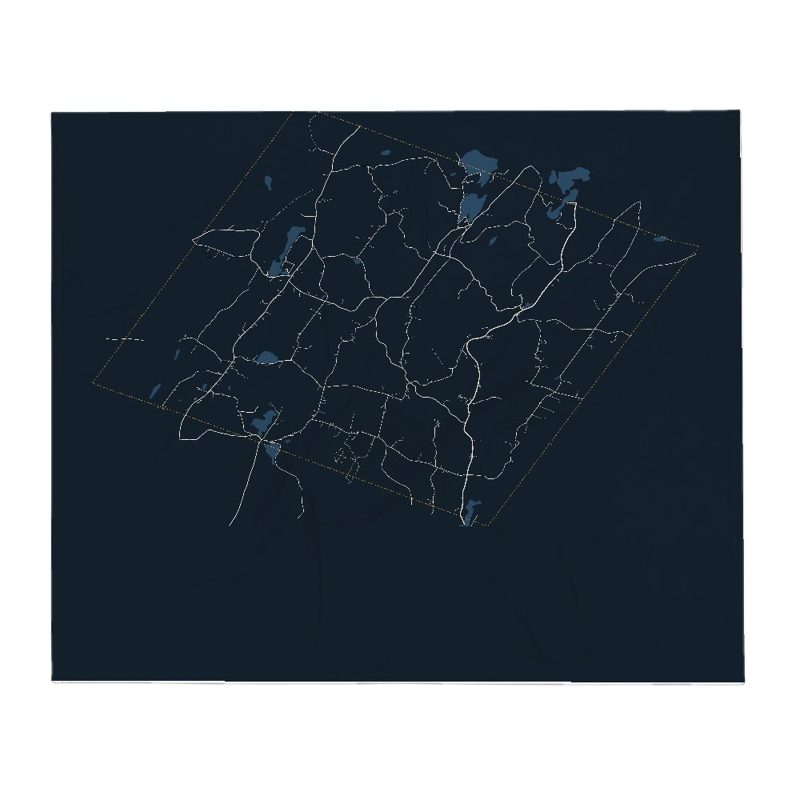
Soft fleece, 50″×60″
20 oz, double-wall stainless
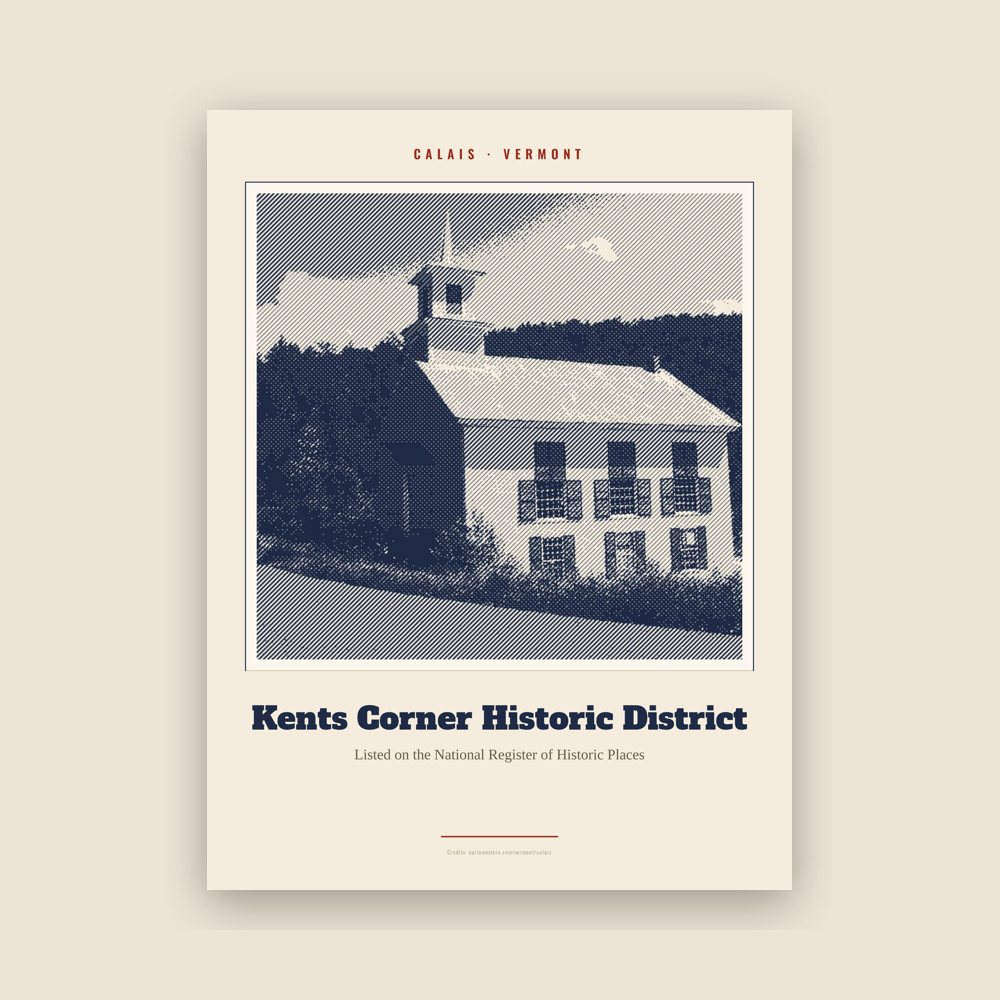
Archival matte print of a local landmark, credited to its photographer
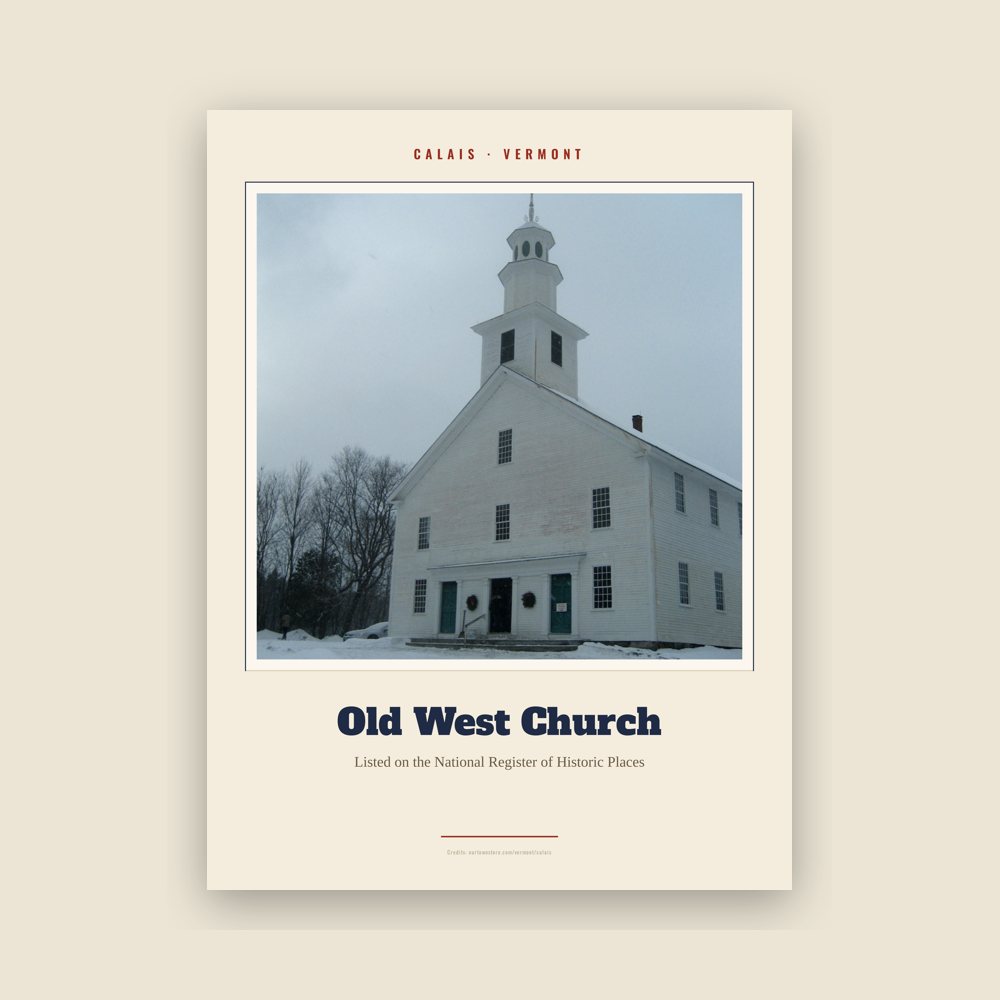
Archival matte print of a local landmark, credited to its photographer
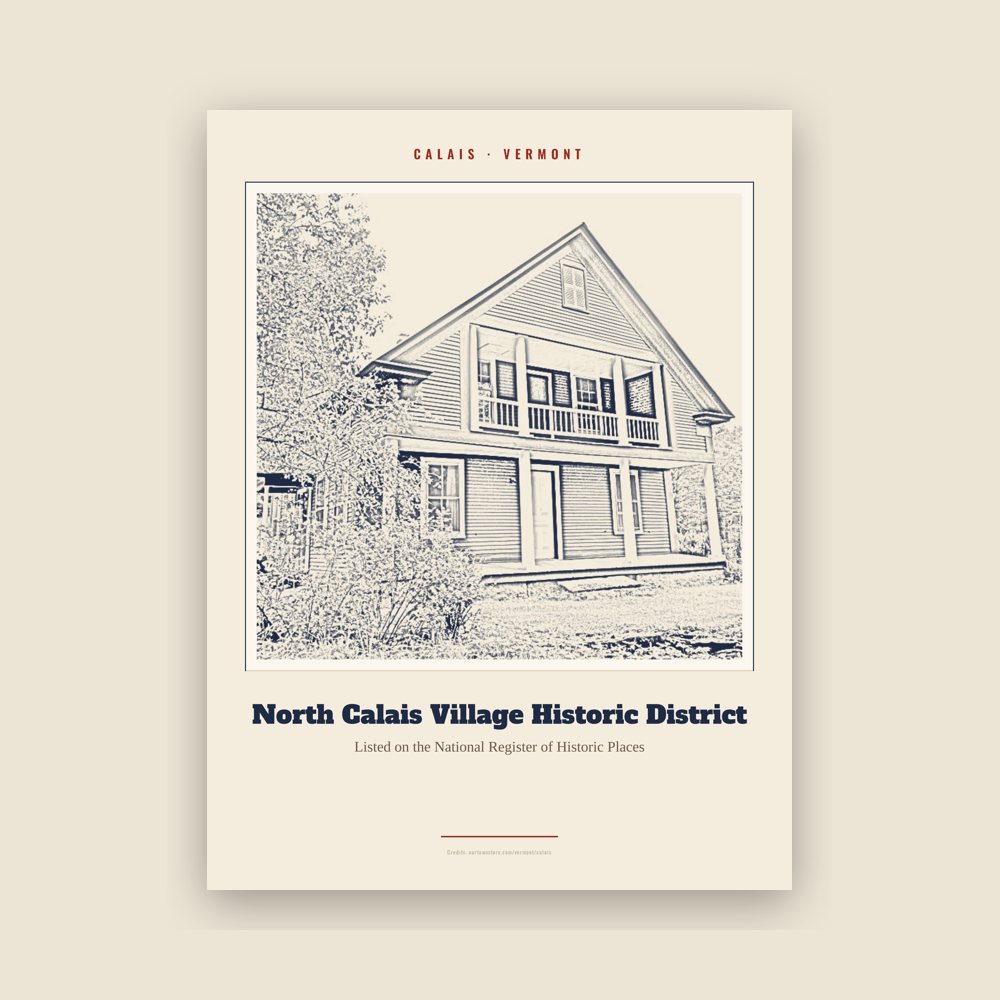
Archival matte print of a local landmark, credited to its photographer
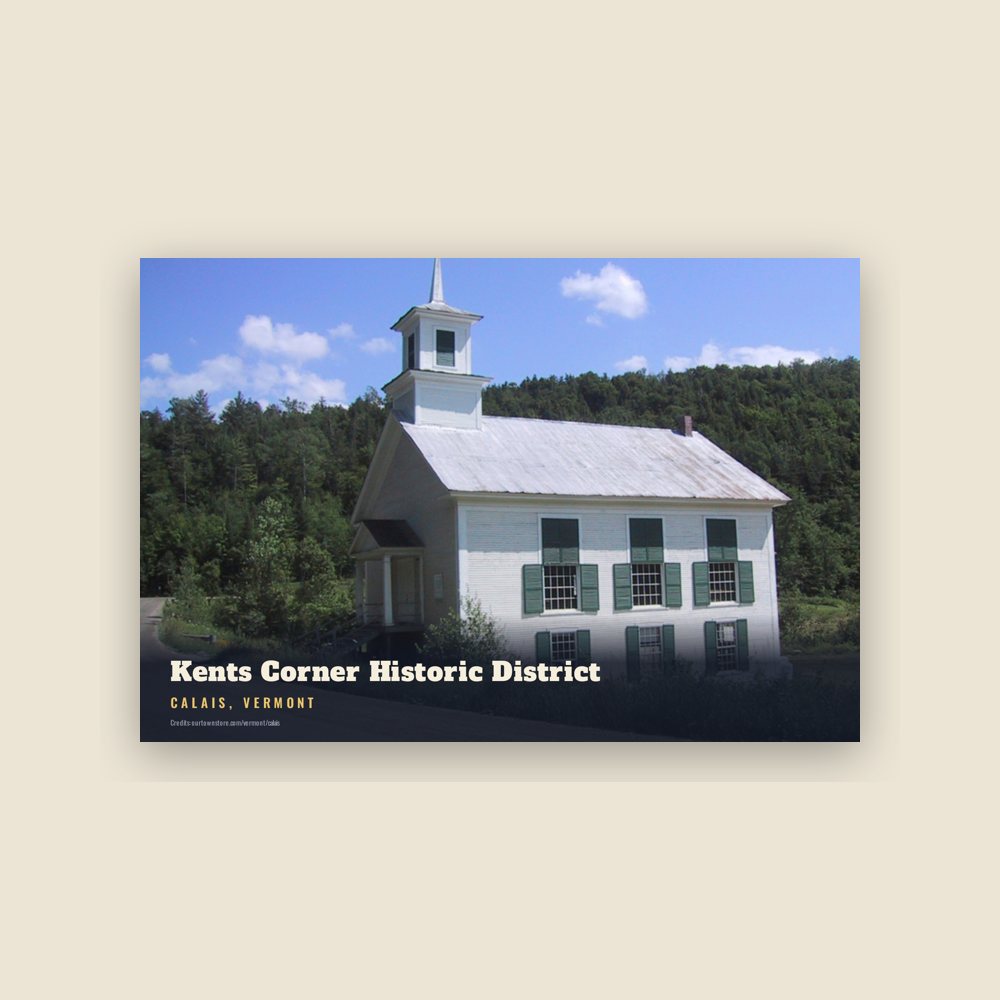
6″×4″ postcard, glossy front
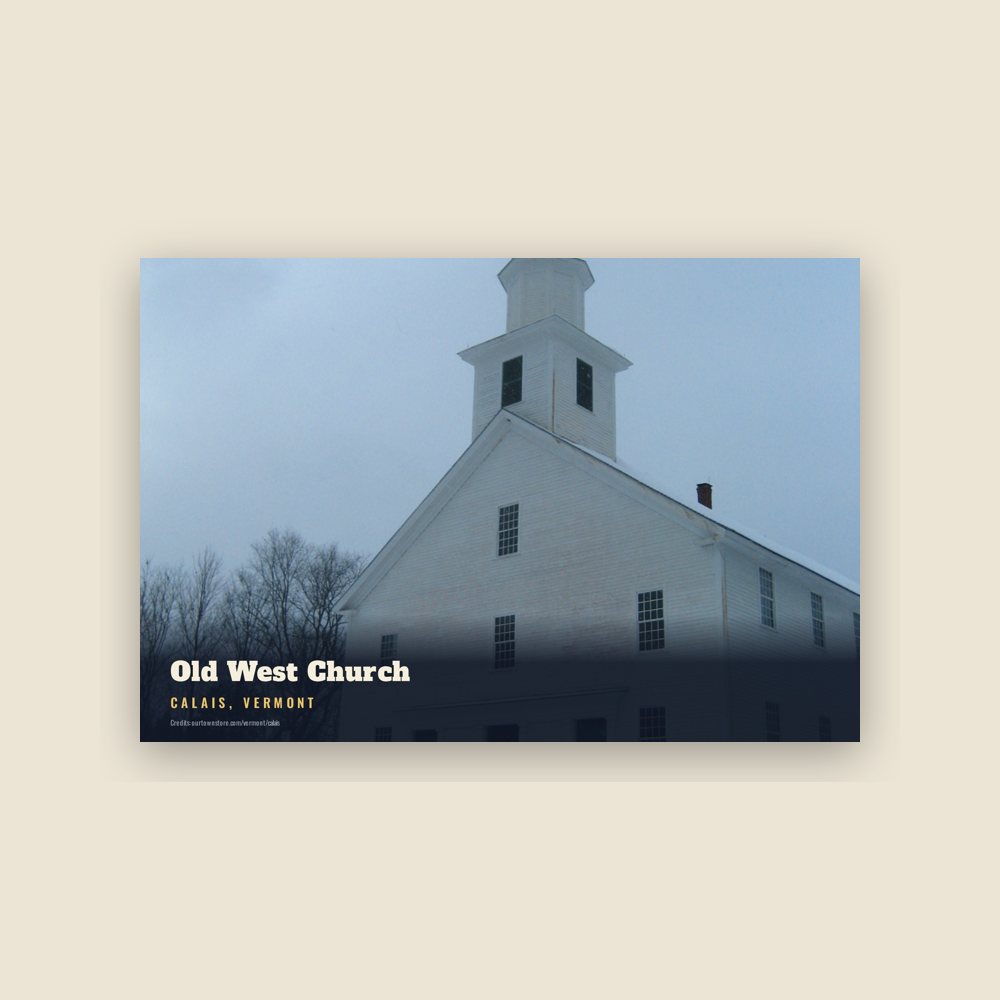
6″×4″ postcard, glossy front
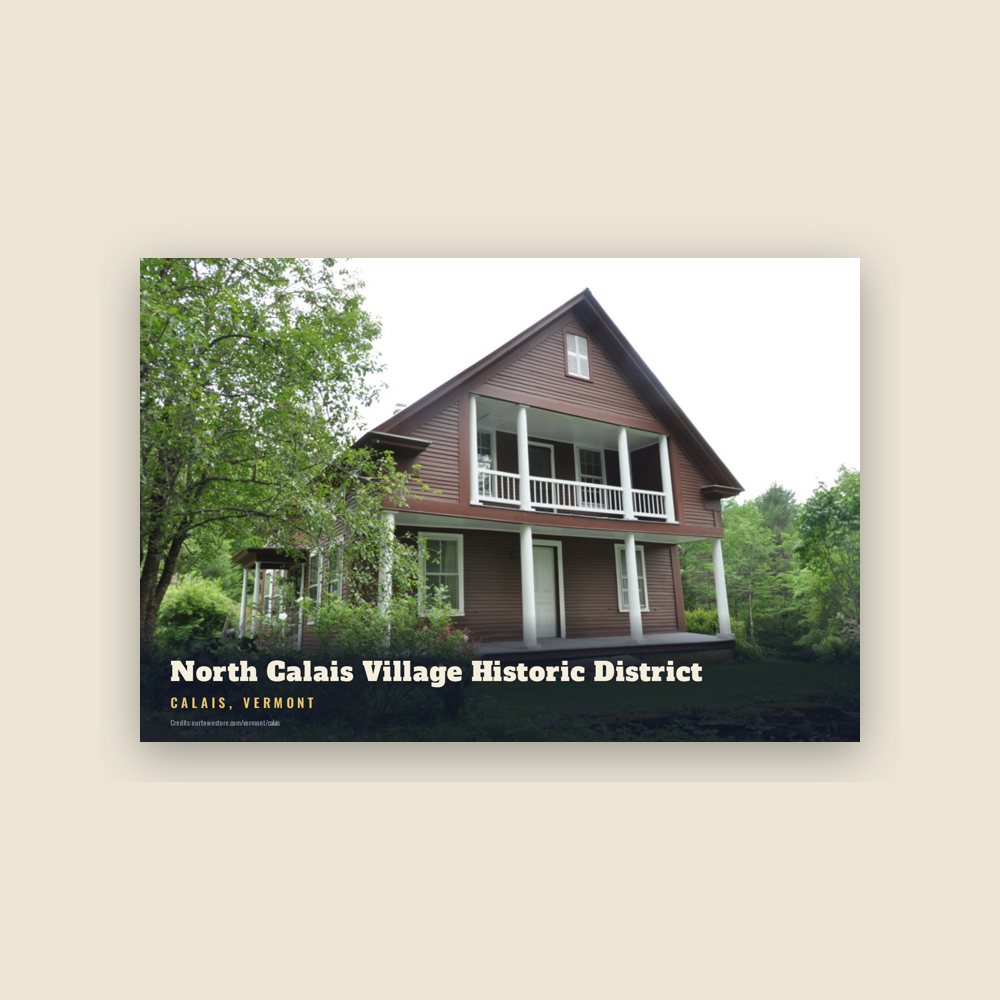
6″×4″ postcard, glossy front
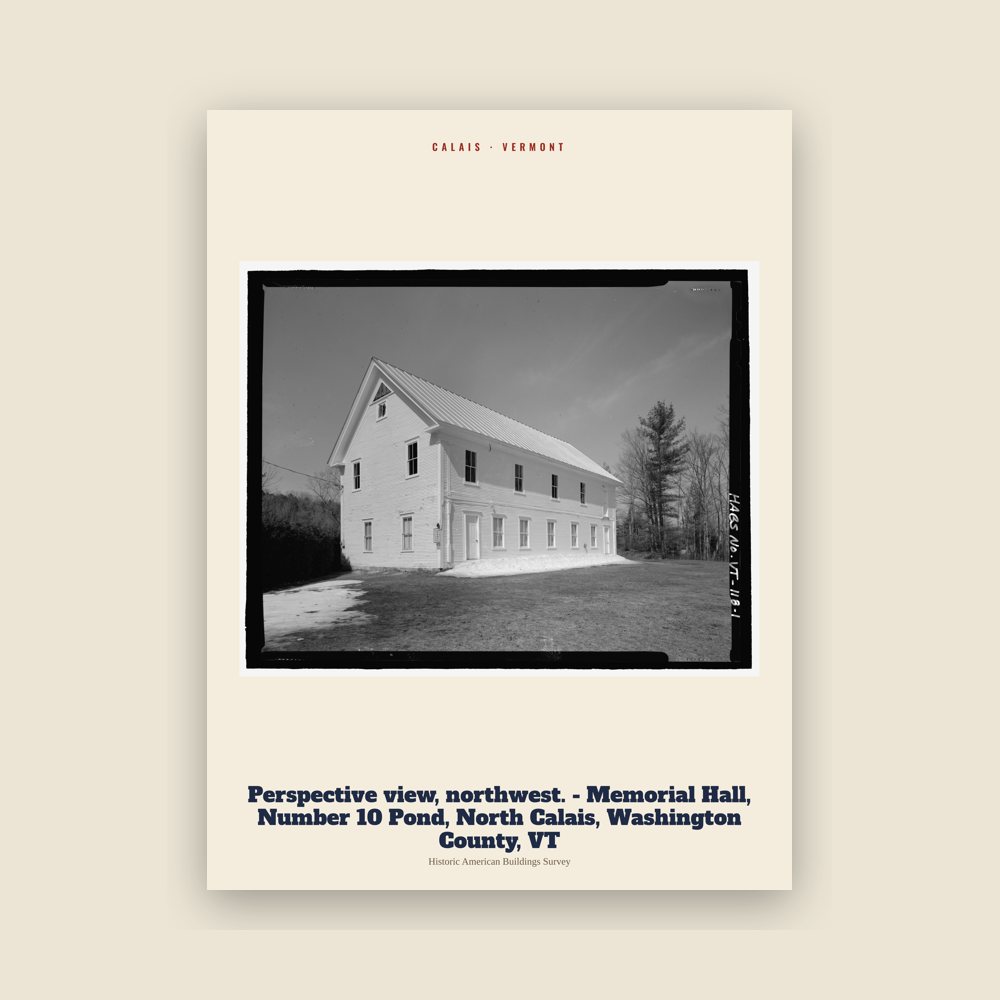
From the Library of Congress collections: a historic survey drawing or photograph of the town
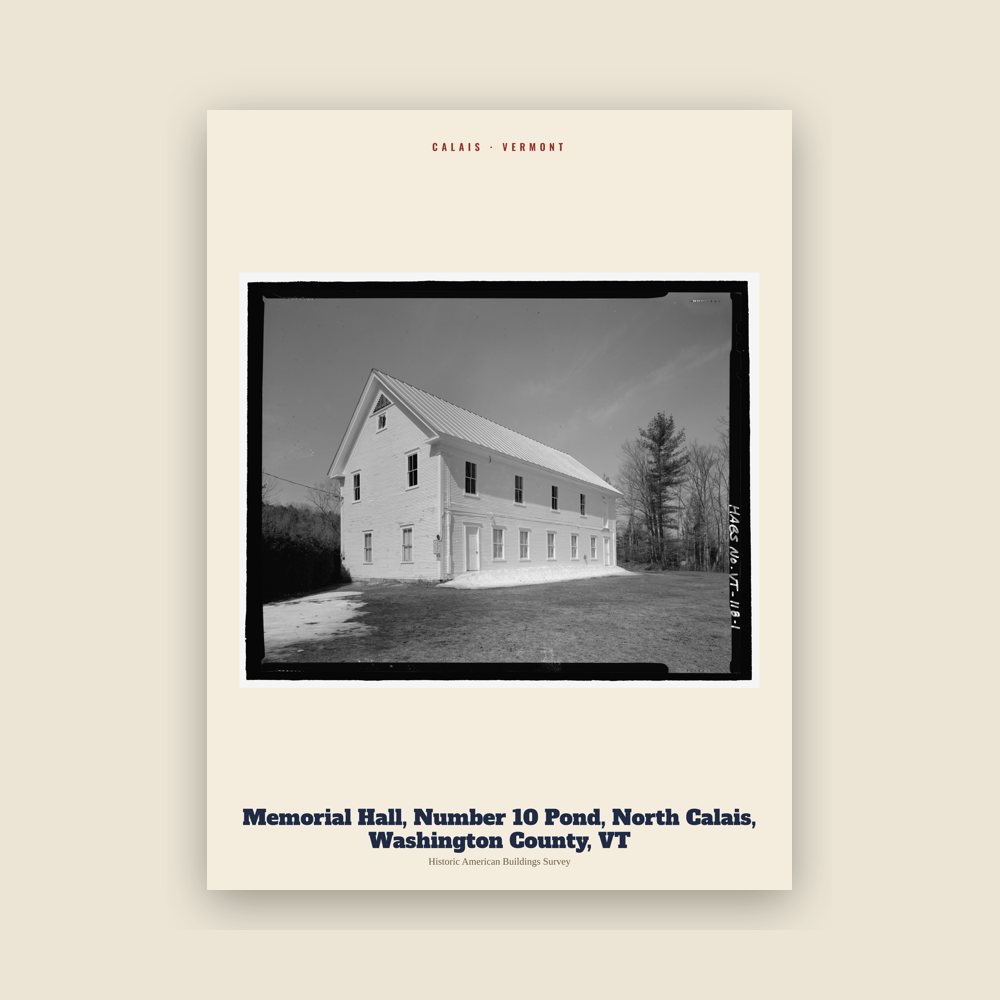
From the Library of Congress collections: a historic survey drawing or photograph of the town
Named for Calais (commune in Pas-de-Calais, France).
Population 2010: 1,607 → 2020: 1,661
From Wikidata (CC0).
Colonel Jacob Davis named Calais after the French port city of the same name, during a time of general enthusiasm for things French as a result of France's aid during the American Revolution.
The Wheelocks and Parkers were the first families to settle the town, in the latter part of the 18th century. In the early and mid 19th century, the Vermont wool industry spawned sheep pastures in the town. Photographs of the time show a heavily de-forested Calais. Like many small Vermont towns, Calais was devastated by the Civil War. Volunteers from Calais flocked to the Union cause, most serving in the Army's volunteer regiments. In the post-Civil War era, agriculture turned from sheep to dairy, and new families came to fill farms that were sold by the families and widows of Civil War veterans.
Calais once had a village called Sodom. Some historians suggested that this name was given because the village had no church, though it did have a few active quarries. However, the name Sodom was in use well before the quarries opened. The reason for the name change from Sodom to Adamant is also a subject of modern conjecture, with some noting that the residents petitioned the state legislature to change the name to Adamant in 1905, chosen to suggest the hardness of granite. Another account says that the name was changed on the request of the postmaster general. This could be true since there is another locality in Vermont named Sodom in North Bennington, so the postmaster general may have wanted to eliminate the ambiguity in Vermont place names.
The name of the village of Pekin is also unclear in Calais history. Some accounts suggest that the village was named after Peking (now Beijing), China, the result of a local farmer who had a friend who was a missionary to China. According to this story, the missionary sent some Chinese wheat back to Vermont, the farmer planted it, and it flourished. It became the style to give directions using the wheat field as a landmark ("up by the Pekin wheat", or "just past the Pekin wheat"). Eventually, the location of the field came to be known simply as Pekin. Another version suggests that the missionary sent back rice, and that the farmer planted the rice in a low-lying plain, which flooded each spring. The river came to be known as Peking Brook, later and presently Pekin Brook. Although this story of a Chinese missionary connection is intriguing, no specific historical records exist to support it. An alternative source for the name could be from the Abenaki word pekan for fisher. This would give Pekin Brook, which runs through the village of Pekin, a similar name source as the Winooski River (winooski is Abenaki for onion), to which it joins.
Adapted (trimmed) from the Wikipedia article Calais, Vermont, revision 1378520725 by its contributors, licensed CC BY-SA 4.0.
We share a part of every Calais sale with local partners, and we'd love to print from your collection. Old photographs, maps and postcards make the best keepsakes.
Partner with us